
The accession of Xerxes in year 26 of Darius I (496 BC) occurred in a normal year, made his first year of reign an intercalary year (in Babylon), but since Xerxes resided in Persepolis the Persian astronomical priests did not add an intercalary month at year’s end (XIIb), they visibly began a new cycle of intercalation from the 2nd year of Xerxes (2U), shifting Xerxes intercalation cycle, that began in Persepolis (Ossendrijver: 2018, 141), from that of Darius. The intercalation cycle began during the reign of Xerxes, continuing till the end of Artaxerxes I’ reign. #2 In our last 2 blog-studies we presented Eclipse evidence for the Death of Xerxes in 475BC from Gerard Gertoux. #3We find in 475 BC the Moon was 20° behind Sagittarius, and in 465 BC it was in the sign Sagittarius. According to an astronomical tablet the 1st lunar eclipse [total] was: in Sagittarius‘ 4 rear stars in [475 BC]. Thus, via astronomy, Xerxes died (14/V/21) on Wed. 23, August 475 BC with his accession 21 years earlier in 496 BC, also Darius I’ Year 26. Despite Pierre Briant denying his co–regency due to his ideology, he admits Xerxes was Crown Prince long before Darius‘ death, because if Xerxes became Crown Prince just before the death of Darius, one must admit that this king waited a long time-till his 72nd year in 486 BC#43/4, as Xerxes was 35 yrs old, when his parent’s union dated to Darius’ accession in 522 BC. Consequently, this chronology involves Xerxes’ choice before 490 BC.# 44/5.In fact, Xerxes was both the crown prince and co–regent, in a 10-year co-regency, with his accession from 496BC till the death of Darius in 486BC.
As we see in the Book of [Esther 1:9-19, 2:4] Ahasuerus‘ former wife was Vashti. Yet, the Great Feast described in v. 3, the 3rd year of his reign as we learn from Persian inscriptions, was held in preparation for the Persian expedition against Greece, after the death of Darius, who relinquished the title-Ahasuerus to his co-regent son Xerxes, ruling 485-465 BC, leading a vast Persian army against Greece c. 482-1 BC.#7b He fought famed battles of Thermopalyae & Salamis in 480 BC, & ostensibly married Esther in the 7th year of his reign [Est. 2:16-17], in 478 BC. #8
A key Archaeological inscription from the Shushan Palace @ Susa-200 miles East of Babylon, capital of Elam & winter residence of Persian Kings was a site identified by Loftus in 1852, where the record from Artaxerxes II [405-358 BC] says; “My ancestor Darius [521-485 BC] built this palace in former times. In the reign of my grandfather [Artaxerxes 1; 465-425 BC] it burned. I have restored it.” The palace of Darius’ residence, who authorized a rebuild of Jerusalem’s Temple; of Xerxes as Esther’s husband; & Artaxerxes 1, who authorized the restoration of Jerusalem by Nehemiah.” #8a
The location of this inscription was in the famed building in Susa called its “Apadana“, an audience hall of the Palace of Darius. Apadana-the word is only known from Susa – was built together with the palace by Darius I the Great (r.522-486BC). This can be deduced from an inscription known as A2Sa, written for Artaxerxes II Mnemon (r.404-358), who finished a restoration of the complex after a great fire during the reign of his grandfather, Artaxerxes I Makrocheir (r.465-424/423): The inscription below reads in part:
“Artaxerxes, the great king, the king of kings, the king of all nations, the king of this world, the son of king Darius [II Nothus], Darius the son of Artaxerxes king [I Makrocheir], Artaxerxes son of king Xerxes, Son of king Darius, Darius the son of Hystaspes, the Achaemenid, says: My ancestor Darius I the Great, made the apadana, but during the reign of Artaxerxes my grandfather, it was burnt down; but, by grace of Ahura-mazda, Anahita, & Mithra, I reconstructed the audience hall. So Ahura-mazda, Anahita, & Mithra protect me against all evil, and may they never destroy or damage what I have built.” #8b
A Pillar Capital “Bull“ of the Apadana at Susa. #8b1
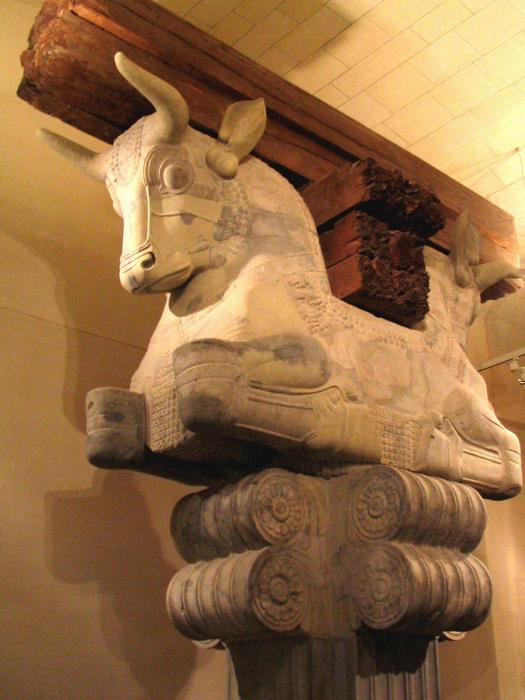
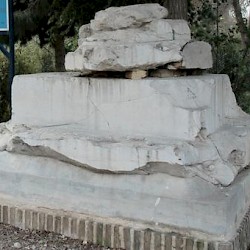
Apadana, site of the throne among the 36 column bases in the audience hall is a thirty-seventh foundation, in the exact center if one enters from the northern, main entrance. This must have been the place of the throne of the Achaemenid king. #8c The fact that there are no columns left to be erected, makes it hard to imagine what a splendid building the Apadana was in Antiquity. Thus, only the column‘ bases are left in Susa today, as seen below;
 A key Achaemenid Royal Inscriptions is the “daiva inscription“. The Old Persian text, known from three stone slabs from Persepolis & the Pasargadae citadel, (Elamite and Babylonian copies exist.) The interesting detail for why this text has become famous turns on a meaning of the word daiva, clearly means “demon” and looks similar to the word daeva in the Avesta (Zoroastrian holy book). If daiva & daeva agree, it makes it more likely the rebels lived in Iran, where the Zoroastrian religion held sway. But, if these words clash; daiva refers to idols of Babylon or Egypt. #8c1
 The Scriptural record confirms a history of Persia especially starting with the Messiah King Cyrus and kings following his line who were influenced by the Prophet Daniel as King Darius was in Daniel 6:1-4; It pleased Darius to set over the kingdom one hundred and twenty satraps, to be over the whole kingdom; 2 and over these, three governors, of whom Daniel was one, that the satraps might give account to them, so that the king would suffer no loss. 3 Then this Daniel distinguished himself above the governors and satraps, because an excellent spirit was in him; and the king gave thought
to setting him over the whole realm.So the other 2 Governors and the Satraps conspired against Daniel regarding his worship of His God, to cause a division between Daniel and King Darius, in decreeing a royal statute that could’nt be changed, against any who petitioned any except King Darius, for 30 days, on penalty of being cast in the lion’s den, [Dan. 6:4-16], King Darius told Daniel his God would deliver Him. Once Daniel was put in the lion’s den, the King visited him the next morning in Dan. 6:20b-28.20bThe king spoke, saying to Daniel, “Daniel, servant of the living God, has your God, whom you serve continually, been able to deliver you from the lions?” 21 Then Daniel said to the king, “O king, live forever! 22 My God sent His angel and shut the lions’ mouths, so that they have not hurt me, because I was found innocent before Him; and also, O king, I have done no wrong before you.”
23 Now the king was exceedingly glad for him, and commanded that they should take Daniel up out of the den. So Daniel was taken up out of the den, and no injury whatever was found on him, because he believed in his God.Darius Honors God24 And the king gave the command, and they brought those men who had accused Daniel, and they cast them into the den of lions—them, their children, and their wives; and the lions overpowered them, and broke all their bones in pieces before they ever came to the bottom of the den. 25 Then King Darius wrote: To all peoples, nations, and languages that dwell in all the earth:
Peace be multiplied to you. 26 I make a decree that in every dominion of my kingdom men must tremble and fear before the God of Daniel. For He is The living God, And steadfast forever; His kingdom is the one which shall not be destroyed, And His dominion shall endure to the end. 27 He delivers and rescues, And He works signs and wonders In heaven and on earth, Who has delivered Daniel from the [i]power of the lions. 28 So this Daniel prospered in the reign of Darius and in the reign of Cyrus the Persian.
We can certainly see the the example set by King’s Cyrus & Darius that would have been followed by King Xerxes in his zeal to remove the idols from the kingdom seen in the Daiva Inscription above. Daniel’s oversight of the Magi influenced King Cyrus, not only availed Daniel to detailed plans to rebuild Jerusalem & the Temple, but too in how these blueprints impacted Isreal & other middle east cultures. The Prophet Daniel and his gifted men of God, were set apart in 1st telling the contents of King Nebuchadnezzar’s dream, then accurately disclosing its import, to decode it, gifted Daniel with a high station in the King’s Babylonian court, holding key government authority, where he was made chief over all wise men, magicians, and soothsayers, of Babylon. This key aspect of their story placed Daniel & his team in influencial posts as many royal decrees came down, not only from Nebuchadnezzar, but also from subsequent kings as Cyrus, Darius & Xerxes during their lifetimes.
The caste of Magi were also accessible to King Xerxes as he prepared to war against the Greeks, where he consulted them concerning Xerxes’ Eclipse.
This too certifies a common God-acknowledged Source of ultimate spiritual authority regarding Jehovah & Ahuramazda both as One monotheistic God.
Biblically King Cyrus is recalled as a Messianic figure, [Isa. 45:1] called “His anointed-[4899-mashiyach]-refers to a class of patriarchs, priests or kings– based on Messiah/Christ-Christos G5547, 1Sam. 2:7-10, 2Sam. 22:51, Ps. 9:2-7, 18:50]” to open the 2-leaved gates of Babylon that shall not be shut, as Isaiah declared [Isa. 44:28-45:1]. As King David in the royal Christ-line became the archetype of the Messiah. [Acts 13:32-37, Heb. 5:5-10] King Cyrus, as a Gentile King, God called as the “Lord’s Anointed” to deliver Israel from their captor’s in Babylon, returning them to their homeland. As King Cyrus authorized the rebuilding of the Jerusalem Temple, freed the Jews from exile in Babylonian Captivity, returned to their Promised Land of Israel. #8f
As a result Israel regained their freedom to exert their spiritual influence as among the worldly kingdoms as agents of the true monotheistic God. As long as they obeyed their Prophets we stood in good stead with the Almighty, but if the Kings of Israel did evil in God’s sight, turning away from the truth of God’s Word, they reaped the fruit of their ways. During the darker times the influence of the Scribes and Pharisees was a key factor in how Israel fared. Their influence is found in The Midrash as a genre of Jewish Biblical exegesis, [2] that includes Talmudic texts that use a classical rabbinic mode of homiletical interpretation (derash). This word means; “textual interpretation“, “study“, or “exegesis“,[3] derived from a root verb (דָּרַשׁ)- darash, which means “resort to, seek, seek with care, enquire, require.”#8g
As we consider the royalty of the book of Esther, concepts of Ahasuerus & Vashti are found in the Rabbinic Midrash, with other sources where Vashti was considered of royal blood. Midrash involves Scripture interpretation
to elucidate legal points [Midrash Halakah], or bring out lessons via stories or homiletics [Midrash Aggadah]. #8h Midrash is too named for the Rabbinic interpretations, of rabbinic readings to “discern value in texts, words, and letters, as potential revelatory vehicles.” “Their review of major Scripture narratives that suggest alternate readings to stand beside—not replace—existing grammatical text. #9
Midrash is also used in a rabbinic work that interprets Scripture in this manner,[7][8] containing early interpretations and commentaries on Written Torah and Oral Torah (spoken law and sermons), as well as non-legalistic rabbinic literature (aggadah) and at times Jewish religious laws (halakha), usually forming running commentary on specific passages in the Hebrew Scripture. The midrash conveys that Vashti was the orphaned daughter of Belshazzar; God was her help and kept her alive to be wed to the emperor of Persia and Media, even though she was Chaldean (=Babylonian) (Esth. Rabbah 3:5).#10
Belshazzar had been known only from the Book of Daniel (chapt. 5, 7–8) and from Xenophon’s Cyropaedia till 1854, when references to him were found in Babylonian cuneiform inscriptions. Though in the Book of Daniel he was the son of Nebuchadnezzar, the Babylonian inscriptions indicate that he was in fact the eldest son of Nabonidus, who was king of Babylon from 555 to 539, and of Nitocris, who was perhaps a daughter of Nebuchadnezzar. As the last king of a Neo-Babylonian Empire, ruling from 556 BC, as Babylon fell to the Achaemenid
Empire under Cyrus the Great in 539 BC. It is possible that Nabonidus was married to a daughter of Nebuchadnezzar II’. Not only would such a link explain Nabonidus’s rise to the throne (as part of the royal family), but it also accounts for histories where Belshazzar is found as Nebuchadnezzar’s descendant. In the Bible Book of Daniel– Belshazzar is not only known as Nebuchadnezzar’s grand-son,[10] but Daniel himself appears to have dated events in the years of Belshazzar’s co-regency, [Dan. 7:1, 8:1]. As Nabonidus goes into exile (550), he entrusted Belshazzar with the throne and the major part of his army, when Belshazzar oversaw the government, his own estates, and those of his father.#11
Jer. 27:6-7 “Now I have given all these lands into the hand of Nebuchadnezzar king of Babylon, My servant, and I have given him also the wild animals of the field to serve him. 7 All the nations shall serve him and his son and his grandson until the time of his own land comes; then many nations and great kings will make him their servant.”
Nebuchadnezzar’s Family Tree Chart #11a

The Kings of Babylon were also mentioned in the book of Daniel. Do these prophecies of Jeremiah harmonize with Daniel Chapter 5?
Jeremiah’s prophecy that many nations (including Judah) and great kings (including Jehoiachin) would serve Nebuchadnezzar and “his son and his grandson.” So Babylon was predicted to end with Nebuchadnezzar’s grand-son. Indeed it ended 60 years later with Belshazzar, son of the state noble Nabonidus who was a usurper to the throne, nonetheless not in the line of Nebuchadnezzar, who allied the Babylonians with the Medes via another royal wedding: as the Babylonian crown prince Nebuchadnezzar married Amytis, the daughter of Astyages. Via the Chart above we find Nabonidus married Nitrocis, Nebuchadnezzar’s daughter, making him Nebuchadnezzar’s son-in-law and Belshazzar, Nebuchadnezzar’s grandson.
If Darius I was indeed the husband of Esther, then what does history tell us about Darius’ wife?
Via Herodotus, Otanes was blessed with royal marriages. Darius I married Otanes’ daughter; Phaedymia while Otanes married a sister of Darius, who gave birth to Amestris. As Queen of the Achaemenid empire, daughter of Otanes (Ctesias, fragment 13, par. 24 [in Jacoby, Fragmente] gives Onophas), one of seven conspirators against Gaumata. She was married to Xerxes I (Herodotus 7.61.2) and was mother of Artaxerxes I, Amytis, and others. She died at an old age, near the end of Artaxerxes’ I reign.#12
Amestris was a daughter of Otanes, one of seven nobles reputed to have killed the magus impersonating King Bardiya in 522 BC. After this, Darius I the Great of Persia assumed the throne. The right side of the chart below shows an Achaemenid lineage, while the left side details Bardiya/Smerdis usurpers as pretenders opposed by Darius to Cyrus I’ throne.

Thus, if Xerxes I who was co-regent with Darius I- starting 496 BC was not Esther’s husband, then who was Xerxes’ wife? History points us to a woman named Amastris;
Amestris (Greek: Άμηστρις, Amēstris, perhaps the same as Άμαστρις, Amāstris, from Old Persian Amāstrī–, “strong woman“)[2] was an Achaemenid queen, wife of king Xerxes I and mother of king Artaxerxes I.[3][4] She was an influential woman of the Achaemenid era, very powerful and vindictive.#13 [5]
1. Achaemenid queen, daughter of Otanes (Ctesias, fragment 13, par. 24 [in Jacoby, Fragmente] gives Onophas), who was one of seven conspirators who killed the Persian usurper king Gaumâta (22 September 522 BC). After this, Darius I the Great who reigned from 522-486BC opened his rule. According to Greek historian Herodotus, (5th century), Otanes was honored in diplomatic marriage: the new king married Otanes’ daughter Phaedymia, as Otanes married a sister of Darius, who birthed Amestris.
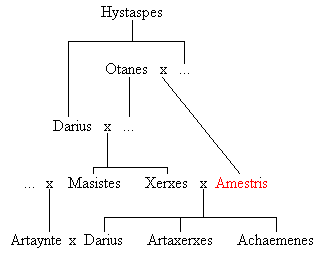
Amastris married Xerxes I (Herodotus 7.61.2) and as mother of Artaxerxes I, Amytis, and others, she had a bad reputation of being licentious and notoriously cruel; (Ctesias, fragment 14), she exercised a baneful influence in Artaxerxes’ court; e.g., she is said to have caused the wife of her brother-in-law Masistes to be mutilated (Herodotus 9.109-l2) One of the only consistent facts in Persian succession referenced in history is the mother of a legitimate heir was always Persian. In fact, all royal wives marked in Greek and Persian sources were Persian women. Any consort who wasn’t, is marked as a concubine.#14This is a popular case for why Esther as Jewess Queen with Persian King fell in history under a shadow of doubt. But as Mordecai the Grand Vizier & adopted Father of Esther, advised she conceal her genealogy, these facts did not come to light till afterwards. The Hebrew-Greek Septuagint– as the source text for the book of Esther, was produced in a later Persian or early Seleucid period, belongs to a Hellenistic genre. For more on Esther: see Ego, B. (2019) “Prayer & Emotion in the Septuagint of Esther“ Ego, B. (2006) Esther, Brill Online.#15
“After the death of Atossa, Amastris, the wife of Xerxes, whom Greek writers such as Herodotus describe as a powerful yet cold-hearted woman, played a leading role in Xerxes’ court. Amastris also accompanied him during his military campaign against Greece.”[15]“Amastris, the first lady of Xerxes’ court, was a most formidable & ruthless women of her time. Though many actions attributed to her by Greek historians cannot be fully accepted, the surviving evidence points to her psychological strength and authority.
Midrash is also used of a rabbinic work that interprets Scripture in this manner,[7][8] containing early interpretations and commentaries on Written Torah and Oral Torah (spoken law and sermons).#17 Midrash also asks questions of the text; proding the reader to seek truth, at times providing text driven answers,”
Mordechai and the Jehoiachin Exile
A good reason for reading the story of the megillah as having occurred before the rebuilding of the Temple comes in Esther 2:5 introducing Mordechai:
אסתר ב:ה אִישׁ יְהוּדִי הָיָה בְּשׁוּשַׁן הַבִּירָה וּשְׁמוֹ מָרְדֳּכַי בֶּן יָאִיר בֶּן שִׁמְעִי בֶּן קִישׁ אִישׁ יְמִינִי. ב:ו אֲשֶׁר הָגְלָה מִירוּשָׁלַיִם עִם הַגֹּלָה אֲשֶׁר הָגְלְתָה עִם יְכָנְיָה מֶלֶךְ יְהוּדָה אֲשֶׁר הֶגְלָה נְבוּכַדְנֶאצַּר מֶלֶךְ בָּבֶל.
Esth. 2:5 In the fortress Shushan lived a Jew by the name of Mordecai, son of Jair son of Shimei son of Kish, a Benjaminite. 2:6 Who was exiled from Jerusalem in the group that was carried into exile along with King Jeconiah of Judah, which had been driven into exile by King Nebuchadnezzar of Babylon.
As a son of Kish, this name of the father of King Saul, another Benjaminite, the Talmud accords Mordecai the status of a descendant of the first King of Israel.
Grammatically speaking, the clause “who had been exiled” can refer to Kish or to Mordecai. If the rabbis hold to the latter, it means that Mordechai lived during the 1st exile, eleven years before the destruction of Jerusalem and its Temple. According to Daniel 9:2, Jerusalem lay desolate for 70 years before the Temple was rebuilt, that would be 81 years after Mordechai had been exiled. As it is hard to imagine Mordechai– a 100-110+ year old man in the story, so the rabbis would have to agree that the story of the megillah took place before the Temple was rebuilt.#18 This agrees with the record of Ezra 4;
Ezra 4:1 “Now when the [a]adversaries of Judah and Benjamin heard the descendants of the captivity were building the temple of the Lord God of Israel… they opposed and discouraged them…
Ezra 4:4-6
3 But Zerubbabel and Jeshua and the rest of the heads of the fathers’ houses of Israel said to them, “You may do nothing with us to build a [b]house for our God; but we alone will build to the Lord God of Israel, as King Cyrus the king of Persia has commanded us.” 4 Then the people of the land tried to discourage the people of Judah. They troubled them in building, 5 and hired counselors against them to frustrate their purpose all the days of Cyrus king of Persia, even until the reign of Darius king of Persia.
Achashverosh [Ahasuerus] reigned between Daryavesh (=Darius I), during whose reign the Temple was rebuilt (Ezra 6:15), & Artachshasta (=Artaxerxes I).[7] This supports the idea that Achashverosh was identified with Xerxes.#19
The Seal of Xerxes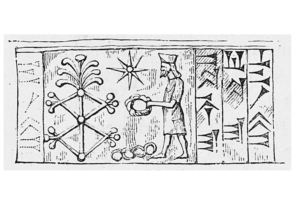
Seal of Xerxes. Perrot & Chipiez 1890 fig. 497, via Briant 2002 fig. 30.
O leaves tender and beautiful
of my beloved plane tree
On you may fate shine resplendent
May thunder, lighting, and storms
never intrude, ever, on your dear peace of mind,
nor may there be any wind that comes to violate you
—some violent wind from the west.
Shade there never was
of any plant
so dear and lovely
or any more sweet.
Trans. Gregory Nagy
As the Seal of Xerxes shows, his veneration of the Tree of Life, which for him is a plane tree that grows in the Greek-speaking territory of Asia Minor, as an overarching symbol of his ambition as king of a multi-ethnic Persian Empire. But the king’s failure on the West side of the Aegean Sea led to an occlusion of his imperial ambition—to be replaced by the ambitions of other Persian kings, all devotees of the Tree of Life. #19a
Mordechai
In an introductory statement about the reign of Xerxes, after presenting two of Xerxes’ influential advisors, Ctesias writes; “among the eunuchs,[29] Natacas (Nατακας) exercised the greatest influence.”[30] A few lines later, he refers to a eunuch of Xerxes named Matacas (Ματακας). These two names likely reflect the same person.[31]
The “as” at the end of either name is almost certainly a Greek addition. Thus, “Matacas” suggests a Persian name with the consonants MTC, which would be very close to the consonants of the name Mordechai, MRDC.[32] Even the name “Natacas” is not that different. “N” and “M” are related consonants, both being nasal stops; it is not unusual for one to transform into the other.
With either form of the name, the information provided by Ctesias, that he was a high-ranking official in Xerxes court, bears a strong resemblance to the last verse in the Megillah, which records by the end of the story, Mordechai was 2nd mishneh (=second) to the king. So, the Matacas of Ctesias and Mordechai of the Megillah may very well refer to the same historical person.#20
In checking in the tablets of Persepolis that Mordecai was an eminent royal scribe called Marduka who worked with Tatennai, the Governor beyond the River, under the direction of Uštanu, the satrap of Babylon, during the years 17 to 32 of Darius. Similarly, the narrative of Herodotus regarding Amestris (a name meaning ‘vigorous woman’ in Old Persian), Xerxes‘ unique wife and only queen known in Persia, correlates in many ways to Esther; ‘star’-Old Persian” despite the unfavourable and biased description of the Persian queen.
According to the book of Esther there was a plot to kill Xerxes which was thwarted in the 11th year of his reign, we read: Bigthan and Teresh, two eunuchs & official‘s–ministers of the King’s Court — the porters — were outraged seeking to lay hands on King Ahasuerus. But this thing came to be known to Mordecai, and he soon revealed it to Queen Esther. Then Esther told the king in Mordecai’s name. The case was thus sought and finally discovered, with both hanged on a pole (…) Shortly afterwards. In the 1st month, that is the month of Nisan, the 12th year of King Ahasuerus (Est 2:21–3:7-15) as Mordecai saved the king’s life. This serious accusation against the Jews is dated in the 12th year of Xerxes legal reign (Est. 3:7–10), was tied to Haman’s desire to genocide the nation/people of Israel, near the start of his effective reign, (Ezr. 4:6).
religious revolt in the empire. A remark by Roman author Arrian of Nicomedia, using 4th-century BC sources, stated Xerxes subdued a Babylonian revolt on his return from the war against Greece (479 BC). Via Arrian, Xerxes punished the city by closing the Esagila, Temple of Marduk, center of Babylon’s state cult. North of the Esagila was the Etemenanki, the ‘Foundation of heaven on earth‘, better known to us as the ‘Tower of Babel‘ [Gen. 11]. This temple tower (or ziggurat) was 92 meters high and had seven levels. According to the Greek researcher Herodotus of Halicarnassus, the Persian king Xerxes had a statue removed from the Esagila when he sacked the city.#21
Figure 3. Ziggurat of Susa. 21a.
![Chogha Zanbil [ Dūr Untash Ziggurat ] | Chiyakotravel](https://chiyakotravel.com/wp-content/uploads/2019/05/7-768x480.jpg)
Parrot’s survey includes numerous illustrations, for example, a three-tiered structure on an Old Babylonian cylinder seal, four-to five-tiered towers on Assyrian cylinder seals, and a five-tiered ziggurat of Susa on a relief sculpture shows Assurbanipal’s Elamite campaign.#21b In addition, a considerable body of literary and pictorial evidence documents a concept of 7-level Ziggurats: 1. The Esagila tablet from Uruk (AO 6555), first noticed by George Smith in 1876, dates to 229 BC,#21c. and is now also known from a partial duplication in the British Museum (BM 40813), they are thought to be copies of an original, no later than the early-seventh century BC.#21d. This displays the dimensions of the temple-tower Etemenanki (é.temen.an.ki) part in a complex @ Esagila-in Babylon, completed by Nebuchadrezzar II. Seven stages are described, in their respective dimensions (AO 6555 ll. 36–42). The height of the structure equal to the base, agreeing with Strabo’s input, & Frankfort’s deduction on the original height of the Ziggurat at Khorsabad.
At Khorsabad only four stages were discerned, but Frankfort thought it reasonable that there had been three further stages, as the height of the structure would then match the base “which was, according to Strabo, the case in Babylon.”#21e.

This sets out dimensions of the temple tower Etemenanki (é.temen.an.ki) of
Esagila’s complex in Babylon, completed by Nebuchadrezzar II, detailing Seven stages, with their respective dimensions; (AO 6555 ll. 36–42).
A broken Neo-Babylonian stele (MS 2063) in the Schøyen Collection depicts a king, apparently Nebuchadrezzar II, “standing before a Ziggurrat of 7-stories drawn in outline & labelled [é].tem[en] .an.ki [ziqúra-at ba-bili (ká.dingir.ra)ki ‘E-temen-anki, Ziqqurrat of Babylon.’ #21f.
If the Babylonian revolts occurred during the first year 1 of Xerxes’ reign, a chronological ranking of contracts29 tells us that they took place when the king had been fully recognized in Borsippa, which would be quite illogical. In fact, for the Babylonians the legitimate king was Šamaš–erîba. For a Babylonian scribe, Xerxes, an Achaemenid, was a usurper in his 1st year of reign, not a legitimate king in his 11th year of reign. To avoid this scene historians have speculated that the Babylonian revolts were at their maximum near 484/ 483 rather than 485 BC, but this assumption is contradicted by 3 elements:
1. If the first Babylonian revolt occurred in 484 BC, this year would have been the 2nd regnal year of Xerxes, however two tablets of Šamaš–erîba are clearly dated in year 1 of Xerxes.
3. An astronomical fragment (JCS 1, 350 n°2) enables a dating of the Babylonian revolts. Although data are fragmentary they describe a revolt, clearly dated 05/IV/[?] during Xerxes’ reign (line 3 of the tablet) in perfect agreement with Bel–šimânni’s tablet (BM 87357). The astronomical fragment reads 30:
2) [...] ……. […]
9) [... to] Borsippa went, destroyed the city [...]
matching Nisan (1st month of Babylonian year), and again33 on March 6th–467 (468 BC). Presumably after the death of Darius, Babylonian priests, given the dissatisfaction with Babylon and this omen early in the reign of Xerxes (year 11), had predicted wars (which happened soon-480 BC after).
Xerxes began his reign on two occasions, first as co-regent till 486 BC, his accession is dated III/00 (June), and again as true king after Darius 1‘ death. dated 10/IX/10 (8 December 486 BC). Darius I 522-496 Darius I/Xerxes 496-486 Pherendates 496-486 Darius I/Xerxes 496-486 Xerxes I co-regency 486-475, 486 Bel-shimanni 14+/V/00 04/VI/00 xx/VI/00 “usurper” 485–485 Shamash-eriba 04/V ! /00 11/VIII/00 xx/VIII/00 “usurper” 485–485 Xerxes I 20/ V/21 14/V/21 –475 486
An astronomical tablet (BM 32234)34 contains 2 lunar eclipses and the death of Xerxes is dated 14/V. Given that the 2nd partial lunar eclipse is dated 14/VIII (November/ December) it is easy to check what year it occurred35. A complete analysis of these 2 eclipses (when they began and ended, how much area of the moon darkened. P = Partial; T = Total; N = Penumbral) enables us to keep only the year 475 BC (=–474), not dated 465 BC that’s usually agreed. #36/21g
(4) The use of “year 21” “accession year,” in either Persian or Jewish dating, agrees with the fact that no known Babylonian tablets recognize any other kings between Xerxes and Artaxerxes, though Jewish dating implies a gap before the beginning of Artaxerxes’ accession year in Egypt.
(5) The alignment of the regnal years of the same number in the Egyptian and the two Semitic calendars (attested by the synchronisms of Ptolemy’s Canon, the Saros list, double-dated papyri, and dated tablets) follows this order: Egyptian (December), Persian (spring), Jewish (fall), in the reign of
Xerxes; likewise in Artaxerxes’ reign the order is: Egyptian, followed by Persian, followed (if AP 6 has a Jewish date) by the Jewish.
(6) This alignment makes it clear that the year formula in AP 6 does not fit the Egyptian calendar, but is an exceptional but normal double formula in either the Persian or the Jewish calendars.#21h
According to this chronological reconstruction, during his 10th year of reign-Xerxes was co-regent of Darius I until 8 December 486 BC, then full king after this date. As the years of reign began on the 1st Thoth in Egypt at that time (early Jan.), the 11th year of Xerxes’ reign began in January 485 BC, while this 11th year began in April 485 BC in Babylon. A careful study of Egyptian documents confirms this change in Xerxes’ status.#22
Indeed, G. Posener notes the Egyptian title of Xerxes had changed from his Year 10 but without giving the reason. In Posener’s collection of hieroglyphic inscriptions (Posener: 1936, 92, 120-124, 162), Posener classified Persian kings according to a chronology accepted in his time. But several anomalies can be explained only by assuming a 10-year co-regency between Xerxes & Darius. In these hieroglyphs, the Egyptian pharaohs, from Amasis to Artaxerxes, are still called “Lord of the Two Lands”, except Xerxes who is called “Master of Crowns” between year 1 and year 10 of his reign. He got a legal title of “Lord of the Two Lands”- official title of the Pharaohs of Egypt, only from his year 10. If Xerxes became Pharaoh shortly after Darius’ death, he then would have received the usual title “Lord of the Two Lands;“ to designate upper & lower Egypt for Egyptian kings, but the title was awarded him only in his year 10. In addition, for no known reason, the name Darius changed from year 27 up to year 36 of his reign to become inDarius. This hieroglyph in, literally meaning “contribution” in Egyptian 14 , or “booster”, can’t be a phonetic complement, as it deteriorates the pronunciation. FIG. 2 Year 2 Month I Akhet Day 9 Master of crowns, Xerxes Year 6, Master of Crowns, Xerxes Year 10, Lord of the 2 lands, Xerxes (Dec. 486 BC) Year 6, Lord of the two lands, Cambyses (II) Year 36, Lord of the two lands, Darius (I) Year 12, Lord of the two lands, Xerxes 14. This hieroglyph appears in names of some pharaohs like Antef
“contribution of his divine father”. It may be an abbreviation of the Egyptian word inpw “royal child”, meaning a pretender to the throne, that is a “Crown prince”. #23
Egyptian documents dated in both lunar and civil calendars allow absolute dates to be obtained because such date coincidences only occur every 25 years- if the lunar day is correctly observed, every 11 years with a 1-day observation error. The Aramaic documents from Elephantine, dated over the period 525-398 BC, contain 21 well identified double dates, make it possible to anchor the reigns of Xerxes and Artaxerxes on absolute dates.
As the “double dates” are witnessed in this context we can correlate Titles that refer to Egyptian Kings like Lord of the two Lands [upper & Lower Egypt] for example, to Persian Kings Darius, Xerxes & Artaxerxes. By cross–referencing the historical reigns of the kings, as to when they held Egyptian titles, or the King of Babylon, with Persian King’s titles, we can anchor the reigns of Xerxes and Artaxerxes on absolute dates.
EGYPTIAN CHRONOLOGY THROUGH ASTRONOMICALLY DATED SYNCHRONISMS 11 TABLE 6 King of Babylon in Egypt Cambyses (II) Kambuzia K-n-b-w-d3 From 5th to 8th year King of Babylon, King of lands, Lord of the Two Lands– Darius (I) Dariawush (in)-šTi-rw-y-w-3 From 1st year to 36th year King of Babylon, King of lands, Lord of the Two Lands– Xerxes- Khisi‘arsa Ḫ-š3-y-rw-š3 From accession to 1st year- King of Babylon, King of lands? From 1st year to 10th year King of Persia & Media, King of Babylon and of lands, Master of Crowns from 10th year to 21st year King of lands, Lord of the Two Lands. The years indicated in those documents have been understood as years of reign when in fact they are years of domination (months/days usually unspecified). 23a.
A study showed that the reigns of Xerxes and Artaxerxes had been shifted by 10 years with respect to astronomical dates 17 giving rise to different inter-calations during the reigns of Darius & Xerxes (Gertoux: 2018, 179-206; 2020, 273-279). From 525 BC Egypt became a Persian satrapy but most scribes were Egyptians or Jews. Persian officials at Elephantine were familiar with three kinds of lunar calendar, Elamite, Old-Persian & Babylonian. Jewish scribes at Elephantine were familiar with different calendars, but used a calendar based on Babylonian calendars after their return to Judea from Babylon. A Babylonian chronology est. by Claudius Ptolemy was confirmed by BM 34576 tablet (King List dated 99 BC). A study of all tablets (contracts/heiroglyphs) dated from 626–331 BC was published (Parker, Dubberstein: 1956) and showed that all durations in the Achaemenid period agreed with the Babylonian royal lists, providing several short co-regencies were admitted shortly before and during an enthronement of the new king. #24
Babylonian astronomers classified lunar eclipses according to an 18-year Saros cycle, as they noticed that astronomical phenomena were reproduced identically in the 19th year of the solar cycle and almost identically in the 11th year (within a day). The 19 solar years last 6939.6 days = 19×365.24219 days and correspond exactly to 19 lunar years plus 7 intercalary months,
lasting 6939.7 days = ([19×12]+7) x 29.530588 days. The 11 solar years last 4017.6 days = 11×365.24219 days and correspond to 11 lunar years plus 4 intercalary months, that last 4016.2 days = ([11×12]+4) x 29.530588 days. With these astronomical cycles the two lunar eclipses of 475 BC (1st total, 2nd partial) were reproduced in 465 BC, but in reverse order (partial then total).
31 December (partial). These adjustments made by Babylonian astronomers altered times in the chronology of Artaxerxes and Xerxes’ reigns, including the Metonic cycle of the intercalary years. The 19-year cycle; a mathematical cycle synchronizing 19 lunar years with 19 solar years by adding intercalary months, a 2nd Adar mo. (XIIa) or 2nd Ulul month (VIb), in 7 years of a 19-year cycle (3A, 6A, 8A, 11A, 14A, 17U, 19A). But, this 19-year Metonic cycle, based on observations, not calculations (Steele: 2007, 121-123) and computed data in diaries (purely computational, not a combo observed & predictive methods) that appeared prior to 350 BC.#25
As the Egyptian calendar had 12 months of 30 days, plus 5 days at the end of the year (365 days), called epagomenon in Greek, it was not lunar (around 354 days). In Elephantine the main system of dating was the Egyptian calendar (civil), but as numerous religious festivals in Egypt were based on lunar phases a lunar calendar was used to fix these dates. The Jews (after 587 BC), then the Persians (after 525 BC), naturally used this calendar for their own religious festivals based on a lunar calendar (ie. Jewish Passover). As the language of administration being either Egyptian or Persian, it was necessary to convert the names of the Egyptian lunar months to the common language understood by all: Aramaic. For example, the Jews converted to Aramaic the name of the months of their Hebrew calendar: « It came about that in the 4th year of Darius (…) on the 4th [day] of the 9th month, [that is] in Kislev » (Za 7:1). There was the same situation in Egypt, for example, an Elephantine Papyri (B24) is dated: « [17] Thoth, which is 17 Kislev, year 21 (of Xerxes), accession year of Artaxerxes » (Porten: 1996, 164-165). As Xerxes died on 14/V/21 (24 August) in 475 BC, the 1st Thoth (I Akhet 1) in 475 BC is dated 20 December and 17 Thoth on 5 January 474 BC.#26
1st Thoth in 475 BC thus links to 20 December in Julian calendar. With astro- software (https://promenade.imcce.fr/fr/pages4/441.html), we find on 20th Dec
–474* (= 475 BC) there was a full moon at 18:20 UT (Universal Time), or at 20:30 Local Time (LT = UT + 2:10) in Elephantine. On Kislev 1 on a lunar calendar in Elephantine thus coincided with the full moon of 20 Dec. in 475 BC. To calculate the 1st Kislev (= 1/IX) of the Babylonian lunar calendar we must first calculate the 1st Tishri (1/VII) coinciding with a 1st lunar crescent after the autumnal equinox on 29 September 01:00 UT in –474*
(https://promenade.imcce.fr/fr/pages4/439.html).#27 The 1st astronomical lunar crescent (day after the astronomical New Moon) after 29 September is that of 8 October 22:11 UT (= 1/VII). It is possible to calculate the 1st lunar day of the following months: 7 Nov. 09:17 UT (= 1/VIII), 6 December 20:22 UT (= 1/IX). The coincidences between observed lunar days & calendar dates are thus perfect. In 475 BC (= -474*): 1 Kislimu (Babylon calendar) = 6 December (in Babylon) 1 Kislev (Egyptian lunar calendar) = 20 December (Elephantine). The 20 records from Elephantine with a double date enable us to reconstruct a chronology of the reigns of the 27th dynasty. The papyrus B23 is dated: «Year 15 [of Xerxes] 18 Elul, thus the 1st lunar day is dated a full moon in 481 BC (30 August). The 11 Pahons or I Shemu 11 fits exactly to day 11: Papyrus year Lunar date on the Egyptian calendar BC 1st lunar day Full moon Xerxes I 15 1 Elul 29 Aug. 30 Aug. Papyrus B23 15 18 Elul (= 11 + 17) 15 Sept. 481 BC.
The matched dates on the three intercalated calandars thus provides a perfect alignment between the Persian, Jewish and Egyptian calendars, that too align the reigns of Kings and Pharaohs in their various royal titles linked to their related kingdom, and periods of reign. With astronomically verified dating system of this caliber, it removes much confusion that has plagued history in the past, especially in light of the Repeating-Matching eclipse dates we have seen related to Purim, during the reigns of Darius 1 to Xerxes 1, in the book and time of Esther.
As always I welcome any questions you may have, through our Facebook forum of our Biblical Astronomy Fellowship.
God Bless,
Rene’
Footnotes
1.https://www.academia.edu/44915277/Intercalations_during_the_co_regency_of_Xerxes_with_Darius_I_in_NABU_2020_4_pp_273_279?email_work_card=reading-history]
2. IBID
3. [https://www.researchgate.net/publication/312069819_Dating_the_reigns_of_Xerxes_and_Artaxerxes]. Gerard Gertoux.
4. IBID
5. IBID
6. IBID
7. IBID
7a. Intercalations during the co-regency of Xerxes with Darius I, in NABU 2020-4, pp. 273-279 By Gerard GERTOUX
7b. Halley’s Bible Handbook, p. 218, Henry H. Halley
8. IBID, p. 218
8a. IBID ppg. 218-219
8b. http://www.achemenet.com/en/results/?q=Susa
8b1. https://www.livius.org/articles/place/susa/susa-photos/susa-apadana/
8c. http://www.achemenet.com/en/results/?q=Susa
8c1. IBID
8d. https://www.livius.org/sources/content/achaemenid-royal-inscriptions/xph/
8e. https://en.wikipedia.org/wiki/Return_to_Zion
8f. Strong’s Concordance [#4899-mashiyach], James Strong
8g. https://www.thetorah.com/article/if-achashverosh-is-xerxes-is-esther-his-wife-amestris?
8h. Encyclopedia Judaica Glossary definition of Midrash.
9. https://en.wikipedia.org/wiki/aggadah
10. https://en.wikipedia.org/wiki/Halakha
11. https://en.wikipedia.org/wiki/Book_of_Daniel
11a. https://www.onepagebiblesummary.com/pad/pad_01.php
12. Herodotus 7.61.2
13. https://en.wikipedia.org/wiki/Amestris
14. (Herodotus-Histories 7.61.2, 9.109-l2)
15. Prayer & Emotion in the Septuagint of Esther“ Ego, B. (2006) Esther, Brill Online.
16. https://en.wikipedia.org/wiki/Amestris
17. https://en.wikipedia.org/wiki/Midrash#cite_note-9
18. https://www.thetorah.com/article/ahasuerus-and-vashti-the-story-megillat-esther-does-not-tell-you
19. https://www.thetorah.com/article/if-achashverosh-is-xerxes-is-esther-his-wife-amestris
19a. [https://continuum.fas.harvard.edu/an-occlusion-of-xerxes-in-medieval-persian-epic/]
20. https://www.thetorah.com/article/if-achashverosh-is-xerxes-is-esther-his-wife-amestris
21. https://www.livius.org/articles/place/babylon/etemenanki/
21a. Fig. 3-Ziggarat of Susa-picture credit. [https://en.wikipedia.org/wiki/Chogha_Zanbil#/media/File:jpg]
21b. (Parrot 1949: 37–50) Ziggurats et Tour de Babel. Paris: Albin Michel.
21c. (Parrot 1949: 22–24.; Wiseman 1991: 71) Nebuchadrezzar and Babylon. The Schweich Lectures of the British Academy. Oxford: Oxford University Press
21d. (George 2005/2006: 75, 78; The Tower of Babel: Archaeology, History and Cuneiform Texts. AfOr 51: 75–95. (Allinger-Csollich 1998: 290–94).
21e. (Frankford 1970: 79) The Art and Architecture of the Ancient Orient. 4th edition. Harmondsworth: Penguin
21f. (George 2005/2006: 75, 77, 78, 79, 86; Allinger-Csollich 1998: 290–94). The Tower of Babel: Archaeology, History and Cuneiform Texts. AfOr 51: 75–95.
21.g [https://www.researchgate.net/publication/312069819_Dating_the_reigns_of_Xerxes_and_Artaxerxes]. Gerard Gertoux
21h. IBID
22. IBID
23. (Posener: 1936, 92, 120-124, 162) Posener’s collection of hieroglyphic inscriptions
23a. (Posener: 1936, 92, 120-124, 162)
24. BABYLONIAN CHRONOLOGY, 626 B.C.-A.D. 75 Parker, Dubberstein: 1956
25. (Rochberg-Halton: 1991, 107-120).
26. Bezalel Porten – The Elephantine Papyri in English
27. (https://promenade.imcce.fr/fr/pages4/439.html) https://about.jstor.org/terms XERXES AND THE BOOK OF ESTHER-LITTMAN