The Lunar Eclipse Pair of 523-522 BC Marking Cambyses’ Ascension.
In our recent OT History Class taught by Rev. Jon Nessle & Ren Manetti, Ren produced a valuable Chronology in his class notes. He stated; “words on the Chronology in bold print & italics show pieces of missing Biblical Chronology as outlined by the 70-year spans and supplied from Ptolemy’s Canon, which shows Ahasuerus-Cambyses throne ascension on July 16, 530 BC. In Ezra 4, we
see the basis of the Persian’s agreement with conquered peoples like the Jews, was more benevolent than powers like the Assyrians, Greeks or Romans; if they promised not to rebel, they were allowed to go back to their homeland.
Ezra 4:3-8
But Zerubbabel and Jeshua and the rest of the heads of the fathers’ houses of Israel said to them, “You may do nothing with us to build a [b] house for our God; but we alone will build to the Lord God of Israel, as King Cyrus the king of Persia has commanded us.” 4 Then the people of the land tried to discourage the people of Judah. They troubled them in building, 5 and hired counselors against them to frustrate their purpose all the days of Cyrus king of Persia, even until the reign of Darius king of Persia. 6 In the reign of Ahasuerus, in the beginning of his reign, they wrote an accusation against the inhabitants of Judah and Jerusalem. 7 In the days of Artaxerxes also, [c]Bishlam, Mithredath, Tabel, and the rest of their companions wrote to Artaxerxes king of Persia; and the letter was written in Aramaic script, and translated into the Aramaic language. 8 [d]Rehum the commander and Shimshai the scribe wrote a letter against Jerusalem to King Artaxerxes in this fashion:
In Rev. Nessle’s Study on “Post-exilic Bible Chronology & Identifying Esther’s Husband,” He points out; “Here we see evidence of the use of both Apellative Names for the Persian Kings, and the names modern historians use. Verse 5 used the names we use, Cyrus and Darius, but verse 6 refers to an “Ahauserus” in the “beginning of his reign.” This would have to be Cambyses as we call him.”
Then the next verse [7] it refers to an Artaxerxes, but this cannot be the king
we refer to by that name in modern times. That monarch we name Artaxerxes’ reign is too late. So the “Artaxerxes” addressed here must be a throne name for Darius 1.” #1
This appears confirmed in the “decrees“ issued by King Darius 1 in Ezra 6:1, 8, 11-12 until the Temple at Jerusalem was rebuilt in vs. 14-16, in the 6th year of Darius the King, in late winter of 515 BC, and King Artaxerxes in Ezr. 7:21-23, that the commandments of the true God of Heaven were diligently done! This also refers to “decrees” made not only by King Darius, and King Cyrus in Ez. 6:2- called a “roll“ [4040] in The Cyrus Cylinder; Hebrew word; [Megillah], even as the 5 Megilloth as the 5 Books of the Hebrew OT, were preserved and read at Feasts to the God of Israel. #1a
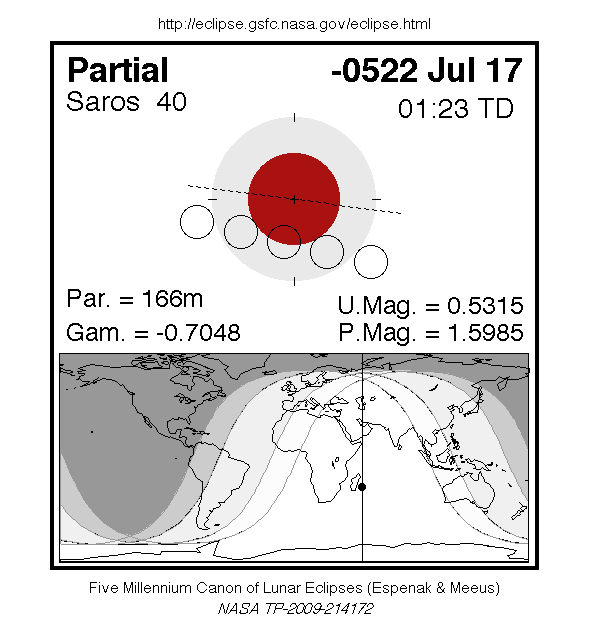
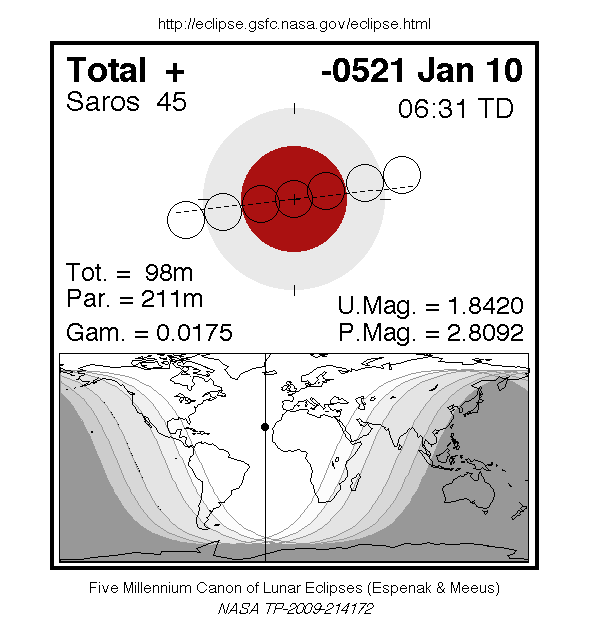
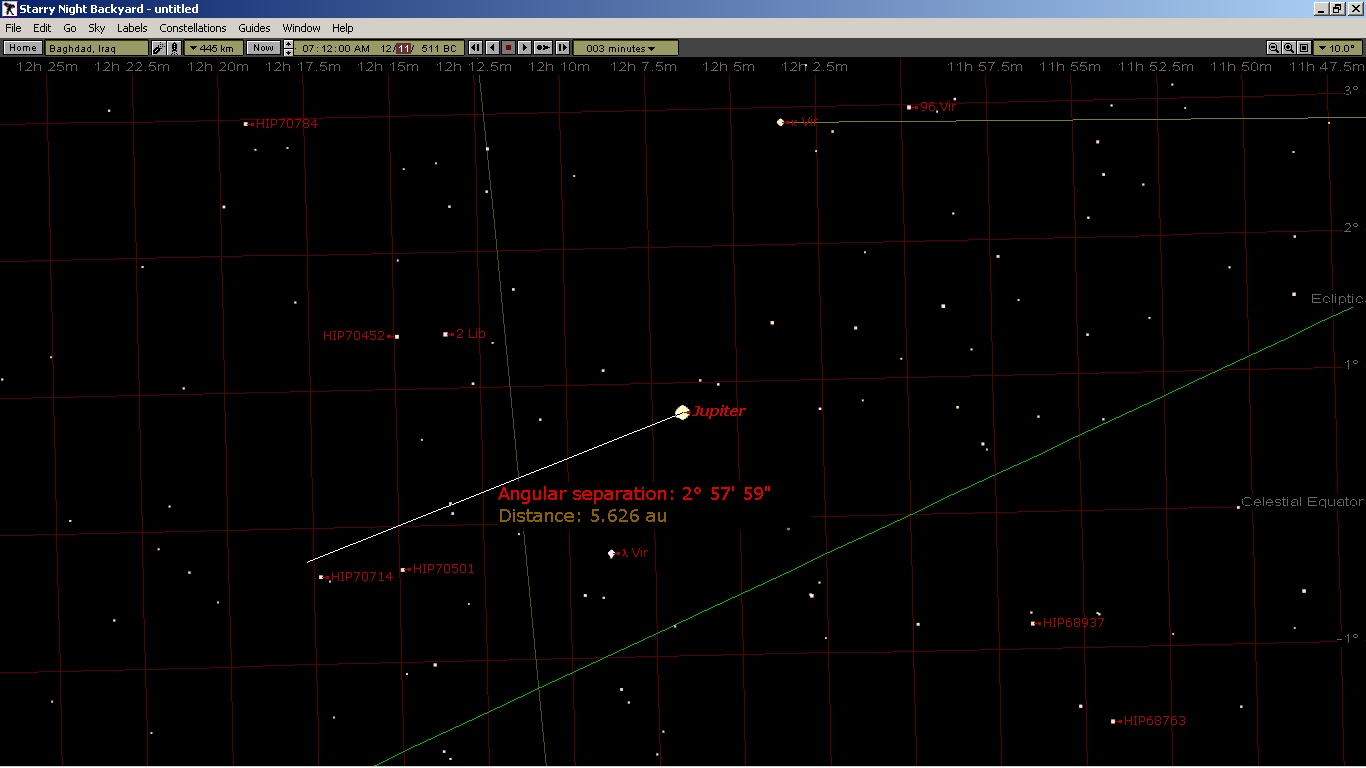
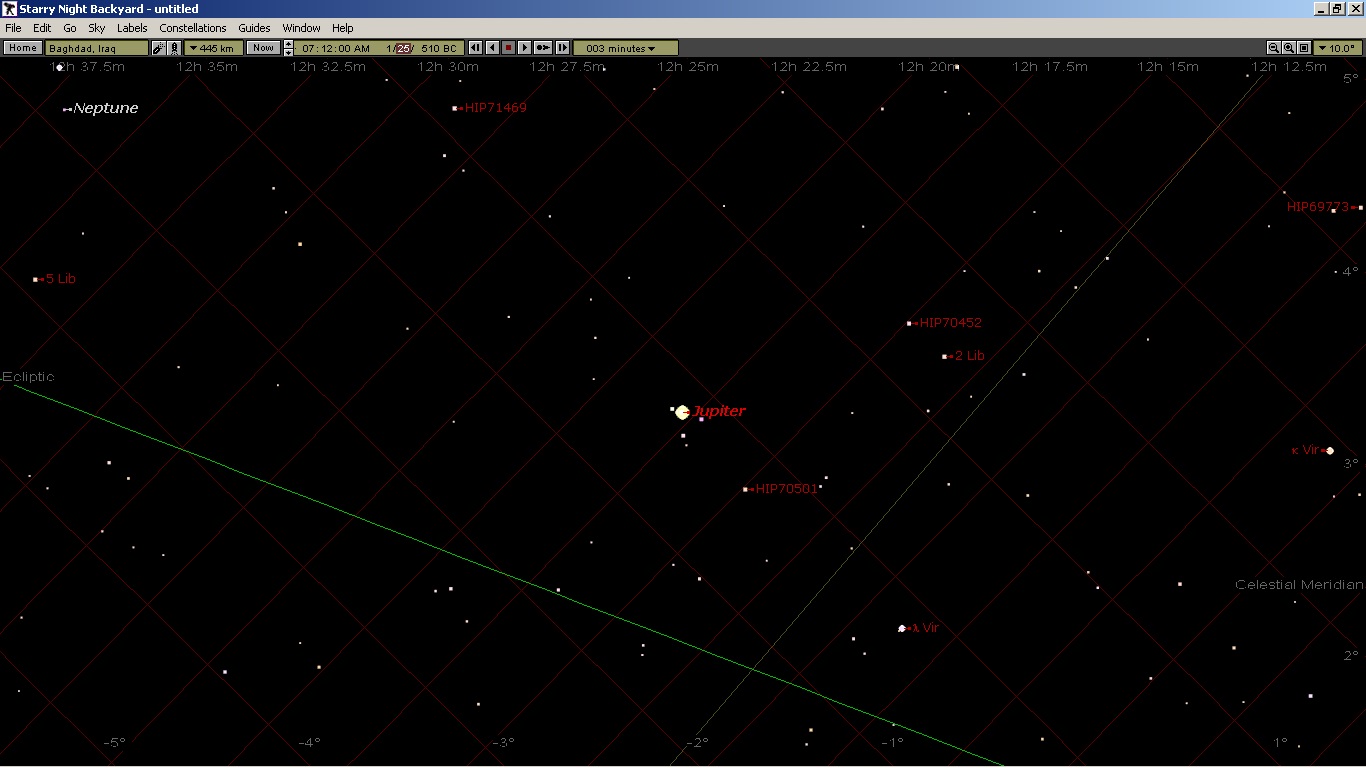
Ren Manetti also shows the 7th year of Cambyses’ reign in 523 BC, confirmed by Eclipses. This month’s blog follows-up on last month’s study of the Greco-Persian Wars, with elements of related chronology.#2 Gertoux’s adapted article below details an astronomical analysis of the British Museum’s Cuneiform Clay Tablet #33066, regarding the 7th year of Cambyses’ reign. This (year 7 Anchor date in 523 BC for Cambyses) owes to tablet BM 33066125: 19 Year 7 month IV, night 14, 1 2/3 beru (= 50° = 50×4 minutes) after sunset, 20 the Moon in Partial Eclipse, with a little left over, north [wind] went. The Partial Eclipse is dated July 16/17, 523 BC [mag. = 0.54] paired with a Jan. 9/10, 522 BC, Total Eclipse. Ptolemy must have known the original tablet as he gave a correct magnitude of 0.50 for the Partial Eclipse. #2a
*Original Footnotes from this adapted study by Gerard Gertoux are fully supplied in their entirety at the end of this article.
In his initial review the author Gertoux, first scanned Espenak’s Lunar Phases Tables (formerly NASA’s) for possible lunar eclipses during the years 540-500 BC to fit lines 19-22 on the reverse side of BM 33066 tablet. After that, he traced Jupiter’s path through the same time period. Initially, he saw only 2 possible eclipse pairs. As it turned out, Jupiter’s path through Virgo falls in the same two time periods as said eclipse pairs: 1) 524-521 BC and, 2) 512-509 BC. Upon closer examination, it soon became clear that, the 512-509 BC scenario, Jupiter events as dated on BM 33066 were incompatible with available lunar eclipses, thus leaving the 524-521 BC scenario as the only viable option.
In particular, this preliminary study made it quite clear that BM 33066… (cf. the bold italicized text within the available footnotes🙂
1. “Based upon the face and format of this astronomical record, it is clear… that the originator of the record was using the Babylonian calendar… beginning each year… month number one.”
2. The beginning of each month is based upon the observable New Moon only.
3. The Jupiter events: as there is no need to debate the existence of a Creator/ God, the greatest scientific evidence and proof for His existence in the truth of the Bible, is the Astronomy of the Star of Bethlehem. One need only wind back the Planetarium and Celestial Computer Programs to see how God spun the planets and laid out the stars in the Universe to declare the Birth of His only Begotten Son. Jupiter Signs like the 3-2BC triple union of Jupiter-Regulus and Jupiter-Venus unions marking the Birth of Christ are prime examples of this Biblical Astronomy, [Try-God.com website]. We have pointed out where these key planetary unions are mirrored in this case on same days or within a day of actual dates aligned with those marking key aspects of Christ’s arrival, to depict how the Creator has sealed these historical dates for those with eyes to see and ears to hear their significance. In this case, it marks key historical Kings leading to the rise of key world Kingdom’s ruling the nations and decrees of King Nebuchadnezzar’s Dream Statue, [Daniel 2, 3:28-30].#3
The Celestial signs marking Christ’s Birth are seen in planet signs of Jupiter, Venus, Mars, Mercury and Saturn as they are documented in numerous blogs @ [Blog.try-god.org] and studies that will keep you busy for a while. References in this month’s blog regarding 523-522 BC as we will see, are directly linked to the planetray signs of the 5 naked-eye visible planets of our Solar System as they pass through the constellations and their God-named stars to tell their story; [Ps. 147:4, Ps. 19, Isa. 45:12, Gen. 1:14-19] of Creation and the birth of Christ.
Gertoux continues; The term ‘Virgo’ is a reference to Gamma Virgo, Porrima (i.e. not a reference to either the constellation Virgo, nor to Alpha Virgo, Spica.)
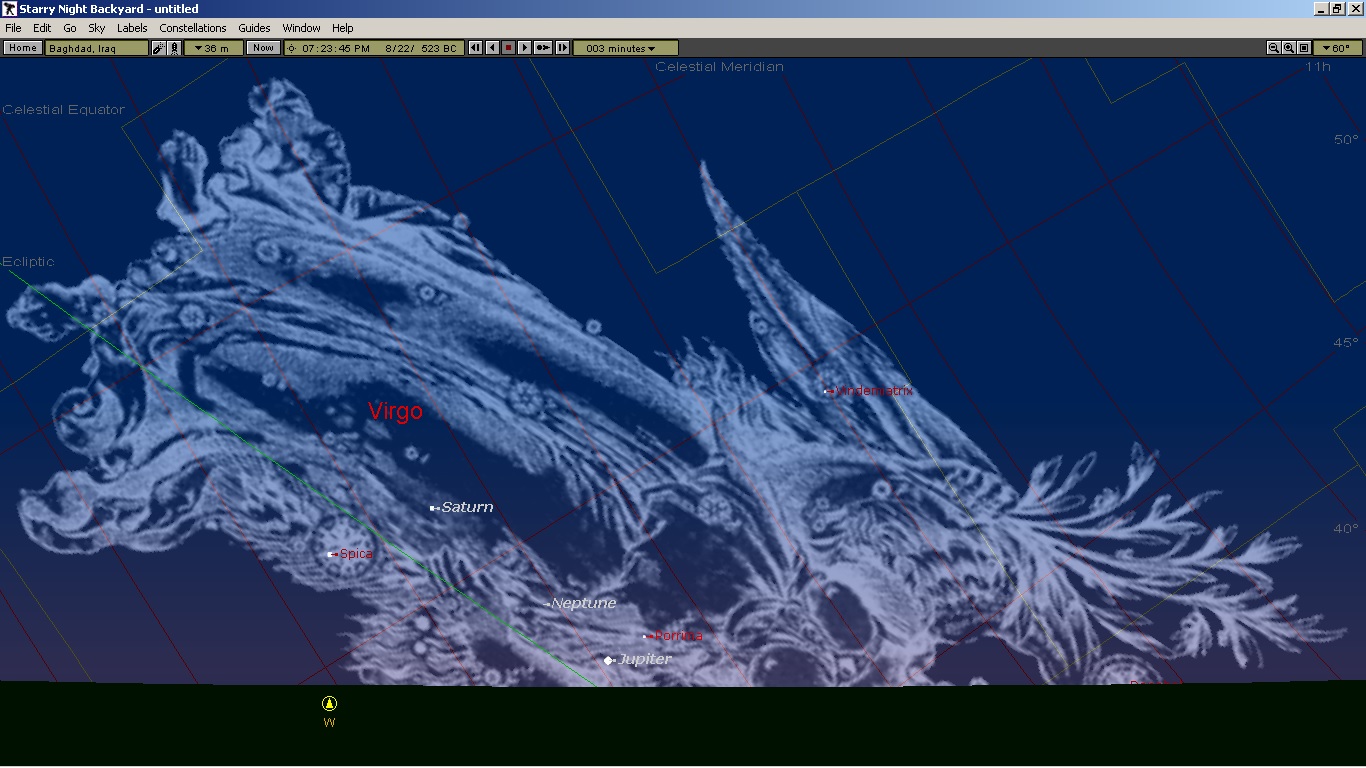
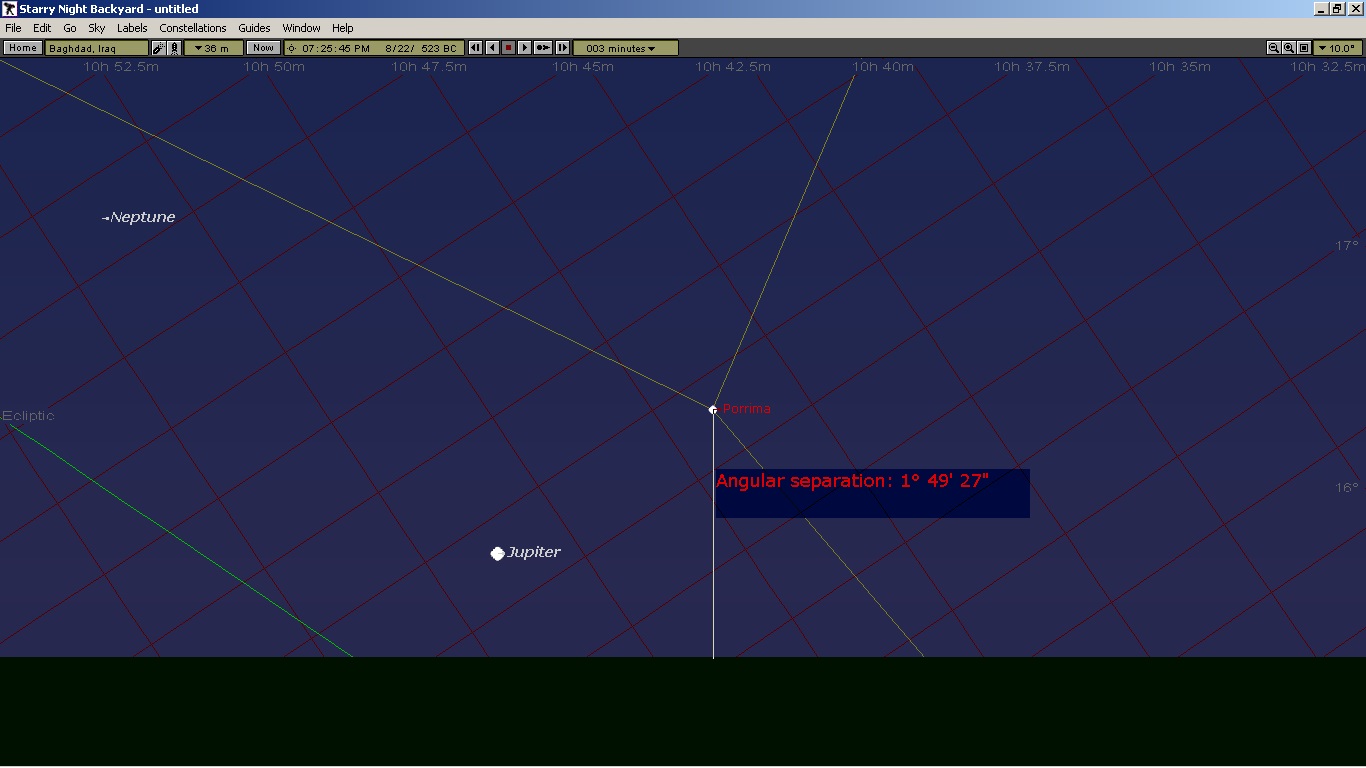
“The 22nd day of Moon 5 began at sunset August 22, 523 BC, which is the very day when Jupiter passed Gamma Virgo! “The 22nd day of Moon 6 began at sunset September 21+, 523 BC, which is when Jupiter and Porrima became visible together on the morning horizon.
“Notice: These two observations, taken together, makes lines 1-2 [reverse] a statement on the visibility – and evidence of an actual firsthand observation- of the setting star Porrima over the western horizon. Cf. Jupiter’s visibility over the eastern horizon!”
4. The Lunar Eclipses of lines 19-22 reverse on BM 33066 tablet are identified as follows: “Within the 7th year beginning in the Spring of 523 BC… we… find two lunar eclipses, both of them visible from the Baghdad horizon: A partial (53.15%) eclipse on July 17, 523 BC and a total eclipse on January 10, 522 BC” (cf. ftnote #1.) This mirrors the eclipse date of Herod’s Death…521 years later; Jan. 10th, 1BC, a key in the correct timing of Christ’s Birth in 3 BC. This high-lights a key feature of these planetary signs-as they align with a date matrix of celestial signs marking the birth of Christ with the planets-a starry concerto linked to key fixed stars, set in their constellations by The Almighty Creator, a unified temporal system of truth in His divine revelation for the wonder of all. His written Word in Creation as the Celestial Gospel.
5. “The New Moon of Abib [month number 1 of] year 7 began at sunset on April (5 or) 6, 523 BC… illum.: 0.81%.”
6. “After reviewing the available Jupiter events and available lunar eclipses, we may narrow our considerations to the following Venus events…
“Day 10 of Moon 3 of year 7 began at sunset June 12, 523 BC. Seems we have a problem here: Venus is in front of Cancer, not [immediately in front of] Leo! However, seeing that the first star visible with Venus in the evening sky was Regulus, alpha Leo, this… makes much sense! Especially in light of a mirrored June 12th date in 3BC, marking a Venus–Saturn union in Taurus, one of two consecutive Saturn unions in Taurus, opening to the 3-1 BC Celestial signs marking the Birth of Christ.
“Day 27 of Moon 3 of year 7 began at sunset June 29, 523 BC. Seems that here too we may have a problem?! Venus is in the area of Gemini, NOT in Cancer. However, the Sun is in Cancer. Perhaps this is an error in translation?… the correct answer is found in recognizing that the Sun too is a star and that the Sun was, at that time, in Cancer! Indeed, as represented by my astronomy software, SNB, Venus was visible even before sunset!…
“Indeed, to me, both of these Venus notations seems powerful evidence of the astronomer’s actual first hand observation of these events.
The conventional 522 BC scenario – which does not(?) fit this astronomical record:
Based upon the face and format of this astronomical record, it is clear 1) that the originator of the record was using the Babylonian calendar, and beginning each year with Abib, month number one, and that 2) the two lunar eclipses of lines 19-22 occurred in the same 7th year as did events pertaining to Jupiter per lines 1-3.
Apparently the conventional dating of this record is based upon little more than an assumption that the lunar eclipses of year 7 & of lines 19-22 are identifiable with the July 5 and December 30, 522 BC lunar eclipses.
Unfortunately for said conventional dating of this record, the closest Jupiter events reminiscent of the events recorded per lines 1-3 in this record occurred one year earlier, that is, between September 20, 523 BC & May 5, 522 BC while being dated within the 7th and 8th years. For these events to fit this record, the events pertaining to Jupiter should have taken place one year later, or else they should be recorded as having occurred in the 6th and 7th year. Alternately, there should be found two lunar eclipses within the 7th year beginning in the Spring of 523 BC. And, Yes, we do indeed find two lunar eclipses within that year, both visible from the Baghdad horizon: A partial (53.15%) eclipse July 17, 523 BC and a total eclipse on January 10, 522 BC. [July 17th, 2015 Jupiter-Regulus in Leo]
Accordingly, per the eclipse record of lines 19-22, Moon 4 of year 7 must include July 17, 523 BC, and Moon 10 of year 7 must include January 10, 522 BC. Using Espenak’s (formerly NASA’s) lunar phase tables, I find the New Moon of Abib year 7 began @ sunset on April (5 or) 6, 523 BC [Starry Nite Backyard set on Baghdad horizon:] Sunset: 18:19:59; moonset: 19:06:23; lag: 46 min 24 sec; illum.: 0.81%.
Also, per the Jupiter record of lines 1-3, the 22nd day of Moon 5 must precede Jupiter’s passing of Spica, alpha Virgo, on October 14, 523BC, as the 22nd day of Moon 6 must fall subsequent to said date. Accordingly, (cf. Espenak’s tables) Moon 5 year 7 began with the New Moon August 30+, 523 BC, and Moon 6 year seven began with the New Moon September 29+, 523 BC. Unfortunately, such a placement does not harmonize with the above said lunar eclipses! It follows that either this placement of BM 33066 about 523 BC is wrong, or our choice of Spica, alpha Virgo, may be incorrect. Alternatively, a most likely contender is Gamma Virgo, Porrima, that Jupiter passed August 22, 523 BC. And per the Jupiter record of lines 1-3, the 22nd day of Moon 5 must precede Jupiter’s by- pass of Porrima, Gamma Virgo, on August 22, 523 BC, while the 22nd day of Moon 6 must fall subsequent to said date. Accordingly, (cf. Espenak’s tables) Moon 5 year 7 began with the New Moon August 1+, 523 BC [August 1 sunset: 19:04:39; moonset: 19:56:06; lag: 51 min 27 sec; illum.: 3.30%,] & Moon 6 year 7 began with the New Moon August 31+, 523 BC, reflects the [Aug. 31st, Jupiter–Venus 3BC union in Leo leading to the birth of Christ.] [August 30 sunset: 18:38:13; moonset: 18:56:39; lag: 18 min 26 sec; illum.: 1.66%.]
Thus:
The 22nd day of Moon 5 began at sunset August 22, 523 BC, which is the very day when Jupiter passed Gamma Virgo, as Saturn by-passed Spica, alpha Virgo at the same time. This mirrors a Jupiter–Venus union also in Virgo on
August 21st, 1 BC.
The 22nd day of Moon 6 began at sunset September 21+, 523 BC, was when Jupiter and Porrima became visible together on the morning horizon. This 9/21/523 BC date mirrors the same date in 2015 that opens Hebrew Jubilee year on Atonement day, while marking a Regulus–Venus alignment/union and Rev. 12 sign on the Christ angle of the Great Pyramid, in 2017!
Notice: These two observations, taken together, makes lines 1-2 a clear statement on the visibility – and an actual firsthand observation – of the setting star Porrima over the western horizon. Cf. Jupiter’s visibility over the eastern horizon, as Jupiter and Mars frame Porrima on the ecliptic!
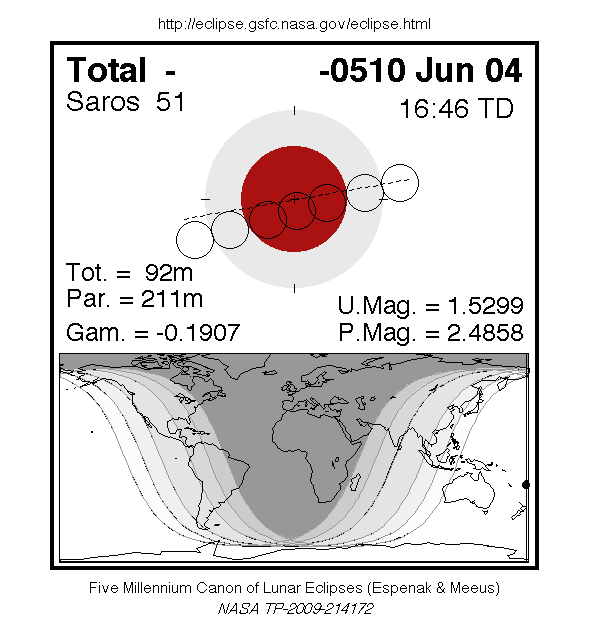
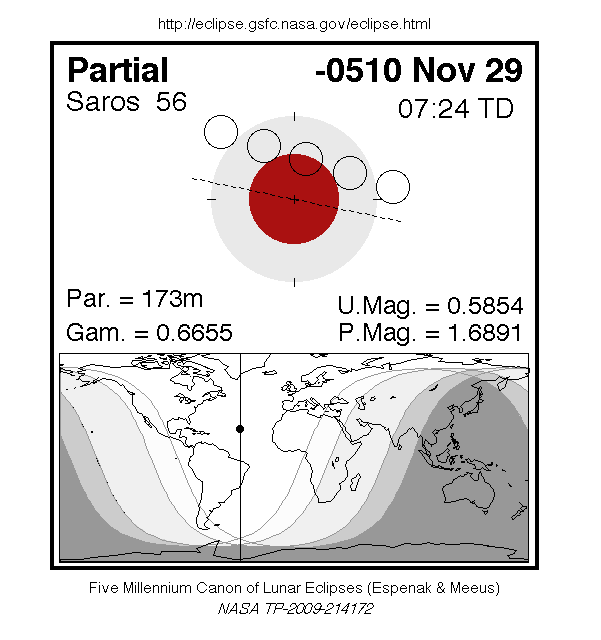
Alternatively, looking upon subsequent series of Jupiter events (which events recur every 12 years) we find that on September 2, 512 BC- Jupiter entered the constellation of Virgo, and on December 13, 510 BC, Jupiter exited Libra while entering Scorpio. More specifically lines 1-3 of this astronomical clay tablet may be understood in terms of depicting the Jupiter events between Sept. 511 BC and Oct. 510 BC. Accordingly, the 7th and 8th years must be placed from the Spring of 511 BC until the Spring of 509 BC, and, for this temporal placement to fit, there must be two lunar eclipses between the Springs of 511 BC and 510 BC, within the 7th year of this record. But the closest pair of lunar eclipses, visible from Babylon, that possibly fit this record occurred on June 14 and December 9, 512 BC. Considering also the lunar eclipses that were not visible from the Baghdad horizon, we find two lunar eclipses also within the 7th year, starting in Spring of 511 BC: A total lunar eclipse on June 4, 511 BC, and a partial (58.54%) lunar eclipse on Nov 29, 511 BC.
Per Starry Night Backyard Constellation Boundaries, Jupiter left Leo for Virgo on Sept 18, 524 BC. Jupiter then became stationary while reversing across the breast of Virgo December 18, 524 BC, and then again April 23, 523 BC reverting to forward motion. Next stationary position occurred –after its last and only passage of Spica, alpha Virgo, on October 14, 523 BC– across the lower left tibia of Virgo on January 20, 522 BC, and following that on May 25, 522 BC. This retro-motion mimics Jupiter’s movements at Christ’s birth, with Jupiter-Regulus triple union. On Sept. 22, 522 BC Jupiter exited a Starry Night Backyard boundary of Virgo for Libra, passed Libra’s alpha star, Zubenelgenubi, [purchase/ deficient price Christ pd] on October 7, 522 BC, mirrors [October 8, 2015 Venus–Regulus in Leo]. On Jan. 5th, 521 BC it exited Libra for Scorpio, by–passing the Sun on Oct. 10, 522 BC, prior to visibility in evening sky, after which it rose higher in morning sky as it trailed ever further behind Libra.
Specifically on lines 1 and 2: ‘Virgo,’ as used in line 1 and 2, could represent either the constellation, or else the lead star, alpha Virgo, Spica. Given that only one month time is provided between lines 1 and 2, I am forced to conclude that Virgo, as used in lines 1 and 2, must apply to Spica, alpha Virgo and not to the constellation as a whole. It follows that the 22nd day of the 5th Moon of line 1 must be placed before Jupiter’s passing Spica, and that the 22nd day of the 6th Moon of line 2 must be placed after Jupiter’s passing Spica.
The conventional 524-522 BC scenario: Given, per Starry Night Backyard soft-ware, that Jupiter passed Spica only once within 524-521 BC, on October 14, 523 BC, I have no choice but to identify Moon 1 as opening May 5, 523 BC, Moon 5 as starting August 30+ [Aug 30, 523 BC sunset: 18:38:13; moonset: 18: 56:32; lag: 28 min 19 sec; illum.: 1.66%;] Moon 6 as opening on Sept. 29+ [Sept 29, 523 BC sunset: 17:59:51; moonset: 18:25:44; lag: 25 min 53 sec; illum.: 2.96%;] and Moon 10 opening on January 26+, 522 BC [Jan 26, 522 BC sunset: 17:27:55; moon- set: 18:52:35; lag: 84 min 40 sec; illum.: 2.25%.
Thus:
Abib 1 was reckoned as beginning on May 5+, 523 BC; ie. per the conventional dating of this record!
The 22nd day of the 5th Moon began on September 20+, 523 BC;
The 22nd day of the 6th Moon began on October 20+, 523 BC;
The 27th day of the 10th Moon began on February 21+, 522 BC. Notice: This is a no fit option, that is since 1) the real event took place on January 20± located 1° 35’ distant, and 2) this real event took place within the boundaries of the Virgo constellation, outside the constellation of Libra!
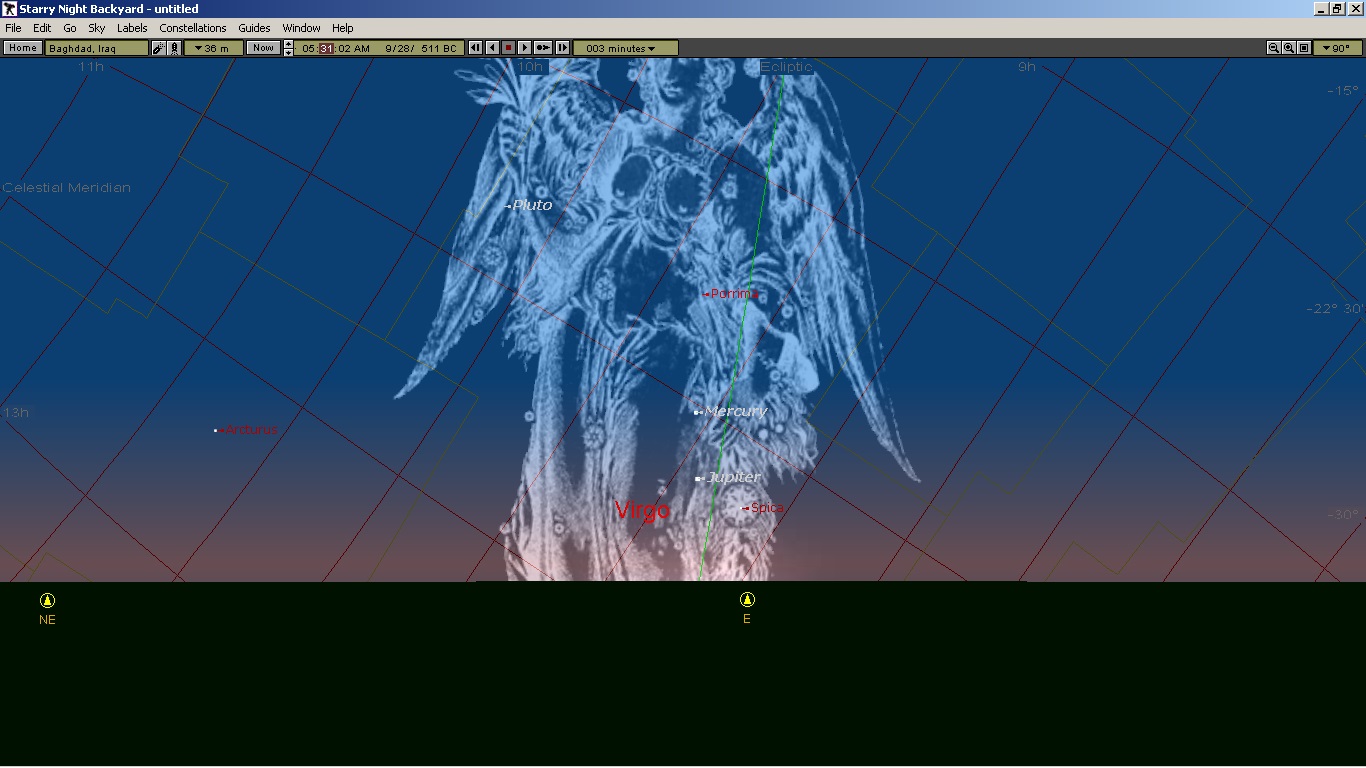
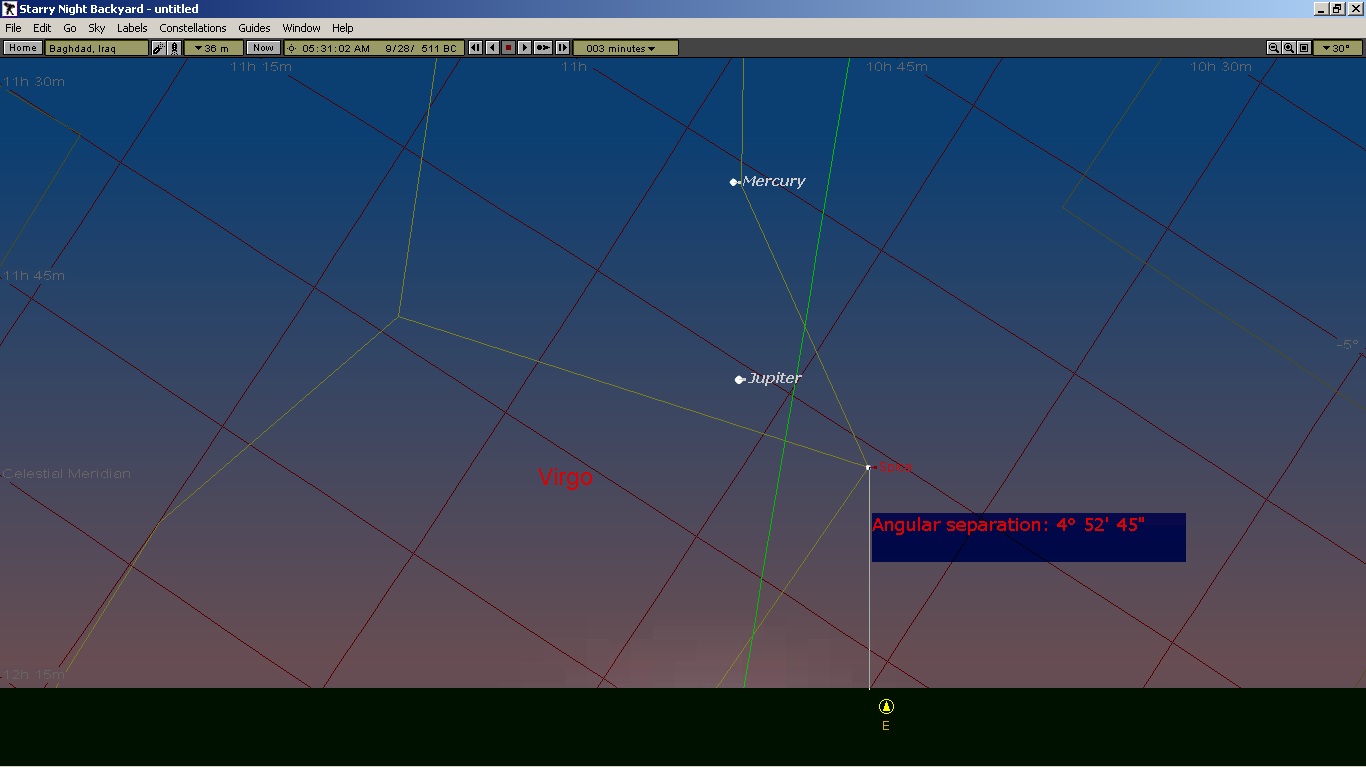
The closest & only alternative – that does(?) fit this astronomical record: The next time following the above 524-522 BC Virgo and Libra passage of Jupiter, began when, on September 2, 512 BC, Jupiter again exited Leo for Virgo, after which it again became stationary near Virgo’s left elbow; Dec. 24, 512 BC, and again reversing its path on April 25, 211 BC. Following next, Jupiter by-passed Spica, alpha Virgo, September 28, 511 BC, mirroring the last Blood Moon of the 9/28/2015 Blood Moon Tetrad, after which Jupiter reversed its path January 26, 510 BC (shortly after passing Libra’s limits, Dec. 23rd, 511 BC) before halting & reversing on May 29, 510 BC, to reenter Libra, August 16th, 510 BC. After by-passing alpha Libra [Zubenalgenubi] September 22, 510 BC, exiting the sign Libra for Scorpio on December 13, 510 BC.
The alternative 512-510 BC scenario: Given, per my Starry Night Backyard soft–ware, that Jupiter passed Spica only once within 512-510 BC, on September 28, 511 BC, [9/28/2015 Super Blood Moon @ Feast of Trunpets] I have no choice but to identify Moon 1 opening April 21, 511 BC, & Moon 5 started August 18+ [Aug 18, 511 BC-sunset: 18:50:57; moonset: 19:39: 02; lag: 48 min 05 sec; illum.: 1.04%;] Moon 6 opening Sept. 17+Sun clothes Virgo/ Moon @ feet/2015 Mercury-Spica, [Sept 17, 511 BC] @ sunset: 18:15:36; moonset: 19:17:25; lag: 61 min 49 sec; illum: 2.88%;] Moon 10 opened January 13+, 510 BC [Jan 13, 510 BC sunset: 17:16:38; moonset: 18:41:57; lag: 86 min 19 sec; illum.: 3.21%.]
Thus:
Abib 1 reckoned as beginning on April 21+, 511 BC; ie. per the one perfect fit dating of this record!
The 22nd day of the 5th Moon began on September 8+, 511 BC;
The 22nd day of the 6th Moon began on October 8+, 511 BC; mirrors Oct. 8/2015 Venus–Regulus in Leo].
The 27th day of the 10th Moon began on February 8+, 511 BC. Notice: Jupiter moved no more than 0° 20’ between Jan 26 and Feb 8. This is a good fit!
Alternatively: Jupiter passed Porrima on August 7, 511 BC.
Thus:
Abib 1 was reckoned starting on February 22+, 511 BC; This is not a likely Aviv date!
The 22nd day of the 5th Moon began on July 11+, 511 BC;
The 22nd day of the 6th Moon began on August 10+, 511 BC;
The 27th day of the 10th Moon began on December 11+, 511 BC. Notice: Jupiter moved almost 3° between Dec 11 and Jan 25. This is not a good fit!
It follows that for this Jupiter scenario to fit, Spica must have been the Virgo reference star, not Porrima!
Next we will review elements of the Chronologies of Darius 1 and Xerxes 1 followed by Artaxerxes. Lets start with the case for Ahasuerus being Darius: [see seforim blog]
A. Another aspect of this topic is consideration of the Chronology of Persian Kings. A reason for uncertainty in a timeline between Darius and Xerxes is they share similar personality traits. Though there are character traits that can fit Xerxes, they too can fit equally well for Darius. For example, Darius is well-known for his greed. Herodotus called Darius a “huckster“ for Darius sought to make a gain in everything. This fits with Haman offering to pay the King 10,000 talents of silver, & also fits Esther appealing to the loss of kingdom revenue with the Israelites in the kingdom being eliminated.
B. Esther 1:1 says this king reigned over Ethiopia. However, it was not until Cambyses; 530-523 BC that Ethiopia and Egypt were conquered. In 525 BC, Cambyses invaded Egypt. In the spring of that year, the Persian and Egyptian forces clashed at Pelusium, where the Persians emerged victorious. This king also chose the city of Susa/Shushan to build his palace according to Pliny, ruling out anyone before Darius.
C. The age of Mordecai rules out any later than Darius, to which Rev. Nessle pointed out and agrees, as seen in the very strong Biblical case he has put together. The age of Mordecai and Esther rules out anyone after Darius. In recognizing this problem have attempted a twisted translation such as the NKJV – that says it was Kish, [not Mordecai] taken captive under Jeconiah. Quotes; Jones says, “Only by a tortured, forced grammatical construction can this sentence ever apply to Mordecai’s Great Grandfather Kish.” If Mordecai was taken into exile, it makes him 78 in the first chapter of Esther, and 87 at the end, rather than 124 years old when promoted to the position of prime minister/Grand Vizier.
This chronology solves major problems in Ezra and Nehemiah where both are either made to be incredibly old or where (as most say) there are two different Ezras and two different Nehemiahs, [but no other Mordecai’s in the Bible.]
D1. Esther 1:14 mentions “the seven princes of Persia and Media.” Darius began the custom of having seven counselors.
D2. Esther 1:14. Notice the order of “Persia and Media” (cf. 1:3,18,19). Before Cyrus, the Medes were dominant and Scripture refers to them as “the Medes and the Persians.” Not until Cyrus’ first year [539-538 BC] did the Persians gain ascendancy over the Medes.
E. Under Darius the Mede there were 120 satrapies (Dan. 6:1), yet under this king there are 127 (Est 1:1). Between the two kings the satrapies increased, but it was not until the 12th year of Darius that all 127 were in place. Under Xerxes the number of provinces controlled by Persia began to decrease.
F. Esther tells us under Xerxes the kingdom actually lost the isles by his 12th year. A good argument for Xerxes comes from Georg Friedrich; Grotefend’s decoding of the Persian characters found in Persepolis ruins. The name of the son of Darius Hystaspis was deciphered as Khshayarsha, in ancient Persian.
G. Grotefend’s translation to Greek = Xerxes. When khshayarsha is transposed into Hebrew, it becomes near letter for letter Akhashverosh, that’s rendered Ahasuerus in English. A problem with this is “Ahasuerus” consists of 2 words “aha“ that means “mighty“ and “Suerus“ meaning “king;”- Mighty king. So the translation into Xerxes leaves out the “aha,“ or the mighty. Jones says that it should have literally been translated “Artaxerxes.” This may be a reference to Darius’s grand-son, Artaxerxes and not Xerxes.
H. Ahasuerus may seem a probable match to Xerxes because:
– The name Ahasuerus is close to some versions of the name Xerxes even though it is not so close to the Xerxes version, as seen below.
Xerxes (Greek) = Xsayaarsan/Khshayarsha/Xsayarsa/Khashayar/Xasayar/Axores (Persian) = Khsherish/Khshiarsh/Khshaiarsha/Xasayarusa/Hasayarusa (Egyptian) = Hisi’arsa/Ahsiyarsu/Ahsiiaarsu (Akkadian/Babylonian) = Aksiwarsu/ Aksiiwaarsu = Hsy’rs (Aramaic) = Ahaseros/Ahaseweros/Ahasveros (Biblical) = Ahasuerus/Assuerus (Latin Biblical) = Ahasweros/Achashverosh (Tiberian Biblical) = Asoueros (Greek Biblical).
I. Although the Septuagint, Vulgate, Midrash & Josephus with an Ethiopic text identifies Ahasuerus as Artaxerxes, these are later traditions, and the name Artaxerxes is similar to Xerxes in Greek at least. (Artaxerxes is “considered a common name/title of kings in Persia.”) Seforim Eclipse Blog
As was pointed out in last month’s blog, the only Solar Eclipses fitting this description of eclipses by Xerxes’ in 480BC are the 4/09/480BC Total Solar &
10/2/480BC Annular Solar Eclipses. In 479BC only the 3/29/479BC Total Solar Eclipse & 9/21/479BC Annular Solar Eclipses fit the bill of “day now eclipsing into night.”
There were unique events going on in the third year of this king’s reign. Xerxes can fit this beautifully in that he took at least 4 years gearing up to campaign against the Greeks and he needed the support of his princes. But this also fits a chronology of Darius as well. Darius spent the first two+ years of his reign putting down rebellions, and a feast in the third year fits perfectly. It would have finally been a celebration of having put down 9 attempted overthrows of the kingdom and numerous rebellions in the empire. Once he consolidated, it was time to celebrate and display his power.#10
Likewise, waiting till the seventh year for the wedding search fits Xerxes. He had come home wasted in his war with Greece. He lost badly and could have sought comfort for himself during this time.
James Jordan says, “we have seen that Darius is called Artaxerxes in Ezra-Nehemiah. In the Greek Septuagint throughout, Esther’s king is called Artaxerxes. Ahasuerus is between Darius & Artaxerxes in Ezra 4. Xerxes is between Darius and Artaxerxes in Persian king lists and in Herodotus.
There is also the exact date match of the 10th month of the king’s 7th year: “Ahasuerus met Esther in the 10th month of his 7th year. Xerxes sought comfort from his harem following his defeat at Salamis in 10th month of his 7th year.” Ahasuerus banished Vashti in his 3rd year, and met Esther in his 7th year. Xerxes ruled from 486 BC, and his Greek invasion was in 480 BC (to before?) his 7th year?). The 13th year of Ahasuerus is also near Xerxes 12th year, [486BC +12 years=474BC which fits a Thucydides timeline who reigned as the fourth King of Kings of the Achaemenid Empire, via a conventional history reigned from 486 BC until his assassination in 465 BC, but for these reasons are we lean to 474 BC for Xerxes I’ death. The next evidence from Gertoux fills out this picture from his article on “Dating the reigns of Xerxes and Artaxerxes.” #11 Dating the Reigns of Xerxes and Artaxerxes, in: Orbis Biblicus et Orientalis Series Archaeologica 40 (2018, pp. 179-206).
According to Diodorus Siculus [Historical Library XI:54-60] and Herodotus [Histories VII:1-5] referenced below; the transfer of power between Darius to Xerxes occurred with a revolt in Egypt in 486 BC, 4 years after the Persian defeat at Marathon. While the transition between Xerxes/Atraxerxes took place just after the storming of Eion in 476 BC. Xerxes recalled most of his Persian troops in the winter of 480/479 BC.[6] A final battle was engaged at Plataea in Boeotia in August 479 BC. Eion was taken by the Delian League in 476 BC led by the Athenian[7] general Cimon. This was a late event in Xerxes’ reign before Artaxerxes ascended, [Histories VII. 106-107]. Xerxes reigned 21 years via Ptolemy’s Kings List, including a 10-year co-regency with Darius his father. From the BM astronomical tablet #32234, lunar eclipses framed the death of Xerxes between June 26th, 474 BC-Total lunar eclipse as the Moon is seen in the 4 rear stars of Saggittarius, and a Partial lunar eclipse Dec. 20, 474 BC. Xerxes death was dated Wed. August 23/24, 474 BC, with his accession year 21 years earlier in 496 BC, or year 26 of Darius I. Xerxes was thus crown Prince long before Darius died, making him Crown Prince and co-regent at the same time. #12 IBID
Having declared Xerxes king, Darius was intent on his expedition. But in the year after this, and the revolt of Egypt, death came upon him in the midst of his preparation, after a reign of thirty six years; nor was it granted him to punish either the revolting Egyptians, or the Athenians. Esther 1 takes place in the third year of King Ahasuerus’ reign.
Let the king appoint overseers in all provinces of his kingdom that they may gather every beautiful young virgin to the citadel of Susa, to the harem, into the custody of Hegai, the king’s eunuch, who is in charge of the women;
All the women were to live in the harem under Hegai’s charge. Intriguingly, the name ‘Hegai‘ occurs as an officer of Xerxes in the Histories of Herodotus (ix. 34).
Esther 2:5-11
5 In [d]Shushan the [e]citadel there was a certain Jew whose name was Mordecai the son of Jair, the son of Shimei, the son of Kish, a Benjamite. 6 Kish[f] had been carried away from Jerusalem with the captives who had been captured with [g]Jeconiah king of Judah, whom Nebuchadnezzar the king of Babylon had carried away. 7 And Mordecai had brought up Hadassah, that is, Esther, his uncle’s daughter, she had neither father nor mother. The young woman was lovely and beautiful. When her father and mother died, Mordecai took her as his own daughter. 8 So it was, when the king’s command and decree were heard, and when many young women were gathered at [h] Shushan the [i]citadel, under the custody of Hegai, that Esther also was taken to the king’s palace, into the care of Hegai the custodian of the women. 9 Now the young woman pleased him, and she obtained his favor; so he readily gave beauty preparations to her, besides [j]her allowance. Then seven choice maidservants were provided for her from the king’s palace, and he moved her and her maidservants to the best place in the house of the women. 10 Esther had not [k]revealed her people or family, for Mordecai had charged her not to reveal it. 11 And every day Mordecai paced in front of the court of the women’s quarters, to learn of Esther’s welfare and what was happening to her.
Verse 6 establishes Mordecai’s grandfather Kish as one, “who had been taken into exile from Jerusalem with captives who had been exiled with Jeconiah king of Judah, whom Nebuchadnezzar the king of Babylon had exiled.” The event of King Jeconiah’s exile is found in Jer. 27:19-20:
In year 8 of Nebuchadnezzar’s reign, in 597 BC he removed [Jehoiachin] king Jeconiah from Jerusalem. Nebuchadnezzar captured Jerusalem on Adar 2, 597 BC but waited till Nisan 1 to take him captive back to Babylon to put Zedekiah on the throne as vassal king- on Nisan 10. [2 Chron. 36:10]
All the nobles of Jerusalem were included in this exile, which included Mordecai. The next character in the narrative of Esther is introduced as Hadassah, a Jewish name meaning ‘myrtle’ and her Persian name Esther meaning ‘star’, maybe a potential reference to the star–like flowers of the myrtle, seen below in the botanical illustration.
Fringe Myrtle (Calytrix tetragona) is a beautiful native shrub that keeps on giving. Not only does it cover itself in an array of starry white flowers from spring, but after flowering the calyces hang on for some weeks, shiny with long curling threads, turning golden bronze and purplish. The name Calytrix is from two Greek words meaning calyx and hair, alluding to the long fine calyx tips and the species name tetragona means four-sided, relating to the leaf cross-section.

Source: Australian National Botanic Gardens
Photos: Wild Blue Mountains
Esther is without living father or mother, however her family line is also from a royal family of Jews just as Mordecai, he adopted her and was raising her as his own daughter. She found favor with Mordecai as he took her in as his own daughter. She also found favor with Hegai as he quickly brought her into the harem and gave her advantage over all the other virgins.
Verse 16 gives us the details of when this event takes place, “So Esther was taken to King Ahasuerus to his royal palace in the tenth month which is the month Tebeth, in the seventh year of his reign.” This would have been about four years from the time the king had issued his edict concerning Vashti.
Verse 17 shows the king’s response after his evening spent with Esther as we read, “The king loved Esther more than all the women, and she found favor and kindness with him more than all the virgins, so that he set the royal crown on her head and made her queen instead of Vashti.
Note that Esther still listened to the direction of her adopted father, Mordecai even as she is no longer under his care having been crowned Queen, showing her humility.
Verse 21 discloses a significant incident, “In those days, while Mordecai was sitting at the king’s gate, Bigthan and Teresh, two of the king’s officials from those who guarded the door, became angry and sought to lay hands on King Ahasuerus,” become angry enough to try and kill King Ahasuerus.
The king’s life was always in peril as this is part of the risk to having so much power, showing the palace intrigue involved that was navigated successfully by Mordecai and Esther in verse 22, where the plot became known to Mordecai and he translated the message through Queen Esther.
Verse 23 shows the results of this revelation that there was an investigation that verified the report with a conclusion of both men being hanged on the gallows.
As with every important event that transpired during the king’s reign this one, “was written in the Book of the Chronicles in the king’s presence.” The books containing the king’s written records would have been destroyed in the fire that happened during the reign of Artexerxes, the son of King Ahasuerus.
God’s special care for His people-Israel is evident based on His foreknowledge to have all key people correctly placed to carry out His will. Only an Omni-scient All-powerful God can pull this off, as we find in the circumstances below.
A Jewish princess, not identified publicly, already resides in the citadel of Susa, who happens to be beautiful, humble, obedient, wise & charming, who catches the attention of Hegai an important official in the king’s service, one who happens to control the daily lives of all the virgins brought to the king. The king happens to adore her as well and selects her to be his queen. As her adopted Father-Mordecai happened to be seated in the Kings Gate, when a plot to kill the king was discovered and thwarted. Esther was a singular woman to deliver her nation from disaster, a rare person with a perfect blend of charm, strength, and guile, whose character was secure from the rot of wealth, power and prosperity, who at a critical juncture in history came through risked death for her people– Israel, escaped dying with them, opening God’s deliverance to His people as a providential instrument for His glorious purpose.
This month’s blog has seemingly generated more questions than perhaps the answers it has provided in certain cases. For example, if Xerxes was not Esther’s wife, who was his wife? This also begs the question of Xerxes‘ successor, as a potential offspring and heir to the Persian throne? We will explore these & other related questions in next month‘s July blog.
From the last two blogs in May and June of 2026, we have presented information on a debate that’s raged literally for centuries on the history of timing of Persian Kings. We have included Historical, Astronomical, Biblical and Archaeological evidence in an effort to be as comprehensive and even-handed as possible, so as not to bias this material in any way. As always, I welcome any and all feed-back you may have to add to this discussion.
God Bless!
Rene’
Footnotes;
1. Post-exilic Bible Chronology & Identifying Esther’s Husband, Jon Nessle.
2. Ptolemy’s (Almagest V:14)
[1.] http://www.adamoh.org/TreeOfLife.wan.io/OTCh/BM_33066-Cambyses_clay_tablet/BM_33066-Cambyses_7th_year_astronomy_clay_tablet-Initial_Review.htm
[1a] Adapted article from; Jul 16, 523 BC – ANCHOR Partial Lunar Eclipse Yr 7 of Cambyses, Chronological, Historical and Archaeological Evidence by Gerard Gertoux
[2] Cf. footnote 1!
[3] Notice that our placement of this event forces a definition of the meaning of the original words behind this sentence! That is, whether or not an intercalary Moon was inserted at this time! At any rate, all considerable dates requires a 12 Moon year at this point, that is, with no intercalary Moon! [Cf. footnote 4!]
[4] The conventional 524-522 BC scenario: The event of May 25, 522 BC (cf. footnote 1.) Month 2 of year 8 began on either May 24+, or else on June 22+ (if a 13th Moon is intercalated.) The 25th day of Moon 2 fell on June 17+, or else on July 16+. June 17+ is perhaps? close enough to May 25, 522 BC (Jupiter moved 0° 51’,) but not July 16+!
The alternative 512-510 BCE scenario: The event of May 29, 510 BC (cf. ftnote 1.) Month 2 of year 8 began on either May 11+, or else on June 10+ (if a 13th Moon is intercalated.) The 29th day of Moon 2 fell on June 8+, or else on July 8+. June 8+ is close enough to May 29, 510 BC (Jupiter moved 0° 15’,) but not July 8+ (Jupiter moved 2° 30’!)
Accordingly, the cuneiform behind this translation is most likely saying that the 12th Moon of this year was the last Moon of this year, and that there was no 13th Moon.
[5] Perhaps the error is found in the translation “behind Libra”, ie. vs. “in front of Libra?”
[6] Given that Moon 2 is already defined, it follows that: The conventional 524-522 BC scenario: Moon 6, 522 BC began Sept 18+, 522 BC. The 4th day of the 6th Moon began on Sept 21+, 522 BC. But, a called for recorded event occurred after passing alpha Libra on October 7, 522 BC.
The alternative 512-510 BC scenario: Moon 6, 510 BC began on Sept 7+, 510 BC. The 4th day of the 6th Moon began on Sept 10+. But, the called for recorded event occurred after passing alpha Libra on September 22, 510 BC.
It becomes obvious that alpha Libra is not the reference star being used in this record. Most likely then, the correct reference star must be beta Libra, Zubeneschamali. The corresponding corrected dates for Jupiter’s passing Libra are Nov 11, 522 BC and Oct 27, 510 BC. [But this suggestion only aggravates the problem!]
[7] The conventional 524-522 BC scenario: After reviewing the available Jupiter events and available lunar eclipses, we may narrow considerations of the Venus events accordingly, that is, the 7th year of BM 33066 beginning in Spring of 523 BC. More precisely, the 3rd Moon of year 7 began with the New Moon June 3, 523 BC [June 3, 523 BC sunset: 18:58:43; moonset: 20:19:51; lag: 81 min 8 sec; illum.: 2.01%.]
Thus, Day 10 of Moon 3 of year 7 began at sunset June 12, 523 BC. Seems we have a problem here: Venus is in front of Cancer, not Leo! However, seeing that the first star visible with Venus on the evening sky was Regulus, alpha Leo, this too makes much sense!
Day 27 of Moon 3 of year 7 began at sunset June 29, 523 BC. Seems that here too we may have a problem?! Venus is in the area of Gemini, NOT in Cancer. However, the Sun is in Cancer. Perhaps this is an error in translation? Or, perhaps the correct answer is found in recognizing that the Sun too is a star and that the Sun was, at that time, in Cancer! Indeed, as represented by my astronomy software, SNB, Venus was visible even before sunset! And, looking up Venus and magnitude I find that Venus is brighter as a crescent than it is at its full, that is, because of its closeness to Earth…
Indeed, to me, both of these Venus notations seems powerful evidence of the astronomer’s actual first hand observation of these events, that is, as opposed to theoretical calculations as some are suggesting.
The alternative 512-510 BC scenario:
Per our findings (cf. footnote #) for the 512-510BC scenario re Jupiter, day 10 of Moon 3 of year 7, must have fallen on June 29 or 30, 511 BC. But, in the 7th year the only lunar eclipses fell, not in the 4th and 10 Moons as required by this record, but in the 2nd and 8th Moons. As there is no fit for both Jupiter events and the eclipse events as recorded on BM33066, I find the 512-510 scenario is not a workable option and can be most certainly ruled out! – Accordingly, I may now freely go on with my creation of an interpretation of BM33066 in terms of the 323-321 BC scenario…
[8] Conventional placement in July 522 BC: As observable from the Baghdad horizon on July 5, 522 BC per Starry Night Backyard software: Sunset: 19:11:36; opening of penumbral (not noticeable) shadow: 20:49:36; beginning of visible shadow: 22:02:36; starting of total eclipse: 22:59:00; end total eclipse: 00:47:00; end of visible shadow: 01:46:00; end of penumbral (not noticeable) shadow: 02:58:00.
Accordingly, the blood colored red totally eclipsed Moon began 3 hours, 48 min, and 24 seconds after sunset, and the visible eclipse began 2 hours 53 min after sunset. It follows that F. X. Kugler’s 1907 translation – “1 2/3 Doppelstunden (3h 20m,)” i.e. “1 2/3 double hours [three hours and twenty minutes]” – is a less correct translation than is “1 2/3 and 1 double hour” as found at this link.
[9] Please note that the cuneiform word translated “the north wind blew” is probably better translated in terms of “stood.” Cf. my discussion at footnote 59 under this link.
[10] Conventional placement in December 522 BC: As observable from the Baghdad horizon on December 30-31, 522 BC per Starry Night Backyard software: Sunset: 17:06:30; beginning of penumbral (invisible) eclipse shadow: 17:35:04; beginning of visible partial (64.36%) eclipse: 18:48:00; end of visible partial eclipse: 21:18:00; sunrise: 07:11:28; moonset: 07:37:52.
Notice: The facts of this eclipse do not agree with the words of the record as conventionally translated!: Not, by far, a total eclipse, and the eclipse occurred in the evening, not in the hours before dawn!
Alternatives to conventional placement: Looking at the placement of lunar eclipses between 539 BC and 500 BC, I find only one other reasonably timed lunar eclipse pair: In 512 BC…
As observable from the Baghdad horizon on June 14-15, 512 BC per Starry Night Backyard software: Sunset: 19:05:09; beginning of penumbral (invisible) eclipse shadow: 23:14:33; beginning of visible partial (76.47%) eclipse: 00:28:00; end of visible partial eclipse: 03:19:00; end of penumbral (invisible) eclipse: 04:31:00; sunrise: 04:46:41; moonset: 04:58:33.
As observable from the Baghdad horizon on December 9-10, 512 BC per Starry Night Backyard software: Sunset: 16:59:59; beginning of penumbral (invisible) eclipse shadow: 00:44:00; beginning of visible total eclipse: 01:53:00; beginning of totally eclipsed Moon: 02:49:00; end of totally eclipsed Moon: 04:34:00; end of visible eclipse: 05:29:00; end penumbral eclipse: 06:38:40; sunrise: 06:58:15; moonset: 07:10:33.
Conclusion re alternative placement in time: Seeing that the beginning of the June 14/15, 512 BC visible eclipse is too far removed from sunset while also not a total eclipse, while the December 9/10, 512 BC eclipse seem a fairly good fit, I find that most likely the translation of the cuneiform is in serious error and must be thoroughly reviewed and reconsidered. Perhaps the best approach to this problem is to begin by considering the within record of Jupiter & Saturn? Cf. lines 1-3 reverse!
[11] If “total eclipse” is a correct translation, then this does not fit 522 BC! Please cf. the Notice under footnote #10!
[12] Cuneiform words translated “the south and north winds blew”, please cf. footnote#9.
#13 Seforim Eclipse Blog [https://seforimblog.com/2013/02/identifying-achashverosh-and-esther-in/]
A. IBID
B. IBID
C. IBID
D1. IBID
D2. IBID
E. IBID
F. IBID
G. IBID
H. IBID
I. IBID