
The Greco-Persian War Astronomical History circa 480 BC
Welcome to the May 2026 Blog folks! This month we will view a history of the Greco-Persian Wars, focusing on the Persian side from a Biblical perspective, starting with a line of Persian Kings from Darius–son of Ahasuerus-Spouse of Queen Esther, to rebuilding the Walls and Temple at Jerusalem. This fell into the times of the Matching Eclipses of 480-469BC, as they reflect in Repeating Eclipses of 2024-2034 AD. This matching of Luni–Solar Eclipses embodies part of the astronomical, archaeological and historical evidence we’re presenting in this study coinciding with the rebuilding of Jerusalem’s Walls and Temple during the period of Ezra-Esther-Nehemiah, aligning with Daniel’s end times prophecies, before Christ’s Return to unify the Church of his Spiritual Body, at the Gathering Together. The preparation of Christ’s Spiritual Body, which he is the Head, includes Messianic Christian Jews with the Born Again Saints in Christ, who is our Peace–having made both One, broken down the middle wall of Partition; has abolished in his flesh the emnity, even dogmatic laws of Commandments contained in ordinances in order to make of the two, one new man in himself, so making Peace. Eph. 2:16 “And that He might reconcile them both to God in one body through the cross, thereby putting to death the enmity. 17 And He came and preached peace to you who were afar off and to those who were near. 18 For through him we both have access by one Spirit to the Father.
Christ Our Cornerstone in the Temple
19 Now, therefore, you are no longer strangers and foreigners, but fellow citizens with the saints and members of the household of God, 20 Having been built on the foundation of the apostles and prophets, Jesus Christ himself being the Chief Cornerstone, 21 In whom the whole building, being fitted together, grows into a holy Temple in the Lord, 22 in whom you also are being built together for a dwelling place of God in the Spirit. [Eph. 2:14-22]
As we expand on re-building and dedication of the physical Temple–and walls of Jerusalem, so we must be cognizant of Christ building of his body-and his Spiritual Temple, [Jn. 2:19] as enemies of these spiritual works resist, so we stand together against their hostility, even as our spiritual enemy opposed the rebuilding of the Walls and Temple of Jerusalem in the days of Nehemiah-Ezra. The following Biblical Structure of Ezra chapt. 4-6; lays out a structural context related to these activities in Ezra-Nehemiah.
The Decree of Cyrus, marked the beginning of a new period in the history of the Jews, issued at Ecbatana in his first regnal year (Ezra 1:1), in the summer of 537 BC, if reckoned from the fall of the Babylonian Empire according to the Jewish method, from fall to fall. Cyrus‘ official decree, (1) dealt with directives, exact specifications on the new Temple, (2) Provided for covering of the building expenses by royal funds, and (3) Commanded a return of vessels of the former Temple to the Jews, (Ezra 6:3-5).
The context of the Structure of Ezra 4, is from E.W. Bullinger’s Companion Bible for Ezra 4:1-6:22, seen below, is an Extended Alternation;#1
The Temple Building & Dedication
F1; Ezra 4:1-6:15 Building
G:Ezra 4:1-2; Adversaries/ Temptation
H:Ezra 4:3; Obedience to God’s Word
J:Ezra 4:4-16; Opposition Letter to Cyrus
K:Ezra 4:17-22; King’s Answer-success of plot
L: Ezra 4:23-24; Work Cessation
M: Ezra 4:24; Duration of Cessation
G: Ezra 5:1; Helpers-Prophets-Exhortation
H: Ezra 5:2; Obedience to God’s Word
J: Ezra 5:3-17; Opposition Letter to Darius
K: Ezra 6:1-12; King’s Answer-Defeat of plot
L:Ezra 6:13-14; Work Recommencment
M:Ezra 6:15; Date of Completion
The section reflected below relates to J:Ezra 4:4-16; 6:15– Opposition Letter to Cyrus; in the above Structure.
Here we find Darius as son of Ahasuerus, while below in Ezra 4:6-7, we see Ahasuerus and Artaxerxes being used as a synonymous repetition for the same king, as Darius’ Father. As in a Biblical sub-Structure of these verses based on related & corresponding a,b,c lines as follows; “A“ link to “A,” “B” to “B,” and “C” to “C.” “A” In the reign of Ahasuerus links to “A” in v. 6-7; “in the days of Artaxerxes.” To whom & when. “B“; enemies of Judah and Benjamin wrote… “C” contents of letter. “A” The days of Artaxerxes. “B” to Artaxerxes- king of Persia. “B2” Judah’s enemies con’t. “C” Letter’s contents to the King Artaxerxes I from your servants. #2
Ezra 4:6-11 [A] In the reign of Ahasuerus, in the beginning of his reign, [B] they wrote an [C] accusation against the inhabitants of Judah and Jerusalem. 7 In [A] the days of Artaxerxes also, Bishlam, Mithredath, Tabel, and the rest of their companions [B] wrote to Artaxerxes king of Persia; [see Neh. 2:1,19] and the letter was written in Aramaic script, and translated into the Aramaic language… [B2] Judah’s enemies con’t.-v. 9-10–9 From Rehum the commander, Shimshai the scribe, and the rest of their companions-representing the Dinaites, Tarpelites, Apharsathchites, the people of Persia and Erech and Babylon and Shushan, the Dehavites, the Elamites, 10 and the rest of the nations whom the great and noble Osnapper [Ashurbanipal] took captive and settled in the cities of Samaria and the remainder beyond [g]the River and[h] so forth. 11
[C] This copy of a letter sent him. To King Artaxerxes I from your servants, the men of the region beyond the river, and so forth: [Ezra 4:11-16]
As an addendum to this study; I’m adding a Timeline that emerges from a study brought to my attention by Rev. Nessle on; “Post-exilic Bible Chronology that Identifies Esther’s Husband.” In his work Jon shows; “that Xerxes 1 was too late, and Arsames [Persian] was too early, and that the only candidate fitting all the details given in Scripture must be Darius 1.” Historians usually refer to King Cyrus; conquerer of Babylon, replaced by his son Cambyses, after which Darius Hystapses prevailed. His reign was followed by Xerxes 1, but confusion has centered around a throne name of Ahauserus– “venerable king” as we find in Esther 1:1. The Bible’s use of throne names like this and Artaxerxes, the Great King or Darius “the Maintainer” can be applied to any of Peria’s ruler’s, not to be confused with modern assigned counterparts. Proof Ahauserus was a throne name we find in a preamble to the above Biblical structure; figurative Parenthesis in Esther 1:1, as Rev. Nessle’s query points out; “Why is there a need for explanation unless there were more than one person called by this name?” #2a
In the 6 month reign and time following Smerdis, Darius contended against a number of pretender’s for the throne, till political conditions stabilized, and work resumed on the Temple in Darius’ 2nd-3rd year-[520-519BC]. In Darius‘ Zoroastrian heritage, the Jews likely welcomed a return to more amicable times they enjoyed previously under Cyrus & Cambyses. Cyrus also appointed a Jew of royal blood, Zerubabel to be governor of the province of Judea, that was part of the satrapy “Beyond the the River,” the great division of the Empire that comprised all lands between the river Euphrates and Egypt. #2b
Three individuals are named as “Governor of Babylon and Across-the-River” between 535 – 486 BC [Stolper1989]. #2c Xerxes I came to throne as the Great King in 486 BC. One of these three has been identified in both Persian and Biblical records of Ezra, “Tattenai, governor on this side the river” (Ezra 5:3; 6:6,13), in Ezra 6:13 below, his office administered portions of Asia Minor and the coastal zone all the way to Egypt; “in this province was all Phoenicia, and part of Syria called Palestine, and Cyprus.” [Herodotus, Histories 3.91].#3
Temple Rebuild and Dedication
Ezra 6:13-15 13 Then Tattenai, governor [#6347-6, prefect Ez. 5:3] of the region beyond the River, Shethar-Boznai, and their companions diligently did as stated by what King Darius had sent. 14 So the elders of the Jews built, and they prospered through the prophesying of Haggai the prophet and Zechariah the son of Iddo. And they built and finished it, according to the commandment of God of Israel, & according to the command of Cyrus, Darius, & Artaxerxes king of Persia. 15 Now the Temple was finished on the third day of the month of Adar, which was in the sixth year of the reign of King Darius.#3a [structure of Ez. 4-6 and rebuilding of the Jerusalem Temple]
“Tatnai, governor on this side of the river” (the province called “Beyond the River” from the Mesopotamian view), with his official staff, to Jerusalem (Ezra 5:3), probably on a routine inspection. Since it was long known that the Satrap of the territories of “Beyond the River” and “Babylonia” during the early years of Darius was Ushtani, it was thought that Tatnai was Ushtani’s subordinate in the administration of “Beyond the River,” to aid Ushtani as co-administer of these two large provinces.
Tatnai as a competent Persian official, upon seeing an industrious building site at the Temple, he asked for the royal permit. The elders of the Jews replied—while Zerubbabel as governor awaited a disposition of the new official. The Jews told the story of the destruction of the first Temple, their captivity in Babylon, and their return under Cyrus, with his return of Temple treasures, and decree to rebuild the Temple. Tatnai was favorably swayed by the work of the Jews, allowed them to continue their project for the present, while research was done for an official written permit, that he reported to the king. To this he added names of the Jewish leaders, requesting an investigation in the archives of Babylon, and a royal decision concerning his attitude toward the Jews, (Ezra 5:3-17, 6:2).
Xerxes the Great; c. 518 BC – 465 BC)[5] was a Persian ruler who reigned as the fourth King of Kings of the Achaemenid Empire, via conventional histories reigned from 486 BC until his assassination in 465 BC, but we are leaning to an alternate date in 475 BC for the death of Xerxes I, below. He was son of Darius the Great and Atossa– daughter of Cyrus the Great. Xerxes’ father was Darius the Great (r. 522–486 BC), the monarch of the Achaemenid Empire, albeit not kinsman of Cyrus the Great, the founder of the Empire.[8][9] Xerxes‘ mother-Atossa, was daughter of Cyrus.[10] Darius and Atossa married in 522 BC, and Xerxes I was born near 518 BC.[12] #3b
The title of King of Kings appears in inscriptions of kings of Urartu.[2] This title was also used by rulers of the Median Empire, since its rulers borrowed much of their royal symbolism and protocol from Urartu and elsewhere in Mesopotamia. The Achaemenid Persian variant; Xšāyaθiya Xšāyaθiyānām, of this title, is Median in form, implies Persian Achaemenids may have taken it from the Medes, rather than Mesopotamia.[2]
Xerxes’ co-regency is challenged because he only wrote an inscription (while his brothers Hystapes and Arsames still lived): Xerxes I said: Darius had other sons, but the pleasure of Ahuramazda was Darius my father made me greatest after him. As my father Darius left the throne, with Ahuramazda, I became king on my father’s throne (XPf §4). But, several carved reliefs at Persepolis show that Xerxes was designated; crown prince, years prior to Darius‘ death. According to a conventional representation of kings, the king seated on his throne was Darius before Xerxes; as Crown prince, [see Fig. 1 shows: a bas relief taken from Persepolis below]. What is difficult to separate in World history, can be easier in Biblical reckoning, as for example: the Bible counts Princes as kings if exerting royal authority during Co-regency-or during the Senior King’s Reign. This appears to be the case with Belshazzar-a key type who was called Crown Prince, [Assyrian Term] in Nebuchadnezzar’s reign.
We also find in Dan. 9:1 below;
Dan. 9:1 In the first year of Darius the son of Ahasuerus, of the lineage of the Medes, made king over the realm of the Chaldeans 2 in the first year of his reign I, Daniel, understood by the books the number of years specified by the word of the Lord through Jeremiah the prophet, He would accomplish 70 years in the desolations of Jerusalem.
In our recent OT History Seminar-Ren Manetti lays out 15 prophecies of Dan. 8:20- in reference to the future Antichrist through Dan. 11:2, with another 40 prophecies-in Dan. 11:1-19 that blend in seamlessly with the Persian historic headlines. All the revelation from God, given to Daniel here is addressed to Daniel, and interpreted by an angel or angels, who insured Daniel grasped what was divinely imparted to him. Dan. 11:1 refers to a 1st year of Darius “the Mede.”#4
Dan. 11:2 says; “Also in the first year of Darius the Mede, I, even I, stood up to confirm and strengthen him.) 2 And now I will tell you the truth: Behold, three more kings will arise in Persia, and the fourth shall be far richer than them all; by his strength, through his riches, he stirred up all against the realm of Greece.
In Greek history 3 kings rose prior to “Darius” the first 2 were; 1. Cambyses, then a missing #2nd Artaxerxes, not recorded in history, only in Scripture-next #3. was Darius 1-“the Mede,” the Father of Xerxes 1, rising as 4th king whose riches passed them all; and by his strength, through his riches he stirred up all against the realm of Greece.”#5 This kingly line matched Darius & Xerxes I’ history and royal geneology, that via Herodotus; their “ancestry reigned for 22 generations covered an 505 yr. era.“#6 Darius’ father [Hystapses] and Grand- dad [Atraxerxes] lived on as he was crowned, in shared co-regency a declared-heir of Hystapses’, appeasing a fractured nobility. Darius‘ ruled the military as the first Persian War opened in 490BC, while Hystapses ruled the Political Administration behind the scenes. So, the 1st Grecian wars opened as Darius 1 was defeated in the 1st Persian invasion, at the 490BC-Battle of Marathon.
In his 2017 “Analysis of the Prophecies of Daniel at the Hope “Mini-Summit” in Tampa, Fl, Rev. Jon Nessle said: in reference to the 70 weeks or “sevens” are weeks of years, or Sabbatical Years which makes the span 490 years. “Most chronologer’s take a starting point of the count in Artaxerxes I’s 20th year, when they say Nehemiah was given the Governorship of Judea so that he could accomplish his goal of rebuilding the walls of Jerusalem. Rev. Nessle disagreed with this, since Xerxes I was NOT the husband of Esther, as most historians suppose. Darius I had to be Esther’s Husband because of the age of Mordecai. A Xerxes I scenario makes Mordechai an impossible minimum of 124 years old in the 12th year, when he was appointed Grand Vizier.”#7
In support of this, Mordecai appears among exiles deported from Jerusalem by Nebuchadnezzar, [Est. 3:5] but that deportation occurred 112 years before Xerxes became king, explaining why Darius should be in power as Esther’s husband during this time.
[Via the Athenian historian– Thucydides, who served as General for Athens during the war, his account of the conflict is widely considered to be a classic, and renowned for his accurate chronology, was deemed as one of the earliest scholarly historical works; (The Peloponnesian War I:98;137). Thucydides was born in 471 BC as a defeated Athenian general who turned to writing history after being relieved of command. As a younger contemporary of Artaxerxes I, his History of the Peloponnesian War recounts the warfare between the rival alliances led by Sparta and Athens through the year 411 BC. Thucydides has been called the father of “scientific history” due to his strict standards of evidence-gathering and analysis of cause and effect with-out reference to intervention by the gods.#7a
From Plutarch (Life of Theseus §§35,36),#7b after Themistocles met with Artaxerxes I, Xerxes’ successor, following the fall of Naxos after Skyros fall, dated with the archonship of Phaedo in 476 BC, Themistocles‘ meet occurred soon after 475 BC, not 465. The present Achaemenid history-mainly sourced from official Babylonian king lists, ignored co-regents and usurpers. Official versions are contradicted by contracts dated “year, month, day,” so proving the existence of frequent co-regencies and usurpers. Also, via astronomical tablet-referenced BM 32234, Xerxes’ death was dated 14/V/21 between two lunar eclipses, one; 14/III/21 (6/26/475 BC), that was total, and a 2nd partial dated 14/VIII/21 (12/20/475 BC), [see Comparison Chart #3 Repeating-Matching Eclipses below]. Thus, Xerxes I death dated on 8/24/475 BC. Also, Artaxerxes I’s death is fixed before a partial Solar Eclipse (3/21/424 BC), by Thucydides (The Peloponnesian War IV:50-52) implying an absurd co-regency of Darius II with a dead king for at least one year! Supporting this, Plutarch and Justinus validly show a long co-regency of Artaxerxes, but with his first son Darius B (434–426).#8
Further support of the 475-474 BC date appears reasonable for Artaxerxes’ 20th year, as his first year in office of Persian “Governor beyond the River,” but not as the “Great King.” As Governor, he was a “king” (Basileus) over the Persian dominions of present day Cyprus, Turkey, Lebanon, and Israel. As Governor, Artaxerxes I would have direct administration of Jerusalem; so, the 20th year of Artaxerxes (Nehemiah 2:1) ruling over Jerusalem was in 454 BC. Both Persian and the Greek records speak of “kings” in reference to one holding governing authority, but still subject to the “Great King.“ Since both Artaxerxes and his father, the Great King Xerxes were alive, a harmonized reading of apparent conflicting histories over the last two millennia comes to the surface. #9
The arrangement of the intercalary months in a chronology without coregency has several anomalies, especially the presence of two months Ulul in a single cycle. By contrast, in a chronology with co-regency, has two distinct cycles, the abnormal intercalary month in year 30 of Darius (Persepolis) links to another cycle ending in year 4 of Xerxes. The titulature of Xerxes (496–475) in Egypt and the data of Diodorus confirm the co-regency of 10 years w/ Darius (522–486), as do Elephantine papyri with many double dates both in civil and lunar calendars. #9a
Rev. Nessle continues: “This fact moves the time of the Jews influence in the Persian State back, and adversely affects any starting point for the 490 year option for Daniel’s Prophecy. The 2nd Temple construction was re-started in Elul 519BC and was finished in Adar 515BC, during Darius 1, Ezra arrived in Jerusalem soon after. Mordechai’s appointment as Grand Vizier and Purim occurred in the winter of 509 BC. The Jewish influence in the Court of Persia persisted eventually involving the appointment of Nehemiah–a known Jew, to a high position as Chief of Security. Rev. Nessle’s belief is that in 501 BC-the 20th year of Darius I, the wall was built. Tishri 1 fell on Sept. 19th, 522BC during a time when the Hebrew Lunar Calendar and months, were synchronous with Babylonian & Persian calendar. Darius assasinated an imposter contending for the throne; Smerdis/Gaumata [?] on Sept. 29th and became king shortly there- after. Therefore his Accession Year was from Tishri 1, 522BC to Tishri 1, 521BC.
So Nisan in his 20th year would have been in 501 BC. If the starting point for the 490 years was the King’s Appointment of Nehemiah for that task, it ends in 11BC, which is not significant for anything. Nehemiah’s King cannot be Xerxes 1, because Nehemiah mentioned him reigning in his 32nd year, [Neh. 5:15]. Xerxes’ reign was only 20 years. If Artaxerxes 1’s 20th year, then 490 Jewish Tishri years results in 44AD.” Rev. Nessle quotes Daniel 9:20-27 here, where he defers to his Appendix from “The Path to Eternity,” where there’s an Introversion structure signaled by a repetition of [seal] in verse 24. This is the only thing that fits.” #10
“Counting 490 years from the 20th year [501BC] of Darius [Sept. 522BC to Nov. 486, yields 11BC, no significance. Counting 490 years from the 20th year [4454 BC] of Artaxerxes I [465-424] yields 44AD– no correlation. #11 However, with an alternate date of Xerxes I’s death given by Thucydides and others in 475BC, puts the start of the reign of Artaxerxes 1 in the year of 475-474BC, opening a word starting in the 20th year of Persian King “Artaxerxes 1,” according to Nehemiah 2:1-6.
Nehemiah 2:1-6 And it came to pass in the month of Nisan, in the twentieth year of King [a]Artaxerxes, when wine was before him, that I took the wine and gave it to the king. Now I had never been sad in his presence. 2 Therefore the king said to me, “Why is your face sad, since you are not sick? This is nothing but sorrow of heart.” So I became dreadfully afraid, 3 and said to the king, “May the king live forever! Why should my face not be sad, when the city, the place of my fathers’ tombs, lies waste, and its gates are burned with fire?” 4 Then the king said to me, “What do you request?” So I prayed to the God of heaven.
And I said to the king, “If it pleases the king, and if your servant finds favor in your sight, I ask that you send me to Judah, to the city of my fathers’ tombs, that I may rebuild it.”
6 Then the king said to me (the queen also sitting beside him), “How long will your journey be? And when will you return?” So it pleased the king to send me; and I set him a time.
In year 20 Artaxerxes I- gave his trusted cup-bearer Nehemiah a commission to rebuild the wall of Jerusalem (Neh. 2:1). Establishing the date of this event has created confusion because there are 2 different lines of testimony. Diodorus in his Library of History places Artaxerxes I on the throne in 464 BC, making his 20th year 444 BC. Claudius Ptolemy (2nd cent. AD) adopts Diodorus’ dating in his influential Canon, which provides a list of kings from various countries spanning a 900-year period. Moreover, these dates were copied into Eusebius’ Chronicles during the 4th cent. AD. But, a differing witness, and second line of testimony occurs when historical events correlate with historical writings of Thucydides. Then the date of Artaxerxes I as governor, or sub-king to Xerxes is 474 BC which also was the date Nehemiah was using. A Summary of the debate over last two millennia [McNeil-1970]; “That Thucydides’… is the best evidence we have… If, on the other hand, we refuse Thucydides’ order on faith but try to check it against what we learn from other sources, it becomes evident to check this is improbable. The only other linked account of the 465-450BC period is Diodorus, who to some extent is dependent upon Thucydides… [and wrote] centuries after the events.”#11a
Ptolemy, noted Greek-Egyptian astronomer (2nd century A.D.), in his Canon of the Kings, assigns 21 years to the reign of Xerxes & 41 years to Artaxerxes immediately following. But as the Canon is dated beyond doubt by 19 eclipses and other astronomical synchronisms and signs, it is certain that in official Egyptian reckoning Xerxes’ year 21 (the year 283 in Ptolemy’s Nabonassar Era) correlates to the chronology of Olympiads.
Olympiad Chronology
The BC/AD dating system had not been developed even in the time of Eusebius (260-340 AD) [Eusebius – Chronicles] and dating the reign of Artaxerxes as the Great King requires reviewing the Greek Olympiad chronology system. Every four years in the midsummer around August, the Greek city-states, swore oaths to meet together in truce, if not in peace, for the Olympic competition. Because these Olympiads were not linked to the reign of any specific king, or kingdom, they provide a convenient method for dating events in history. The Olympiad counting system began in mid-summer and Olympic years always covered part of 2 Julian years (mid-Aug. to next mid-Aug.). Olympiad counting was adopted in Greece well before Artaxerxes I. The start date for this counting was 776BC in Olympiad 1. Olympiad reckoning employed both the number of the Olympiad and the year within the cycle, 1-4. Eusebius in his Chronicles carries Olympiad dating from its inception in 776BC to 217AD, the 249th Olympiad. The Olympiad dating is completely reliable for dating Persia’s invasion of Greece by Xerxes I-father of Artaxerxes I, in 480 BC. [Shaw-2003].#11b
Seventy-fifth Olympiad [480 BC]… It was in this year king Xerxes opened his campaign against Greece- Olympiad 75.2 (479 BC; Xerxes year 6/7) Herodotus, Histories, Book 9 – concludes the history of the Persian invasion the following summer, when the Persian forces staying in Greece were defeated at Platea – ending the last Persian incursion on the Greek mainland. Olympiad 75.3 (478BC; Xerxes year 7/8): Athenians returned & rebuild. Thucydides; Peloponnesian War 1.89: “When the Persians, defeated by the Hellenes on sea and land, retreated from Europe, and the remnant of the fleet, had taken refuge at Mycalè, and there perished…
They both [Eusebius & Herodotus] included Artabanus with a seven month reign between Xerxes and Artaxerxes, i.e., in the 4th year of 78th Olympiad (465 14). They also dated Artaxerxes’ year 20 in the 4th year of the 83rd Olympiad. 20/11c
This added research uncovers that “Artaxerxes I” ascended the throne in the year 475 BC, and his 20th year of reign would then be 455 BC. But, some of Christendom’s secular scholars will tell us “Artaxerxes I” began his reign in the year 465 BC, making his 20th year 445 BC, a difference of about ten years. The question then is who is correct? This short study intends to show 4 basic lines of evidence, in support of the date 475 BC. as a correct date for the start of Artaxerxes reign vs. 465BC. A 1st line of evidence: came in the year 1847AD, from a German scholar named Ernst Hengstenberg, in his book: “Christology of the Old Testament“, saying, “For then the 20th year of Artaxerxes is the year 455 BC“, and “Artaxerxes 1st full regnal year began in 474 BC“. Also, the book;“Pay Attention to Daniel’s Prophecy” relates this in a 1999 printing, from p. 197 we find “Ernst Hengstenberg in his Christology of the Old Testament; Artaxerxes 1’s reign commenced in 474 BC, #12 as do other following sources.
In Archaeological history, the bas relief taken from Persepolis, in Fig. 1, below of the man sitting on the throne is none other than Persian King Darius.
Representations of lions can be found frequently in Persepolis, for the city’s entire purpose, after all, was to direct attention to the great king of Persia. The central relief, now displayed in the Archaeological Museum of Tehran, brought the focus of the room and all its carved figures to the image of Darius, seated on his throne, flanked by his son, and receiving the tributes of the visitors.
A Persian coutier leads a foreign delegate by the hand – Persepolis Apadana
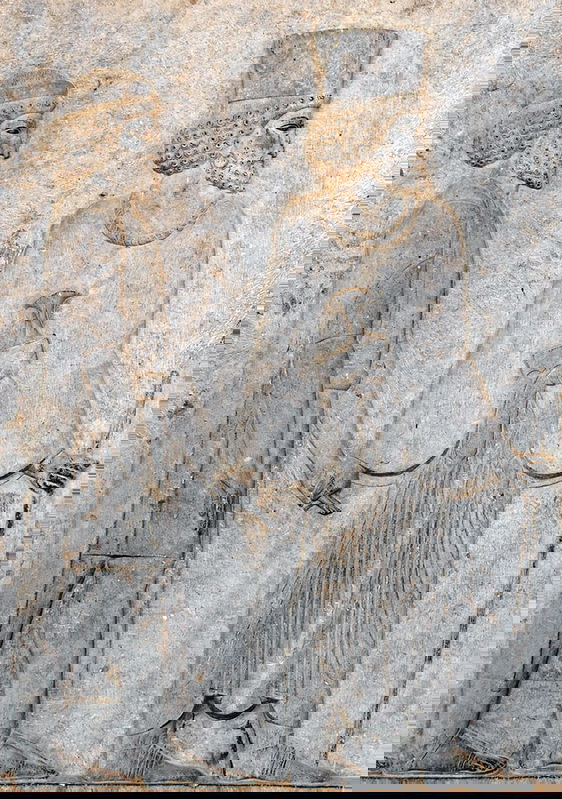
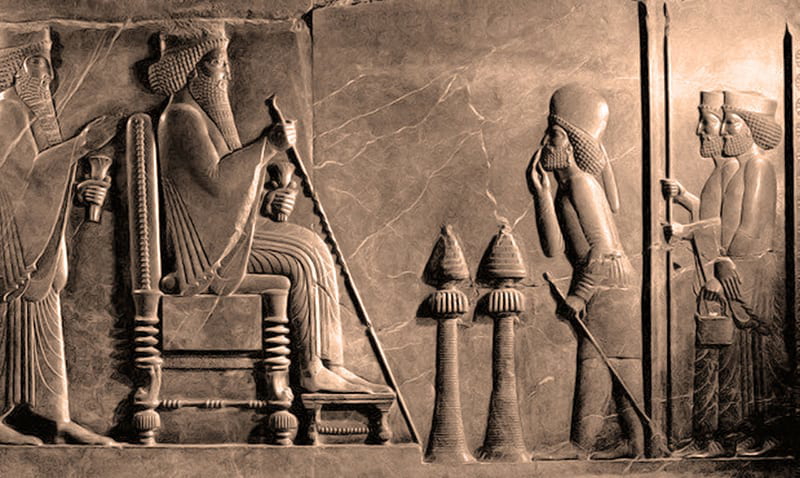
Somewhat unique to ancient kingdoms is the tolerance of the Persian king and empire reflected in those images of the monarchy. Where Greek and Roman art often shows their leaders crushing surrounding nations, the Persian courtiers are shown leading them by the hand to come before Darius. It was a powerful piece of propaganda for all those who entered the halls, but also largely true. Having been violently subjugated by the Assyrians, Cyrus worked to build an empire that would integrate its conquered nations and remain respectful of their cultures and religions.
As we turn our gaze to a history of religious policies of the Achaemenids. The Achaemenid rulers were Zoroastrian, but they were extremely tolerant of other religions in their Empire and even contributed to building of temples and gave special privileges to priesthoods.#12b On cylinder inscriptions; Cyrus records “I gave daily care to his (Marduk’s) work”.12c Cyrus rebuilt the temple of Marduk; Cyrus and Darius both let the Jews deduct rebuilding cost of the Jerusalem Temple from their taxes. Cambyses was no less tolerant.” He and Darius both partook in a ceremony; called “seizing the hands of Marduk” at the statue of Bel-Marduk in Esagila, which entitled them in the eyes of the Babylonians to bear the title “king of Babylon.”
A Third line of evidence: is what is known as cuneiform tablet BM 65494 taken from the British Museum. It is a business document from Borsippa dated to the 50th year of Artaxerxes I.
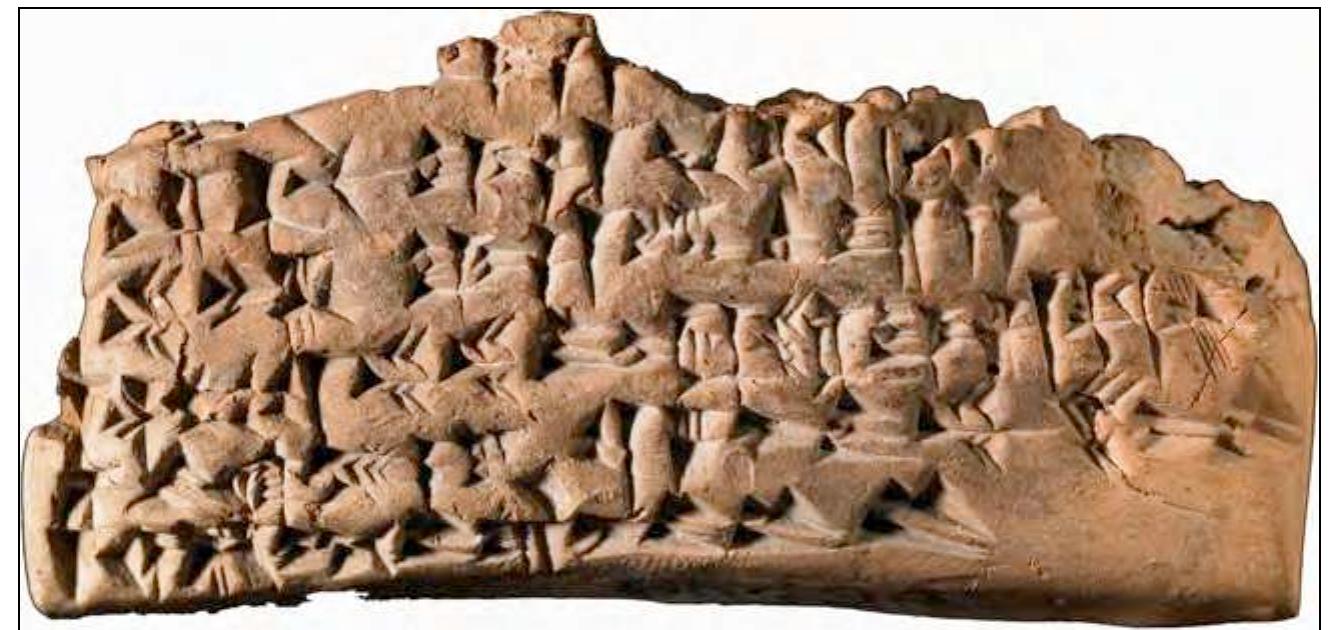
Tablet BM 65494 dated 4/V1/50 of Artaxerxes I –Stolper reconstituted the prosopography of Murashu’s family and has dated it according to the accepted chronology’*’. 13a
In the 2nd graphic provided, the number 50 is written in Akkadian language found is in the lower right corner of the tablet to find it. The final picture below is the Akkadian numerical system, shows how they would write the number 50, which exactly matches this cuneiform tablet, above.#14

This shows robust archaeological evidence of Artaxerxes’ reign exceeded 41 years. And that the 51st year of Artaxerxes was 424 BC, making his first regnal year 474 BC, and not 465 BC as some of Christendom’s secular scholars would have us believe.
Fourth line of evidence: Archbishop James Usher in his book entitled the “Annals of the World“, published back in 1650 AD, made these paraphrased statements “In the year 455 BC, that was the 20th year of Artaxerxes I, when Nehemiah requested to obtain permission from the king to be the governor of Judah and to rebuild Jerusalem (Nehemiah 2:1-6). This event marks the start of Daniel’s 70 weeks.” #15
These four, powerful lines of evidence, show a correct date to the beginning of Artaxerxes reign, and how we may unlock a secret to the start date of Daniel 9:24-27. Many thanks to Ernst Hengstenberg for his work published in 1847, and James Ussher for his book published in the year 1650AD. I’m also thankful to the British Museum for providing the cuneiform tablet BM 65494, and finally the headquarters staff at Jehovah’s Witnesses (WTBTS) for their help in grasping the regnal year start of King Artaxerxes I’ in 474 B.C., with his 20th year as 455 BC.
The last Year of Xerxes and the 1st Year of Artaxerxes
As we have seen throughout the reigns involved here; regnal-year numbers in the Egyptian calendar are known from astronomically fixed reckoning of Ptolemy’s Canon and synchronisms of several double-dated papyri. It is also known in the Persian calendar from the Saros list, based on the 18-year Saros cycle. #16
ACCESSION OF ARTAXERXES I
Figure 2. Xerxes and Artaxerxes in Three Calendars
The regnal years of Xerxes (shortened in this drawing by an 18-year gap of the Saros cycle) and the early years of Artaxerxes are shown as reckoned (1) In the Egyptian calendar (with years beginning in December), (2) in the Persian calendar (with years beginning in the spring), and (3) in the Jewish calendar (with years beginning in the autumn), all three aligned against the back-ground of the BC years.
The Saros list is extant on two clay tablets containing a series of regnal years at eighteen-year intervals based on a Babylonian Eclipse cycle (published by J. N. Strassmaier in reports in ZA, VII [~Sgz], zoo, 201; VIII [1893], 106). #17 Starting with the 7th year of Nabonidus, this list includes the year of Xerxes and the years 6 and 24 of Artaxerxes.
A SCIENTIFIC APPROACH TO AN ABSOLUTE CHRONOLOGY THROUGH SYNCHRONISMS DATED BY ASTRONOMY
The death of Xerxes is dated, at the present time, in 465 BC. This date comes mainly from the official Babylonian chronology, however, the testimony of Thucydides and from some Elephantine Egyptian records support dating of 475 BC. A careful chronological analysis of Babylonian astronomical tablets allows a fixing of a precise date of Xerxes’ death on August 24th, 475 BC. An official Babylonian chronology is based on the tablet BM 34576 (King List copy dated 99 BC). #18
Likewise, the death of Artaxerxes I is fixed precisely by Thucydides (The Peloponnesian War IV:50-52) just before a partial Solar Eclipse (21 March 424 BC) which implies absurd co-regency of Darius II with a dead king for at least one year! The arrangement of the intercalary months in a chronology without co-regency has several anomalies especially the presence of two months Ulul in a single cycle. By contrast, in a chronology with co-regency, and two distinct cycles, the abnormal intercalary month in year 30 of Darius (Persepolis) links to another cycle ending in year 4 of Xerxes. The titulature of Xerxes I (496-475) in Egypt and data of Diodorus confirm a Co-regency of 10 years with Darius-1 (522-486), with Elephantine papyri and many double dates with civil and lunar calendars. #19
A popular date of Xerxes 1′ death in 465 BC by mainstream historians, comes mainly from the official Babylonian chronology, recorded in the King’s List such as the tablet BM 34576 (copy dated 99 BC) 1 , but a witness of Thucydides support the dating in 475 BC, added to this, careful chronological analysis of Babylonian astronomical Tablets allows a fixing of a precise date of Xerxes’ death on August 24 in 475 BC. Why do mainstream historians prefer to rely on the Babylonian royal lists to establish the Achaemenid chronology, rather than on evidence from Greek historians who clearly mention several usurper kings and co-regencies?#20
We can agree that the Book of Esther has a historical setting in the reign of Darius, replete with details of Persian court life. A purpose of this study, while not denying romantic and ritual elements and a complicated blend of of history and religion, is a return to search for historical material, aligned with an Astronomical Chronology especially in Darius/Xerxes‘ reigns, with solid links to the Book of Esther, and a Bible Chronology. A good starting place may be the historical seed in the Book of Esther with religious policies of King Darius I, in whose reign events of the book are set, as his decree singled out the Jews as a religious-ethnic group in Persia for destruction, albeit fomented by Haman.
An initial question to be answered is the Jewish seed of Mordecai and Esther. The Jewish name ‘Mordechai‘ is found on multiple occasions in the Bible. #21 The name “Mordecai“ shows on a list of Jews who returned to Jerusalem with Zerubbabel (Ezra 2:2, Neh. 7:7). 2 Now these are the people of the province who returned from Babylonian captivity, of those carried away, by the king of Babylon–Nebuchadnezzar, who returned to Jerusalem & Judah, all to their own city. 2 Those who returned with Zerubbabel: Jeshua; [a man of Pahath-moab with Zerubbabel [Ez. 2:6], Nehemiah, [Neh. 7:7] Seraiah, [1Chron. 6:13-4] Reelaiah, Bilshan, Mordecai, known by some as finance officer at Susa under Darius 1. [Est. 2:7] [c]Mispar, Bigvai, [d]Rehum, [Ez. 4:8] and Baanah, numbered among the men of the people of Israel: The name Mordecai, listed in Aramaic; see G. R. Driver, Aramaic Documents of the Fifth Century BC. (Oxford 1957) 20 n. 2. It also occurs in the Treasury Tablets from Persepolis;
G.G. Cameron, Persepolis Treasury Tablets (Chicago 1948) 85; also found in an undated text, probably from the end of Darius’ reign or the beginning of Xerxes I, an official’s name, perhaps an accountant/scribe, on tour from Susa; #22
There is no other “Mordecai” in the Bible, and every leader on the list of exiles who returned ie; (Zerubbabel the son of Shetiel of royal blood, Jeshua the high priest, Nehemiah the cup-bearer to the king of Persia, Seraiah the son of a former high priest Hilkiah, etc.) all are VIP‘s! These events occuring next in Nehemiah, happen AFTER the book of Esther, when Nehemiah “is governor” (Neh 8:9), who likely became governor by Mordecai, the Grand Vizier. #22a
Ezra came to Judea in the seventh year of King Xerxes, in 479 BC. We are now referring to the 20th year of king Artaxerxes, and with the death of Xerxes in 475BC and the accession year of Artaxerxes in 474 BC-makes it 455 BC. For we have not an innumerable multitude of books among us, in disagreement or contradicting one another: [as the Greeks have:] but only twenty two books: which contain the records of all the past times: which are justly believed to be divine. (Josephus, Against Apion, 1.9) #22b
Josephus goes on to explain the division & categories of the Hebrew OT books:
And of them five belong to Moses: which contain his laws, and the traditions of the origin of mankind, till his death. This interval of time was little short of three thousand years. But as to the time from the death of Moses, till the reign of Artaxerxes, King of Persia, who reigned after Xerxes, the Prophets, who were after Moses, wrote down what was done in their times, in thirteen books. The remaining four books contain hymns to God; and precepts for the conduct of human life. (Josephus, Against Apion, 1.9) #22c
Josephus continues to explain the CHRONOLOGY of when these were written:
’Tis true, our history hath been written since Artaxerxes very particularly; but hath not been esteemed of the like authority with the former by our forefathers; because there hath not been an exact succession of Prophets since that time. And how firmly we have given credit to these books of our own nation, is evident by what we do. For during so many ages having already passed, no one has been so bold, as either to add any thing to them; to take any thing from them; or to make any change in them. But it is become natural to all Jews, immediately, and from their very birth, to esteem these books to contain divine doctrines; and to persist in them: and, if occasion be, willingly to die for them. (Josephus, Against Apion, 1.9) #22d
The extra books he is talking about are what we would call the “apocrypha.” These include the books of Enoch, Maccabees, Tobit, and many others. However, the last “succession of Prophets since that time” ends in Artaxerxes reign, who is Malachi. And so THAT is the chronology of the last parts of the Old Testament.
As there are 39 books in our Old Testament Bibles, why does Josephus refer to only 22 books? This is due to the OT scrolls not dividing 1 and 2 Samuel, 1 and 2 Kings, 1 and 2 Chronicles, Ezra and Nehemiah, Jeremiah and Lamentations, or any of the minor prophets (Amos to Malachi) into separate books. This means the books that Josephus is talking about are the following: #22e
- Genesis 2. Exodus 3. Leviticus 4. Numbers 5. Deuteronomy 6. Joshua 7. Judges 8. Ruth 9. Samuel 10. Kings 11. Chronicles 12. Ezra/Nehemiah/Esther 13. Job
14. Psalms 15. Proverbs 16. Ecclesiastes 17. Song of Songs 18. Isaiah 19. Jeremiah/Lamentations 20. Ezekiel 21. Daniel 22. Amos to Malachi-Prophets
This Biblical Chronology provides a superstructure upon which to build our history on much more reliable sources than the testimony of contradictory historians, whose witness however, is valued in agreement with a Biblical Chronology. To return now to a chronology of the Greco-Persian wars;
In 499 BC, the tyrant of Miletus, Aristagoras, incited Hellenic Asia Minor into rebellion against the Persians. This opened an Ionian Revolt, that lasted until 493 BC, progressively drawing more regions of Asia Minor into the conflict.
Aristagoras got military support from Athens & Eretria, and in 498 BC these forces captured the Persian regional capital of Sardis. The Persian king Darius the Great vowed revenge on Athens and Eretria for this. His 492 BC Persian invasion of Greece, as Persian General Mardonius successfully re-subjugated Thrace & Macedon before several mishaps forced an early end to the rest of his campaign.[3] Darius then began raising a huge new army with designs to subjugate Greece; but, in 486 BC, his Egyptian subjects revolted, delaying any Greek expedition. After Darius died, his son Xerxes I restarted preparations for a second invasion of Greece, that finally began in 480 BC.#23
In 480 BC, the Persian King led a large army across the Hellespont into Europe, winning military victories at Thermopylae & Artemisium before their defeat & razing of Athens. His forces got control of mainland Greece-north of the Corinthian Isthmus till they were defeated at the Battle of Salamis. Fearing the Greeks might trap him in Europe, Xerxes I retreated with a greater part of his army back to Asia, leaving behind Mardonius to continue his campaign.
Achaemenid king killing a Greek hoplite. Impression from a cylinder seal, sculpted c. 500–475 BC, at the time of Darius I Metropolitan Museum of Art.#23a

At the Battle of Thermopylae, a small force of Greek warriors led by King Leonidas of Sparta resisted much larger Persian forces, but were ultimately defeated. Via Herodotus, the Persians broke the Spartan phalanx after a Greek man called Ephialtes betrayed his country by telling the Persians of another pass around the mountains.
In 480 BC, following the Battle of Thermopylae, all of Boeotia fell to the Persian army. Thespiae and Plataea, the two Greek cities that resisted Darius I, were captured and subsequently razed, as a surviving Athenian population evacuated, by the Greek fleet, to Salamis. [1]
After Thermopylae, Athens was captured. Most of the Athenians abandoned the city, fled to the island of Salamis before Xerxes‘ arrived. Xerxes I ordered the Destruction of Athens, leaving an archaeologically intact destruction layer, called “Persian debris.”
The following Charts for Repeating-Matching Eclipse Tetrads in 2024 AD with 480 BC, show how our current Eclipse decade of 2024-2034 match the ancient Eclipses of Darius/Xerxes I, open in 480-479 BC. They also match the 3 Blood Moon Purim Eclipses to open the Purim Holiday for Israel in Persia under Queen Esther and Mordecai. Considering Darius I’/Xerxes military history aligned with this key eclipse period, we can gain a more complete image and impression not only of Modern Persia, reflected in today’s Iran, but also a spiritual perspective of the building of the Wall & Temple of Jerusalem, and perhaps even the Coming building of a Third Temple, that the Jewish Temple Institute stands ready to enact.
| Comparison Chart #1 of Repeating Eclipse Tetrads 2024 AD with 480 BC.#24 | ||||
| Eclipse Date | AD | Sun/Moon | Eclipse Date | BC |
| 3/25/2024 | AD | Lunar | 3/25/480 | BC |
| 4/08/2024 | AD Total | Solar | 4/09/480 | BC Total |
| 9/18/2024 | AD | Lunar | 9/18/480 | BC |
| 10/2/2024 | AD Annular | Solar | 10/2/480 | BC Annular |
Battles of Salamis and Plataea
The Battle of Salamis (26-27th Sept. 480 BC) won by the Greek fleet, followed Xerses I setting up a winter camp in Thessaly. [The history of April 8th/ Sept. 18th/ Oct. 2nd, 480 BC, eclipses, is mirrored in Chart 1 above.]
The Persian active military campaign against the Greeks initiated a battle in Salamis, fought in the straits between the mainland and Salamis, an island in Saronic Gulf near Athens, marked a high point of the 2nd Persian invasion of Greece, arguably the largest naval battle of the ancient world, marking a turning point in the invasion.[8]
According to Thucydides: Themistocles manifested a desire to visit the king of Persia (…) The storm caused the vessel to drift towards the Athenians camp who then besieged Naxos (…) Guided by a Persian coast, then he penetrated into the interior of the country and sent to Artaxerxes, who had succeeded Xerxes, his father a letter (The Peloponnesian War I:98;137). Therefore, he reports the fall
of Naxos after the one of Skyros dated at the beginning of the archonship of Phaedo in –476BC, according to Plutarch.#24a This, meeting with Themistocles would have occurred soon after 475/474BC. Furthermore, Themistocles died under the archon of Praxiergos (in –471BC) according to Diodorus Siculus (Historical Library XI:54-60), and Herodotus situated the transfer of power from Darius to Xerxes at the time of the revolt of Egypt, four years after Marathon, or –486, #24b and the change Xerxes/Artaxerxes shortly after the storming of Eion [dated –476 BC], last event of reign of Xerxes.#24c. Though heavily out-numbered the Greeks persuaded by Themistocles returning the Persian fleet to battle, hoping victory might prevent naval advance against the Peloponnese. The Persians were also eager for a decisive battle. So, the Persian navy rowed into the Straits of Salamis in an effort to block both entrances. But in the cramped waters, the great Persian numbers proved a detriment, as ships struggled to maneuver, becoming disorganized. To sieze the opportunity the Greek fleet formed in line to win a victory. The Naval battle as the Repeating-Matching Eclipses in Chart 1 above, reflects modern Iran’s attempt to control the oil traffic via straits of Hormuz, and loosing their entire Navy in the process.
The majority of the Persian army retreated to Asia, leaving Mardonius to complete the conquest of Greece. The following year the remainder of the Persian army was defeated at the Battle of Plataea and the Persian navy at a Battle of Mycale. The Persian ships were then captured and burned. The complete destruction of the Persian navy, along with the destruction of Mardonius’ army at Plataea, decisively ended the invasion of Greece. After Plataea and Mycale, the Greeks went on the offensive against the Persians, marking a new phase of Greco-Persian Wars. The Persians made no further attempts to conquer Greece, as the battles of Salamis & Plataea marked a turning point in the course of the Greco-Persian Wars. The Greco-Persian wars were a series of conflicts between Achaemenid Empire and Greek city-states starting in 499 BC[i] and lasted until 449 BC. This near 50-year period of conflict reflects a near 50 years of conflict between US/Israeli’s vs. Iran today. The historical reflection of ancient and modern Iran pointed out above is mirrored by astronomical activity typical in these periods in ancient Persia and modern Iran, in Repeating Purim Blood Moon Eclipses.
The last time there was a set of Triple Lunar Eclipses on Purim, before the current triad of 2024-26; and 480 BC–2500 years ago, was from 1978-1980; as the radical Islamic revolution and terrorist regime in Iran first took power! It’s interesting that one Total Lunar Eclipse on 3/24/1978 and two Eclipses in 1979 & 3/1/80 match Purim dates 3/13/1979 with a 3/14/2025 Lunar Eclipse in Chart #2 below with Summer Lunar Eclipse of 9/6/1979 with 9/7/2025 and 479 BC! This serves to foreshadow the Purim events of 2024-2026! After a March 1979 Islamic Republic referendum, with 98% approval- a shift to an Islamic republic, the terrorist radical regime has been in power nearly 50 years.
Xerxes left a contingent in Greece to finish the campaign under Mardonius, who according to Herodotus suggested the retreat in the first place. This force was defeated in the next year-479 BC; [See March 14/29th-9/7 Eclipses in 479BC in Chart 2 below, the following year at Plataea by the Allied forces of Greek city-states, ended the Persian invasion of Greece for good.
| Comparison Chart#2 for Repeating Eclipse Tetrads 2025 AD with 479 BC#25 | ||||
| Eclipse Date | Eclipse type | Sun/Moon | Eclipse Date | Saros# |
| 3/14/2025 AD | Partial | Lunar | 3/14/479 BC | 34 |
| 3/29/2025 AD | Total | Solar | 3/29/479 BC | 60 |
| 9/07/2025 AD | Partial | Lunar | 9/07/479 BC | 39 |
| 9/21/2025 AD | Annular | Solar | 9/21/479 BC | 65 |
In Book 7.37, Herodotus describes the movements of the Persian forces as they gathered to invade Greece in 480 BC. The King wrote what follows: “At the start of its journey, the sun left its seat in the heavens, disappeared and although the sky had been especially clear and cloudless, day now eclipsed into night.”#26 Xerxes himself observing this, was concerned. He asked his Magi of the Zoroastrian’s-the portent’s import. They said “the god showed the Hellenes in advance and they left their cities, as the sun prophesied for the Hellenes, but for the Persians it was the moon.” This speaks to Purim’s 3 Blood Moon Lunar eclipses in a row, related to the import of their linked Soli–Lunar Eclipses in 480-478BC matched with today’s repeating eclipses in 2024-2026 AD, in context of the current US/Israeli war with Iran!
In addition, the only Solar Eclipses that fit Xerxes’ description in 480BC are the 4/09/480BC Total Solar and the 10/2/480BC Annular Solar Eclipses. In 479BC only the 3/29/479BC Total Solar and the 9/21/479BC Annular Solar Eclipses fit the bill of “day now eclipsing into night.” [see Chart #1 above]
The editors of the Landmark Edition of Herodotus provide a footnote here explaining that “this purported eclipse cannot be verified by astronomical calculations.”27 Historians have argued about this for centuries– in an article published in “The Observatory” in 1884, W.T. Lynn noted that the issue might be the dates given by Herodotus. While the article finds no Solar Eclipse evidence visible in Asia Minor/Anatolia in 480BC, it appears Solar Eclipses took place in 481 & 478 BC.”#28 However, the dates given here for both Lunar and Solar Eclipses obviously verified by NASA’s Five Millennium Canon of Eclipses and other modern resources, hold Eclipse records are proven to have happened in 480-478BC- the Repeating-Matching Eclipses renewed in [2024-2026 AD].#29
Based on scholarly & historical sources, we can confirm what was previously may not be visible; for unknown causes. These dates not only match Esther’s reign with Darius I/Xerxes as he readied his forces to attack Greece, but also draws unique reflection to our current decade of Repeating-Matched eclipses. Below the example is found cited above as “Xerxes’ Eclipse…“
Xerxes’ Eclipse– Note
“…while he was offering sacrifice to know if he should march out against the Greeks, the sun was suddenly darkened in mid-sky…“
– History, IX, 10, Herodotus #30
The fact that Xerxes, while offering sacrifice to the monotheistic god Ahura–Mazda of the Persian–Zoroastrian Religion of the Biblical Magi, was able to consult the Magi in his Army on the meaning of this eclipse, is striking in light of their wisdom revealing Celestial signs of Christ’s birth with the Repeating signs circa 480-469 BC/2024-2034 AD. In 481 BC, as part of Xerxes 1‘ lead-up for the 2nd invasion of Greece in Greco-Persian Wars, the Xerxes Canal dug via an isthmus of Mount Athos peninsula, had provisions stored on Thracian road, & 2 pontoon bridges, later known as Xerxes‘ Pontoon Bridges were built across the Hellespont. This is noteworthy, as of the few monuments left by the Persian Empire in Europe.[1]
Histories of ancient Greek historian Herodotus, recounts the events of the Greco-Persian Wars, the Persian commander Mardonius, in 492 BC, lost a great part of his fleet, 300 ships & 720,000 men, in a storm going around the cliffs of the Athos peninsula, during the First Persian invasion of Greece.[2]
Xerxes, in preparation for the Second Persian invasion of Greece, in 483 BC had a channel built through the Athos isthmus in order to avoid falling prey to the similar disaster. According to other astronomical tablet notations BM 32234, Xerxes I’ death- dated 14/V/21 between 2 Lunar Eclipses, one dated 14/III/21
6/25/475 BC, that was partial, and the 2nd dated 14/VIII/21 [12/20/475BC] was total, dates the death of Xerxes I-on 24 August 475 BC. [see Chart #3 below]
Comparison Chart#3 for Repeating Eclipse Tetrads 2029 AD with 475 BC#30a
| Eclipse Date | Sources | Saros | Sun/Moon | Eclipse Date | Source | Saros |
| 1/14/29 AD | T&D/Nasa | 151 | Partial Solar | 1/14/475 BC | ||
| 4/13/2029 AD | Apophis | 99942 | Asteroid flyby | |||
| 6/12/29 AD | T&D/Nasa | 118 | Partial Solar | 6/12/475 BC | ||
| 6/25-6/29 AD | T&D/Nasa | 130 | Partial Lunar | 6/26/475 BC | LBAT | 51 |
| 7/11/29 AD | T&D/Nasa | 156 | Partial Solar | 7/11/475 BC | ||
| 12/6/29 AD | T&D/Nasa | 123 | Partial Solar | 12/6/475 BC | ||
| 12/20/29 AD | T&D/Nasa | 135 | Total Lunar | 12/20/475 BC | LBAT | 56 |
Haman’s intended Genocide for the Jews is mirrored in today’s modern Iran. As Haman intended Genocide for the Jews, so modern Hamas terrorists show a similar hatred for Israel, seen in their October 7th atrocities. We also find a reflection of the reversal that Haman brought on himself, being hung with his 10 sons on the very gallows he made to hang Mordecai! [Est. 8:1-8]. In the Iran of today– Ayatollah Ali Khameni and his 10 top leaders met their final ruin on Saturday–Feb. 28th, “Sabbath of Remembrance“-3 days before a 3rd [2024-2026] Blood Moon Purim Eclipse 3/3/2026–in a row, on the Jews annual victory bash recalling Haman’s demise! As we consider this Purim Eclipse culminated at maximum on 3/3/2026 @ 3:33am (PST), we note many Bible references to the number “3” linking God’s descent in a cloud, (Ex. 19:9–11; John 2:1; weddings, and 1 Cor. 15:4 with resurrection, all of which denote “spiritual completion,” as a spiritual symbol for the number 3. #31
Part of the Purim celebration includes a Torah Reading in Jewish Synagouges of Haman being blotted out, [1 Sam. 15:2 -3] as Khameni and his leaders, were bombed out by Israeli/US forces. Iran has been busy developing the Nuclear bomb to bring “death to America and Israel” for decades, but were themselves Bombed into submission on this day! As Haman & his Sons had their gallows, so Khamanei & his sons got their bomb. As Haman rose so many generations after Amalek’s fall, so Khamanei pursued so many generations after Haman, but our Lord recalls the ancient battle vs. the seed of evil, [Gen. 3:15] as the Almighty wrote it in the Sun, Moon & Stars in Repeating-Matching Eclipses of our day in the current Purim Lunar Eclipses!
The February 28th –“Sabbath of Remembrance“ recalls Exod. 17:8-16 Amalek in a battle with Israel at Rephidim. In 1 Samuel 15:2 the Lord recalls Amalek and his actions against Israel, how he laid wait for him in the way [#1870] as Israel came up from Egypt. It’s no coincidence that Ali Khameni met a demise on this Sabbath of Remembrance, so near the 3/3/26-3rd Purim Blood Moon in a row! This aligns with God’s Promise in Ex. 17:14 below that; “I will utterly blot out the remembrance of Amalek from under heaven.”
Ali Khameni-as a notorious ruler since 1989, having recently massacred 40K+ of his own Iranian people, while sponsoring the likes of Hamas and terrorist proxies, Hezzbollah with other Palestinian groups vs. the US and Israel. Not only do we find the link to a Sabbath of Remembrance, but we too find dates Matched- to Repeating 3/3/478 BC Purim Lunar Eclipses, on the same March 3rd date with another Lunar Eclipse in 478BC, during Esther’s reign with Ahaseraus/& Mordecai! The Purim feast is a permanent yearly notice and celebration of Israel’s victory and Freedom from Haman’s Genocide, evident in history. It’s also a main reason for these Repeating, Matching dates seen in current events of 3/3/2026 Purim Lunar Eclipse, with the signs of Repeating-Matched dates of a decade of Luni-Solar Eclipses from 480-478BC to 469 BC.
Exodus 17:14-16 14 Then the Lord said to Moses, “Write this for a memorial; [#2146-to pierce, invoke in memory]#32 in the book and recount it in hearing
of Joshua, that I will utterly blot out the remembrance of Amalek from under heaven.” 15 And Moses built an altar and called its name, [f]The-Lord-Is-My-Banner; 16 for he said, “Because the Lord has sworn: the Lord will have war with Amalek from generation to generation.”
The generations of Amalek from Agag and Esau in 1 Samuel 15:2-3, we find Haman the son of Hammedatha the Agagite, [Est. 3:1], shows a priority in God’s Mind concerning Israel’s generational enemies, with a low ranking of Amalek’s seed, so “the Lord desired war with Amalek.” As God looks on the heart of Men, there can be no better Judge of mankind than Almighty God. [Est. 3:1], shows Haman in Hebrew; (the Agagite) is named pouyaooq, but ‘Agagite‘ means descendent of Agag, king of the Agagites, first, for the Jewish readers of Esther, evidenced by Josephus, in the Talmud and the Targums, took Agagite as implacable enemies of Israel, that they proved to be. Lewy found in Esther 3:6 a verse where Haman’s plot to destroy Mordecai and all Jews in the kingdom of Ahasuerus, the genocide of “the people of Mordecai.” Thus Greek translators of Esther modernized an old term “Agagite“ into pouyaooq, as a meaningful form for Greek speaking Jews. #33
The Book of Esther is set in the reign of Darius/Xerxes as heavily committed to Zoroastrianism of an orthodox variety. There was a temple of Ishtar and certainly worshippers of Marduk in Susa at this time. We agree the religious persecution referred to in the Book of Esther originally was not Persians vs. Jews, but only Haman’s Agagite hatred of the Jews, as they lay in wait for Israel coming out of Egypt, in Exodus 17.
Thus, We have not yet heard the end of God’s Judgment on Agag!
In Elephantine Papyri, and inscriptions from Persepolis, devotees of Ahura-Mazda are referred to as “worshippers of Mazda.” This logic seems to fail as for the Zoroastrian Magi “Ahura-Mazda” was a monotheistic God like that of Hebrew Jehovah, not like the idolatrous Mithraic gods or Egyptian trinities, many times seen as Sol/Ra; the Sun-god, Luna-mistress of the Moon, & Saturn, who-often is seen passing a dagger or short sword to Mithras, in ancient icon-ography of Bull sacrifice.
It also occurs in the Treasury Tablets in Persepolis;
17 Although many biblical critics and scholars from antiquity argued that Esther and Mordecai are merely theophoros names and represent secular names, much as Jews in Daniel 1:6-7 had Jewish and Babylonian names [see Moore, op. cit., 19],#34 the collocation of the names Esther and Mordecai, the names of a Babylonian god and goddess, [Marduk & Ishtar] as close cousins and skewed images in the Babylonian pantheon myths, even as Esther and Mordecai were cousins in their family at Persian Court.
In summary, I find the history of the Greco-Persian Wars a fascinating aspect of both a Historical and Astronomical record, as they relate to Bible History. The times of ancient Persia and Greece represent a key period of prophecy in the Book of Daniel, related to Nebuchadrezzar’s Dream Statue and the kingdoms of history. Even more, an overlap of this period with Repeating-Matching Eclipses of 480-469BC as they match with our current decade, speaks volumes in light of current events, prophecy and ancient history. I invite all comments and feed-back as these topics are open for discussion on my Biblical Astronomy Fellowship page in the Facebook forum.
God Bless!
Rene’
Footnotes
1. E.W. Bullinger’s Companion Bible for Ezra 4:1-6:22, p. 623.
2. Ren Manetti’s Notes on Ahasuerus & Artaxerxes–OT History Class.
2a. “Post-exilic Bible Chronology that Identifies Esther’s Husband.” J. Nessle
2b. https://www.biblechronologytimeline.com/biblechronologytimeline5b.html
2c. https://biblestudentarchives.com/documents/Artaxerxes20thYear.pdf
3. Herodotus, Histories 3.91.
3a. E.W. Bullinger’s Companion Bible for Ezra 6:15-22.
3b. https://en.wikipedia.org/wiki/List_of_monarchs_of_Iran
4. Ren Manetti’s Notes on Dan. 11:1-19 from OT History Class.
5. Ren Manetti’s Notes on Dan. 11:2 from OT History Class.
6. E.W. Bullinger’s Companion Bible, App. 57 ppg. 80-81.
7. Analysis of the Prophecies of Daniel at the Hope “Mini-Summit” in Tampa, Fl, Rev. Jon Nessle
7b. Plutarch (Life of Theseus §§35,36)
8. Intercalations during the co-regency of Xerxes with Darius I, in NABU 2020-4, pp. 273-279. By Gerard GERTOUX
9. https://biblestudentarchives.com/documents/Artaxerxes20thYear.pdf
9a. https://www.academia.edu/2421036/Dating_the_reigns_of_Xerxes_and_Artaxerxes
10. Analysis of the Prophecies of Daniel at The Hope “Mini-Summit” in Tampa, Fl, Rev. Jon Nessle
11. IBID
11a. https://biblestudentarchives.com/documents/Artaxerxes20thYear.pdf
11b. IBID
12. Christology of the Old Testament; 1999 printing, p. 197 Ernst Hengstenberg
12a. Fig. 1 picture credit, [https://www.thecollector.com/fascinating-facts-from-the-bas-reliefs-of-persepolis/]
12b. Cyrus Cylinder
12c. Ibid
13. A bas relief from Persepolis, in the Insight Book Vol II page 615 entitled “Evidence from Persian sources“ in the Archaeological Museum of Tehran.
13a. Tablet BM 65494 dated 4/V1/50 of Artaxerxes I –Stolper
14. Akkadian numerical system shows how to wrote the #50, that exact match.[https://www.academia.edu/99055324/_King_Artaxerxes_475_BCE_or_465_BCE_ And_the_seventy_weeks_of_years_]
15. “Annals of the World,” by Archbishop James Usher book published 1650 AD.
16. Horn and Wood, op. cit., pp. 14-16, 20; Thiele, 09. cit., pp. 28-31.
17. J. N. Strassmaier in reports in ZA, VII [~Sgz], zoo, 201; VIII [1893], 106).
18. Babylonian chronology based on tablet BM 34576 (King List dated 99 BC)
19. [https://www.researchgate.net/publication/312069819_Dating_the_reigns_of_Xerxes_and_Artaxerxes] Data of Diodorus confirm a Co-regency of 10 years with Darius (522-486), with Elephantine papyri.
20. King’s List from the tablet BM 34576 (copy dated 99 BC).
21. [see V. Ryssel, Zusdtzen zum Buch Esther (Tiibingen 1900) and L. B. Paton, A Critical and Exegetical Commentary on the Book of Esther, (New York I908) 51-54].
22. A. Ungnad, Keilin-schriftliche Beitrage zum Buch Esra und Ester,” ZAW 58 (I940-4I) 240-244 and addenda in ZA W 59 (1942-43).
22a. https://jcalebjones.com/2021/09/07/the-complete-chronology-of-ezra-nehemiah-and-esther-fully-explained/
22b. IBID
22c. IBID
22d. IBID
22e. IBID
https://en.wikipedia.org/wiki/Cyrus_the_Great
23. Impression from a cylinder seal, sculpted c. 500–475 BC, Metropolitan Museum of Art
24. Comparison Chart #1 of Repeating Eclipse Tetrads 2024 AD with 480 BC.
24a. [Life of Theseus §§35,36]
24b. [Diodorus Siculus’ Historical Library XI:54-60]
24c. Herodotus [The Histories VII :106-107]
25. Comparison Chart#2 for Repeating Eclipse Tetrads 2025 AD with 479 BC
26. Xerxes’ Eclipse, Book 7.37, Herodotus History, IX, 10,
27. Landmark Edition of Herodotus provide a footnote
28. The Observatory” in 1884, W.T. Lynn noted the dates given by Herodotus, as the article finds no Solar Eclipse evidence visible in Asia Minor/Anatolia in 480BC, it appears Solar Eclipses took place in 481 & 478 BC
29. NASA’s Five Millennium Canon of Eclipses, Time and date.com
30. [https://www.eclipsewise.com/extra/SEhistory.html#-479BC]
30a. NASA’s Five Millennium Canon of Eclipses, Timeanddate.com.
31. Number in Scripture, E. W. Bullinger on #3, ppg 107-122.
32. Strong’s Concordance [#2146-to pierce, invoke in memory] Ex. 17:14-16.
33. GG. Cameron, The Persepolis Treasury Tablets (Chicago 1948) 85; A. Ungnad, Keilinschriftliche Beitrage zum Buch Esra und Ester,” ZAW 58 (I940-4I) 240-244 and addenda in ZA W 59 (1942-43) 219. 16 Lewy, op. cit., 128 n. 14.
34. IBID, Moore, op. cit., 19
35. Certain Historical sections of this study were taken from Wikipedia where the links remain active for reference.
