King Cyrus God’s Anointed King

Welcome to the 2026 July Blog folks! This month’s study continues our work in the ancient Persian Empire, specifically with King’s Darius I, Artaxerxes I, & Xerxes 1, in their transitions of royal power. Our approach to the topic assumes
Queen Esther’s husband was Darius, due to Mordecai’s age, thus a goal of this study to find the identity of Xerxes’ wife, urges us to consider evidence from other views to complete a contextual view. First, we will lay a chronology for the end of Darius’ reign, opening to Xerxes’ rule. To align this chronology, we refer to a key period in history aligned with the co-regency of Xerxes 1 and Darius 1. A key reference to aid us in search of this co-regency we find by Gerard Gertoux, is related to the astronomical intercalations of this period:

Intercalations during the co-regency of Xerxes with Darius I has sparked a
chronological debate among Greek historians as to whether Xerxes died in 475 BC, according to Herodotus and Thucydides, or in 465 BC, according to the Babylonian royal lists, was decided by the famed Greek astronomer, Claudius Ptolemy, who published around 150 AD the Babylonian (and Achaemenid) chronology dated after the Nabonassar era, which began in 748 BC. Claudius Ptolemy converted all Babylonian dates into the Egyptian civil calendar, that allowed him to verify historical synchronisms with Egyptian chronology. He also verified accurately of some lunar eclipses found in astronomical tablets dated  in Year of the King (Almagest). A result of Ptolemy’s reliance on verifiablydated eclipses, all historians after 150 AD, without exception, adopted Babylonian chronology and modified the Greek chronology to bring it into line with this new absolute chronology of the Achaemenid period. The Babylonian chronology established by Claudius Ptolemy was confirmed by the BM 34576 tablet (copy of the King List dated 99 BC). A study of all tablets (contracts & inscriptions) dated during the period 626–331 BC was published (Parker, Dubberstein: 1956) and demonstrated that all durations of the Achaemenid period agreed with those of the Babylonian royal lists, providing several short co-regencies were admitted shortly before and during the enthronement of the new king.” #1

The accession of Xerxes in year 26 of Darius I (496 BC) occurred in a normal year, made his first year of
reign an intercalary year (in Babylon), but since Xerxes resided in Persepolis the Persian astronomical priests did not add   an intercalary month at year’s end (XIIb), they visibly began a new cycle of  intercalation from the 2nd year of Xerxes (2U), shifting Xerxes intercalation cycle, that began in Persepolis (Ossendrijver: 2018, 141), from that of Darius. The intercalation cycle began during the reign of Xerxes, continuing till the end of Artaxerxes I’ reign. #In our last 2 blog-studies we presented Eclipse evidence for the Death of Xerxes in 475BC from Gerard Gertoux. #3  We find in 475 BC the Moon was 20° behind Sagittarius, and in 465 BC it was in the sign Sagittarius. According to an astronomical tablet the 1st lunar eclipse [total] was: in Sagittarius 4 rear stars in [475 BC]. Thus, according to the astronomy, Xerxes died (14/V/21) on Wed. 23August 475 BC with his accession 21 years earlier in 496 BC, also Darius I’ Year 26. Despite Pierre Briant denying his coregency due to his ideology, he admits Xerxes was Crown Prince long before Darius‘ death, because if Xerxes became Crown Prince just before the death  of Darius, one would have to admit that this king waited a long time-till he was 72 years old in 486 BC#43/4, as Xerxes was 35 yrs old, when his parent’s union dated to Darius’ accession in 522 BC. Consequently, this chronology involves Xerxes’ choice before 490 BC. #44/5. In fact, Xerxes was both the crown prince and coregent, in a 10-year co-regency, with his accession from 496BC till the death of Darius in 486BC.

Alignment depends on Accession Date. The alignment of the Persian & Jewish years of Xerxes to any postdated reigndepends on whether the Persian or Jewish New Year came first after the accession. If Xerxes’ year 21 on a Persian Calendar was 465, his year 1 was 485 BC, from spring to spring; he must have come to the throne some time before that, since his “accession year was the part of his reign preceding his first full calendar year. The date of his accession can be determined some time in the preceding Nov. of 486BC, because the latest known tablet dated in his father-Darius last regnal year is in the 7th month, and was first dated in Xerxesreign in the 8th month (approx. Dec. 1). #38/6

After his accession in November, 486 BC, the first New Year’s Day to arrive was the Egyptian 1st of Thoth, in December (Fig. 2- I);#39/7. The Egyptian 1st year began, but those of his subjects who used the Babylonian-Persian calendar (band 2) would not begin to date by his year I until the next Nisanu I, the next Spring; and those who used the Jewish fall-to-fall; Tishri calendar (band 3) continued to date the accession year until their New Year’s Day came-next Tishri I, in the 7th monthalmost a year after his accession and half a year after the Persian year I had begun. (That’s why, in some of these papyri, the Dateline in 2 calendars can have 2 regnal year numbers.) So, in his reign,   any specific year of Xerxes from year I to year 21–began the earliest in the Egyptian calendar, then in a Persian calendar, and last in the Jew’s calendar. This demonstrated that the Jewish year 21, reckoned from Tishri I, must be 465BC.#7a.

As we see in the Book of [Esther 1:9-19, 2:4] Ahasuerusformer wife was Vashti. Yet, the Great Feast described in v. 3, the 3rd year of his reign as we learn from Persian inscriptions was held in preparation for the Persian expedition against Greece, after the death of Darius, who relinquished the title-Ahasuerus to his co-regent son Xerxesruling 485-465 BC, leading a vast Persian army against Greece c. 482-1 BC.#7b  He fought famed battles of Thermopalyae & Salamis in 480 BC, & married Esther in the 7th year of his reign [Est. 2:16-17], in 478 BC. #8 In a key Archaeological inscription from the Shushan Palace @ Susa-200 miles East of Babylon, capital of Elam & winter residence of Kings of Persia was a site identified by Loftus in 1852, where the record from Artaxerxes II [405-358 BC] says; “My ancestor Darius [521-485 BC] built this palace in former times. In the reign of my grandfather [Artaxerxes 1; 465-425 BC] it was burned. I have restored it.” This palace was the residence of Darius, who authorized the rebuilding of the Jerusalem Temple; of Xerxes as Esther’s husband; and
Artaxerxes 1, who authorized a restoration of Jerusalem by Nehemiah.” #8a

The location of this inscription was in the famed building in Susa called its “Apadana“, an audience hall of the Palace of DariusApadana-the word is only known from Susa – was built together with the palace by Darius I the Great (r522-486BC). This can be deduced from an inscription known as A2Sa,  written for Artaxerxes II Mnemon (r404-358), who finished a restoration of the complex after a great fire during the reign of his grandfatherArtaxerxes I Makrocheir (r465-424/423): The inscription below reads in part:

  “Artaxerxes, the great king, the king of kings, the king of all nations, the king of this world, the son of king Darius [II Nothus], Darius the son of Artaxerxes king [I Makrocheir], Artaxerxes the son of king Xerxes, Xerxes the son of king Darius, Darius the son of Hystaspes, the Achaemenid, says: my ancestor Darius I the Great, made the apadana, but during the reign of Artaxerxes my grand-father, it was burnt down; but, by the grace of Ahuramazda, Anahita, & Mithra,  I reconstructed the audience hall. So Ahuramazda, Anahita, & Mithra protect me against all evil, and may they never destroy or damage what I have built.” #8b

Susa, Apadana, Capital

Apadana
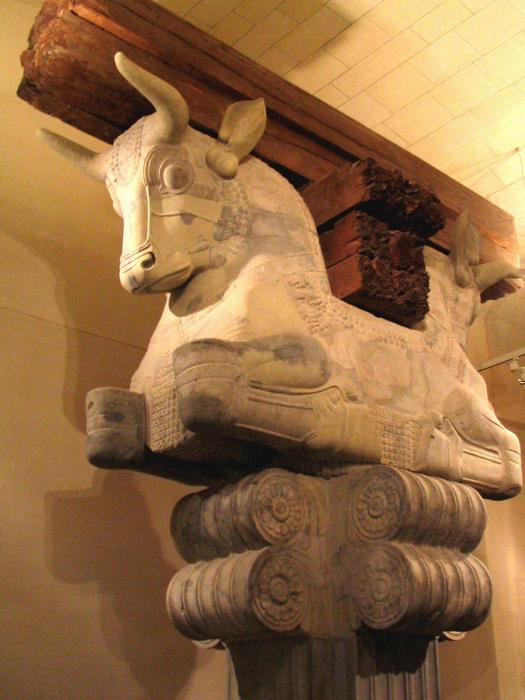
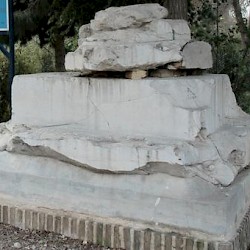
, site of the throne among the 36 column bases in the audience hall is a thirty-seventh foundation, in the exact center if one enters from the northern, main entrance. This must have been the place of the throne of the Achaemenid king. #8c The fact that there are no columns left to be erected, makes it hard to  imagine what a splendid building the Apadana was in Antiquity. Thus, only the column‘ bases are left in Susa today, as seen below;
A key Achaemenid Royal Inscriptions is the “daiva inscription“. The Old Persian text is known from three stone slabs from Persepolis & the Pasargadae citadel, (Elamite and Babylonian copies exist.) The interesting detail for which this text has become famous turns on a meaning of the word daiva, that clearly means “demon” and looks similar to the word daeva in the Avesta (Zoroastrian holy book). If daiva daeva agree, it makes it more likely the rebels lived in Iran, where the Zoroastrian religion held swayBut, if these words clash; daiva refers to idols of Babylon or Egypt.#8c1 As Xerxes adhered tAhura-mazda primary God of Zoroastrianism, who was the only other monotheistic God than Jehovah of Israel, not considered an idol or part of an idol pantheon, it seems logical that the Persian kings especially after King Cyrus, who himself was a Messianic figure with a Godly commission to lead people positively to the One true God-even as the PersianZoroastrian Magi did to Christ. With  this in mind we find this sentiment in other parts of the daiva inscription;

King Xerxes says: when I became king, there was among these countries one that was in rebellion. Ahuramazda bore me aid. By the grace of Ahuramazda,    I smote that country and put it down in its place. And among these countries there was a place where previously demons (daiva) were worshipped. After-wards, by the grace of Ahuramazda I destroyed that sanctuary of demons, &   I proclaimed: ‘The demons shall not be worshipped!Where previously the demons were worshipped, there I worshipped Ahuramazda at a proper time and manner. And the other business that had done ill, I made good. That which I did, all I did by the grace of Ahuramazda. Ahuramazda bore me aid until completed the work.” #8d

This line of Persian kings referred to after King Cyrus share same righteous motives with the kings of Israel like king David to further the worship of the true Monotheistic God, and cast down the false idols. This is established in Isa. 45:1 below where Cyrus is called Messiah-King Cyrus is exalted in Judaism for his role in freeing the Jewish people from the Babylonian captivity by issuing the Edict of Restoration following the Persian conquest of Babylon. This event is described in the Hebrew Bible as the return to Zion, whereby displaced Jews were repatriated to what had been the Kingdom of Judah, thus enabling the resurgence of Jewish sovereignty in the Land of Israel. King Cyrus also brings about Jewish aspirations for a new Temple in Jerusalem in the Achaemenid Empire’s province of Yehud, where Solomon’s Temple first stood before being destroyed during the Babylonian siege of Jerusalem. His efforts resulted in the completion of the Second Temple.#8e 

Daniel’s relationship with King Cyrus, would have not only made Daniel privy

to detailed plans to rebuild Jerusalem and the Temple, also how these blue-prints influenced other examples of ancient architecture in the cultures of the middle east. Daniel and his team of gifted and intelligent men were set  apart by first accurately revealing king Nebuchadnezzar’s dream, and then
interpreting it, gifting Daniel with a high position in the king’s royal court of Babylon, that included key governmental authority, where he was made chief over all wise menmagicians, and soothsayers, of Babylon. This was a key aspect of their story placing Daniel & his team in positions of influence
as many royal decrees that came down, not only from Nebuchadnezzar, but
many of the subsequent kings including Cyrus, during their lifetimes.

(Note: Daniel’s captivity in 605 BC unto 1917/1947 is 1260 + 1260 & 1260 + 1290 years plus a day/year or two, (Dan. 12Rev. 11-12). Jerusalem again fell in 586 BC, 19 years later, and thus the pattern repeats, this time to 1967a second witness!

Daniel’s knowledge of the Gospel in the Stars not only enlightened his view 
of the OT Prophecies of Christ, provided the key insight needed to teach the critical keys to the Zoroastrian Magi, whose Godly monotheistic religion also influenced King Cyrus, as one of the most enlightened leaders in history. As seen in the principles of the Cyrus Cylinder– his example of leadership was the first true model of diversity, that included successful rule over nations with different languages, belief systems and Religions. Since a number of
Persian Kings were of Zoroastrian Faith including Cyrus, this provided a source of religious tolerance exhibited in his rulershipCyrus’ influence in ruling conquered nations impacted many other historical kingdoms that  included the Roman Empire, who applied similar principles in like states. 
 
This speaks highly of how and why The Hand of the Almighty God dealt so graciously not only with this line of Persian kings but also with the class of Parthian/Zoroastrian Magi, instructed by the Prophet Daniel as followers of the path leading to Christs Birth, the ultimate anointed Son of God in 3BC. This too certifies a common God-acknowledged Source of ultimate spiritual authority regarding Jehovah & Ahuramazda both as One monotheistic God 

Biblically King Cyrus is recalled as a Messianic figure, [Isa. 45:1] called “His anointed-[4899-mashiyachrefers to a class of patriarchs, priests or kings– basis of Messiah/Christ-Christos G5547, 1Sam. 2:7-10, 2Sam. 22:51, Ps. 9:2-7, 18:50]” to open the gates of Babylon as declared by the Prophet Isaiah [Isa. 44:28], as King David in the royal Christ-line became the archetype of the Messiah. [Acts 13:32-37, Heb. 5:5-10King Cyrus was a Gentile King, appointed by God as theLord’s Anointed” to deliver Israel from it’s Babylonian captors to return them to their homeland. King Cyrus authorized the rebuilding of the Jerusalem Temple, while freeing the Jews from exile from a Babylonian Captivity, returning to their Promised Land of Israel. #8f

Widely-held images of Ahasuerus & Vashti are found in the rabbinic midrash, and other sources where Vashti was considered of royal blood. The Midrash is a genre of Jewish Biblical exegesis,[2] including Talmudic texts that use a classical rabbinic mode of homiletical interpretation (derash). This word means; “textual interpretation“, “study”, or “exegesis“,[3] derived from a root verb (דָּרַשׁ‎)- darash, which means “resort to, seek, seek with care, enquire, require.”#8g

Midrash contains a method in Scripture interpretation to elucidate legal points [Midrash Halakah], or to bring out lessons by stories or homiletics [Midrash Aggadah].#8h Midrash is too named for the Rabbinic interpretations, of rabbinic readings to discern value in texts, words, and letters, as potential revelatory vehicles.” “They review major Scripture narratives that suggest alternate readings to stand besidenot replaceexisting grammatical text. #9

Midrash is also used in a rabbinic work that interprets Scripture in this manner,[7][8] containing early interpretations and commentaries on Written Torah and Oral Torah (spoken law and sermons), as well as non-legalistic rabbinic literature (aggadah) and at times Jewish religious laws (halakha), usually forming running commentary on specific passages in the Hebrew Scripture. The midrash conveys that Vashti was the orphaned daughter of Belshazzar; God was her help and kept her alive so she was wed to the emperor of Persia and Media, even though she was a Chaldean (=Babylonian) (Esth. Rabbah 3:5).#10

Belshazzar had been known only from the Book of Daniel (chapt. 5, 7–8) and from Xenophon’s Cyropaedia till 1854, when references to him were found in Babylonian cuneiform inscriptions. Though in the Book of Daniel he was the son of Nebuchadnezzar, the Babylonian inscriptions indicate that he was in fact the eldest son of Nabonidus, who was king of Babylon from 555 to 539, and of Nitocris, who was perhaps a daughter of Nebuchadnezzar. As the last king of the Neo-Babylonian Empire, ruling from 556 BC to the fall of Babylon occured to the Achaemenian Empire under Cyrus the Great in 539 BC. The possibility exists that Nabonidus was married to one of Nebuchadnezzar II’s daughters. Not only would such a link explain Nabonidus’s rise to the throne (due to being part of the royal family), but it also explains later historical traditions when Belshazzar is described as Nebuchadnezzar’s descendant. In the Biblical Book of DanielBelshazzar is not only known as Nebuchadnezzar’s grand-son,[10] but Daniel himself seems to have dated events in the years of Belshazzar’s co-regency, [Dan. 7:1, 8:1]. As Nabonidus went into exile (550), he entrusted Belshazzar with the throne and the major part of his army, when Belshazzar oversaw the government, his own estates, and those of his father.#11

Jer. 27:6-7 Now I have given all these lands into the hand of Nebuchadnezzar king of Babylon, My servant, and I have given him also the wild animals of the field to serve him. 7 All the nations shall serve him and his son and his grandson until the time of his own land comes; then many nations and great kings will make him their servant.”

Nebuchadnezzar’s Family Tree Chart #11a

The Kings of Babylon were also mentioned in the book of Daniel. Do these prophecies of Jeremiah harmonize with Daniel Chapter 5?

Jeremiah’s prophecy that many nations (including Judah) and great kings (including Jehoiachin) would serve Nebuchadnezzar and his son and his grandson.” So Babylon was predicted to end with Nebuchadnezzar’s grand-son. Indeed it ended 60 years later with Belshazzar, son of the state noble Nabonidus who was a usurper to the throne, nonetheless not in the line of Nebuchadnezzar, who allied the Babylonians with the Medes via another royal wedding: as the Babylonian crown prince Nebuchadnezzar married Amytis, the daughter of AstyagesVia the Chart above we find Nabonidus married Nitrocis, Nebuchadnezzar’s daughter, making him Nebuchadnezzar’s son-in-law and Belshazzar, Nebuchadnezzar’s grandson.

If Darius I was indeed the husband of Esther, then what does history tell us about Darius’ wife

Via Herodotus, Otanes was blessed with royal marriages. Darius I married Otanes’ daughter; Phaedymia while Otanes married a sister of Darius, who gave birth to Amestris. As Queen of the Achaemenid empire, daughter of Otanes (Ctesias, fragment 13, par. 24 [in Jacoby, Fragmente] gives Onophas),  one of seven conspirators against Gaumata. She was married to Xerxes I (Herodotus 7.61.2) and was mother of Artaxerxes I, Amytis, and others. She died at an old age, near the end of Artaxerxes’ I reign.#12

Amestris was a daughter of Otanes, one of seven nobles reputed to have killed the magus impersonating King Bardiya in 522 BC. After this, Darius I the Great of Persia assumed the throne. The right side of the chart below shows an Achaemenid lineage, while the left side details Bardiya/Smerdis usurpers as pretenders opposed by Darius to Cyrus I’ throne.

Thus, if Xerxes I who was co-regent with Darius I- starting 496 BC was not Esther’s husband, then who was Xerxes’ wife? History points us to a woman named Amastris;

Amestris (GreekΆμηστριςAmēstris, perhaps the same as Άμαστρις, Amāstris, from Old Persian Amāstrī, “strong woman“)[2] was an Achaemenid queen, wife of king Xerxes I and mother of king Artaxerxes I.[3][4] She was an influential women of the Achaemenid era, very powerful and vindictive.#13 [5]

1. Achaemenid queen, daughter of Otanes (Ctesias, fragment 13, par. 24 [in Jacoby, Fragmente] gives Onophas), who was one of seven conspirators who killed the Persian usurper king Gaumâta (22 September 522 BC). After this, Darius I the Great who reigned from 522-486BC opened his rule. According to Greek historian Herodotus, (5th century), Otanes was honored in diplomatic marriage: the new king married Otanes’ daughter Phaedymia, as Otanes married a sister of Darius, who birthed Amestris.
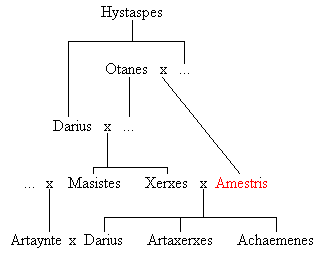
Family tree of Amestris

Amastris married Xerxes I (Herodotus 7.61.2) and as mother of Artaxerxes I, Amytis, and others, she had a bad reputation of being licentious and notoriously cruel; (Ctesias, fragment 14), she exercised a baneful influence in Artaxerxes’ court; e.g., she is said to have caused the wife of her brother-in-law Masistes to be mutilated (Herodotus 9.109-l2) One of the only consistent facts in Persian succession referenced in history is the mother of a legitimate heir was always Persian. In factall royal wives marked in Greek and Persian sources were Persian women. Any consort who wasn’t, is marked as a concubine.#14 This is a popular case for why Esther as Jewess Queen with Persian King fell in history
under a shadow of doubt. But as Mordecai the Grand Vizier & adopted Father of Esther, advised she conceal her genealogy, these facts did not come to light till afterwards. The Hebrew-Greek Septuagint– as the source text for the book of Esther, was produced in a later Persian or early Seleucid period, belonging to a Hellenistic genre. For more on Esther: see Ego, B. (2019) “Prayer & Emotion in the Septuagint of Esther Ego, B. (2006) Esther, Brill Online.#15” After the death of Atossa, Amastris, the wife of Xerxes, whom Greek writers such as Herodotus describe as a powerful yet cold-hearted woman, played a leading role in Xerxes’ court. Amastris also accompanied him during his military campaign against Greece.”[15]Amastris, the first lady of Xerxes’ court, was a most formidable & ruthless women of her time. Though many of the actions attributed to her by Greek historians cannot be fully accepted, the surviving evidence points to her psychological strength and authority.

Amastris outlived Xerxes, remained active in royal affairs serving as Queen mother during a long reign of her son Artaxerxes I. “During his reign, powers of kingdom influence were in her hands. The young king, Artaxerxes I, was heavily swayed by his mother, Amastris, and his sister, Amestris. The Queen Mother lived a long life, and her reputable standing of lineage and wealth, ranked highly, as her authority and respect remained intact until the endShe died in early 424 BC, aged near ninety, with the passing of Artaxerxes himself following soon after.[12][13] #16 


Midrash
is also used of a rabbinic work that interprets Scripture in this manner,[7][8] containing early interpretations and commentaries on Written Torah and Oral Torah (spoken law and sermons). Midrash also asks questions of the text; at times it provides answers, that prods the reader to seek truth.” As a Jewish mode of interpretation; Midrash not only engages the words of the text, behind the text, and beyond the text, but also focuses on each letter, and their part in forming the words of each line. #17 


Mordechai and the Jehoiachin Exile

A good reason for reading the story of the megillah as having occurred before the rebuilding of the Temple comes in Esther 2:5 introducing Mordechai:

אסתר ב:ה אִישׁ יְהוּדִי הָיָה בְּשׁוּשַׁן הַבִּירָה וּשְׁמוֹ מָרְדֳּכַי בֶּן יָאִיר בֶּן שִׁמְעִי בֶּן קִישׁ אִישׁ יְמִינִי. ב:ו אֲשֶׁר הָגְלָה מִירוּשָׁלַיִם עִם הַגֹּלָה אֲשֶׁר הָגְלְתָה עִם יְכָנְיָה מֶלֶךְ יְהוּדָה אֲשֶׁר הֶגְלָה נְבוּכַדְנֶאצַּר מֶלֶךְ בָּבֶל.

Esth. 2:5 In the fortress Shushan lived a Jew by the name of Mordecai, son of Jair son of Shimei son of Kish, a Benjaminite2:6 Who was exiled from Jerusalem in the group that was carried into exile along with King Jeconiah of Judah, which had been driven into exile by King Nebuchadnezzar of Babylon.

As a son of Kish, this name of the father of King Saul, another Benjaminite, the Talmud accords Mordecai the status of a descendant of the first King of Israel.
Grammatically
speaking, the clause “who had been exiled” can refer to Kish or to Mordecai. If the rabbis hold to the latter, it means that Mordechai lived during the 1st exile, eleven years before the destruction of Jerusalem and its Temple. According to Daniel 9:2, Jerusalem lay desolate for 70 years before the Temple was rebuilt, that would be 81 years after Mordechai had been exiled. As it is hard to imagine Mordechai- a 100-110+ year old man in the story, so the rabbis would have to agree that the story of the megillah took place before the Temple was rebuilt.#18 This agrees with the record of Ezra 4;

Ezra 4:1 
“Now when the [a]adversaries of Judah and Benjamin heard the descendants of the captivity were building the temple of the Lord God of Israel… they opposed and discouraged them

Ezra 4:4-6
But Zerubbabel and Jeshua and the rest of the heads of the fathers’ houses of Israel said to them, “You may do nothing with us to build a [b]house for our God; but we alone will build to the Lord God of Israel, as King Cyrus the king of Persia has commanded us.” Then the people of the land tried to discourage the people of Judah. They troubled them in building, and hired counselors against them to frustrate their purpose all the days of Cyrus king of Persia, even until the reign of Darius king of Persia.

Achashverosh [Ahasuerus] reigned between Daryavesh (=Darius I), during whose reign the Temple was rebuilt (Ezra 6:15), & Artachshasta (=Artaxerxes I).[7] This supports the idea that Achashverosh was identified with Xerxes.#19

 The Seal of Xerxes
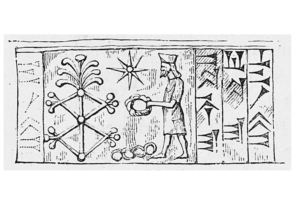
Seal of Xerxes. Perrot & Chipiez 1890 fig. 497, via Briant 2002 fig. 30.

O leaves tender and beautiful
of my beloved plane tree
On you may fate shine resplendent
May thunder, lighting, and storms
never intrude, ever, on your dear peace of mind,
nor may there be any wind that comes to violate you
—some violent wind from the west.

Shade there never was
of any plant
so dear and lovely
or any more sweet.

Trans. Gregory Nagy

As the seal of Xerxes shows, his veneration of the Tree of Life, which for him is a plane tree that grows in the Greek-speaking territory of Asia Minor, is an overarching symbol of his ambition as king of a multi-ethnic Persian Empire. But the king’s failure on the West side of the Aegean Sea has led to an occlusion of his imperial ambition—to be replaced by the ambitions of other Persian kings, all devotees of the Tree of Life.#19a 

Mordechai

In an introductory statement about the reign of Xerxes, after mentioning two of Xerxes’ influential advisors, Ctesias writes that among the eunuchs,[29] Natacas (Nατακας) exercised the greatest influence.”[30] A few lines later, he refers to a eunuch of Xerxes named Matacas (Ματακας). These two names likely reflect the same person.[31]

The “as” at the end of either name is almost certainly a Greek addition. Thus, “Matacas” suggests a Persian name with the consonants MTC, which would be very close to the consonants of the name Mordechai, MRDC.[32] Even the name “Natacas” is not that different. “N” and “M” are related consonants, both being nasal stops; it is not unusual for one to transform into the other.

With either form of the name, the information provided by Ctesias, that he was a high-ranking official in Xerxes court, bears a strong resemblance to the last verse in the Megillah, which records by the end of the story, Mordechai was 2nd mishneh (=second) to the king. So, the Matacas of Ctesias and Mordechai of the Megillah may refer to the same historical person.#20

In checking in the tablets of Persepolis that Mordecai was an eminent royal scribe called Marduka who worked with Tatennai, the Governor beyond the River, under the direction of Uštanu, the satrap of Babylon, during the years 17 to 32 of Darius. Similarly, the narrative of Herodotus regarding Amestris (a name meaning ‘vigorous woman’ in Old Persian), Xerxes‘ unique wife and only queen known in Persia, corresponds in many ways to Esther star’-Old Persian”

despite the unfavourable and biased description of the Persian queen.

According to the book of Esther there was a plot to kill Xerxes which was thwarted in the 11th year of his reign, we read: Bigthan and Teresh, two eunuchs & officialsministers of the King’s Court the porters were outraged seeking to lay hands on King Ahasuerus. But this thing came to be known to Mordecai, and he soon revealed it to Queen Esther. Then Esther told the king in Mordecai’s name.  The case was thus sought and finally discovered, with both hanged on a  pole (…) Shortly afterwards. In the 1st month, that is the month of Nisan, the 12th year of King Ahasuerus (Est 2:213:7). This serious accusation against the Jews is dated in the 12th year of Xerxes legal reign (Est. 3:710), at the start of his effective reign, (Ezr. 4:6).

This information from Ctesias & Plutarch overlap, making it possible to locate the two brief reigns of Belšimânni and Šamašerîba in year 485 BC or early in the effective reign of Xerxes after the death of DariusContemporary records in Babylonian archives dating to the reigns of Bêl-šimânni and Šamaš-eriba; over a division of a large satrapy of Babylonia, early in Xerxes reign in 2 parts, as seen in the “daiva inscription” of Xerxes, that recorded the suppression of a

religious revolt in the empire. A remark by Roman author Arrian of Nicomedia, using 4th-century BC sources, stated Xerxes subdued a Babylonian revolt on his return from the war against Greece (479 BC). Via Arrian, Xerxes punished the city by closing the Esagila, Temple of Mardukcenter of Babylon’s state cult. North of the Esagila was the Etemenanki, the ‘Foundation of heaven on earth‘, better known to us as the ‘Tower of Babel‘ [Gen. 11]. This temple tower (or ziggurat) was 92 meters high and had seven levels. According to the Greek researcher Herodotus of Halicarnassus, the Persian king Xerxes had a statue removed from the Esagila when he sacked the city.#21

Figure 3. Ziggurat of Susa. 21a.

Chogha Zanbil [ Dūr Untash Ziggurat ] | Chiyakotravel

Parrot’s survey includes numerous illustrations, for example, a three-tiered structure on an Old Babylonian cylinder seal, four-to five-tiered towers on Assyrian cylinder seals, and a five-tiered ziggurat of Susa on a relief sculpture shows Assurbanipal’s Elamite campaign.#21b In addition, a considerable body of literary and pictorial evidence documents a concept of 7-level Ziggurats: 1. The Esagila tablet from Uruk (AO 6555), first noticed by George Smith in 1876, dates to 229 BC,#21c. and is now also known from a partial duplication in the British Museum (BM 40813), they are thought to be copies of an original no later than the early-seventh century BC.#21d. This displays the dimensions of the temple-tower Etemenanki (é.temen.an.ki) part in a complex @ Esagila-in Babylon, completed by Nebuchadrezzar IISeven stages are described, in their respective dimensions (AO 6555 ll. 36–42). The height of the structure equal to the base, agreeing with Strabo’s input, & Frankfort’s deduction on the original height of the ziggurat at Khorsabad.

At Khorsabad only four stages were discerned, but Frankfort thought it reasonable that there had been three further stages, as the height of the structure would then match the base “which was, according to Strabo, the case in Babylon.”#21e.

The Ziggurat at Ur.

Sümerler, Mezopotamya’ya yaklaşık olarak M.Ö. 3500’lerden sonra gelmeye başlamıştır.

This sets out dimensions of the temple tower Etemenanki (é.temen.an.ki) of the Esagila complex in Babyloncompleted by Nebuchadrezzar II. Seven stages are described, with their respective dimensions (AO 6555 ll. 36–42).
broken Neo-Babylonian stele (MS 2063) in the Schøyen Collection depicts a king, apparently Nebuchadrezzar II, “standing before a ziggurrat of 7-stories drawn in outline & labelled [é].tem[en] .an.ki [ziqúra-at ba-bili (ká.dingir.ra)ki ‘E-temen-anki, ziqqurrat of Babylon.’ #21f.

If the Babylonian revolts occurred
during the first year 1 of Xerxes’ reign, a chronological ranking of 
contracts29 tells us that they took place when the king had been fully recognized in Borsippa, which would be quite illogical. In fact, for the Babylonians the legitimate king was Šamašerîba. For a Babylonian scribe, Xerxesan Achaemenid, was a usurper in his 1st year of reign, not a legitimate king in his 11th year of reign. To avoid this scene historians have speculated that the Babylonian revolts were at their maximum near 484/ 483 rather than 485 BC, but this assumption is contradicted by 3 elements:

1If the first Babylonian revolt occurred in 484 BC, this year would have been the 2nd regnal year of Xerxeshowever two tablets of Šamašerîba are clearly dated in year 1 of Xerxes.

2Greek historians describing the succession Darius/ Xerxes all indicate that some Babylonian revolts occurred just after the death of Darius, not 2 years later. In addition, that chronology makes sense because revolts usually occur just after the death of a king when some pretenders to the throne contest the succession, which was the case for Xerxes.


3
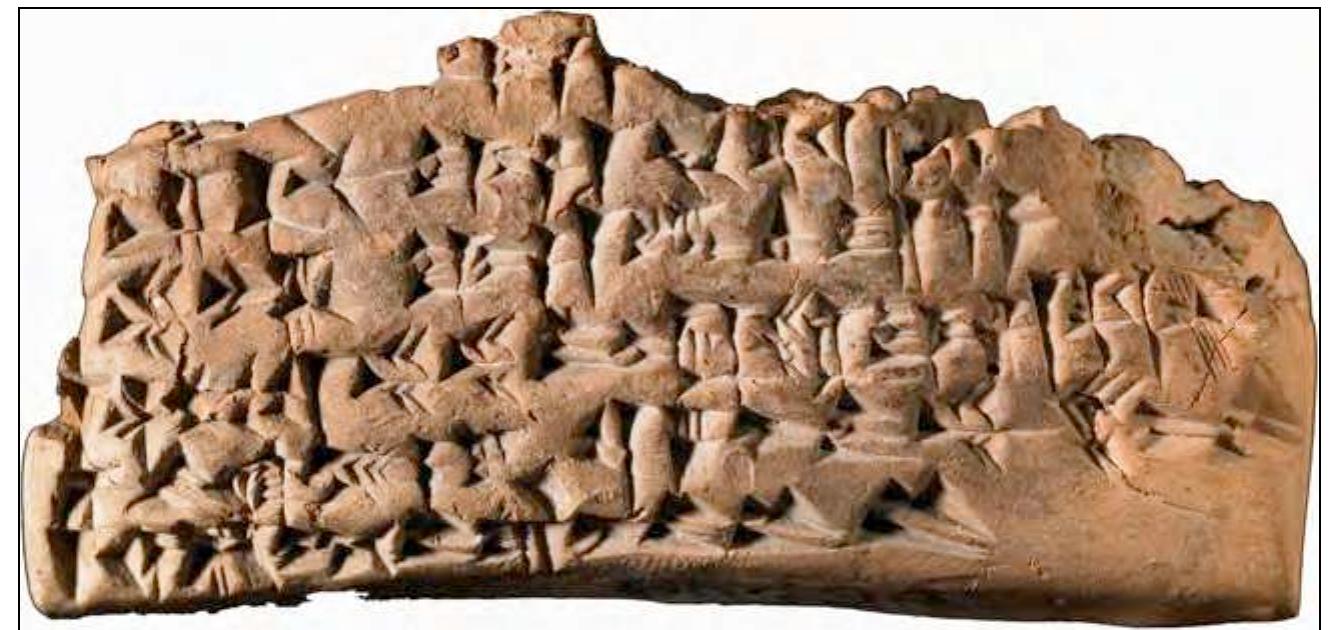
An astronomical fragment (JCS 1, 350 n°2) enables a dating of the Babylonian revolts. Although 
data are fragmentary they describe a revolt, clearly dated 05/IV/[?] during Xerxes’ reign (line 3 of the tablet) in perfect agreement with Belšimânnis tablet (BM 87357). The astronomical fragment reads 30:

2) [...] ……. […]

3) [...] the month of Tammuz (IV), the 5th day […]
4) [...] to Babylon went […]
5) [...] the troops of Elam […]
6) [... the religion of Mars which to […]
7) [... Mars into Cancer entered …]
8) [... fled and into the river jumped and […]
9) [... to] Borsippa went, destroyed the city [...]
The historical notices appear to be related to a conflict between Babylon and Elam (Media and Persia). Line 4 indicates that the troops, &/or others, went to Babylon. Line 5 mentions the troops of Elam, and line 8 apparently refers to a military defeat (Here someone flees and then jumps into a river, a parallel is to be found in the annals of Assurbasirpal). In line 9 a group of people go to Borsippa. Lines 67 date these events to a year when the planet Mars was in
the vicinity of Cancer during the month of Tammuz (IV). Observations of Mars in this context may be more than coincidental since planet Mars is not only the planet of Nergal, the Babylonian War-god, but is also often linked with Elam in astrologyThe fragment must refer to an astronomical omen rather than an astronomical diary for two reasons: most data comes from a chronicle rather than an astronomical record (in which historical events are rare); given that the constellation of Cancer covers 20° of the sky31 it needs 20 days for a planet
to cross it, preventing one from making observations dated to a specific days. For practical reasons, Mars was entered visibly in a star sign /constellation when it was crossing its centre. An astronomical simulation32 indicates that Mars was in the center of the constellation of Cancer near the 9th of April 484 (485 BC),

matching Nisan (1st month of Babylonian year), and again33 on March 6th467 (468 BC). Presumably after the death of DariusBabylonian priests, given the dissatisfaction with Babylon and this omen early in the reign of Xerxes (year 11), had predicted wars (which happened soon after).

Xerxes began his reign on two occasions, first as co-regent till 486 BC, his accession is dated III/00 (June), and again as true king after Darius 1′ death. dated 10/IX/10 (8 December 486 BC). Darius I 522-496 Darius I/Xerxes 496-486 Pherendates 496-486 Darius I/Xerxes 496-486 Xerxes I co-regency 486-475486 Bel-shimanni 14+/V/00 04/VI/00 xx/VI/00 usurper 485–485 Shamash-eriba 04/V ! /00 11/VIII/00 xx/VIII/00 usurper 485–485 Xerxes I 20/ V/21 14/V/21 475 486

The fragment must refer to an astronomical omen rather than belonging to an astronomical diary for two reasons: most information comes from a chronicle rather than an astronomical record (where historical events are rare); given that the constellation of Cancer covers 20° of the sky#31 it needs 20 days to be crossed by a planet, which prevents one from making observations dated to specific days. For practical reasons, Mars entering visually into a constellation
when it was crossing its centre. An astronomical simulation#32 indicates that Mars was central in the sign Cancer near April 9th484 (485 BC), matched in

Nisan (1st month of Babylonian year), & again #33 on 6 March 467 (468 BC). Presumably after Darius’ deathBabylonian priests, in their dissaffection with Babylon and this omen early in the reign of Xerxes (year 11), had predicted wars as (Greco-Persian wars happened soon after).

An astronomical tablet (BM 32234)34 contains 2 lunar eclipses and the death of Xerxes is dated 14/V. Given that the 2nd partial lunar eclipse is dated 14/VIII (November/ December) it is easy to check what year it occurred35. A complete analysis of these 2 eclipses (when they began and ended, how much area of the moon darkened. P = Partial; T = Total; N = Penumbral) enables us to keep only the year 475 BC (=474), not dated 465 BC that’s usually agreed. #36/21g

(4) The use of “year 21accession year,” in either Persian or Jewish dating, agrees with the fact that no known Babylonian tablets recognize any other kings between Xerxes and Artaxerxes, though Jewish dating implies a gap before the beginning of Artaxerxes’ accession year in Egypt.

(5) The alignment of the regnal years of the same number in the Egyptian and the two Semitic calendars (attested by the synchronisms of Ptolemy’s Canon, the Saros list, double-dated papyri, and dated tablets) follows this order: Egyptian (December), Persian (spring), Jewish (fall), in the reign of
Xerxes; likewise in Artaxerxes’ reign the order is: Egyptian
, followed by Persian, followed (if AP 6 has a Jewish date) by the Jewish.

(6) This alignment makes it clear that the year formula in AP 6 does not fit the Egyptian calendar, but is an exceptional but normal double formula in either the Persian or the Jewish calendars.#22

Xerxes began his reign on two occasions, first as co-regent in 496 BC, his accession is dated III/00 (June), and again as true king after Darius 1 death. dated 10/IX/10 (8 December 486 BC).  Xerxes I / [Xerxes as new king] 485 Xerxes I / Bel-šimânni 9 VI IX 0 Xerxes I / Šamaš-erîba Year 1 of Xerxes/ 24/VI/00 (BM 96414) 10 VII X 11 VIII XI 12 IX XII *** OECT 10 176 dated 5/IX/11 (Kish) 484 1 X I 12 2 XI II *** JCS 28 38 dated 24/XI/11 (unassigned) According to this chronological reconstruction, during his 10th year of reign Xerxes was co-regent of Darius I until 8 December 486 BC, then full king after this date. As the years of reign began on the 1st Thoth in Egypt at that time (early Jan.), the 11th year of Xerxes’ reign began in January 485 BC, while this 11th year began in April 485 BC in Babylon. A careful study of Egyptian documents confirms this change in Xerxes’ status.#23

Indeed, G. Posener notes the Egyptian title of Xerxes had changed from his Year 10 but without giving the reason. In Posener’s collection of hieroglyphic inscriptions (Posener: 1936, 92, 120-124, 162), Posener classified Persian kings according to a chronology accepted in his time. But several anomalies can be explained only by assuming a 10-year co-regency between Xerxes & Darius. In these hieroglyphs, the Egyptian pharaohs, from Amasis to Artaxerxes, are still called “Lord of the Two Lands”, except Xerxes who is calledMaster of Crowns between year 1 and year 10 of his reign. He got a legal title of “Lord of the Two Lands”- official title of the Pharaohs of Egypt, only from his year 10. If Xerxes became Pharaoh shortly after Darius’ death, he then would have received the usual title Lord of the Two Lands; to designate Egyptian kings, but the title was awarded him only in his year 10. In Addition, for no known reason, the name Darius changed from year 27 up to year 36 of his reign to become inDarius. This hieroglyph in, literally meaningcontributionin Egyptian 14 , or “booster”, can’t be a phonetic complement, as it deteriorates the pronunciation. FIG. 2 Year 2 Month I Akhet Day 9 Master of crowns, Xerxes Year 6, Master of crowns, Xerxes Year 10, Lord of the two lands, Xerxes (Dec. 486 BC) Year 6, Lord of the two lands, Cambyses (II) Year 36, Lord of the two lands, Darius (I) Year 12, Lord of the two lands, Xerxes 14 This hieroglyph appears in the names some pharaohs like Antef contribution of his divine father”. It may be an abbreviation of the Egyptian word inpw royal child”, meaning a pretender to the throne that is a “Crown prince”. #24

EGYPTIAN CHRONOLOGY THROUGH ASTRONOMICALLY DATED SYNCHRONISMS 11 TABLE 6 King in Babylonia in Egypt Cambyses (II) Kambuzia K-n-b-w-d3 From 5th to 8th year King of Babylon, King of lands Lord of the Two Lands Darius (I) Dariawush (in)-Ti-rw-y-w-š3 From 1st year to 36th year King of Babylon, King of landsLord of the Two Lands– Xerxes- Khisi‘arsa Ḫ-š3-y-rw-š3 From accession to 1st year King of Babylon, King of lands? From 1st year to 10th year King of Persia & Media, King of Babylon and of lands, Master of Crowns from 10th year to 21st year King of lands, Lord of the Two Lands The years indicated in those documents have been understood as years of reign when in fact they are years of domination (months/days usually unspecified).

The Egyptian administrator Atiyawahy, for example, says that he spent “6 years under Cambyses and 36 years under Darius”. The hieroglyph with an eyebrow above the date is used, while the years of reign are typically identified by the hieroglyph. As the Egyptian word inḥ eyebrow” also means “surround”, those years [of reign] were for the Egyptians years [of surrender]. Diodorus dates a beginning of the Persian domination in Egypt in the third year of the 63rd Olympiad [526 BC]

(Historical Library I: 68:6) and the end in the archonship of Euclid [in 403 BC], or in the year 2 of Artaxerxes II, when Amyrtaeus had become the new pharaoh of the 28th dynasty (Historical Library XIV:11:1-12:1, I:44:3). Those data taken from his Greek chronology are accurate. However, Diodorus wrote in summary: The Persians were masters, after King Cambyses subjected the nation by force of arms, for 135 years, contradicting his own chronological calculations (length of 123 years obtained between 526 and 403 BC). In fact, a total period of 123 years corresponds to an amount calculated with a 40-year reign for Artaxerxes I, as  the 135 years corresponds to an actual reign of 51 years. Diodorus probably compiled different data from an Egyptian informer (Historical Library III:11) without trying to harmonize them. The reign of 6 years* in Egyptian reckoning can correspond to 4 years in the Babylonian reckoning (526-522). TABLE 7 Length according to: dates: official reign Diodorus Ptolemy actual reign BC Cambyses II 526 6 years 526520 526-522 (6 years*) 526-522 Darius I 36 years 520-484 522-486 36 years 522-486 Xerxes I 20 years 484-464 486-465 21 years 496-475 Artaxerxes I 40 years 464-424 465-424 51 years 475-424 Darius II 19 years 424-405 424-405 19 years 424-405 Artaxerxes II 403 2 years 405-403 2 years 405-403 Total: 123 years 123 years 526-403 526-403 135 years

According to the Bible, the massive emigration of Jews into Egypt began shortly after the Pharaoh Nekau II set King Jehoiakim (in 609 BC) on the Jerusalem throne (2Ki 23:34, Jer. 26:21-23, 42:14). After Gedaliah’s murder, many Jews immigrated to Egypt (Jer. 43:7, 44:1) in land of Patros (“the Land of the South” in Egyptian) southern province in which Elephantine was a main town.

12 FUNCTIONING OF THE EGYPTIAN LUNAR CALENDAR The calendar of Elephantine (in the far south of Egypt) with its system of double dates, using Egyptian and Babylonian names, was used by Persian officials and Jewish scribes only during a short period from 525 to 400 BC. For example, a Persian official erected a votive stela stating: This temple, (W)id(arnaga) the garrison commander of Syene made in month of Sivan, that is Meḥir, Artaxerxes’ 7th

year, the king (to) Osirnaḥty, the god. Peace (Lemaire: 1991, 199-201). Egyptian documents dated in both lunar and the civil calendars allow absolute dates to be obtained because such date coincidences only occur every 25 years if the lunar day is correctly observed, or every 11 years with a 1-day observation error. The Aramaic documents from Elephantine, dated over the period 525-398 BC, contain 21 well identified double dates, making it possible to anchor the reigns of Xerxes and Artaxerxes on absolute dates.


A study showed that the reigns of Xerxes and Artaxerxes had been shifted by 10 years with respect to astronomical dates 17 giving rise to different inter-calations during the reigns of Darius & Xerxes (Gertoux: 2018, 179-206; 2020, 273-279). Elephantine papyri are letters dated in both the lunar calendar & the Egyptian civil calendar, so they provide absolute dates, assuming the lunar calendar agreed with Babylon’s conventional chronology (Porten: 1996, 152–234), but this is not scientifically adequate because if the average error is one day among most dated recordsin seven contracts the double dates deviate by more than one day; in two contracts it differs by two days (C13; K2); in one it is four days (C10); in three its 1 month (K8; C8; C9); and in one it is a year (K6), which is aberrant. (Porten: 1990, 22). If the Babylonian lunar calendar is replaced by Egyptian lunar calendars suggested by Richard A. Parker (in 1950), that starts the lunar month at the 1st invisibility (day after the new moon and before the first lunar crescent), the average error increases from 1 to 2 days on lunar days (Stern: 2000, 159–171). From 525 BC Egypt became a Persian satrapy but most scribes were Egyptians or Jews. Persian officials at Elephantine were familiar with three kinds of lunar calendar, Elamite, Old-Persian and Babylonian, that appear on Darius I’s inscriptions at Behistun. Jewish scribes at Elephantine were familiar with different calendars, but they used a calendar based on the Babylonian calendar after their return to Judea from Babylon. The Babylonian chronology est. by Claudius Ptolemy was confirmed by the BM 34576 tablet (King List dated 99 BC). A study of all tablets (contracts/heiroglyphs dated during the period 626–331 BC was published (Parker, Dubberstein: 1956) and showed that all durations in the Achaemenid period agreed with the Babylonian royal lists, providing several short co-regencies were admitted shortly before and also during the enthronement of the new king


17 Babylonian astronomers classified lunar eclipses according to an 18-year Saros cycle, as they noticed that astronomical phenomena were reproduced identically in the 19th year of the solar cycle and almost identically in the 11th year (within a day). The 19 solar years last 6939.6 days = 19×365.24219 days and correspond exactly to 19 lunar years plus 7 intercalary months,
 lasting 6939.7 days = ([19×12]+7) x 29.530588 days. The 11 solar years last 4017.6 days = 11×365.24219 days and correspond to 11 lunar years plus 4 intercalary months, that last 4016.2 days = ([11×12]+4) x 29.530588 days. With these astronomical cycles the two lunar eclipses of 475 BC (1st total, 2nd partial) were reproduced in 465 BC, but in reverse order (partial then total). For example, the two lunar eclipses of 475 BC were exactly reproduced in 457 BC on 6th July (total) and 31 December (partial). These adjustments made by Babylonian astronomers altered times in the chronology of Artaxerxes and

Xerxes reigns, including the Metonic cycle of the intercalary years. This 19-year cycle; a mathematical cycle synchronizing 19 lunar years with 19 solar years by adding intercalary months, a 2nd Adar mo. (XIIa) or 2nd Ulul month (VIb), in 7 years of a 19-year cycle (3A, 6A, 8A, 11A, 14A, 17U, 19A). But, this 19-year cycle was based on observations, not calculations (Steele: 2007, 121-123) and computed data in diaries (purely computational, not a combo observed & predictive methodology) that appear just prior to 350 BC (Rochberg-Halton: 1991, 107-120). The reading of a few months between is disputed, for example the year 7Adar (XIIa) of Xerxes should perhaps be replaced by the year 8 Ulul (VIb) of Xerxes (Ossendrijver: 2018, 138-143)


As the Egyptian calendar had 12 months of 30 days, plus 5 days at the end of the year (365 days), called epagomenon in Greek, it was not lunar (around 354 days). In Elephantine the main system of dating was the Egyptian calendar (civil), but as numerous religious festivals in Egypt were based on lunar phases a lunar calendar was used to fix these dates. The Jews (after 587 BC), then the Persians (after 525 BC), naturally used this calendar for their own religious festivals based on a lunar calendar (ie. Jewish Passover). The language of administration being either Egyptian or Persian, it was necessary to convert the names of the Egyptian lunar months to the common language understood by all: Aramaic. For example, the Jews converted into Aramaic the name of the months of their Hebrew calendar: « It came about that in the 4th year of Darius (…) on the 4th [day] of the 9th month, [that is] in Kislev » (Za 7:1). There was the same situation in Egypt, for example, an Elephantine Papyri (B24) is dated: « [17] Thoth, which is 17 Kislev, year 21 (of Xerxes), accession year of Artaxerxes » (Porten: 1996, 164-165). As Xerxes died on 14/V/21 (24 August) in 475 BC, the 1st Thoth (I Akhet 1) in 475 BC is dated 20 December and 17 Thoth on 5 January 474 BC.

1st Thoth in 475 BC thus links to 20 December in Julian astro-calendar. With
astron software (https://promenade.imcce.fr/fr/pages4/441.html)we find on 20th December474* (= 475 BC) there was a full moon at 18:20 UT (Universal Time), or at 20:30 Local Time (LT = UT + 2:10) in Elephantine. On Kislev 1 on a lunar calendar in Elephantine thus coincided with the full moon of 20 Dec. in 475 BC. To calculate the 1st Kislev (= 1/IX) of the Babylonian lunar calendar one must first calculate the 1st Tishri (1/VII) coinciding with the 1st lunar crescent after the autumnal equinox on 29 September 01:00 UT in –474* (https://promenade.imcce.fr/fr/pages4/439.html). The 1st astronomical lunar crescent (day after the astronomical new moon) after 29 September is that of 8 October 22:11 UT (= 1/VII). It is possible to calculate the 1st lunar day of the following months: 7 Nov. 09:17 UT (= 1/VIII), 6 December 20:22 UT (= 1/IX). The coincidences between observed lunar days & calendar dates are thus perfect. In 475 BC (= -474*): 1 Kislimu (Babylon calendar) = 6 December (in Babylon) 1 Kislev (Egyptian lunar calendar) = 20 December (Elephantine). The 20 records from Elephantine with a double date enable us to reconstruct a chronology of the reigns of the 27th dynasty. The papyrus B23 is dated: «Year 15 [of Xerxes] 18 Elul, which is 28 Pahons », hence the 1st lunar day is dated 11 Pahons (= 28 – 17), which was a full moon in 481 BC (30 August). The 11 Pahons or I Shemu 11 fits exactly to day 11: Papyrus year Lunar date Egyptian calendar BC 1st lunar day Full moon Xerxes I 15 1 Elul 11 Pahons (I Shemu 11) 29 Aug. 30 Aug. Papyrus B23 15 18 Elul 28 Pahons (= 11 + 17) 15 Sept. 481A concurrent presence of two different lunar calendars, Babylonian and Egyptian, complicates the dating of the synchronisms between these two chronologies, particularly during the reign of Cambyses II.


Nebby Captured Jerusalem on Adar 2, 597BC

although the prosopography of the officials of Ebabbara’s administration #24 shows that Mardukmukînapli and Mardukbêlšunu were scribes (upšarru) from year 28 of Darius to year 2 of Xerxes, however, Bêlittanu was not a scribe, but only chief of Temple administration (šangû). He was used as a scribe only for the accession of Xerxes, afterwards he made the receipt for

offering of Xerxes in his letter dated []/III/01 of Xerxes (VS 6, 179). He was still šangû in a contract dated 21/III/01 of Xerxes (BM 65378) and one dated 17/III/29 of Darius (BM 64022). Consequently it’s more logical to have synchronism: Year 26 of Darius = Year 0 of Xerxes (see pages 1213 hereafter). Also, the Babylonian revolt early in the reign of Xerxes could not occur to open his co-regency. But these revolts were early in Xerxes reign (year 11), in the 1st year after Darius’ death. Indeed, from the Battle of Marathon (in 490 BC), Herodotus describes a climate of insurrection in the Persian Empire (The Histories VII:14). Ctesias said after the death of Darius: Xerxes decided to make war upon Greece (…) Hence he went to Ecbatana, where he got word of a Babylonian revolt and the murder of Satrap Zopyrus (Persica F13§§2526). Arrian also puts the Babylonian revolt at the time of his campaign against the Greeks (Anabasis of Alexander III:16:4; VII:17:2), which began in Spring of 485 BC via to Herodotus (Histories VII:20).


Mardukmukînapli and Mardukbêlšunu were scribes (upšarru) from year
28 of Darius to year 2 of Xerxes, however, Bêlittanu was not a scribe, but only the chief of the temple administration (šangû). He was used as a scribe only for the accession of Xerxes, afterwards he made the receipt for the offering of Xerxes in his letter dated []/III/01 of Xerxes (VS 6, 179). He was still šangû in a contract dated 21/III/01 of Xerxes (BM 65378) and one dated 17/III/29 of Darius (BM 64022). Consequently it would be more logical to have a synchronism: Year 26 of Darius = Year 0 of Xerxes (see pages 1213 hereafter). Next, a Babylonian revolt early in the reign of Xerxes could not have occurred to start his coregencyBabylonian revolts that took place early in the reign of Xerxes (year 11), after the death of Darius, can’t have occurred when he was coregent (year 1). Indeed, from the Battle of Marathon (in 490 BC), Herodotus describes a climate of insurrection in the Persian Empire (The Histories VII:14). Ctesias said after the death of Darius: Xerxes decided to make war on Greece (…) So he left for a trip to Ecbatana, when he heard of the revolt of the Babylonians and murder of Zopyrus their satrap (Persica F13§§2526). Arrian situated also a Babylonian revolt at the time of his campaign against the Greeks (Anabasis of Alexander III: 16:4; VII:17:2), which began in the spring of 485 BC according to Herodotus (The Histories VII:20).
These 2 brief rebellions to start Xerxes’ reign confirm his coregency
 during the accession in his 1st year of reign, Xerxes was welcomed by the Babylonians and the two Babylonian revolts, just after Darius’ death, imply that Xerxes’ accession could not have occured at the time. Plutarchconfirms the account of Ctesias, saying that after the death of Darius the kingdom of Xerxes was challenged in a climate of revolt (very different from the period  of accession 10 years earlier): When Xerxes was declared king, Arimenes immediately did him homagecrowning him; as Xerxes gave him the next
place to himself. Being offended with the Babylonians, who rebelled, and having overcome them, he forbade them weapons (Sayings of kings and commanders 173c). If Arimenes disputed  the kingdom of Xerxes that means he (Xerxes) was already king. In addition, a Babylonian revolt early in his reign, visibly worried Babylon’s scribes, as we read in a trilingual inscription at Persepolis: King Xerxes says: When I became king, among the nations that are written above, it is one that rebelled, as Ahuramazda gave me his support and thanks to Ahuramazda I beat these people and I put it back in its place #26. Xerxes does not name Babylon as most likely this old people constituted a prestigious historical foundation of Achaemenid power, so it was embarrassing to admit such an insurrection. The translation of the Babylonian inscription is also indicative of this awkwardness as it replaces the offending people by “these countries have rebelled,” combining the revolt that occured at the time of Darius with the rebels, who were the two Babylonians: Nebuchadnezzar III and Nebuchadnezzar IV. The information from Ctesias and Plutarch overlap, making it possible to locate two brief reigns of Belšimânni and Šamašerîba in the year 485 BC or early in an effective reign of Xerxes after Darius’ death.


According to the book of Esther, a plot to kill Xerxes that was thwarted in the 11th year of his reign, we read: Bigthan and Teresh, two officials of the king’s court the porters were outraged and sought to lay hands on King Ahasuerus. But the thing came to be known to Mordecai, that he soon revealed to Queen Esther.
Then Esther told the king in the name of Mordecai. The case was thus sought and finally discovered, and both were hanged on a pole (…) Shortly afterwards (…) In the 1st month, that is the month of Nisan, of the 12th year of King Ahasuerus (Est 2:213:7). The serious accusation against the Jews is dated in the 12th year of Xerxes’ legal reign (Est 3:710), to open his reign [Ezr. 4:6].

Cameron #27 notes that the accession of Xerxes and his 1st year are well represented in Babylon, it does not put the revolt during the first 2 years since the Babylonians had clearly recognized Xerxes in his early steps, but Waerzeggers#28 notes that the tablet BM 96414, dating the accession of Šamašerîba mentions the 1st year of Xerxes.


Footnotes

1.https://www.academia.edu/44915277/Intercalations_during_the_co_regency_of_Xerxes_with_Darius_I_in_NABU_2020_4_pp_273_279?email_work_card=reading-history]
2. IBID
3. [https://www.researchgate.net/publication/312069819_Dating_the_reigns_of_Xerxes_and_Artaxerxes]. Gerard Gertoux. 
4. IBID
5. IBID
6. IBID
7. IBID
7a. Intercalations during the co-regency of Xerxes with Darius I, in NABU 2020-4, pp. 273-279 By Gerard GERTOUX
7b. Halley’s Bible Handbook, p. 218, Henry H. Halley
8. IBID, p. 218
8a. IBID ppg. 218-219
8b. http://www.achemenet.com/en/results/?q=Susa
8c. IBID
8c1. IBID
8d. https://www.livius.org/sources/content/achaemenid-royal-inscriptions/xph/
8e. https://en.wikipedia.org/wiki/Return_to_Zion
8f. Strong’s Concordance [#4899-mashiyach], James Strong
8g. https://www.thetorah.com/article/if-achashverosh-is-xerxes-is-esther-his-wife-amestris?
8h. Encyclopedia Judaica Glossary definition of Midrash.
9. https://en.wikipedia.org/wiki/aggadah
10. https://en.wikipedia.org/wiki/Halakha
11. https://en.wikipedia.org/wiki/Book_of_Daniel
11a. https://www.onepagebiblesummary.com/pad/pad_01.php
12. Herodotus 7.61.2
13. https://en.wikipedia.org/wiki/Amestris
14. (Herodotus-Histories 7.61.2, 9.109-l2)
15. Prayer & Emotion in the Septuagint of Esther Ego, B. (2006) Esther, Brill Online.
16. https://en.wikipedia.org/wiki/Amestris
17. https://en.wikipedia.org/wiki/Midrash#cite_note-9
18. https://www.thetorah.com/article/ahasuerus-and-vashti-the-story-megillat-esther-does-not-tell-you
19. https://www.thetorah.com/article/if-achashverosh-is-xerxes-is-esther-his-wife-amestris
19a. [https://continuum.fas.harvard.edu/an-occlusion-of-xerxes-in-medieval-persian-epic/]
20. https://www.thetorah.com/article/if-achashverosh-is-xerxes-is-esther-his-wife-amestris
21. https://www.livius.org/articles/place/babylon/etemenanki/
21a. Fig. 3-Ziggarat of Susa-picture credit. [https://en.wikipedia.org/wiki/Chogha_Zanbil#/media/File:jpg]
21b. (Parrot 1949: 37–50)  Ziggurats et Tour de Babel. Paris: Albin Michel.
21c. (Parrot 1949: 22–24.; Wiseman 1991: 71) Nebuchadrezzar and Babylon. The Schweich Lectures of the British Academy. Oxford: Oxford University Press
21d. (George 2005/2006: 75, 78; The Tower of Babel: Archaeology, History and Cuneiform Texts. AfOr 51: 75–95. (Allinger-Csollich 1998: 290–94).
21e. (Frankford 1970: 79) The Art and Architecture of the Ancient Orient. 4th edition. Harmondsworth: Penguin
21f.  (George 2005/2006: 75, 77, 78, 79, 86; Allinger-Csollich 1998: 290–94). The Tower of Babel: Archaeology, History and Cuneiform Texts. AfOr 51: 75–95.
21.g [https://www.researchgate.net/publication/312069819_Dating_the_reigns_of_Xerxes_and_Artaxerxes]. Gerard Gertoux
22. IBID
23. IBID
24. Posener’s collection of hieroglyphic inscriptions (Posener: 1936, 92, 120-124, 162)
25.

https://about.jstor.org/terms XERXES AND THE BOOK OF ESTHER-LITTMAN
 

The Greco-Persian War Astronomical History circa 480 BC

The Greco-Persian War Astronomical History circa 480 BC

Welcome to the May 2026 Blog folksThis month we will view a history of the Greco-Persian Wars, focusing on the Persian side from a Biblical perspective, starting with a line of Persian Kings from Dariusson of Ahasuerus-Spouse of Queen Esther, to rebuilding the Walls and Temple at JerusalemThis fell into  the times of the Matching Eclipses of 480-469BC, as they reflect in Repeating Eclipses of 2024-2034 AD. This matching of LuniSolar Eclipses embodies part of the astronomical, archaeological and historical evidence we’re presenting in this study coinciding with the rebuilding of Jerusalem’s Walls and Temple during the period of Ezra-Esther-Nehemiah, aligning with Daniel’s end times prophecies, before Christ’s Return to unify the Church of his Spiritual Body, at the Gathering Together. The preparation of Christ’s Spiritual Body, which he is the Headincludes Messianic Christian Jews with the Born Again Saints in Christ, who is our Peacehaving made both Onebroken down the middle wall of Partition; has abolished in his flesh the emnity, even dogmatic laws of Commandments contained in ordinances in order to make of the two, one new man in himself, so making Peace. Eph. 2:16 “And that He might reconcile them both to God in one body through the cross, thereby putting to death the enmity17 And He came and preached peace to you who were afar off and to those who were near18 For through him we both have access by one Spirit to the Father.

Christ Our Cornerstone in the Temple 

19 Now, therefore, you are no longer strangers and foreigners, but fellow citizens with the saints and members of the household of God20 Having been built on the foundation of the apostles and prophets, Jesus Christ himself being the Chief Cornerstone, 21 In whom the whole building, being fitted together, grows into a holy Temple in the Lord22 in whom you also are being built together for a dwelling place of God in the Spirit[Eph. 2:14-22]

As we expand on re-building and dedication of the physical Templeand walls of Jerusalem, so we must be cognizant of Christ building of his body-and his Spiritual Temple, [Jn. 2:19] as enemies of these spiritual works resistso we stand together against their hostility, even as our spiritual enemy opposed the rebuilding of the Walls and Temple of Jerusalem in the days of Nehemiah-Ezra. The following Biblical Structure of Ezra chapt. 4-6; lays out a structural context related to these activities in Ezra-Nehemiah.

The Decree of Cyrus, marked the beginning of a new period in the history of the Jewsissued at Ecbatana in his first regnal year (Ezra 1:1), in the summer of 537 BC, if reckoned from the fall of the Babylonian Empire according to the Jewish method, from fall to fallCyrusofficial decree, (1) dealt with directives, exact specifications on the new Temple, (2) Provided for covering of the building expenses by royal funds, and (3) Commanded a return of vessels of the former Temple to the Jews, (Ezra 6:3-5).

The context of the Structure of Ezra 4is from E.W. Bullinger’s Companion Bible for Ezra 4:1-6:22, seen below, is an Extended Alternation;#1

The Temple Building & Dedication

F1; Ezra 4:1-6:15 Building
 G:Ezra 4:1-2; Adversaries/ Temptation
  H:Ezra 4:3; Obedience to God’s Word
   J:Ezra 4:4-16; Opposition Letter to Cyrus
    K:Ezra 4:17-22; King’s Answer-success of plot
     L: Ezra 4:23-24; Work Cessation
      M: Ezra 4:24; Duration of Cessation
 G: Ezra 5:1; Helpers-Prophets-Exhortation
H: Ezra 5:2; Obedience to God’s Word
J: Ezra 5:3-17; Opposition Letter to Darius
K: Ezra 6:1-12; King’s Answer-Defeat of plot
L:Ezra 6:13-14; Work Recommencment
M:Ezra 6:15; Date of Completion

The section reflected below relates to J:Ezra 4:4-16; 6:15Opposition Letter to Cyrus; in the above Structure

Here we find Darius as son of Ahasuerus, while below in Ezra 4:6-7, we see Ahasuerus and Artaxerxes being used as a synonymous repetition for the same king, as Darius’ Father. As in a Biblical sub-Structure of these verses based on related & corresponding a,b,c lines as follows; “A link to “A,” “B”  to “B,” and “C” to “C.” “AIn the reign of Ahasuerus links to “A” in v. 6-7; “in the days of Artaxerxes.To whom & when. “B“; enemies of Judah and Benjamin wrote… “Ccontents of letter. “A” The days of Artaxerxes. Bto Artaxerxes- king of Persia. “B2Judah’s enemies con’t. “CLetter’s contents to the King Artaxerxes I from your servants. #2  

Ezra 4:6-11 [AIn the reign of Ahasuerus, in the beginning of his reign, [B] they wrote an [C] accusation against the inhabitants of Judah and Jerusalem7 In [A] the days of Artaxerxes alsoBishlam, Mithredath, Tabel, and the rest of their companions [B] wrote to Artaxerxes king of Persia; [see Neh. 2:1,19] and the letter was written in Aramaic script, and translated into the Aramaic language[B2] Judah’s enemies con’t.-v. 9-10From Rehum the commander, Shimshai the scribe, and the rest of their companions-representing the DinaitesTarpelites, Apharsathchites, the people of Persia and Erech and Babylon and Shushan, the Dehavites, the Elamites10 and the rest of the nations whom the great and noble Osnapper [Ashurbanipal] took captive and settled in the cities of Samaria and the remainder beyond [g]the River and[h] so forth11
 [C] This copy of a letter sent him. To King Artaxerxes I from your servants, the men of the region beyond the river
, and so forth: [Ezra 4:11-16]

As an addendum to this study; I’m adding a Timeline that emerges from a study brought to my attention by Rev. Nessle on; “Post-exilic Bible Chronology that Identifies Esther’s Husband.” In his work Jon shows; “that Xerxes 1 was too late, and Arsames [Persian] was too early, and that the only candidate fitting all the details given in Scripture must be Darius 1.” Historians usually refer to King Cyrus; conquerer of Babylon, replaced by his son Cambyses, after which Darius Hystapses prevailed. His reign was followed by Xerxes 1, but confusion has centered around a throne name of Ahauserus– venerable king” as we find in Esther 1:1. The Bible’s use of throne names like this and Artaxerxes, the Great King or Darius the Maintainer” can be applied to any of Peria’s ruler’s, not to be confused with modern assigned counterparts. Proof Ahauserus was a throne name we find in a preamble to the above Biblical structure; figurative Parenthesis in Esther 1:1, as Rev. Nessle’s query points out; “Why is there a need for explanation unless there were more than one person called by this name?” #2a

In the 6 month reign and time following Smerdis, Darius contended against a number of pretender’s for the throne, till political conditions stabilized, and work resumed on the Temple in Darius’ 2nd-3rd year-[520-519BC]. In DariusZoroastrian heritage, the Jews likely welcomed a return to more amicable times they enjoyed previously under Cyrus & CambysesCyrus also appointed  a Jew of royal blood, Zerubabel to be governor of the province of Judea, that was part of the satrapy Beyond the the River,” the great division of the Empire that comprised all lands between the river Euphrates and Egypt. #2b

Three individuals are named as “Governor of Babylon and Across-the-River between 535 – 486 BC [Stolper1989]. #2c Xerxes I came to throne as the Great King in 486 BC. One of these three has been identified in both Persian and Biblical records of Ezra, “Tattenai, governor on this side the river” (Ezra 5:3; 6:6,13), in Ezra 6:13 belowhis office administered portions of Asia Minor and the coastal zone all the way to Egypt; “in this province was all Phoenicia, and part of Syria called Palestine, and Cyprus. [Herodotus, Histories 3.91].#3

Temple Rebuild and Dedication

Ezra 6:13-15 13 Then Tattenai, governor [#6347-6, prefect Ez. 5:3] of the region beyond the River, Shethar-Boznai, and their companions diligently did as stated by what King Darius had sent14 So the elders of the Jews built, and they prospered through the prophesying of Haggai the prophet and Zechariah the son of Iddo. And they built and finished it, according to the commandment of God of Israel, & according to the command of Cyrus, Darius, & Artaxerxes   king of Persia15 Now the Temple was finished on the third day of the month of Adar, which was in the sixth year of the reign of King Darius.#3a [structure of Ez. 4-6 and rebuilding of the Jerusalem Temple]

Tatnai, governor on this side of the river” (the province called Beyond the River” from the Mesopotamian view), with his official staff, to Jerusalem (Ezra 5:3), probably on a routine inspection. Since it was long known that the Satrap of the territories of “Beyond the River” and “Babylonia” during the early years of Darius was Ushtani, it was thought that Tatnai was Ushtani’s subordinate in the administration of “Beyond the River,” to aid Ushtani as co-administer of these two large provinces.

Tatnai as a competent Persian official, upon seeing an industrious building site  at the Temple, he asked for the royal permit. The elders of the Jews replied—while Zerubbabel as governor awaited a disposition of the new official. The Jews told the story of the destruction of the first Temple, their captivity in Babylon, and their return under Cyrus, with his return of Temple treasures, and decree to rebuild the Temple. Tatnai was favorably swayed by the work of the Jews, allowed them to continue their project for the present, while research was done for an official written permit, that he reported to the king. To this he added names of the Jewish leaders, requesting an investigation in the archives of Babylon, and a royal decision concerning his attitude toward the Jews, (Ezra 5:3-17, 6:2).

Xerxes the Great; c. 518 BC – 465 BC)[5] was a Persian ruler who reigned as the fourth King of Kings of the Achaemenid Empire, via conventional histories reigned from 486 BC until his assassination in 465 BC, but we are leaning to an alternate date in 475 BC for the death of Xerxes I, below. He was son of Darius the Great and Atossa daughter of Cyrus the GreatXerxes’ father was Darius the Great (r.522–486 BC), the monarch of the Achaemenid Empire, albeit not kinsman of Cyrus the Great, the founder of the Empire.[8][9] Xerxes‘ mother-Atossa, was daughter of Cyrus.[10] Darius and Atossa married in 522 BC, and Xerxes I was born near 518 BC.[12] #3b

The title of King of Kings appears in inscriptions of kings of Urartu.[2] This title was also used by rulers of the Median Empire, since its rulers borrowed much of their royal symbolism and protocol from Urartu and elsewhere in Mesopotamia. The Achaemenid Persian variant; Xšāyaθiya Xšāyaθiyānām, of this titleis Median in form, implies Persian Achaemenids may have taken it from the Medes, rather than Mesopotamia.[2]

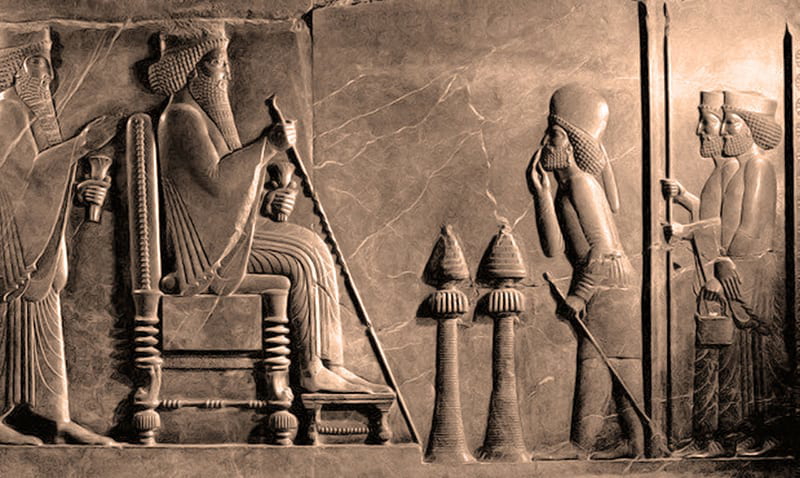
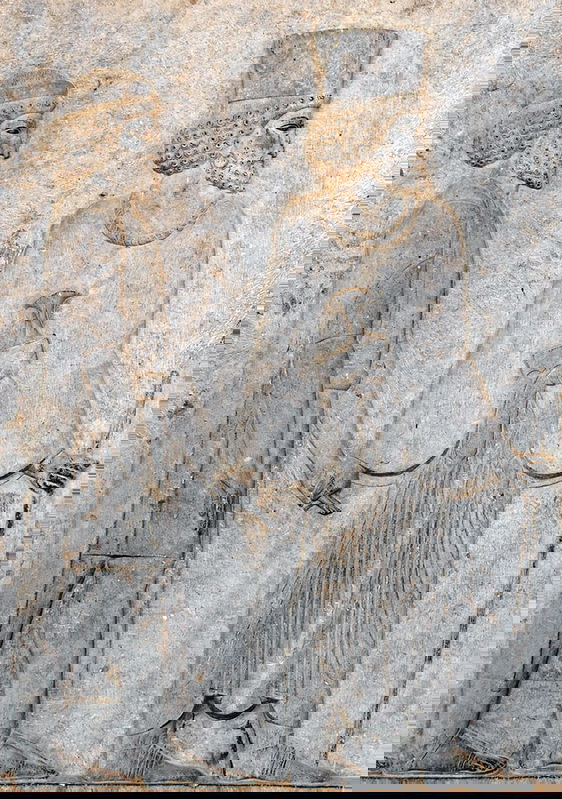
Xerxes’ co-regency is challenged because he only wrote an inscription (while his brothers Hystapes and Arsames still lived): Xerxes I said: Darius had other sons, but the pleasure of Ahuramazda was Darius my father made me greatest after him. As my father Darius  left the throne, with Ahuramazda, I became king on my father’s throne (XPf §4). But, several carved reliefs at Persepolis show that Xerxes was designatedcrown princeyears prior to Darius death. According to a conventional representation of kings, the king seated on his throne was Darius before Xerxes; as Crown prince, [see Fig. 1 shows: a bas relief taken from Persepolis below]. What is difficult to separate in World history, can be easier in Biblical reckoning, as for example: the Bible counts Princes as kings if exerting royal authority during Co-regency-or during the Senior King’s Reign. This appears to be the case with Belshazzar-a key type who was called Crown Prince[Assyrian Term] in Nebuchadnezzar’s reign.

We also find in Dan. 9:1 below;

Dan. 9:1 In the first year of Darius the son of Ahasuerus, of the lineage of the Medes, made king over the realm of the Chaldeans in the first year of his reign I, Daniel, understood by the books the number of years specified by the word of the Lord through Jeremiah the prophetHe would accomplish 70 years in the desolations of Jerusalem.

In our recent OT History Seminar-Ren Manetti lays out 15 prophecies of Dan. 8:20- in reference to the future Antichrist through Dan. 11:2, with another 40 prophecies-in Dan. 11:1-19 that blend in seamlessly with the Persian historic headlines. All the revelation from God, given to Daniel here is addressed to Daniel, and interpreted by an angel or angels, who insured Daniel grasped what was divinely imparted to him. Dan. 11:1 refers to a 1st year of Darius the Mede.”#4

Dan. 11:2 says“Also in the first year of Darius the Mede, I, even I, stood up to confirm and strengthen him.) And now I will tell you the truth: Behold, three more kings will arise in Persia, and the fourth shall be far richer than them all; by his strength, through his riches, he stirred up all against the realm of Greece.

In Greek history 3 kings rose prior to Dariusthe first 2 were; 1. Cambyses, then a missing #2nd Artaxerxes, not recorded in history, only in Scripture-next #3. was Darius 1-“the Mede,” the Father of Xerxes 1, rising as 4th king whose riches passed them all; and by his strength, through his riches he stirred up all against the realm of Greece.”#5 This kingly line matched Darius & Xerxes I’ history and royal geneology, that via Herodotus; their ancestry reigned for 22 generations covered an 505 yrera.#Darius’ father [Hystapses] and Grand- dad [Atraxerxes] lived on as he was crownedin shared co-regency declared-heir of Hystapses’appeasing fractured nobility. Dariusruled the military as the first Persian War opened in 490BC, while Hystapses ruled the Political Administration behind the scenes. So, the 1st Grecian wars opened as Darius 1 was defeated in the 1st Persian invasion, at the 490BC-Battle of Marathon.

In his 2017 Analysis of the Prophecies of Daniel at the Hope Mini-Summit” in Tampa, Fl, Rev. Jon Nessle said: in reference to the 70 weeks or “sevens” are weeks of years, or Sabbatical Years which makes the span 490 years. “Most chronologer’s take a starting point of the count in Artaxerxes I’s 20th year, when they say Nehemiah was given the Governorship of Judea so that he could accomplish his goal of rebuilding the walls of Jerusalem. Rev. Nessle disagreed with this, since Xerxes I was NOT the husband of Esther, as most historians suppose. Darius I had to be Esther’s Husband because of the age of Mordecai. A Xerxes I scenario makes Mordechai an impossible minimum of 124 years old in the 12th year, when he was appointed Grand Vizier.”#7

In support of this, Mordecai appears among exiles deported from Jerusalem by Nebuchadnezzar, [Est. 3:5] but that deportation occurred 112 years before Xerxes became king, explaining why Darius should be in power as Esther’s husband during this time.

[Via the Athenian historian– Thucydides, who served as General for Athens during the war, his account of the conflict is widely considered to be a classic, and renowned for his accurate chronology, was deemed as one of the earliest scholarly historical works; (The Peloponnesian War I:98;137). Thucydides was born in 471 BC as a defeated Athenian general who turned to writing history after being relieved of command. As a younger contemporary of Artaxerxes I, his History of the Peloponnesian War recounts the warfare between the rival alliances led by Sparta and Athens through the year 411 BC. Thucydides has been called the father ofscientific history due to his strict standards of evidence-gathering and analysis of cause and effect with-out reference to intervention by the gods.#7a

From Plutarch (Life of Theseus §§35,36),#7b after Themistocles met with Artaxerxes IXerxes’ successor, following the fall of Naxos after Skyros fall, dated with the archonship of Phaedo in 476 BCThemistocles meet occurred soon after 475 BC, not 465. The present Achaemenid history-mainly sourced from official Babylonian king listsignored co-regents and usurpers. Official versions are contradicted by contracts dated “yearmonth, day,” so proving the existence of frequent co-regencies and usurpers. Also, via astronomical tablet-referenced BM 32234Xerxes’ death was dated 14/V/21 between two lunar eclipses, one; 14/III/21 (6/26/475 BC), that was total, and a 2nd partial dated 14/VIII/21 (12/20/475 BC), [see Comparison Chart #3 Repeating-Matching Eclipses below]. Thus, Xerxes I death dated on 8/24/475 BC. Also, Artaxerxes I’s death is fixed before a partial Solar Eclipse (3/21/424 BC), by Thucydides (The Peloponnesian War IV:50-52) implying an absurd co-regency of Darius II with a dead king for at least one year! Supporting this, Plutarch and Justinus validly show a long co-regency of Artaxerxes, but with his first son Darius B (434–426).#8

Further support of the 475-474 BC date appears reasonable for Artaxerxes 20th year, as his first year in office of Persian Governor beyond the River,” but not as the Great King.” As Governor, he was a king(Basileus) over the Persian dominions of present day Cyprus, Turkey, Lebanon, and Israel. As Governor, Artaxerxes I would have direct administration of Jerusalem; so, the 20th year of Artaxerxes (Nehemiah 2:1) ruling over Jerusalem was in 454 BC. Both Persian and the Greek records speak of kings” in reference to one holding governing authority, but still subject to the Great King. Since both Artaxerxes and his father, the Great King Xerxes were alive, a harmonized reading of apparent conflicting histories over the last two millennia comes to the surface. #9

The arrangement of the intercalary months in a chronology without coregency has several anomalies, especially the presence of two months Ulul in a single cycle. By contrast, in a chronology with co-regency, has two distinct cycles, the abnormal intercalary month in year 30 of Darius (Persepolis) links to another cycle ending in year 4 of Xerxes. The titulature of Xerxes (496475) in Egypt and the data of Diodorus confirm the co-regency of 10 years w/ Darius (522–486), as do Elephantine papyri with many double dates both in civil and lunar calendars. #9a

Rev. Nessle continues: “This fact moves the time of the Jews influence in the Persian State back, and adversely affects any starting point for the 490 year option for Daniel’s Prophecy. The 2nd Temple construction was re-started in Elul 519BC and was finished in Adar 515BC, during Darius 1, Ezra arrived in Jerusalem soon after. Mordechai’s appointment as Grand Vizier and Purim occurred in the winter of 509 BC. The Jewish influence in the Court of Persia persisted eventually involving the appointment of Nehemiaha known Jew, to a high position as Chief of Security. Rev. Nessle’s belief is that in 501 BC-the 20th year of Darius I, the wall was built. Tishri 1 fell on Sept. 19th, 522BC during a time when the Hebrew Lunar Calendar and months, were synchronous with Babylonian & Persian calendar. Darius assasinated an imposter contending for the throne; Smerdis/Gaumata [?] on Sept. 29th and became king shortly there- after. Therefore his Accession Year was from Tishri 1, 522BC to Tishri 1, 521BC.
So Nisan in his 20th year would have been in 501 BC. If the starting point for the 490 years was the King’s Appointment of Nehemiah for that task, it ends in 11BC, which is not significant for anything. Nehemiah’s King cannot be Xerxes 1, because Nehemiah mentioned him reigning in his 32nd year, [Neh. 5:15]. Xerxes’ reign was only 20 years. If Artaxerxes 1’s 20th year, then 490 Jewish Tishri years results in 44AD.” Rev. Nessle quotes Daniel 9:20-27 here, where he defers to his Appendix from “The Path to Eternity,” where there’s an Introversion  structure signaled by a repetition of [seal] in verse 24. This is the only thing that fits.” #10

Counting 490 years from the 20th year [501BC] of Darius [Sept. 522BC to Nov. 486, yields 11BC, no significance. Counting 490 years from the 20th year [4454 BC] of Artaxerxes I [465-424] yields 44ADno correlation. #11  However, with an alternate date of Xerxes I’s death given by Thucydides and others in 475BC, puts the start of the reign of Artaxerxes 1 in the year of 475-474BC, opening a word starting in the 20th year of Persian King Artaxerxes 1,according to Nehemiah 2:1-6.

Nehemiah 2:1-6 And it came to pass in the month of Nisan, in the twentieth year of King [a]Artaxerxeswhen wine was before him, that I took the wine and gave it to the king. Now I had never been sad in his presence.  Therefore the king said to me, “Why is your face sad, since you are not sick? This is nothing but sorrow of heart.” So I became dreadfully afraid, and said to the king, “May the king live forever! Why should my face not be sad, when the city, the place of my fatherstombslies waste, and its gates are burned with fire?” Then the king said to me, “What do you request?” So I prayed to the God of heaven.
 And I said to the king, “If it pleases the king, and if your servant finds favor in your sight, I ask that you send me to Judah, to the city of my fathers’ tombs, that I may rebuild it.”
Then the king said to me (the queen also sitting beside him), “How long will your journey be? And when will you return?So it pleased the king to send me; and I set him a time.

In year 20 Artaxerxes I- gave his trusted cup-bearer Nehemiah a commission to rebuild the wall of Jerusalem (Neh. 2:1). Establishing the date of this event has created confusion because there are 2 different lines of testimony. Diodorus in his Library of History places Artaxerxes I on the throne in 464 BC, making his 20th year 444 BC. Claudius Ptolemy (2nd cent. AD) adopts Diodorusdating in his influential Canon, which provides a list of kings from various countries spanning a 900-year period. Moreover, these dates were copied into Eusebius’ Chronicles during the 4th cent. AD. But, a differing witness, and second line of testimony occurs when historical events correlate with historical writings of Thucydides. Then the date of Artaxerxes I as governor, or sub-king to Xerxes is 474 BC which also was the date Nehemiah was using. A Summary of the debate over last two millennia [McNeil-1970]; “That Thucydides’… is the best evidence we have… If, on the other hand, we refuse Thucydides’ order on faith but try to check it against what we learn from other sources, it becomes evident to check this is improbable. The only other linked account of the 465-450BC period is Diodorus, who to some extent is dependent upon Thucydides… [and wrote] centuries after the events.”#11a

Ptolemy, noted Greek-Egyptian astronomer (2nd century A.D.), in his Canon of the Kingsassigns 21 years to the reign of Xerxes & 41 years to Artaxerxes immediately following. But as the Canon is dated beyond doubt by 19 eclipses and other astronomical synchronisms and signsit is certain that in official Egyptian reckoning Xerxes’ year 21 (the year 283 in Ptolemy’s Nabonassar Era) correlates to the chronology of Olympiads.

Olympiad Chronology

The BC/AD dating system had not been developed even in the time of Eusebius (260-340 AD) [Eusebius Chronicles] and dating the reign of Artaxerxes as the Great King requires reviewing the Greek Olympiad chronology system. Every four years in the midsummer around August, the Greek city-states, swore oaths to meet together in truce, if not in peace, for the Olympic competition. Because these Olympiads were not linked to the reign of any specific king, or kingdom, they provide a convenient method for dating events in history. The Olympiad counting system began in mid-summer and Olympic years always covered part  of 2 Julian years (mid-Aug. to next mid-Aug.). Olympiad counting was adopted in Greece well before Artaxerxes I. The start date for this counting was 776BC in Olympiad 1. Olympiad reckoning employed both the number of the Olympiad and the year within the cycle, 1-4Eusebius in his Chronicles carries Olympiad dating from its inception in 776BC to 217AD, the 249th Olympiad. The Olympiad dating is completely reliable for dating Persia’s invasion of Greece by Xerxes I-father of Artaxerxes I, in 480 BC[Shaw-2003].#11b

Seventy-fifth Olympiad [480 BC]… It was in this year king Xerxes opened his campaign against Greece- Olympiad 75.2 (479 BC; Xerxes year 6/7) Herodotus, Histories, Book 9 – concludes the history of the Persian invasion the following summer, when the Persian forces staying in Greece were defeated at Plateaending the last Persian incursion on the Greek mainland. Olympiad 75.3 (478BC; Xerxes year 7/8): Athenians returned & rebuild. Thucydides; Peloponnesian War 1.89: “When the Persians, defeated by the Hellenes on sea and land, retreated from Europe, and the remnant of the fleet, had taken refuge at Mycalè, and there perished

They both [Eusebius & Herodotus] included Artabanus with a seven month reign between Xerxes and Artaxerxes, i.e., in the 4th year of 78th Olympiad (465  14). They also dated Artaxerxes’ year 20 in the 4th year of the 83rd Olympiad. 20/11c

This added research uncovers that “Artaxerxes Iascended the throne in the year 475 BC, and his 20th year of reign would then be 455 BC. But, some of Christendom’s secular scholars will tell us Artaxerxes I” began his reign in the year 465 BC, making his 20th year 445 BC, a difference of about ten years. The question then is who is correct? This short study intends to show 4 basic lines of evidence, in support of the date 475 BC. as a correct date for the start of Artaxerxes reign vs. 465BC. A 1st line of evidence: came in the year 1847AD, from a German scholar named Ernst Hengstenberg, in his book: “Christology of the Old Testament“, saying, “For then the 20th year of Artaxerxes is the year 455 BC“, and Artaxerxes 1st full regnal year began in 474 BC“. Also, the book;Pay Attention to Daniel’s Prophecy” relates this in a 1999 printing, from p. 197 we find Ernst Hengstenberg in his Christology of the Old Testament; Artaxerxes 1reign commenced in 474 BC, #12 as do other following sources

In Archaeological history, the bas relief taken from Persepolis, in Fig. 1, below of the man sitting on the throne is none other than Persian King Darius.

Representations of lions can be found frequently in Persepolis, for the city’s entire purpose, after all, was to direct attention to the great king of Persia. The central relief, now displayed in the Archaeological Museum of Tehran, brought the focus of the room and all its carved figures to the image of Darius, seated on his throne, flanked by his son, and receiving the tributes of the visitors.

A Persian coutier leads a foreign delegate by the handPersepolis Apadana

A Persian coutier leads a foreign delegate by the hand - Persepolis Apadana
The figures are recognized as Darius and his son Xerxes as they commissioned the work, but the reliefs are also intentionally ambiguous, not capturing any unique features of Darius himself. In that way, the relief serves also as a larger, symbolic depiction of the strong Achaemenid royal line, Great king and ready successor, at the center of the great Persian Empire.

Enthroned Darius with Xerxes behind - central relief of the Persepolis Apadana, found in the treasury

Figure 1. Enthroned Darius with Xerxes behindcentral Bas relief of the Persepolis Apadana, found in the Treasury. 12a.

Somewhat unique to ancient kingdoms is the tolerance of the Persian king and empire reflected in those images of the monarchy. Where Greek and Roman art often shows their leaders crushing surrounding nations, the Persian courtiers are shown leading them by the hand to come before Darius. It was a powerful piece of propaganda for all those who entered the halls, but also largely true. Having been violently subjugated by the Assyrians, Cyrus worked to build an empire that would integrate its conquered nations and remain respectful of their cultures and religions.

As we turn our gaze to a history of religious policies of the Achaemenids. The Achaemenid rulers were Zoroastrian, but they were extremely tolerant of other religions in their Empire and even contributed to building of temples and gave special privileges to priesthoods.#12b On cylinder inscriptions; Cyrus records “I gave daily care to his (Marduk’s) work”.12c Cyrus rebuilt the temple of Marduk; Cyrus and Darius both let the Jews deduct rebuilding cost of the Jerusalem Temple from their taxes. Cambyses was no less tolerant.” He and Darius both partook in a ceremony; called seizing the hands of Marduk” at the statue of Bel-Marduk in Esagila, which entitled them in the eyes of the Babylonians to bear the title king of Babylon.”

Notice that his attendants to his left and to his right are all lower than him, and that his head is above them all. Now, notice the man standing directly behind him. He is standing on the same elevated platform as the king, and his clothes are almost identical to his. His right hand is resting on the high back of his throne, and his head is at the same level as well. This is unusual, as ordinarily the king’s head would be higher than all others. Who is this man? None other than Xerxes, Darius’ son. Also notice the lotus that is being carried in the left hand of both Xerxes and Darius, and the scepter being held in Darius’ right handthe king. This image shows powerful evidence that there was, in fact, a coregency between father and son. This same line of evidence has also been provided in the Insight Book Vol II page 615 entitled “Evidence from Persian sources“.#13

A Third line of evidence: is what is known as cuneiform tablet BM 65494 taken from the British Museum. It is a business document from Borsippa dated to the 50th year of Artaxerxes I.

Tablet BM 65494 dated 4/V1/50 of Artaxerxes I Stolper reconstituted the prosopography of Murashu's family and has dated it according to the accepted chronology’*’. According to this reconstruction (choice 1), length of service is 27.5 years for the first two generations, 20.5 years for the third and 11.5 years for the fourth, which would be a surprising rejuvenation’. By contrast, taking into account Darius B (choice 2), we get a more balanced period of activity for four generations with an average of 22.5 years respectively for the first two, then 20.5 years and 21.5 years for the two following ones:

Tablet BM 65494 dated 4/V1/50 of Artaxerxes I –Stolper reconstituted the prosopography of Murashu’s family and has dated it according to the accepted chronology’*’. 13a

In the 2nd graphic provided, the number 50 is written in Akkadian language found is in the lower right corner of the tablet to find it. The final picture below is the Akkadian numerical system, shows how they would write the number 50, which exactly matches this cuneiform tablet, above.#14

This shows robust archaeological evidence of Artaxerxes’ reign exceeded 41 years. And that the 51st year of Artaxerxes was 424 BC, making his first regnal year 474 BC, and not 465 BC as some of Christendom’s secular scholars would have us believe.

Fourth line of evidence: Archbishop James Usher in his book entitled the “Annals of the World“, published back in 1650 AD, made these paraphrased statements “In the year 455 BC, that was the 20th year of Artaxerxes I, when Nehemiah requested to obtain permission from the king to be the governor of Judah and to rebuild Jerusalem (Nehemiah 2:1-6). This event marks the start of Daniel’s 70 weeks.” #15

These four, powerful lines of evidence, show a correct date to the beginning of Artaxerxes reign, and how we may unlock a secret to the start date of Daniel 9:24-27. Many thanks to Ernst Hengstenberg for his work published in 1847, and James Ussher for his book published in the year 1650AD. I’m also thankful to the British Museum for providing the cuneiform tablet BM 65494, and finally the headquarters staff at Jehovah’s Witnesses (WTBTS) for their help in grasping the regnal year start of King Artaxerxes I’ in 474 B.C., with his 20th year as 455 BC.

The last Year of Xerxes and the 1st Year of Artaxerxes

As we have seen throughout the reigns involved hereregnal-year numbers in the Egyptian calendar are known from astronomically fixed reckoning of Ptolemy’s Canon and synchronisms of several double-dated papyri. It is also known in the Persian calendar from the Saros list, based on the 18-year Saros cycle. #16

ACCESSION OF ARTAXERXES I

Figure 2. Xerxes and Artaxerxes in Three Calendars

The regnal years of Xerxes (shortened in this drawing by an 18-year gap of the Saros cycle) and the early years of Artaxerxes are shown as reckoned (1) In the Egyptian calendar (with years beginning in December), (2) in the Persian calendar (with years beginning in the spring), and (3) in the Jewish calendar (with years beginning in the autumn), all three aligned against the back-ground of the BC years.

The Saros list is extant on two clay tablets containing a series of regnal years at eighteen-year intervals based on a Babylonian Eclipse cycle (published by J. N. Strassmaier in reports in ZA, VII [~Sgz], zoo, 201; VIII [1893], 106). #17 Starting with the 7th year of Nabonidus, this list includes the year of Xerxes and the years 6 and 24 of Artaxerxes.

SCIENTIFIC APPROACH TO AN ABSOLUTE CHRONOLOGY THROUGH SYNCHRONISMS DATED BY ASTRONOMY

The death of Xerxes is dated, at the present time, in 465 BC. This date comes mainly from the official Babylonian chronology, however, the testimony of Thucydides and from some Elephantine Egyptian records support dating of 475 BC. A careful chronological analysis of Babylonian astronomical tablets allows a fixing of a precise date of Xerxes’ death on August 24th, 475 BC. An official Babylonian chronology is based on the tablet BM 34576 (King List copy dated 99 BC). #18

Likewise, the death of Artaxerxes I is fixed precisely by Thucydides (The Peloponnesian War IV:50-52) just before a partial Solar Eclipse (21 March 424 BC) which implies absurd co-regency of Darius II with a dead king for at least one year! The arrangement of the intercalary months in a chronology without co-regency has several anomalies especially the presence of two months Ulul in a single cycle. By contrast, in a chronology with co-regency, and two distinct cycles, the abnormal intercalary month in year 30 of Darius (Persepolis) links to another cycle ending in year 4 of Xerxes. The titulature of Xerxes I (496-475) in Egypt and data of Diodorus confirm a Co-regency of 10 years with Darius-1 (522-486), with Elephantine papyri and many double dates with civil and lunar calendars. #19

A popular date of Xerxes 1′ death in 465 BC by mainstream historians, comes mainly from the official Babylonian chronology, recorded in the King’s List such as the tablet BM 34576 (copy dated 99 BC) 1 , but a witness of Thucydides support the dating in 475 BCadded to thiscareful chronological analysis of Babylonian astronomical Tablets allows a fixing of a precise date of Xerxes’ death on August 24 in 475 BC. Why do mainstream historians prefer to rely on the Babylonian royal lists to establish the Achaemenid chronology, rather than on evidence from Greek historians who clearly mention several usurper kings and co-regencies?#20

We can agree that the Book of Esther has a historical setting in the reign of Darius, replete with details of Persian court life. A purpose of this study, while not denying romantic and ritual elements and a complicated blend of  of history and religion, is a return to search for historical material, aligned with an Astronomical Chronology especially in Darius/Xerxesreigns, with solid links to the Book of Esther, and a Bible Chronology. A good starting place may be the historical seed in the Book of Esther with religious policies of King Darius I, in whose reign events of the book are set, as his decree singled out the Jews as a religious-ethnic group in Persia for destruction, albeit fomented by Haman

An initial question to be answered is the Jewish seed of Mordecai and Esther. The Jewish name ‘Mordechai‘ is found on multiple occasions in the Bible. #21 The name Mordecai shows on a list of Jews who returned to Jerusalem with Zerubbabel (Ezra 2:2, Neh. 7:7). 2 Now these are the people of the province who returned from Babylonian captivity, of those carried away, by the king of BabylonNebuchadnezzar, who returned to Jerusalem & Judah, all to their own cityThose who returned with ZerubbabelJeshua; [a man of Pahath-moab with Zerubbabel [Ez. 2:6], Nehemiah, [Neh. 7:7] Seraiah, [1Chron. 6:13-4Reelaiah, Bilshan, Mordecai, known by some as finance officer at Susa under Darius 1. [Est. 2:7[c]Mispar, Bigvai, [d]Rehum, [Ez. 4:8and Baanah, numbered among the men of the people of IsraelThe name Mordecai, listed in Aramaic; see G. R. Driver, Aramaic Documents of the Fifth Century BC. (Oxford 1957) 20 n. 2. It also occurs in the Treasury Tablets from Persepolis;
G.G. Cameron
Persepolis Treasury Tablets (Chicago 1948) 85; also found in an undated text, probably from the end of Darius’ reign or the beginning of Xerxes I, an official’s name, perhaps an accountant/scribe, on tour from Susa; #22

There is no otherMordecai” in the Bible, and every leader on the list of exiles  who returned ie; (Zerubbabel the son of Shetiel of royal blood, Jeshua the high priest, Nehemiah the cup-bearer to the king of Persia, Seraiah the son of a former high priest Hilkiah, etc.) all are VIP‘s! These events occuring next in Nehemiah, happen AFTER the book of Esther, when Nehemiah “is governor” (Neh 8:9), who likely became governor by Mordecai, the Grand Vizier. #22a

Ezra came to Judea in the seventh year of King Xerxes, in 479 BC. We are now referring to the 20th year of king Artaxerxes, and with the death of Xerxes in 475BC and the accession year of Artaxerxes in 474 BC-makes it 455 BC. For we have not an innumerable multitude of books among us, in disagreement or contradicting one another: [as the Greeks have:] but only twenty two books: which contain the records of all the past times: which are justly believed to be divine. (Josephus, Against Apion, 1.9) #22b

Josephus goes on to explain the division & categories of the Hebrew OT books:

And of them five belong to Moses: which contain his laws, and the traditions of the origin of mankind, till his death. This interval of time was little short of three thousand years. But as to the time from the death of Moses, till the reign of Artaxerxes, King of Persia, who reigned after Xerxes, the Prophets, who were after Moses, wrote down what was done in their times, in thirteen books. The remaining four books contain hymns to God; and precepts for the conduct of human life. (Josephus, Against Apion, 1.9) #22c

Josephus continues to explain the CHRONOLOGY of when these were written:

’Tis true, our history hath been written since Artaxerxes very particularly; but hath not been esteemed of the like authority with the former by our forefathers; because there hath not been an exact succession of Prophets since that time. And how firmly we have given credit to these books of our own nation, is evident by what we do. For during so many ages having already passed, no one has been so bold, as either to add any thing to them; to take any thing from them; or to make any change in them. But it is become natural to all Jews, immediately, and from their very birth, to esteem these books to contain divine doctrines; and to persist in them: and, if occasion be, willingly to die for them. (Josephus, Against Apion, 1.9) #22d

The extra books he is talking about are what we would call theapocrypha.” These include the books of Enoch, Maccabees, Tobit, and many others. However, the last “succession of Prophets since that time” ends in Artaxerxes reign, who is Malachi. And so THAT is the chronology of the last parts of the Old Testament.

As there are 39 books in our Old Testament Bibles, why does Josephus refer to only 22 books? This is due to the OT scrolls not dividing 1 and 2 Samuel, 1 and 2 Kings, 1 and 2 Chronicles, Ezra and Nehemiah, Jeremiah and Lamentations, or any of the minor prophets (Amos to Malachi) into separate books. This means the books that Josephus is talking about are the following: #22e

  1. Genesis 2. Exodus 3. Leviticus 4. Numbers 5. Deuteronomy 6. Joshua 7. Judges 8. Ruth 9. Samuel 10. Kings 11. Chronicles 12. Ezra/Nehemiah/Esther 13. Job
    14. Psalms 15. Proverbs 16. Ecclesiastes 17. Song of Songs 18. Isaiah 19. Jeremiah/Lamentations 20. Ezekiel 21. Daniel 22. Amos to Malachi-Prophets

This Biblical Chronology provides a superstructure upon which to build our history on much more reliable sources than the testimony of contradictory historians, whose witness however, is valued in agreement with a Biblical Chronology. To return now to a chronology of the Greco-Persian wars;

In 499 BC, the tyrant of MiletusAristagoras, incited Hellenic Asia Minor into rebellion against the Persians. This opened an Ionian Revolt, that lasted until 493 BC, progressively drawing more regions of Asia Minor into the conflict.
Aristagoras got military support from Athens & Eretria, and in 498 BC these forces captured the Persian regional capital of Sardis. The Persian king Darius the Great vowed revenge on Athens and Eretria for this. His 492 BC Persian invasion of Greece, as Persian General Mardonius successfully re-subjugated  Thrace Macedon before several mishaps forced an early end to the rest of his campaign.[3]  Darius then began raising a huge new army with designs to subjugate Greece; but, in 486 BC, his Egyptian subjects revolted, delaying any Greek expedition. After Darius died, his son Xerxes I restarted preparations for a second invasion of Greece, that finally began in 480 BC.#23

In 480 BC, the Persian King led a large army across the Hellespont into Europe, winning military victories at Thermopylae & Artemisium before their defeatrazing of Athens. His forces got control of mainland Greece-north of the Corinthian Isthmus till they were defeated at the Battle of Salamis. Fearing the Greeks might trap him in Europe, Xerxes I retreated with a greater part of his army back to Asia, leaving behind Mardonius to continue his campaign.

Achaemenid king killing a Greek hoplite. Impression from a cylinder seal, sculpted c. 500–475 BC, at the time of Darius I Metropolitan Museum of Art.#23a


At the Battle of Thermopylae, a small force of Greek warriors led by King Leonidas of Sparta resisted much larger Persian forces, but were ultimately defeated. Via Herodotus, the Persians broke the Spartan phalanx  after a Greek man called Ephialtes betrayed his country by telling the Persians of another pass around the mountains.

In 480 BC, following the Battle of Thermopylae, all of Boeotia fell to the Persian armyThespiae and Plataea, the two Greek cities that resisted Darius I, were captured and subsequently razed, as a surviving Athenian population evacuated, by the Greek fleet, to Salamis[1]

After ThermopylaeAthens was captured. Most of the Athenians abandoned the city, fled to the island of Salamis before Xerxes‘ arrived. Xerxes I ordered the Destruction of Athens, leaving an archaeologically intact destruction layer, called “Persian debris.” 

The following Charts for Repeating-Matching Eclipse Tetrads in 2024 AD with 480 BC, show how our current Eclipse decade of 2024-2034 match the ancient Eclipses of Darius/Xerxes I, open in 480-479 BC. They also match the 3 Blood Moon Purim Eclipses to open the Purim Holiday for Israel in Persia under Queen Esther and Mordecai. Considering Darius I’/Xerxes military history aligned with this key eclipse period, we can gain a more complete image and impression not only of Modern Persia, reflected in today’s Iran, but also a spiritual perspective of the building of the Wall & Temple of Jerusalem, and perhaps even the Coming building of a Third Temple, that the Jewish Temple Institute stands ready to enact.    

Comparison Chart #1 of Repeating Eclipse Tetrads 2024 AD with 480 BC.#24
Eclipse Date AD Sun/Moon Eclipse Date BC
3/25/2024 AD Lunar 3/25/480 BC
4/08/2024 AD Total Solar 4/09/480 BC Total
9/18/2024 AD Lunar 9/18/480 BC
10/2/2024 AD Annular Solar 10/2/480 BC Annular

Battles of Salamis and Plataea

The Battle of Salamis (26-27th Sept. 480 BCwon by the Greek fleet, followed Xerses I setting up a winter camp in Thessaly. [The history of April 8thSept. 18th/ Oct. 2nd, 480 BC, eclipses, is mirrored in Chart 1 above.]

The Persian active military campaign against the Greeks initiated a battle in Salamis, fought in the straits between the mainland and Salamis, an island in Saronic Gulf near Athensmarked a high point of the 2nd Persian invasion of Greecearguably the largest naval battle of the ancient world, marking a turning point in the invasion.[8]

According to Thucydides: Themistocles manifested a desire to visit the king of Persia (…) The storm caused the vessel to drift towards the Athenians camp who  then besieged Naxos (…) Guided by a Persian coast, then he penetrated into the interior of the country and sent to Artaxerxes, who had succeeded Xerxes, his father a letter (The Peloponnesian War I:98;137). Therefore, he reports the fall
of Naxos
after the one of Skyros dated at the beginning of the archonship
of Phaedo in –476BC, according to Plutarch.#24a This, meeting with Themistocles would have occurred soon after 475/474BC. Furthermore, Themistocles died under the archon of Praxiergos (in –471BC) according to Diodorus Siculus (Historical Library XI:54-60), and Herodotus situated the transfer of power from Darius to Xerxes at the time of the revolt of Egypt, four years after Marathon, or –486, #24b and the change Xerxes/Artaxerxes shortly after the storming of Eion [dated –476 BC], last event of  reign of Xerxes.#24c. Though heavily out-numbered the Greeks persuaded by Themistocles
 returning the Persian fleet to battle, hoping victory might prevent naval advance against the Peloponnese
The Persians were also eager for a decisive battle. So, the Persian navy rowed into the Straits of Salamis in an effort to block both entrances. But in the cramped waters, the great Persian numbers proved a detrimentas ships struggled to maneuver, becoming disorganized. To sieze the opportunity the Greek fleet formed in line to win a victory. The Naval battle as the Repeating-Matching Eclipses in Chart 1 above, reflects modern Iran’s attempt to control the oil traffic via straits of Hormuz, and loosing their entire Navy in the process.

The majority of the Persian army retreated to Asia, leaving Mardonius to complete the conquest of Greece. The following year the remainder of the Persian army was defeated at the Battle of Plataea and the Persian navy at a Battle of Mycale. The Persian ships were then captured and burned. The complete destruction of the Persian navy, along with the destruction of Mardonius’ army at Plataea, decisively ended the invasion of Greece. After Plataea and Mycale, the Greeks went on the offensive against the Persians, markingnew phase of Greco-Persian Wars. The Persians made no further attempts to conquer Greece, as the battles of Salamis & Plataea marked a turning point in the course of the Greco-Persian Wars. The Greco-Persian wars were a series of conflicts between Achaemenid Empire and Greek city-states starting in 499 BC[i] and lasted until 449 BC. This near 50-year period of conflict reflects a near 50 years of conflict between US/Israeli’s vs. Iran today. The historical reflection of ancient and modern Iran pointed out above is mirrored by astronomical activity typical in these periods in ancient Persia and modern Iran, in Repeating Purim Blood Moon Eclipses

 The last time there was a set of Triple Lunar Eclipses on Purim, before the current triad of 2024-26; and 480 BC2500 years ago, was from 1978-1980; as the radical Islamic revolution and terrorist regime in Iran first took power! It’s interesting that one Total Lunar Eclipse on 3/24/1978 and two Eclipses in 1979 & 3/1/80 match Purim dates 3/13/1979 with a 3/14/2025 Lunar Eclipse in  Chart #2 below with Summer Lunar Eclipse of 9/6/1979 with 9/7/2025 and 479 BC!  This serves to foreshadow the Purim events of 2024-2026! After a March 1979 Islamic Republic referendum, with 98% approval- a shift to an Islamic republic, the terrorist radical regime has been in power nearly 50 years.

Xerxes left a contingent in Greece to finish the campaign under Mardonius, who according to Herodotus suggested the retreat in the first place. This force was defeated in the next year-479 BC[See March 14/29th-9/7 Eclipses in 479BC in Chart 2 below, the following year at Plataea by the Allied forces of Greek city-states, ended the Persian invasion of Greece for good.

Comparison Chart#2 for Repeating Eclipse Tetrads 2025 AD with 479 BC#25
Eclipse Date Eclipse type Sun/Moon Eclipse Date Saros#
3/14/2025 AD Partial Lunar 3/14/479 BC 34
3/29/2025 AD Total Solar 3/29/479 BC 60
9/07/2025 AD Partial Lunar 9/07/479 BC 39
9/21/2025 AD Annular Solar 9/21/479 BC 65

In Book 7.37, Herodotus describes the movements of the Persian forces as they gathered to invade Greece in 480 BC. The King wrote what follows: “At the start of its journey, the sun left its seat in the heavensdisappeared and although the sky had been especially clear and cloudless, day now eclipsed into night.”#26 Xerxes himself observing this, was concerned. He asked his Magi of the Zoroastrian’s-the portent’s import. They said the god showed the Hellenes in advance and they left their cities, as the sun prophesied for the Hellenes, but for the Persians it was the moon.” This speaks to Purim’s 3 Blood Moon Lunar eclipses in a row, related to the import of their linked SoliLunar Eclipses in 480-478BC matched with today’s repeating eclipses in 2024-2026 AD, in context of the current US/Israeli war with Iran!

In addition, the only Solar Eclipses that fit Xerxes’ description in 480BC are the 4/09/480BC Total Solar and the 10/2/480BC Annular Solar Eclipses. In 479BC only the 3/29/479BC Total Solar and the 9/21/479BC Annular Solar Eclipses fit the bill of “day now eclipsing into night.” [see Chart #1 above]

The editors of the Landmark Edition of Herodotus provide a footnote here explaining that this purported eclipse cannot be verified by astronomical calculations.”27 Historians have argued about this for centuries– in an article published in “The Observatory” in 1884, W.T. Lynn noted that the issue might be the dates given by Herodotus. While the article finds no Solar Eclipse evidence visible in Asia Minor/Anatolia in 480BC, it appears Solar Eclipses took place in 481 & 478 BC.”#28 However, the dates given here for both Lunar and Solar Eclipses obviously verified by NASA’s Five Millennium Canon of Eclipses and other modern resources, hold Eclipse records are proven to have happened in 480-478BC- the Repeating-Matching Eclipses renewed in [2024-2026 AD].#29
Based on scholarly & historical sources, we can confirm what was previously may not be visible; for unknown causes. These dates not only match Esther’s reign 
with Darius I/Xerxes as he readied his forces to attack Greece, but also draws unique reflection to our current decade of Repeating-Matched eclipses. Below the example is found cited above as “Xerxes’ Eclipse

Xerxes’ Eclipse– Note
“…while he was offering sacrifice to know if he should march out against the Greeks, the sun was suddenly darkened in mid-sky…
– History, IX, 10, Herodotus  #30

The fact that Xerxes, while offering sacrifice to the monotheistic god AhuraMazda of the PersianZoroastrian Religion of the Biblical Magi, was able to consult the Magi in his Army on the meaning of this eclipse, is striking in light of their wisdom revealing Celestial signs of Christ’s birth with the Repeating signs circa 480-469 BC/2024-2034 ADIn 481 BC, as part of Xerxes 1lead-up for the 2nd invasion of Greece in Greco-Persian Wars, the Xerxes Canal dug via an isthmus of Mount Athos peninsula, had provisions stored on Thracian road, &pontoon bridges, later known as XerxesPontoon Bridges were built across the Hellespont. This is noteworthy, as of the few monuments left by the Persian Empire in Europe.[1]

Histories of ancient Greek historian Herodotus, recounts the events of the Greco-Persian Wars, the Persian commander Mardonius, in 492 BC, lost a great part of his fleet, 300 ships & 720,000 men, in a storm going around the cliffs of the Athos peninsula, during the First Persian invasion of Greece.[2]

Xerxes, in preparation for the 
Second Persian invasion of Greece, in 483 BC had a channel built through the Athos isthmus in order to avoid falling prey to the similar disaster
According to other astronomical tablet notations BM 32234, Xerxes I’ death-  dated 14/V/21 between 2 Lunar Eclipses, one dated 14/III/21
6/25/475 BC, that was partial, and the 2nd dated 14/VIII/21 [12/20/475BC] 
was total, dates the death of Xerxes I-on 24 August 475 BC. [see Chart #3 below]

 Comparison Chart#3 for Repeating Eclipse Tetrads 2029 AD with 475 BC#30a

Eclipse Date Sources Saros Sun/Moon Eclipse Date Source Saros
1/14/29 AD T&D/Nasa 151 Partial Solar 1/14/475 BC    
4/13/2029 AD Apophis 99942 Asteroid flyby    
6/12/29 AD T&D/Nasa 118 Partial Solar 6/12/475 BC    
6/25-6/29 AD T&D/Nasa 130 Partial Lunar 6/26/475 BC LBAT 51
7/11/29 AD T&D/Nasa 156 Partial Solar 7/11/475 BC    
12/6/29 AD T&D/Nasa 123 Partial Solar 12/6/475 BC    
12/20/29 AD T&D/Nasa 135 Total Lunar 12/20/475 BC LBAT 56

Haman’s intended Genocide for the Jews is mirrored in today’s modern Iran. As Haman intended Genocide for the Jews, so modern Hamas terrorists show a similar hatred for Israel, seen in their October 7th atrocitiesWe also find a reflection of the reversal that Haman brought on himself, being hung with his 10 sons on the very gallows he made to hang Mordecai[Est. 8:1-8]. In the Iran of today Ayatollah Ali Khameni and his 10 top leaders met their final ruin on Saturday–Feb. 28th, “Sabbath of Remembrance“-3 days before a 3rd [2024-2026] Blood Moon Purim Eclipse 3/3/2026in a row, on the Jews annual victory bash recalling Haman’s demise! As we consider this Purim Eclipse culminated at maximum on 3/3/2026 @ 3:33am (PST), we note many Bible references to the number 3 linking God’s descent in a cloud, (Ex. 19:9–11; John 2:1weddings, and 1 Cor. 15:4 with resurrection, all of which denote spiritual completion,” as a spiritual symbol for the number 3. #3

Part of the Purim celebration includes a Torah Reading in Jewish Synagouges of Haman being blotted out, [1 Sam15:2 -3] as Khameni and his leaders, were bombed out by Israeli/US forcesIran has been busy developing the Nuclear bomb to bring “death to America and Israel” for decadesbut were themselves Bombed into submission on this day! As Haman & his Sons had their gallows, so Khamanei & his sons got their bomb. As Haman rose so many generations after Amalek’s fall, so Khamanei pursued so many generations after Haman, but our Lord recalls the ancient battle vs. the seed of evil, [Gen. 3:15] as the Almighty wrote it in the Sun, Moon & Stars in Repeating-Matching Eclipses of our day in the current Purim Lunar Eclipses!

The February 28th –“Sabbath of Remembrance recalls Exod. 17:8-16 Amalek in a battle with Israel at Rephidim. In 1 Samuel 15:2 the Lord recalls Amalek and his actions against Israel, how he laid wait for him in the way [#1870] as Israel came up from EgyptIt’s no coincidence that Ali Khameni met a demise on this Sabbath of Remembrance, so near the 3/3/26-3rd Purim Blood Moon in a row! This aligns with God’s Promise in Ex. 17:14 below that; “I will utterly blot out the remembrance of Amalek from under heaven.

Ali Khameni-
as a notorious ruler since 1989, having recently massacred 40K+ of his own Iranian people, while sponsoring the likes of Hamas and terrorist proxies, Hezzbollah with other Palestinian groups vsthe US and IsraelNot only do we find the link to a Sabbath of Remembrance, but we too find dates Matched- to Repeating 3/3/478 BC Purim Lunar Eclipses, on the same March 3rd date with another Lunar Eclipse in 478BC, during Esther’s reign with Ahaseraus/& Mordecai! The Purim feast is a permanent yearly notice and celebration of Israel’s victory and Freedom from Haman’s Genocide, evident in history. It’s also a main reason for these Repeating, Matching dates seen in current events of 3/3/2026 Purim Lunar Eclipse, with the signs of Repeating-Matched dates of a decade of Luni-Solar Eclipses from 480-478BC to 469 BC.

Exodus 17:14-16 14 Then the Lord said to Moses
Write this for a memorial; [#2146-to pierce, invoke in memory]#32 in the book and recount it in hearing
of Joshua, 
that I will utterly blot out the remembrance of Amalek from under heaven.” 15 And Moses built an altar and called its name[f]The-Lord-Is-My-Banner; 16 for he said, Because the Lord has sworn: the Lord will have war with Amalek from generation to generation.”

The generations of Amalek from Agag and Esau in 1 Samuel 15:2-3, we find Haman the son of Hammedatha the Agagite, [Est. 3:1], shows a priority in God’s Mind concerning Israel’s generational enemies, with a low ranking of Amalek’s seed, so the Lord desired war with Amalek.” As God looks on the heart of Men, there can be no better Judge of mankind than Almighty God. [Est. 3:1], shows Haman in Hebrew; (the Agagite) is named pouyaooq, but ‘Agagite‘ means descendent of Agag, king of the Agagites, first, for the Jewish readers of Esther, evidenced by Josephus, in the Talmud and the Targums, took Agagite as implacable enemies of Israel, that they proved to be. Lewy found in Esther 3:6 a verse where Haman’s plot to destroy Mordecai and all Jews in the kingdom of Ahasuerus, the genocide of “the people of Mordecai.” Thus Greek translators of Esther modernized an old term “Agagite into pouyaooq, as a meaningful form for Greek speaking Jews#33 

The Book of Esther is set in the reign of Darius/Xerxes as heavily committed to Zoroastrianism of an orthodox variety. There was a temple of Ishtar and certainly worshippers of Marduk in Susa at this time. We agree the religious persecution referred to in the Book of Esther originally was not Persians vs.  Jews, but only Haman’s Agagite hatred of the Jews, as they lay in wait for Israel coming out of Egypt, in Exodus 17.

Thus, We have not yet heard the end of God’s Judgment on Agag!

In Elephantine Papyriand inscriptions from Persepolis, devotees of Ahura-Mazda are referred to as worshippers of Mazda.” This logic seems to fail as for the Zoroastrian Magi Ahura-Mazda” was a monotheistic God like that of Hebrew Jehovah, not like the idolatrous Mithraic gods or Egyptian trinities, many times seen as Sol/Ra; the Sun-god, Luna-mistress of the Moon, & Saturn, who-often is seen passing a dagger or short sword to Mithras, in ancient icon-ography of Bull sacrifice.

It also occurs in the Treasury Tablets in Persepolis;

17 Although many biblical critics and scholars from antiquity argued that Esther and Mordecai are merely theophoros names and represent secular names, much as Jews in Daniel 1:6-7 had Jewish and Babylonian names [see Moore, op. cit., 19],#34 the collocation of the names Esther and Mordecai, the names of a Babylonian god and goddess, [Marduk & Ishtar] as close cousins and skewed images in the Babylonian pantheon myths, even as Esther and Mordecai were cousins in their family at Persian Court.

In summary, I find the history of the Greco-Persian Wars a fascinating aspect of both a Historical and Astronomical record, as they relate to Bible History. The times of ancient Persia and Greece represent a key period of prophecy in the Book of Daniel, related to Nebuchadrezzar’s Dream Statue and the kingdoms of history. Even more, an overlap of this period with Repeating-Matching Eclipses of 480-469BC as they match with our current decade, speaks volumes in light of current events, prophecy and ancient history. I invite all comments and feed-back as these topics are open for discussion on my Biblical Astronomy Fellowship page in the Facebook forum.

God Bless!

Rene’


Footnotes

1E.W. Bullinger’s Companion Bible for Ezra 4:1-6:22, p. 623.
2
. Ren Manetti’s Notes on Ahasuerus & ArtaxerxesOT History Class.
2a. “Post-exilic Bible Chronology that Identifies Esther’s Husband.” J. Nessle
2b. https://www.biblechronologytimeline.com/biblechronologytimeline5b.html
2c. https://biblestudentarchives.com/documents/Artaxerxes20thYear.pdf
3
. Herodotus, Histories 3.91.
3a. E.W. Bullinger’s Companion Bible for Ezra 6:15-22.
3b. https://en.wikipedia.org/wiki/List_of_monarchs_of_Iran
4
. Ren Manetti’s Notes on Dan. 11:1-19 from OT History Class.
5
. Ren Manetti’s Notes on Dan. 11:2 from OT History Class.
6
E.W. Bullinger’s Companion Bible, App. 57 ppg. 80-81.
7
Analysis of the Prophecies of Daniel at the Hope Mini-Summit” in Tampa, Fl, Rev. Jon Nessle
7b. Plutarch (Life of Theseus §§35,36)
8
. Intercalations during the co-regency of Xerxes with Darius I, in NABU 2020-4, pp. 273-279. By Gerard GERTOUX
9. https://biblestudentarchives.com/documents/Artaxerxes20thYear.pdf
9a. https://www.academia.edu/2421036/Dating_the_reigns_of_Xerxes_and_Artaxerxes
10
Analysis of the Prophecies of Daniel at The Hope “Mini-Summit” in Tampa, Fl, Rev. Jon Nessle
11. IBID
11a. https://biblestudentarchives.com/documents/Artaxerxes20thYear.pdf
11b. IBID
12Christology of the Old Testament; 1999 printing, p. 197 Ernst Hengstenberg
12a. Fig. 1 picture credit, [https://www.thecollector.com/fascinating-facts-from-the-bas-reliefs-of-persepolis/]
12bCyrus Cylinder
12c. Ibid
13. bas relief from Persepolis, in the Insight Book Vol II page 615 entitled “Evidence from Persian sources in the Archaeological Museum of Tehran.
13aTablet BM 65494 dated 4/V1/50 of Artaxerxes I –Stolper
14Akkadian numerical system shows how to wrote the #50, that exact match.[https://www.academia.edu/99055324/_King_Artaxerxes_475_BCE_or_465_BCE_ And_the_seventy_weeks_of_years_]
15Annals of the World,” by Archbishop James Usher book published 1650 AD.
16. Horn and Wood, op. cit., pp. 14-16, 20; Thiele, 09. cit., pp. 28-31.
17. J. N. Strassmaier in reports in ZA, VII [~Sgz], zoo, 201; VIII [1893], 106).
18Babylonian chronology based on tablet BM 34576 (King List dated 99 BC)
19[https://www.researchgate.net/publication/312069819_Dating_the_reigns_of_Xerxes_and_Artaxerxes] Data of Diodorus confirm a Co-regency of 10 years with Darius (522-486), with Elephantine papyri.
20King’s List from the tablet BM 34576 (copy dated 99 BC).
21. [see V. Ryssel, Zusdtzen zum Buch Esther (Tiibingen 1900) and L. B. Paton, A Critical and Exegetical Commentary on the Book of Esther, (New York I908) 51-54].
22A. Ungnad, Keilin-schriftliche Beitrage zum Buch Esra und Ester,” ZAW 58 (I940-4I) 240-244 and addenda in ZA W 59 (1942-43).
22a. https://jcalebjones.com/2021/09/07/the-complete-chronology-of-ezra-nehemiah-and-esther-fully-explained/
22b. IBID
22c. IBID
22d. IBID
22e. IBID
https://en.wikipedia.org/wiki/Cyrus_the_Great
23Impression from a cylinder seal, sculpted c. 500–475 BCMetropolitan Museum of Art
24Comparison Chart #1 of Repeating Eclipse Tetrads 2024 AD with 480 BC.
24a. [Life of Theseus §§35,36]
24b. [Diodorus Siculus’ Historical Library XI:54-60]
24c. Herodotus [The Histories VII :106-107]
25Comparison Chart#2 for Repeating Eclipse Tetrads 2025 AD with 479 BC
26. Xerxes’ EclipseBook 7.37, Herodotus History, IX, 10,
27Landmark Edition of Herodotus provide a footnote
28The Observatory” in 1884, W.T. Lynn noted the dates given by Herodotus, as the article finds no Solar Eclipse evidence visible in Asia Minor/Anatolia in 480BC, it appears Solar Eclipses took place in 481 & 478 BC
29NASA’s Five Millennium Canon of Eclipses, Time and date.com
30. [https://www.eclipsewise.com/extra/SEhistory.html#-479BC]
30aNASA’s Five Millennium Canon of EclipsesTimeanddate.com.
31. Number in Scripture, E. W. Bullinger on #3, ppg 107-122.
32. Strong’s Concordance [#2146-to pierce, invoke in memory] Ex. 17:14-16.
33GG. Cameron, The Persepolis Treasury Tablets (Chicago 1948) 85; A. Ungnad, Keilinschriftliche Beitrage zum Buch Esra und Ester,” ZAW 58 (I940-4I) 240-244 and addenda in ZA W 59 (1942-43) 21916 Lewy, op. cit., 128 n. 14.
34. IBIDMoore, op. cit., 19
35. Certain Historical sections of this study were taken from Wikipedia where the links remain active for reference.

A History of Passover and Easter.

A History of Passover and Easter.

Welcome to the April 2026 Blog folks! In this Spring Season when Nature is bursting forth with signs of Life at every turn, we remain always aware and cognizant of our Loving Creator and Heavenly Father, as the Source of Life in all its manifestations. So it is with thankful hearts, we recognize the Father of Life and Light with His only Begotten Son Jesus Christ, as Author & Agent of all Blessings to mankind. Through his sinless blood as the Passover Lamb, as we look to the first full Moon following the Spring Equinox each year, as a time thought to mark this Spring Feast, but is it truly as Exodus 12 tells us,  according to the standard of God’s everlasting ordinance? This is a focus of the topic of this month’s blog study. How did the God’s Passover commands morph into Easter?

Ex. 12:12-14 For I will pass through the land of Egypt on that night, and will strike all the firstborn in the land of Egypt, both man and beast; and against all the gods of Egypt I will execute judgment: I am the Lord13 Now the blood shall be a sign for you on the houses where you are. And when I see the blood, I will pass over you; and the plague shall not be on you to destroy you when I strike the land of Egypt14 So this day shall be to you a memorial; [#2146] and you will keep it as a feast to the Lord throughout your generations. You shall keep it as a feast by an everlasting ordinance.

Just as the blood of the sacrificed Passover Lamb saved the inhabitants of the Jewish dwellings in ancient Egypt, from the angel of Death, so the Blood of Jesus Christ our Passover protects us today from our sinful nature that is the death of all– without Christ. His perfect sinless blood was the only righteous sacrifice that could ever cover for our sin, as the rest of mankind all shares in the sinful blood of the 1st Adam, coursing through our veins. It’s key to note that Almighty God commanded that the Passover on Nisan 14 was to be a Memorial- kept as a Feast to the Lord throughout Israel’s Generations, as    an everlasting Ordinance, without exception.

In this way, the life ministry of the Messiah Jesus Christ embodies pictures of future redemptive truths seen in the Sacred Feasts of Judaism. The First Coming of Jesus fulfilled 3 of these Feasts, as his Second Coming fulfils the remaining four. This aligning of the Hebrew Feasts of God with the 1st & 2nd Advents of Jesus Christ, depicts a unified Biblical Calendar recognizing Jesus’ sacrificial crucifixion aligned with Passover.

Figure 1. Feasts of the Hebrew Calendar

This record in Exodus 12 reveals more details of the Passover Lamb for Israel;

Ex. 12:2 This month shall be your beginning of months; it shall be the first month of the year to youSpeak to all the congregation of Israel, saying: ‘On the tenth of this month every man shall take for himself a lamb, according to the house of his father, a lamb for a household.

Verse 3 tells us the Passover Lamb was selected on the 10th day of the month, followed on the 14th, when the families of Israel killed their Passover Lamb. The two aspects of the Passover Lamb-its flesh for healing health, and Blood for Salvation/Atonement we find today in Communion, [Levi. 17:11, Heb. 9:23].

This Passover Feast recalls the final plague before Israel was released from Egyptian Bondage, as the death angel passed over” the nation of Israel who applied the blood of the Lamb to their doors. The Israelites dipped bundles of Hyssop into the blood in the basin at the threshold of their doors’ entrance, and going up they applied it to their lintelstouching both sides of the door-frames, [Ex. 12]. A deeper look at this imagery shows the form applied in this process makes the shape of a Cross, exhibiting God’s intention to align Jesus’ crucifixion with Passoveropening Wednesday- Nisan 14th established by God on the Hebrew Calendar, agreeing with Messianic prophecies in Amos 8:8-10. Reflected in the image of this 10th and final plague on Egypt, was the truth in the Lord’s Passover that “He would smite all the firstborn in Egypt, both man and beast; and against all the gods of Egypt, the Lord executed judgment: I am the Lord.” The Hebrew nounpesach’ 1st usage [Ex. 12:11-12] refers to “the Lord’s Passover” or killing the Passover Lamb, applying Lamb’s blood to the doorposts, and eating the Passover Meal, [Lk. 22:8-13] These are 3 different Biblical usages of “Passover,” with a 4th referring to the entire 7-day Feast of Unleavened Bread, [Lk. 22:1]. #1 

The image of the firstborn in Egypt, both man and beast, [Heb. 11:28, 12:23] is mirrored in the truth that Almighty God and our Heavenly Father, gave His only begotten Firstborn Son Jesus Christ, who gave himself for all mankind on Passoverto embody the Spiritual First-Fruits of a truly abundant harvest of souls, foreshadowed in the Feast of Firstfruits; [Ex. 23:16-19, Levi. 23:9-10, 17-20, Num. 18:15, Deut. 26:1-10, Neh. 10:35-37, 12:44, Prov. 3:9, Ezek. 44: 30, Ex. 4:23, Mt. 1:25, Acts 26:23, Romans 6:9-11, 8:29, 1Cor. 15:20-23prototoktos]#2

Jesus Christ fulfilled this when John the Baptist-seeing him, said Look! The Lamb of God who takes away the sin of the world, [Jn. 1:29]. Jesus’ perfect Passover Sacrifice on April 28th, 28AD paid it all for us, rescuing us from spiritual death! This unity of the Calendars of Judaism and Christianty was  however wrongfully divided by the Roman Catholics in the 1st Council of Nicea in 325 AD.

Ex. 12:5 Your lamb shall be without[a] blemish, a male [b]of the first year.

There are important clues in this verse that are glossed over by most of the Christian world. This verse describes the qualifications of the Passover Lamb, being a Lamb of the First Year. Jesus-a Judean Rabbi, had to be at least 30 years old before he could begin his ministry to Israel. With his birth on 9/11/3 BC, it means 30 years later puts us in 27 AD. As God’s Chosen Passover Lamba Lamb in his first year means that the length of his ministry to Israel did not exceed 2 years before the sacrifice of the Lamb could occur! Thus, the freedom that Christ brought to the Jews in Passover is evident in the freedom Christian’s share in the New Birth

 This automatically eliminates all the many who maintain that Jesus’ ministry to Israel lasted 3 years! It means too-the record in John 1:26-34 as John, seeing Jesus- identified him as the Lamb of Godin v. 29, occurred Winter-Spring of 27 AD, meaning the events of Jesus’ ministry occured in Spring 27AD toward the balance of 28 AD. As the Ministry of the Lamb of Goda Lamb of the first year, technically extends till before the end of the 2nd yearcovering 27-28 AD. History tells the 15th year of Tiberius aligned with 27 AD as Tiberius Caesar, the Emperor during Christ’s lifetime, appears to have believed in Christ-as Lord, and that Pilate also became a Christian as well. [Lk. 3:1-3] #3

After Jesus conquered the Temptations of the Devil in the wilderness, he went to his home-town Nazareth to teach in it’s synagogue, where he read from the scroll of [Isa. 61:1-2, 63:1-4]. In Luke 4:16-19; “Jesus preached the Gospel to the poor, deliverance to the captives, healed the broken-hearted, and recovering sight to the blind, set them at liberty them who are bruised. To Preach the Acceptable Year of the Lord.”

This word “Acceptable
 in Greek is [#1184-dektos-a form of Dechomai-#1209 is not only a subjective decision but a favorable acceptance of God’s will, and divine approval.] The Acceptable Year is a time of God’s approval and His Choosing, [2 Cor. 6:2]. This word repeats again in Luke 4:24;No prophet is accepted in [#1184] his own country.”#This was a prophetic reference not only of Christ and his Gospel of deliverance and liberty, but also the Jew’s rejection of his kingdom. It’s ironic that Jesus’ first declares his ministry to his hometown crowd, in Nazareththe people most familiar with him and his family, foreshadows also Christ’s rejection by the Jew’s religious leaders.

In the Spring of the year the 1st month-called Abib, on the Jew’s Calendar was known as Nisan after the Babylonian Captivity. We find evidence of this in the book of Esther below.

Esther 3:5-7 When Haman saw that Mordecai did not bow or pay him homage, Haman was filled with wrathBut he disdained to lay hands on Mordecai alone, for they had told him of the people of Mordecai. Instead, Haman sought to destroy all Jews who were throughout the whole kingdom of Ahasuerus—the people of MordecaiIn the first month, which is the month of Nisan, in the twelfth year of King Ahasuerus, they cast Pur (that is, the lot), before Haman to determine the day and the [b]month[c]until it fell on the twelfth month, which is the month of Adar.

Casting Pur in verse 7, is not a Hebrew word but refers to “casting of lots” a practice of the “monthly prognosticator’s, enchantments & sorceries engaged in by astrologers & star-gazer’s,” employed by Haman whose prophesied end seen in Isa. 47:9-13, is found with those who practice theseblack arts.” “Pur” is likely from the Assyrianpuru“-as a pebble in casting lots#5 

In current events today we find a very similar picture to what happened in ancient Persia, as Haman’s Genocide of the Jews is mirrored in modern Iran. As Haman intended Genocide for the Jews, so modern terrorists like Hamas have shown similar hatred for the Jews, seen in their October 7th atrocities. We can also see a reflection of the reversal that Haman brought on himself, being hung with his 10 sons on the very gallows he built to hang Mordecai! [Est. 8:1-8]. In today’s Iran-the Ayatollah Ali Khameni and his top leadership met their final ruin on a SaturdayFeb. 28th, a Sabbath of Remembrance“-3 days before a 3rd [2024-2026] Purim Blood Moon 3/3/2026-in a row on the Jews annual victory bash for Haman’s demise! Part of this celebration included a Torah Reading in Jewish Synagouges of Haman being blotted out, [1Sam. 15:2 -3] as Ali Khameni & his leaders were bombed by Israeli/US forces. Iran has been developing a Nuclear bomb to bringdeath to America and Israelfor decades, but were themselves bombed into submission! Like Haman and his Sons had the gallows, so Khamanei and his sons got their bomb. Like Haman rose many generations after the fall of Amalek, so Khamanei followed many generations after Haman, but our Lord recalls the ancient battle vs. the seed of evil, [Gen. 3:15] as the Almighty wrote it in the stars in Repeating-matched in our day in current Purim Lunar Eclipses!

The Feb
. 28th SaturdaySabbath of Remembrance recalls Exod. 17:8-16 as
Amalek fought with Israel at Rephidim. In 1 Samuel 15:2 the Lord remembered what Amalek did to Israel, how he laid wait for him in the way [#1870] when he came up from Egypt. It is no coincidence that Ali Khameni met his demise on this Sabbath of Remembrance, so near a 3rd Purim Blood Moon in a row! This aligns with God’s Promise in Ex. 17:14 below that; “I will utterly blot out the remembrance of Amalek from under heaven.

Ali Khameni-as a notorious ruler since 1989, having recently massacred 35-40K of his own Iranian people
, while sponsoring the likes of terrorist proxies Hamas, Hezzbollah & other Palestinian groups vs. the US and IsraelNot only do 
we find the link to a Sabbath of Remembrance, but we also find Matched-Repeating dates of the 3/3/2026 Purim Lunar Eclipse, back to the same March 3rd date with another Lunar Eclipse in 478BC, during Esther’s actual reign as Queen with Ahaseraus and Mordecai! The Purim feast is a permanent yearly notice and celebration of Israel’s victory & freedom from Haman’s intended Genocide, evident throughout history. It is also the reason for these Repeating, Matching dates found in current events of 3/3/2026 Purim Lunar Eclipse, with the signs of Repeating-Matched dates of Luni-Solar Eclipses from 480-478BC to 469BC.

Exodus 17:14-16 14 Then the Lord said to Moses
Write this for a memorial;
[#2146-to pierce, invoke in memory]#6 in the book and recount it in hearing
of Joshua,
that I will utterly blot out the remembrance of Amalek from under heaven.” 15 And Moses built an altar and called its name[f]The-Lord-Is-My-Banner; 16 for he said, Because the Lord has sworn: the Lord will have war with Amalek from generation to generation.”

In the seed and generations of Amalek from Agag in 1 Samuel 15:2-3 we find Haman the son of Hammedatha the Agagite, [Est. 3:1]. This shows a priority in the mind of God concerning the generational enemies of Israel, with the high ranking of Amalek’s seed, as the Lord desired to war with Amalek.” As God looks on the heart of Men, there is no better righteous Judge of man than the Almighty God.

As Moses stood atop of a hill where he could see Amalek’s armies below him. He held to the “rod of God”—the same rod with which he had raised to part the Red Sea for Israel’s crossing, and with he struck the rock to bring water for Israel in the desert (Exodus 17:5–6).

This battle was unusual: “As long as Moses raised his hands, Israel prevailed, but when he lowered his hands, with the rod of God the Amalekites prevailed (Ex. 17: 11). As Moses’ arms grew weary, they had to be supported by his brother, Aaron, and a man named Hur. At sunset, Israel defeated the Amalekites (Ex. 17:12–13). After the battle, Moses built an altar and named it Jehovah-Nissi, “the Lord is my banner.”

The unique manner of this conquest, left no doubt as to who was responsible for the victory. Only as the rod of God was held aloft did the Israelites prevail. The battle was not won by military might or superior battle plans; it was won by the power of God. “The battle is the Lord’s” (1 Samuel 17:47).

The hands and rod of Moses were held up in the same way that soldiers hold up their flags in the time of battle. As these flags bear the insignia of their country, the soldiers are said to fight under that banner. The Israelites fought under the direction of God, Jehovah-Nissi. It was under the Lord’s banner and with His aid they fought, and in His name and strength they conquered.

The lesson that, as Moses held up the rod of God, he was praying for the success of the Israelite troops below him. Moses’ lifting up of the rod can thus be seen as a picture of intercessory prayer. “The prayer of a righteous person is powerful and effective” (James 5:16). Moses’ weariness, evidenced by the lowering of his hands, illustrates a truth that “the spirit is willing, but the flesh is weak,” (Mark 14:38). The naming of the altar Jehovah-Nissi is a reminder to believers of every era that we are always victorious as we honor the name of the Lord and rally to Him as our Banner. If God be for us ,Who can be against us?

An added purpose in this blog study is to utilize written historical references to show that the Church Jesus set upobserved the biblical Passover on the 14th of Aviv/ Nisan for the first 200 years of its existence. And only after significant political pressure, many Christian Churches changed the date of observance to what is now called Easter Sunday.” I’m blessed to say that our church is not included among those who made this change, against God’s Command. [Ex. 12: 12-14.]

If the apostle Paul taught against the observance of biblical holy days as many falsely proclaim, then why was the church still observing holy days 2 centuries after his death? The historical record shows the very congregations he set up in Asia Minor, were holding to a Biblical Passover 200 years later, that they kept on the 14th of Aviv/Nisan just as recorded in the book of Exodus and Leviticus 23:5.

Early post-Apostolic Observance of the Passover #7

Those that favored abandoning the observance of Passover according to Biblical standards tell us the history of life in the early church is foggy…”and since our view of how Passover was observed in the Church of the Apostles is unclear we are free to rewrite history and improvise our own traditions.” This is a falsehood of a highest order, since God’s Word provides us the clearest images of how and where the New Covenant records are preserved. Every year there are Church fellowships on the 14th of Nisan that conduct ceremonies as Christ taught his disciples where a Passover Lamb was replaced by Communion’ Bread & Wine [John 13:3-15]… [Matthew 26:26-29]… together we read Jesus’ encouraging words to the disciples on that night [John 14:1 – 17:26]…we sing     a hymn together and we conclude, our Communion service [Matthew 26:30].

1Cor. 5:6-8 Your glorying is not good. Do you not know that a little leaven leavens the whole lumpTherefore [d]purge out the old leaven, that you may be a new lump, since you truly are unleavened. For indeed Christ, our Passover, was sacrificed [e]for usTherefore let us keep the feast, not with old leaven, nor with the leaven of malice and wickedness, but with the unleavened bread of sincerity and truth.

The New Testament Passover is not based on Jewish tradition, or Old Covenant practice, except the date of observance, which is the 14th day of the month of Aviv/Nissan. Jesus himself replaced the sacrificed lamb with the bread and wine. Jesus instructs us in 28 AD till today, that Passover was a memorial of Jesus’ death and our deliverance from sin rather than Israel’s deliverance from EgyptHe said;

this is my body given for you, do this in remembrance of me“…”this cup is the  blood of the new covenant which is poured out for you“…”poured out for the many, for the forgiveness of sin“.

This is summarized in 1 Cor. 11:23-26 as Churches of God hold New Covenant Passover services according to a pattern given by Jesus Christ, passed down to us via the apostles, and to the Church of God into the present day.

The Scriptural records document the followers of Christ still observed and referred to the Passover on Nisan 14.  Their recalling of the memorial of Jesus’ death honors this sacrifice, rather than Israel’s Exodus from Egypt. Those remaining faithful to the Biblical standards from the Apostles are on good and solid ground, while others influenced mostly by the Roman Catholic Church, veered into new practices linked to Easter, based on heretical practices
of their own presumed authority. This divisive practice generated controversy

The 1st Historic References to the Controversy

A writer named Irenaus who lived during the decades after the last of the apostles reports on a meeting that took place in 154 AD, between two church leaders: Polycarp and Anicetus. Polycarp was bishop of Sardis representing the eastern congregations, while Anicetus was bishop of Rome in the west.

During that meeting Anicetus tried to persuade Polycarp to stop observing the Passover according to the practice of the apostle John, while Polycarp worked to persuade Anicetus to stick with the Passover. Since part of the Church kept the Passover while others did not, a doctrinal schism was exposed. Churches in the east, set up and taught by the Apostle Paulrejected Rome’s efforts to alter times and practices. Due to a rise of Antisemitism, based on Jews themselves who were stirring up trouble and unrest in the empire that was used to respond by rejecting the Passover, that began to sweep across the Roman Empire.

In 70 AD. while some of the apostles were still on the sceneJerusalem was sacked and destroyed by Roman troops because of Jewish rebellion against the empire. The Church of God had fled to nearby Pella as destruction came. but after decades passed Christians drifted back to Jerusalem once again.

About 62 years later the Jews tried again to overthrow the Roman rule. The Bar Kokhba Revolt of AD. 132 – 135 was forcefully put down by Rome. Because of the revolt the emperor Hadrian put measures into place to try and stamp out Jewish influence for good.

  1. Hadrian built a brand new Roman style city called Aelia Capitolina on the ruins of Jerusalem
  2. Hadrian instituted laws that prohibited the practise of the Jewish religion
  3. Hadrian specifically targeted the Jewish festivals [which are God’s feasts] presumably to remove any excuse for the Jews to gather in large numbers and instigate riots and revolts.
  4. Hadrian expelled the Jews (therefore including the Jewish Christians) from His new city Aelia Capitolina. After ethnic Jewish leaders of the influential Jerusalem church were gone, they were replaced with Gentile members and leaders.

This set a stage for major change and serious controversy about observance of the Passover. A Palestinian historian Epiphanius wrote a report about the Quarto-deciman controversy in the late 300’s AD:

The controversy arose after the exodus of the bishops of the circumcision in A.D. 135 and it has continued until our time.” He goes on to say that the 15 Jerusalem bishops had held fast to the date of the 14th of Nisan in keeping with the Apostolic Constitutions where the following rule was given; you shall not change the calculation of the time but you shall celebrate it as the same time as your brethren who came out of the circumcision. With them you shall celebrate the Passover.

Once a removal of Christian bishops with a Jewish background occured the Passover controversy rose up. Epiphanius also speculated that the new Gentile leaders changed the date to separate & differentiate Christian churches from the Jews… as the Jews came under attack from the Roman government. Soon after the changes initiated by Hadrian in Jerusalem, other Gentile Christian churches began to adopt the Sunday after Nisan 14 as the  Passover date. The congregations in Rome were early adopters of this new standard.

In Scripture, Paul dealt with Jewish legalism in Galatians and Gentile philosophy in Colossians. So, these differing approaches existed beneath the surface even in the 1st century congregations. Later, as Gentile Christians came to dominate the leadership of Church congregations…The Anti-semitism of Hadrian made anything that seemed Jewish undesirable. With the passage of time, Gentile Christians lead a church increasingly anti-semitic, as the two primary topics of this strife became the Sabbath and the holy days, the two prominent practices that were prioritzed by the Jews. Contrary to the Roman Cathholic positions, the Bible held the Sabbath and Holy days/God’s Feasts as basic Scriptural tenets. [Ex. 12:12-14]

The Council of Nicea 325 AD. #8

The Quarto-deciman controversy continued on, after men like Polycarp and Polycrates had tried to hold the line. Then after 200 years the debate over the  observance of Passover was settled by an agreement hammered out between the Roman Emperor Constantine and the Bishops of the Roman Church.

This debate intensified during the Second Century, historically known as the Quartodeciman controversy. Quartodeciman” is simply a Latin term meaning “fourteenth.” What the 2nd century ecclesiastical record reveals is there was a controversy over the fourteenth— specifically, it concerned the change from the fourteenth of Nisan (Passover) to Easter, with all its pagan associations & links with typologies of fertility and fecundity. This was openly contested and rejected by congregations of the Asiatic East. It came to a head when Polycarp, the bishop of Smyrna (who was personally taught by John the apostle), faced off with Anicetus, the preeminent bishop of Rome, in about 95 AD.

The Anti-Semitic influence in this part of the resolution is obvious: it appears an unworthy thing that in the celebration of this Most Holy Feast we should follow Jewish practices, who impiously defiled their hands with enormous sin, and are therefore deserving to be afflicted with blindness of soul let us then have nothing in common with the detestable Jewish crowd: for we have received from our Savior a different way. Strive and pray continually that the purity of your soul may not seem in anything to be sullied by fellowship with the custom of these most wicked men… All should unite in desiring that which sound reason appears to demand, avoiding all participation in the perjured conduct of the Jews.

Furthermore, to ensure the new Passover never coincided with the Jewish Passover, the Nicean Council decreed that if the 14th of Nisan ever fell on a Sunday, their celebration would be celebrated the following Sunday. In effect, this was how the biblical Passover was suppressed and world ended up with what is now called Easter… a humanly devised tradition. A disagreement that  was not settled by an appeal to Scripture, or an appeal to Apostolic Practice or Teaching but settled politically in this Roman Catholic Church Council.

The celebration called Easter wore on; changed according to human tradition. Not only was it given a new date, and given new meaning, becoming a Spring Festival filled with fertility symbols reinterpreted as symbols of resurrection, along with elements of sun worship twisted into stories of light triumphing over darkness. This degradation of Passover from an annual Biblical Feast to abide by Godly Commandments, deteriorated to a religious dogma decided by Constantine and the Roman Catholic Bishops, which eventually changed the 
name
to Easter near 200 years after the Council, in honor of a Spring goddess Eoster/Astarte… as Baal’s consort a thinly veiled version of Ishtar. The entire pagan concoction was merely an expression of the Babylon Mystery Religion.

“For I received of the Lord Jesus the same night in which he was betrayed [not Easter Sunday!] took bread” (1 Corinthians 11:23). Keep in mind Jesus Christ was betrayed during the night of Nisan 14 (Luke 22:15-22), that was thought the evening portion of the day of Passover (Exodus 12:6-13). Remember, God begins a new day at evening commencing at sunset (Genesis 1:5). With this established fact, how then was it changed from the 14th of Nisan (Passover) to Sunday following the first full moon after the vernal equinox, and then assigned the pagan name Easter; (Ishtarte)?

Unquestionably, this was no minor change from the original observance that Jesus Christ exemplified (especially since people died refusing to obey this change). And furthermore, to supersede the authority of Jesus’ own example, is obviously presumptuous at best; and at worst, it is outright heretical! How can such a blatant act of contradiction and disregard for our Lord’s example and commands be allowed to take place? 

Notice what history tells us from the Roman Catholic Church itself, concerning this second century controversy: “The dioceses of all Asia, as from the older tradition [Passover], held that the fourteenth day of the moon, on which day the Jews were commanded to sacrifice the lamb, should always be observed as the feast of the life-giving Pesach-Passover]… However, it was not a custom of the churches in the rest of the world [primarily the West, expressed by Rome] to end it at this point [a non-biblical based fast ending Easter Sunday], as they observed the practice, which from apostolic pracitice has prevailed to present timeSynods and assemblies of bishops [not Jesus Christ’s example or the Gospel records!] were held on this account and all with one consent through mutual correspondence drew up an ecclesiastical decree [ignoring Christ’s personal example as recorded in the Gospels] that the mystery of the Lord’s resurrection should be celebrated on no other day but, the Sunday [Easter] and that we should observe the close of the paschal fast on that day only. A letter of Saint Irenaeus is among extracts just referred to, says Polycarp who [bishop of Smyrna], like the other Asiatics, kept Easter the fourteenth day of the moon [the real Passover], whatever day of the week that might be, after  the practice of [Polycarp] said to have derived from St. John the Apostle, was not swayed by Pope Anicetus to give up his Quartodecimen observance. The debated question was primarily whether Easter was to be kept on a Sunday, or whether Christians should observe the holy day of the Jews#9

Clearly, this historical record from the Catholic Church proves that they themselves (not Jesus Christ) chose to exercise authority to sever the link with Passover. Undoubtedly, there was a long-term agenda to undermine and shift any and all associations connecting Jewish underpinnings that were foundational to the early Christian Church. This included doctrine of the Trinity, that was not introduced till the same Council of Nicea in 325 AD, based on the same political basis of negotiation amongst Synod’s and Bishop’s, with Constantine. Why is it that the word “Trinity” never occurs in Bible text? Very simply, because it did not exist as Church doctrine till introduced in the same Nicean Council of 325 AD, by Constantine & his Roman Catholic Bishops. If we recall from The 10 Commandments, God decreed that we should have no other God’s before Him, [Ex. 20:2-3]. since the Trinity makes Jesus-“God the Son” this idolatrous doctrine puts the Man-Jesus [1Tim. 2:5] on an equal basis with The Almighty God, his Heavenly Father. This violates the Laws of Physics, as its impossible for a Man to be both finite and infinite, at the same time and same relationship. It also violates God’s will; Hear, O Israel, the Lord our God, the Lord is one!” [Deut. 6:4-shemaAs opposed to the polytheistic religions of her neighbors, Israel was deeply impressed with the truth that there is only One true God (hence, the term, “monotheism“). The monotheistic doctrine of God is an invioable tenet of Creator’s Doctrine at the headwaters of the Christian faith. When the Apostle’s wrote their Gospel’s and Epistle’s in the 1st Century after Christ’s Crucifixion in 28AD, there was no Trinitarian Church Doctrine except in the pagan nations that all shared a form of a Trinity of idol gods, as in Egypt with the Sun god Ra, Isis & Oriris, or in India with Brahma, Vishnu & Shiva, or ancient Greece; had Zeus, Athena & Apollo, or in Norse Mythology with; Odin, Freya & Thor. In Rome it was Jupiter, Juno & Minerva. Not till the 1st Roman Council of Nicea in 325 AD, did Roman Catholics legislate a policy agreed amongst Synod’s and Bishop’s to spread this malady of idolatry in the Christian Church.

Remember, Paul told us that, the household of God (Church) is built upon the foundation of the apostles and prophets [not Synods, Councils, and bishops], Jesus Christ himself being the chief comer stone(Ephesians 2:20, 1 John 2:6). There was absolutely no authorization to change the framework of these major points of doctrine, disconnecting from Jesus Christ’s own worship exemplified by His life, habits, and customs as seen in Peter’s 1st Epistle-

(1 Peter 2:20-24)20 For what credit is it if, when you are beaten for your faults, you take it patiently? But when you do good and suffer, if you take it patiently, this is commendable before God21 For to this you were called, because Christ also suffered for [e]us, leaving [f]us an example, that you should follow his steps: 22 Who committed no sinNor was deceit found in his mouth”23 who, when he was reviled, did not revile in return; when he suffered, he did not threaten, but committed [3680#10] himself to Him Who Judged righteously24
who himself bore our sins in his own body on the tree, that we, having died to sins, might live for righteousnessby whose [g]stripes you were healed.

Yes, its by the example of Jesus’ own worship, he commits himself to the Only Righteous Judge; the Greek word for ‘commit‘ here is [paradidomi#3860; yield up, to surrender, entrust, transmit, cast, give over. Jesus gave himself over to surrender to God’s will, even in his prayer to Almighty Father in the Garden of Gethsamane that this cup might pass, but His [the Heavenly Father’s will] be done. This act of worship and obedience to the Heavenly Father is seen in  the early life of Christ, as he was always about His Father’s business. [Lk. 2: 49]

1Cor. 15:20-28 20 But now Christ is risen from the deadand has become the firstfruits of those who have [d]fallen asleep21 For since by man came death, by Man also came the resurrection of the dead. 22 For as in Adam all die, even so in Christ all shall be made alive23 But each one in his own order: Christ the firstfruits, afterward those who are Christ’s at his coming24 Then comes the end, when he delivers the kingdom to God the Father, when He puts an end to all rule and all authority and power25 For he must reign till He has put all enemies under his feet26 The last enemy that will be destroyed is death27 For He has put all things under his feet.” But when He says all things are put under him,” it is evident that He Who put all things under  him is excepted28 Now when all things are made subject to Him, then the Son himself will also be subject [#5293hupotassosubmission in a dependent position, 2Cor. 9:13, 1Tim. 3:4-5]#11 to Him who put all things under him, that God may be all in all.

As the Almighty Heavenly Father put all things under the feet of Christ, in the finality of events God Almighty-Who put all things under Christ, Himself is excepted in v. 27. As the exception, and the Righteous Judge of all, including the Son who is also subject to God the Father-Who put all things under Christ. This is the Godly designed order and spiritual heirarchy that we all share life in, not a Trinity of 3 god’s where the Son is made God-man. This, of course was the other link to God of the Jews, that Rome sought to sever, the Righteous Judge who judged not only all Egyptian god’s in 10 plagues against Pharaoh, but all rebellious fallen spirits in idol pantheons in Satan’s world dominion, [Lk. 4:5-8, Dan. 11:10-13].

 It is important we recall: Jesus Christ never kept an Easter in His life! Unequivocally, it is undeniable that Easter has no Biblical connection, foundation, or authority on the name of Jesus Christ requiring observance and/or recognition by any who claim Christ as their Savior.

Yet, regardless of these verifiable facts; this trend finally became law in the year A.D. 325 at the Council of Nicaea. Notice, in the Catholic Encyclopedia: “The emperor himself [Constantine] writing to the churches after the council of Nicaea, exhorts, ‘At this meeting the question concerning the most holy day of Easter was discussed, and it was resolved by the united judgment of all present [regardless of the example/commands of Jesus Christ and original apostolic fathers, Matthew 26:17-30] that this feast ought to be kept by all and in every place on one and the same day [Easter Sunday]…And first of all it appeared an unworthy thing that in celebration of this most holy feast we should follow the practice of the Jews, who impiously defiled their hand with enormous sin… for we have received from our Savior a different way [Where then, is the Biblical proof or Christological authorization?] …and I [Constantine] have undertaken that this decision should meet with the approval of your sagacity in the hope that your wisdoms will gladly admit that practice which is observed [Easter Sunday] at once in the city of Rome and in Africa, throughout Italy and Egypt… with entire unity of judgment.” #12

And finally, under the article “Councils” in the Catholic Encyclopedia again, we read about the purpose of the Council of Nicaea. ‘The 1st Ecumenical Council, of Nicaea (325 A.D.) lasted two months and twelve days. Three [318] hundred and eighteen bishops were present. Hosius, bishop of Cordova, assisted as legate of Pope Sylvester. The Emperor, Constantine, was also present. To the council we owe the Creed of Nicaea, defining against Arius the true divinity of the Son of God [Arius challenged the divinity of Jesus Christ], and the fixing of the date for keeping Easter [opposing the Quartodecimans who observed Passover]. #13

It was now made “official”: Easter Sunday, the day after the first full moon, after the spring equinox, became the day to celebrate Christ’s resurrection. This was a serious and critical shift of theology. Critical, as it not only changed the day of the observance, but changed the focus, and meaning of the observance. It now became an observance and celebration of his resurrection, contrary to the Biblical admonition of remembering the willing sacrifice of His death! In the Creed of Nicaea we note the dual purpose of the Council of Nicaea; first to define the divinity of the Son of God [the idol God-Man], the Trinity and 2nd to fix the date for keeping Easter, to separate it from the 14th of Nisan to preface the further idolatry of the pagan Spring festivals of Astrate 

Jesus Christ’s act of surrender to the Will of the Heavenly Father, made the will of the Son himself also subject [#5293-hupotassosubmissive in a dependent position Jesus Christ so he could fulfill the purpose God sent him to complete, to endure the Cross as an act of Jesus’ will and Faith to agree with the Father, as seen in Heb. 12:2; below.

Hebrews 12:1-2
Therefore we also, since we are surrounded by so great a cloud of witnesses, let us lay aside every weight, and the sin which so easily ensnares us, and let us run with endurance the race that is set before uslooking unto Jesus, the [a]
author and [b]finisher of our faithwho for the joy that was set before him endured 
the cross, despising the shame, and has sat down at the right hand of the throne of God.”

Notice what Paul says, “For as often as ye eat this bread, and drink this cup, ye do shew the Lord’s death [not His resurrection] till he come” (1 Corinthians 11:26). There is a purposeful point of significance our Lord placed exclusively on Passover concerning His death. It’s fundamental, but crucial to understand; Passover was intended to distinctly address the impeccable fact that it was by Jesus Christ’s sacrificed life and shed blood that we have access to eternal life. Unfortunately, merging His death and resurrection in one holy day, embodied in Easter, blurs a deep profound meaning of both these events by removing  the emphasis that each so richly deserves.

Sadly, on a broader scale, the abandonment of the observance of God’s holy days has contributed to this greatly. Understanding the additional holy days throughout the year, their enriched meanings and sequence they portray, would clarify how each step in the salvation/atonement process is explained for our understanding and spiritual edification.

After the Council of Nicaea, the Roman government became more entangled with the ecclesiastical matters of the Church, derailing it further from the original intent by multiple means. “Emperor Theodosius (A.D. 78-98) made Christianity the State Religion of the Roman Empire, making membership in the church compulsory. This was the worst calamity that has ever befallen the Church. The forced conversion filled the churches with unregenerate people. Christ had designed to outreach by purely spiritual and moral means. Up to this time conversion was voluntary, a genuine change in heart and life. But now the military spirit of Imperial Rome had entered the Church. The Church conquered the Roman Empire. But in reality the Roman Empire conquered the Church, by making the Church over into the image of the Roman Empire. The Church had changed its nature, had entered its great Apostasy (2 Thessalonians 2: 1-12), had become a political organization in the Spirit and pattern of Imperial Rome, and took its nose-dive into the millennium of Papal abominations. The Imperial Church of the 4th and 5th centuries had become an entirely different institution from the persecuted Church of the first three centuries. In its ambition to rule, it lost and forgot the Spirit of Christ” (Halley’s Bible Handbook, “Paganization of the Church,” p. 760). #14

Regrettably, the combination of Rome’s secular power and the integration of fertility symbols and observances, adopted from many of the existing pagan religions that saturated Rome, took its toll; and by means of forced compliance and/or persecution, marginalized the true Church, reducing its influence. Notice again, “Conversion of Barbarians, the Goths, Vandals, and Huns who overthrew the Roman Empire accepted Christianity; but to a large extent their conversion was nominal and this further filled the Church with pagan practices.

“…Even as every generation seeks to interpret Christ in terms of its own thinking, so, no sooner had Christianity made its appearance than it began its process of amalgamation in Greek & Oriental philosophies; and there arose many Sects…”

The historical record of the Passover/Easter controversy is a prime illustration of how man endeavors to evade God, avoiding His authority. History reveals the combination of the Greco-Roman government, implemented by ecclesiastical authority of the Popes and Catholic Councils over the centuries, replaced Passover with Easter. There is absolutely no Biblical directive or Christlike example throughout the whole Bible authorizing the institution of Easter as a Christian holy day! It’s simply a man-made tradition, adopted, concocted, and assimilated with ancient pagan fertility rites and symbols that are linked to the “sun-worshippingcults of Babylon that came down to us through the Greco-Macedonian/Roman cultures. Lamentably, over the years, it has contributed to misdirecting much of the vast Christian community, causing it to render laws of God of none effect because of the traditions of men. Even Jesus Christ had to personally deal with this same principle during His ministry and cautioned against it. Notice what He said. “Full well ye reject the commandment of God, that ye may keep your own tradition” (Mark 7:6-9).

As we observed our Communion Passover this month, I trust this history of the transformation of the Biblical Passover into the Roman Catholic Easter, along with the introduction of the Roman Catholic Trinity doctrine, regarding the identity of Jesus Christ-the only begotten Son of God, we find evidence of a role of the Roman Catholic Church to influence Biblical Christian Churches to re-interpret the Passover observance of Jesus Christ and his Apostles and Prophets. As we are aware of these Roman Catholic historical records to this effect, we can better equip ourselves to walk circumspectly and avoid the snares and doctrinal pitfalls that our spiritual adversary has laid for us.

God Bless!

Rene’


Footnotes

1. [Jesus Christ Our Passover-Appendix 4] American Christian Press.
2. Strong’s Concordance, [4415-4416], James Strong
3. Jesus Christ Our Promised Seed, American Christian Press.
4. Strong’s Concordance, #1184-dektos-a form of Dechomai-#1209], James Strong
5. Tyndale’s New Bible Dictionary p. 1002 
6. Strong’s Concordance, [#2146]-to pierce, invoke in memory, James Strong
7. https://www.ucg.org/sermons/quartodecimans-and-council-nicea-325-ad-how-passover-got-changed [blog content adopted from this text]
8. https://www.cgi.org/new-page-56  [blog content adopted from this text]
9. Catholic Encyclopedia
10. Strong’s Concordance, [#3680-paradidomi], James Strong
11. IBID [#5293-hupotasso-submit in a dependent stance, 2Cor. 9:13, 1Tim. 3:4-5].
12. Catholic Encyclopedia
13. IBID
14.  (Halley’s Bible Handbook, “Paganization of the Church,” p. 761).

Triad of Purim Blood Moon Eclipses from 2024-2026 with signs of 70-71 AD.

Repeating-Matching Purim Blood Moon Lunar Eclipses of 70-71 AD and 2016-2028.

Welcome to the March 2026 Blog everyone! This month has witnessed key Middle East developments with Iran, Israel and the US, as we find ourselves in a critical time marked astronomically by omnious notable Celestial signs of Repeating Eclipses reflected, as 3 current Purim Eclipse Tetrads in a row, set against their ancient counterparts in Queen Esther’s Bible text-the Book of Esther, 1st in a Series of Repeating-Matching Blood Moon Eclipses opened starting in 480 BC. This has singular bearing in light of current world events related to the present state of Israel and the United States, against a modern fundamentalist terror state in Iran-ruled by Anti-Semetic/US radical Muslim clerics and their proxies, until recently led by Ali Khamenei, with a majority of his top leaders-until they were taken out by Israeli and US forces.

These Celestial Signs directly refer to this weeks’ 3/3/2026 Purim Blood Moon, the 3rd of 3 Purim Blood Moon Eclipses in a Row in 2024-2026! It’s interesting that Blood Moons are Biblically mentioned only 3 times -[Joel 2:31, Acts 2:20, and Revelation 6:12], as these Blood Moons link to end-time events. Thus, the events tied to Blood Moons deserve our focused attention, especially as they  relate to Israel today! Thus its with heightened interest that we take special note of a 3rd Blood Moon in a row from 2024-2026 that occurred the morning of March 3rd 2026, as the last Blood Moon till 2029! The last time there was a set of Triple Lunar Eclipses on Purim, was from 1978-1980; when the radical Islamic revolution in Iran took place! Before then, there were triple sets in 1959-1961 and in WW2 from 1940-1942! But none of these were visible from Israel. This cycle of 3 Consecutive Annual Purim Blood Moons is thus a very rare event in history, surely demanding our undivided attention. 

May be an image of text that says 'A BREATHTAKING CELESTIAL EVENT! TOTAL LUNAR ECLIPSE- MARCH 3, 2026 TOTAL Penumbra ECLIPSE Umbra Blood Moon Totality: GlowingBlooMoo 58 Minutes FULLY VISIBLE across Western U.S. RARE SELENELION: SUN ECLIPSED ΜΟΟΝ SEEN SIMULTANEOUSLY (Eastern U.S.) PEAK VISIBILITİ B TIME ZONE ET CT 6:04-7:02 A.M. 5:04-6:02 A.M. 4:04-5:02 Α.Μ. 3:04-4:02 Α.Μ. PT T MT PEAK VISIBILITY TIMES BY TIME ZONE 6:04-7:02 Α.Μ. 5:04-6:02 A.M. 4:04-5:02 Α.Μ. mT 3:04-4:02 Α.Μ. PT cT'

Even more when we consider how this cycle of 3 Purim Blood Moon Eclipses in a Row matches the Repeating Eclipse Tetrads from 480BC to 469BC during Queen Esther’s Reign in ancient Persia
, confirms added reasons to reognize related Middle Eastern events. This is specially true as we realize this week’s specific match with a 3rd Purim Blood Moon Eclipse in a row, on March 3rd, 2026- a Repeating Purim Blood Moon Eclipse that occurred 3/3/478 BC seen in Chart #3 below, matching the exact date in 478 BC during Esther’s Reign in ancient Persia! This celestial replay echoes battles faced by Queen Esther against the Evil Haman, who was also bent on Jewish Genocide in ancient Persia, as Iran-the largest world sponsor’s of terror for nearly the last 50 years have incessantly vowed death to Americaand Israel.

A Comparison Chart #2 below shows an Eclipse Season, or-“A period of about a month, occurring about every 6 months, as orbits of the Earth, Sun, and Moon align such that Solar and Lunar eclipses occur. During this season, the “lunar nodes” – the line where the Moon’s orbital plane intersects the Earth’s orbital plane – align with the Sun and Earth, such that a solar eclipse is formed during the new moon phase and a lunar eclipse forms during the full moon phase. #1

Comparison Chart #2 for Repeating Eclipse Tetrads 2025 AD with 479 BC #2
Eclipse Date Eclipse type Sun/Moon Eclipse Date Saros#
3/14/2025 AD Partial Lunar 3/14/479 BC 34
3/29/2025 AD Total Solar 3/29/479 BC 60
9/07/2025 AD Partial Lunar 9/07/479 BC 39
9/21/2025 AD Annular Solar 9/21/479 BC 65

These two Repeating-Matching Eclipses of the Eclipse Season in the month of Sept. 7th [Lunar] & 21st [Solar] occured in late Summer and early Fall of 2025, led to the Eclipses of Chart #3 belowincluding the #3rd Purim Blood Moon Eclipse on 3/3/2026.

No photo description available.

Comparison Chart #3 for Repeating Eclipse Tetrads 2026 AD with 478 BC #3
Eclipse Date AD Sun/Moon Eclipse Date BC
2/17/2026 AD Solar 2/17/478 BC
3/03/2026 AD Lunar 3/03/478 BC
8/12/2026 AD Solar 8/12/478 BC
9/28/2026 AD Lunar 9/28/478 BC

In 2015 when the Penumbral Blood Moon Lunar Eclipse on Purim Feast took
place during a Hebrew Jubilee Year, it drew our focus for the following reasons. First, shortly after the 2014-2015 Blood Moon Tetrad- a 5th Lunar Eclipse fell on the key Hebrew Feast Day of Purim, as no small matter added to the Blood Moon Tetrad of 2014-2015, showed us a first ever Blood Moon Quintet in 2014-2016! Purimthus effected Hebrew timekeeping by marking the Jubilee Year.

The uniqueness of the 2016 Jubilee Year was that Purim fell on March 23rd, on the exact time the Lunar Eclipse took place, although as a Penumbral Lunar Eclipse, the entire Lunar surface was not fully eclipsed. It fell 120 days after The Super Blood Moon on September 28, 2015, the last of the 2014-2015 Blood Moon Tetrad. This September 28th, 2015 date happens to Match the Repeating Lunar Eclipse falling on 9/28/2026 in Comparison Chart #3 above, reflecting a Lunar Eclipse on the same date during Queen Esther’s Reign in 478BC! This not only affords us a direct astronomical link mirroring the list of Celestial Signs of 2014-2015, but also keys to the significance of Rev. 12 sign unions of JupiterVenus and VenusRegulus marking the Birth of Christ in his Celestial Encore. [Ties to Plate 3 Info]

There is some confusion about the numerics and operation of the Jubilee Cycle. Jubilee Years are based on the Shemitah Years occurring every 7th year. Seven Shemitahs (7×7=49 years is Shemitah of Shemitah’s). The year following the 7th Shemitah is a Jubilee. The Jubilee Year after the 7th Shemitah becomes the 50th year. However, if the Shemitah cycle continues every 7 years, then the next Jubilee year becomes the first of the next Shemitah cycle, where a next Jubilee follows 49 years after the first. But, if we start a next Shemitah cycle after the Jubilee then you have Jubilee years occurring every 50 years, but, this breaks the 7 year cycle. Bible scholars remain in disagreement as to which version is right. There is a method based on a 49 year cycle that keeps the 7-year cycle intact, which makes the most sense.

Specifically, Purim began on the Hebrew Calendar on Wednesday evening, March 23, 2016 through Thursday night, March 24th. It was also the first full Moon after the Spring Equinox. As a key transition to the last decade of 2015-2026 these Purim Feast Blood Moons set the stage for the appearance of the 3 Purim Eclipses in a Row; opening Repeating Matching Eclipses in 2024-2034!

One cannot help, but be struck by the unique and very rare occurrence of a Tetrad of Four Blood Moons during the Shemitah of Shemitah’s, followed by the Jubilee coming with yet another Lunar Eclipse on Purimforming a Quintet of Blood Moons on Hebrew Feast & Holidays from 2014-2016! This 2014-2015 Blood Moon Tetrad followed on Wednesday evening, March 23, 2016 to Thursday night, March 24th as another Purim Lunar Eclipse to set a transitional link to [3] 2024-2026 Purim Eclipses in a row, to bond Queen Esther’s ancient era to modern times via Purim Lunar Eclipses. This bond ties Esther’s Purim Lunar Eclipses to modern Iran, as Haman foreshadows the incited Genocide of Israel in Modern Iran, impelled by our same spiritual adversary who always opposes Israel as the genetic source of Jesus Christ-the Promised Seed

The Announcement of the Messiah’s Reign

A Psalm of David.
110:1 The Lord said to my Lord, “Sit at My right handTill I make Your enemies Your footstool.” The Lord shall send the rod of Your strength out of ZionRule in the midst of Your enemies!

As King David wrote these inspired wordfrom God, Who was prophetically addressing David’s Lord, [Jesus Christ], to sit at the Heavenly Father’s own right hand [Eph. 2:6-7], so we as the spiritual body of his Church can enjoy the same bird’s eye view of Creation, with his enemies under our feet; [Eph. 1:19-23]. God has sent us the Rod of His strengthembodied in Christ Jesusout of Zion to rule over our enemies!

The Hebrew word for “rod here [H4294mattah], is a scepter of rulership, authorityand judgment. It is also used of a branch or staff linked with the tribal authority of each of the 12 tribes of Israel. #4a The word for “rule” here  is [H7287-radah], meaning to tread down as crushing grapes with one’s feet or in a winepress; [Rev. 19:15], used of exercising dominion, to subdue, prevail subjugateor reign. #4b We can see this authority exercised by Christ in verses 5-6 below where; “He shall execute kings in the day of His wrath. He shall judge among the nations

There is also an interesting Talmudic idiom associated with this word, tied to the idea of taking bread out of an oven. #4c [Jn. 6:31-35, 48-58 G#740, 1Cor. 10:16-17, 11:23-34]. This idiom is one for birth, that survives today as; “she has a bun in the oven,” but more importantly in Communion. We have already seen quotes on this in Rev. 12 with the Birth and Second Coming of Christ to declare the King of Kings, in his everlasting righteous KingdomRev. 12:5 tells us the “woman brought forth a man-child to rule” & shepherd nations with hisrod of iron,” compares closely to this record in Psalm 110.

Your people shall be volunteers In the day of Your powerIn the beauties of holiness, from the womb of the morning, You have the dew of Your youth4
 The Lord has sworn And will not relentYou are a priest forever according to the order of Melchizedek.” [Heb. 7:10-28]

Ps. 110:4 provides another critical aspect of the Lord’s ministry to Israel and all Mankindas High PriestIn the Jerusalem Temple as the Tabernaclethe High  Priest always performed a special sacrifice once a year in the Holy of Holiesat the Ark of the Covenant, to cover the sins of Israel on the Day of Atonement. Since the blood of bulls and goats could never satisfy the requirements of man’s complete redemption, a more perfect sacrifice was needed, embodied in Jesus Christ as the Passover Lamb and High Priestnot of Aaron’s Priesthood, but after the everlasting priesthood of MelchizedekThis Righteous Priestking symbolized in Jupiterthe king planetcalled the Zedek planeta Hebrew word for righteousness,” typified in the Messiah, Jesus Christ the Righteous King. Genesis 49:8-10 says this scepter is from Leo the Lion of Judah. The brightest star in Leo, the royal tribe out of Jacob’s seed is Regulusmeaning “king, in HebrewMelechThus the Jupiter-Regulus triple coronation in 3-2 BC, at the birth of Christ not only crowned the righteous King, but also forms the two elements of the title Melchizedek,” reflected in the triple union of JupiterVenus in Leo, as these two brightest planets were aligned in Regulus in the Summer and Fall of 2015. Here we find two of three callings of Christ as Prophet, Priest and King.

Figure 2. Christ the High Priest

Christ the High Priest
Christ the High Priest after Melchizedek

In this light we can understand Balaam’s great prophecy in Numbers 24, below where the star, also identified with the scepter, is coming out of Jacob.

 Num. 24:17 I shall see him, but not now: I shall behold him, but not nigh, there shall come a star out of Jacob, and a sceptre shall rise out of Israel, and he shall smite the corners of Moab, and destroy all the children of Sheth.”

Star out of Jacob and a sceptre shall rise out of Israel“- Star = [H3556kowkab], #4d Figuratively an illustrious Prince who is the star rising out of Jacobholding the scepter as ruler over Israel. We note the figure of speech utilized in this verse regarding the authority of the sceptre held by the Prince. This star” linked with the sceptre rising out of Israel, is a celestial reference to the sign of Leo the Lion with specific references first for it’s brightest luminary–Regulus the king star, and brightest star on the ecliptic also known as the “heart of the Lion.” The King’s sceptre is the symbol of his power over the heathens and those who oppose his purposes, as he will rule over them with unbending authority or a “rod of iron,” [Ps. 2, Rev. 19:15].

Regulus was known by the ancients as the fixed king star that is linked with this scepter. This fulfills Jacob’s prophecy, that one holding this scepter would arise from Judah according to Gen. 49. Secondly, the regal authority of this star is established in the king planetJupiter, whose dominion as we have just seen, was symbolized by Leo the Lion, of the tribe of Judah providing the regal stock from which the kingly line of Israel arose, first in King David, and ultimately in Jesus Christ from the “root of David” [Rev. 5:5]. The triple planetary Conjunction of the mobile king planet-Jupiter, with the fixed king star-Regulus in Leo from 3-2 BC, thus aligns with the prophecy of Genesis 498-10, showing the maturation of the Lion of the Tribe of Judah. Balaam’s revelation here in Numbers 24:17 gives a Scriptural basis for a link between the star of Jacob” [Regulus] and “Jupiter’sSceptre,” to the advent of Christ the King, who rose out of Jacob’s genealogical line. Thus we can see maturation of the Lion from cub to the full prowess of the reigning King in the dual elements of Rev. 12, as they apply both his birth and sufferings, to the full glory and authority of his Kingship, as he establishes his kingdom on earth.

The details of the correlation between the triple Conjunction of Jupiter and Regulus in 3-2 BC, and the record in Gen. 49, are expounded in greater detail in the following video on “The Biblical Astronomy of the Birth of Christ,” seen below.

The Triple Conjunction of Jupiter-Regulus and Genesis 49.

As we just saw in the video above, the prophecies of Balaam in Numbers 23-24 correspond to Jacob’s prophecies in Genesis 49, because they not only both deal with the destiny of Jacob/Israel in general, but they prophesy of the Promised Seed- Jesus Christ specifically, in Rev. 12:1-5. The Prophesied man-child of Rev. 12:5 who was to rule all nations with a rod of iron, is the embodiment of the sceptre of holy power, that God caught up” [G726harpazo] to his throne at God’s Right Hand. #4

An evident and recurring dual theme in Rev. 12 is not only the birth of the King of Kings, but also the birth of his Kingdom of everlasting righteousness. [Rev. 12:10]. Thus we find clear references to this Kingdom, in the authority of he who rules with a rod of ironsymbolized in the king’s scepter-Jupiter. In a previous post [The Blood Moon Tetrad and the Rev. 12 Heavenly Signs [Part 2.] a birth of Jupiter from Virgo’s wombleads to a Rev. 12 sign –Sept23rd, 2017, leaving Virgo after 42 [6×7] weeks in retrograde, a normal human gestation period, that combines the gestation period of Christ the human woman’s seed created by God spiritually in her with sinless blood. This is based upon Jesushuman [6] geneology in Luke as Son of Man, with his spiritual geneology in Matthew as the Son of God, comparing and contrasting his human [6] and spiritual [7] ministry elements to mankind

This fits with the connotations of the Hebrew word for “rule” noted above in Psalm 110:2, linked to the Talmud’s birth idiom, for the coming King. As this emphasis was evident in the skies of 3-2 BC, at Christ’s birth, as we saw a triple Conjunction of JupiterVenus taking place in 2015, all in Leo. The key element confirming the JupiterVenus unions was their alignment with Regulus on the ecliptic in Leo, carried not only the original import of Regulus‘ triple crowning, with the king planet Jupiter, but Regulus as seen with Venus the Bright Morning Star hold critical weight [Rev. 2:27-28] also! The planetary union symbols show the King planet Jupiter-uniting in Venusthe Bright and Morning Staraligned with Regulus in Leo-the Lion of Judah[Rev. 5:5], over a four month period.

These planetary unions were followed by JupiterVenus unions in Virgo in 2016-17, depicts a Celestial Sphinx sign, another link to the Giza Plateau. This Triple Conjunction of JupiterVenus, the two brightest stars in the skies after the Sun and Moon, is key in light of the addition of Mercury, leading to their planetary alignment with Regulus in Leo, forming Virgo’s Crown, in a repeat of the Rev. 12:1-2; “Great Wonder in Heaven on Sept. 23rd, 2017. 

The following list dates not only the JupiterVenus unions in Leo during the transition from the Hebrew Sabbatical year to the Jubilee year of 2015-16, but other key planetary unions and heavenly signs as VenusRegulus unions in the woman Virgo and Leo the Lion in this period:

32831844

June 30th- July 1, 2015 [JupiterVenus]
July 17th, 2015
[VenusRegulus in Leo]*
July 31st, 2015 [JupiterVenus in Leo]
August 5th 2015
[VenusMercury in Leo]
August 6th
, 2015 [Regulus-JupiterMercury in Leo]
August 7th [JupiterMercury in Leo]
August 7th
[MercuryRegulus in Leo]
August 11th 2015
 [Jupiter-Regulus in Leo]
August 29th 2015
[VenusMars]
Sept
. 13th 2015 [Partial Solar Eclipse]
Sept
. 17th 2015 [Sun clothing Virgo with the Moon at her feet]
Sept
. 17th 2015 [MercurySpica in Virgo]
Sept
. 21st 2015 [Hebrew Jubilee Year opens on the Day of Atonement]
Sept. 28th 2015 [Final Super Blood MoonFeast of Trumpets]
October 8th
, 2015 [VenusRegulus in Leo]*
October 17th-18th
, 2015 [JupiterMars in Leo]
October 21st
, 2015 [Orionids Meteor Peak]
October 25-26th, 2015 [JupiterVenus]
October 28th, 2015 [JupiterVenus, Mars unite in a 1° triangular massing] in 2016.
October 29th
, 2015 [MercurySpica in Virgo]
Nov
. 2-3rd, 2015 [VenusMars]

We find the sky was thick with heavenly signs leading to and including the Final Super Blood Moon of the 2014-2015 Blood Moon Tetrad. The 1st three notable signs on this list show a VenusRegulus union bracketed by 2 JupiterVenus unions in the first 3 signs in July of 2015! This is a conspicuous opener as we consider the importance of VenusRegulus unions aligned in the Christ Angle built into the Great Pyramid’s Ascending Passage. [see Plate 3 below]

As there were 3 JupiterVenus Conjunctions marking the birth of Christ in 3-2 BC, so this triple union of JupiterVenus aligned with Regulus in Leo, mirrors a similar spiritual light in 2015. In fact, the Rev. 12 heavenly sign: the [Sun clothes Virgo with the Crescent Moon at her feet] on September 17th, 2015 is declared by Mercury-Gabriel located just outside the womb area of Virgo above Spica/ Al Zimach, 2 years before the repeat of the Great Wonder in Heaven, on Sept. 23rd, 2017! But there were more heavenly signs involving JupiterVenus after this, leading up to the birthing of Jupiter in retrograde motion in Virgo. These include added brackets of a VenusMars union between August 29th, 2015 and Nov2-3rd, 2015, that encapsules two MercurySpica unions in the 2nd half of signs in 2015.

As we compare Jupiter’s retrograde in 2017, with Jupiter’s motion at the birth of Christ, we find some key correlations. First, it was the planet Jupiter that led the Magi to Jerusalem in search of the Promised seed. In [Matt. 2:2,9] the Magi saw Jupiter [his star in the eastG395-Anatole] meaning in the rising.”The King Planet Jupiterannual orbits including its retrograde motionbegan via Dr. Earnest Martin, on December 25 in 2 BC. As Martin states:

Jupiter arrived at its ordinary time for retrogression and it became stationary among the stars. But this time something unusual happened. In 2 BC as seen from Jerusalem, Jupiter came to its normal stationary position over Bethlehem on December 25thnot only that, the planet assumed its stationary position while in the middle of the Constellation of Virgo, the Virgin.” 6 Thus, according to Dr. Martin, the same astronomical motion forming Jupiter’s Conjunctions with Regulusits annual retrogression, or retrograde motion  triggered Jupiter to stand still in the heavens for 6 days near the crossing point of the ecliptic and the Meridian mid-body in Virgo. This took place during celebration of the Feast of Dedication-Hannukah in December of 2 BC.

Also recall the relationship between the cycles of the Sun and Jupiter, and that it was the Sun, mid-bodied in Virgo for the 20-day period, in 3 BC from August 27 to September 15th, that marked the birth of Christ, as prophesied in Rev. 12:1-2Martin goes on to say that:

on December 25th, 2 BC at the ordinary time for the pre-dawn observations, of the MagiJupiter appeared in Meridian position (directly over Bethlehem) at an elevation of 68 degrees above the southern horizon. This precise position would show the planet shining directly down on Bethlehem while it was stationary among the stars.” 7#

Martin’s assertion that Jupiter began its retrograde motion on December 25th, 2 BC, agrees with research by V.P. Wierwille regarding the beginning of the Feast of Dedication, that year from 12th-22nd to 29th. Wierwille, also points out that;

 “As the Magi left Jerusalemthey saw Jupiter on its nightly course. Looking south they saw it high in the skynearing its apex on the Meridian of Jerusalem and Bethlehem.” #8

 As, the king planetJupiter was mid-body in Virgo, even as the Sun was during the birth of Christ, mirroring the light of the world, clearly marking the birth-place of the King of the Jews for the Magi. These key celestial indicators for the Magiwho would have seen the spiritual import of his star” Jupiterin Virgo’s mid-section during December in 2 BCdirectly over Bethlehem, revealed the birthplace of the King of Kingswho inherited David’s throne.

This background is designed to set the context for the current conjunctions and celestial events from 2024-2026 covered above, marking current war involving the US & Israel with Iran. The context includes a decade of Celestial signs in the list above from 2016-2026.

 The VenusJupiter union, May 23, 2024, was one that occured too close to the Sun for easy observation, although the August 12, 2025, conjunction was easily visible before sunrise. These key JupiterVenus unions occur during the 2024-2026 current Triple set of Purim Lunar Eclipses-a table below lists an outline for the next 3 VenusJupiter conjunctions, in 2026-2028.

VenusJupiter Conjunctions, 2024-2028Chicago, Illinois
Date When Notes
May 23, 2024 a.m. The planets are only 0.2° apart, but the conjunction is only 3° from the sun. Not easily visible.
August 12, 2025 a.m. One hour before sunrise, Venus is nearly 20° up in the east-northeast. VenusJupiter, 0.9°.
June 9, 2026 p.m. One after sunset, Venus is over 15° above the west-northwest horizon.  The VenusJupiter gap, 1..
August 25, 2027 p.m. The planets are 0. apart, but about from the sunNot easily visible.
November 9, 2028 a.m. Forty-five minutes before sunrise, Venus is over 20° above the east-southeast horizon, 1. from JupiterSpica is over 10° below Venus.

Last year’s two blood moonscame as Israel completed a final stage of the military campaign to defeat Hamas and free Gaza from its terrorist infestation. On the heels of Israeli and US efforts to end the Iranian nuclear threat with direct military strikes inside Iran.

May be an image of planet, eclipse and text that says 'Don't Miss These March 2026 Sky Events Saturn Mars Mercury Venus Jupiter March 3 Total Lunar Eclipse (Blood Moon) March 1-4 Planetary Parade Continuation Venus Moon Mars March 7-8 7- Venus-SaturnConjunction Venus-Saturn Conjunction Mercury March March14-18 14-18 Moon-Mars-Mercury Morning Trio March 20 MarchEquinox March Equinox March10-25 March 10-25 Zodiacal Light Peak Season'

With that uncertain geopolitical stage as a backdrop, the world witnessed a “Ring of fireSolar Eclipse on Feb. 17, 2026. On Feb. 27-28, 2026 the Planets aligned for US & Israel’s strikes on Iran, set to be followed by a 3rd consecutive Purim Blood Moon on March 3, 2026, a few days later. The second eclipsethe “blood moon,” lasted nearly an hour on March 3, 2026, visible across the America’s, Asia & Australia. This culminates 3 months later in a June 9th, 2026 post-sunset JupiterVenus Union, with only a 1.6° gap in between planets. To complete the four Solar and Lunar eclipses of 2026 we can see an Aug. 12, 2026, Total Solar Eclipse, in Comparison Chart #3 above of Repeating Eclipse Tetrads for 2026 AD Matching 478 BC & Aug 27–28, 2026 — Partial Lunar Eclipse as seen below.

The first of those events is a ring of fireeclipse where the Moon passes in between Earth and Sun, without entirely eclipsing the Sun, allowing a halo of its fiery glow to still be seen. The “ring of fire,” a.k.a. an Annular Solar Eclipse, will mainly be visible in southern South America, Africa, and the Atlantic. A 3rd major celestial event of this year, a Total Solar Eclipse, then passes over the Arctic Ocean, Greenland, Iceland, the Atlantic Ocean, Portugal, and northern Spain.

The Feb. 17, 2026 ring of fire and the Aug. 12 Total Solar Eclipse also kick off a new series of eclipses in each category. Space.com is calling this unique set of eventsa Golden Age of Solar Eclipses.” From 2026 to 2028Earth encounters a double eclipse cascade3 Total Solar Eclipses (August 2026, August 2027July 2028) with 3 Annular Solar Eclipses (February 2026, February 2027 & Jan. 2028) — a repetition of a pattern last seen from 2008 to 2010. #9

The “rings of fire occur in Feb. 2026, Feb. 2027, and Jan. 2028. Then, in August, we will kick off a stretch of 3 Total Solar Eclipses in just 710 days. These three Total Solar Eclipses occur on August 12, 2026, August 2027, and July 2028.

A Golden Age of Solar Eclipses’: 3 Total Eclipses & 3 ‘Rings of Fire’ in 3 Years! Starting Feb. 17, we find a cycle of 3 Ring of fire Eclipses within just 3 years, as well as a series of three Total Solar Eclipses within the same three years! This symmetrically links God’s Judgement on Israel tied to Hebrew Mysteries  reflected in a repeating pattern of 3 Eclipses with 27 [9×3] Historical Seiges of Jerusalem below, consummated in the Blood Moon Tetrads of 1948-49 with the reforming of the State of Israel and 1967-68 reclaiming of Jerusalem by Israel.

In the Blood Moon on March 14, 2025, the lunar surface turned red for more than an hour over North and South America. The second Blood Moon- Sept. 7th, 2025, lasted 82 minutes and was visible over Europe, Asia, Africa, & Australia.

The Third Blood Moon in this Series arrived on a 3rd Jewish Purim Holiday, on March 3, 2026, [3×3]. It was visible for nearly an hour from Asia to parts of North America. When we consider the very rare 3 consecutive Purim Blood Moon Lunar Eclipses from 2024-2026 that precedes this “golden age of solar eclipses,” we should not view it as coincidental, as it provides 3 sets of 3 distinct types of Eclipsesopening a Series of Repeating Matching Eclipses that agree over the next 7 years, mirroring the years 480 BC-469 BC, during the Biblical reign of Queen Esther & Mordecai while they foiled a Genocide plot against the Jews in ancient Persia, of the evil Haman during her Reign.

To view more background on this, you can visit a resource at CBN News. #10

Here are Blood Moon Eclipses including 3 consecutive Purim Lunar Eclipses over the last three years;

5 Eclipses in 2024

3/24-25/2024 Purim Total Eclipse
4/8/2024 Total Solar Eclipse
9/17-18/24 Partial Lunar Eclipse
10/2/24 Annular Total Eclipse
10/17/24 Lunar Eclipse

4 Eclipses in 2025

4 Eclipses in 2026

As the 2025 Purim Lunar Eclipse moved in process between Leo and Virgo, it moved exactly where the Head of Virgo was Crowned near the Tail of Leo, as the Moon passed from the constellation Leothe Lion the coming Lion King-Jesus, to Virgo, the virgin, or bride, joining the Head of the woman Virgo to the body of the Lion-Leo to form the Celestial Sphinx., a key Celestial sign marking Jupiter’s triple crowning of Regulus at Christ’s Birth. [Fig. 3 Below]

Comparing these heavenly signs near the birth of Christwith the signs of the modern Blood Moon Tetrad leading to 2017, as Jupiter’s annual retro motion entered Virgo in Aug. 26-27th 2016, for a total of 294 days, into 2017, it remained 40 days in Virgo’s mid-section, to foreshadow the birthing of the Messiah’s KingdomJupiter marked its entrance into Virgo with a 2nd JupiterVenus union in 2016. This gets our attention to indicate a key event in the King PlanetJupiter linked to his virgin Bride–with Virgo’s Crowning of Leo’s 9 stars plus 3 added planets of Mercury, Venus and Mars aligned to the Regulus King star in Leo, totaling 12 stars in Virgo’s Crown. This not only alerted us to watch for the Sun Clothing Virgo leading directly to these signs of 9-23-2017, but it also shows the Great Pyramid’s Christ Angle alignment of VenusRegulus in Leo, in this key sign of the Giza Plateau reflecting the Celestial Sphinx, near Sept. 20, 2017. [Rev. 1:8, 11-17, 20- Jesus as Alpha & Omega], [Rev. 213-7, 22:12-13, 16].

Figure 3The Celestial Sphinx. The Head of the Woman and the Body of the Lion seen as a Birth Sign of Christ on Sept. 14th, 3 BC, on the eastern horizon from Jerusalem forming the elements of the Great Sphinx, and marking the first Jupiter-Regulus Conjunction in Leo. #12

head of a woman and body of a lion

We find these landmarks at the head and tail of the zodiac, that adds light to Dr. Martin’s observation that: “the woman Virgo is the Constellation of Headship for all 12 signsVirgo’s head position is found in the last 10 degrees of Leo.”13

Virgo’s head is seen in Fig. 3, just below and adjacent to the star Denebola in the tail of the Lion, unifies the circle of the zodiac. The Sphinx also unifies the Biblical Canon, establishing the canonical order of God’s written revelation, in Genesis to Revelation, in the Bible’s earliest book of Job, [Job 19:23-25]. Even as Christ embodies the Alpha-Omega [Rev. 1:9-20] both in the Celestial Gospel, and Mazzaroth Signs, but in the Scripture’s also from Genesis to Revelation.

Jon Nessle taught us the record in his recent 8/15/23 Session 1b of Chapter 5 in the OT History class, as Persian King Darius Ireached his golden scepter to his beautiful Queen Esther, [Est. 5:1-3] upon entering royal courts uninvited, to save his Jewish populace, from Haman’s plan of Jewish genocide in Persia. #14 With a futuristic viewCassiopeia can also embody the saved bride of Christ, he delivered. Even as King Darius I saved all Israel with his extended scepter, so Christ saved all Israel and his Church, who embody 2 versions of Christ’s Bride, with the “Woman” of Rev. 12:1-24-613-17Christ-Cepheus is enthroned over the Northern Pole Starsets his foot “Al Ruccaba” depicted in a timelapse photo below, shows how all the stars revolve around the King of Kings. [I Cor15:24-28].


Stars orbit polaris

These signs and constellations at the North Pole, or circumpolar stars are reflective of the Royal Family since they never set. The ancients called them the imperishables. With the King’s right foot standing over his penned and guarded sheep in Ursa Minor, we can see Jesus the Shepherd protecting his flock of the “little dipper” from his enemies, that will be trodden underfoot.

Figure 3Cepheus Decan with Cassiopeia and Ursa Minor.#15

43B0547C-C993-458A-9C2E-5BC90774E8AE

Even in a veiled mythology we find in the light of the narrative of a returning Good Shepherd-redeemer shining through to deliver his flocks, whom he laid down his life for.

Star out of Jacob and a scepter shall rise out of Israel“; Star=[H3556; kowkab] #16. Figuratively an illustrious Prince who is the star rising from Jacob, holding the scepter as ruler over Israel. We notice a figure of speech utilized in this verse regarding the authority of the scepter held by the Prince

This “star” linked with the scepter rising out of Israel, is a celestial reference to the sign of Leo the Lion with specific implications first for it’s brightest luminary, of the Lion.” The King’s scepter is the symbol of his power over the heathens and those who oppose his purposes, as he will rule over them with  a “rod of iron,” or unbending authority[Ps. 2, Rev. 19:15].

As we consider the import of the Penumbral Lunar Eclipses in 2016, and the 2nd Purim Blood Moon, of March 2025, we uncover relations to the 70 AD Penumbral Lunar Eclipses to seal the Roman’s destruction of the Temple in Jerusalem. This also seals God’s Judgment on Israel seen in the history of the Sieges of Jerusalem, totaling 27 in number; [9×3] including 3-a number of divine completeness related to Judgment=9This Jerusalem Siege is the 20th instance, in the history of Israel, carried out by forces under Roman Titus in 70 AD, as the Temple was burnt in spite of Titus orders against it .#17

The following summary from our Biblical Blood Moon Calendar post, shows the 70 AD Roman Temple Destruction as Jesus Prophesied, [Matt. 24:1-2]. I’ve added the 3 Consecutive Purim Eclipses, from 2024-2026 picking up where a 3/4/71 AD Purim Lunar Eclipse was a final 71 AD Purim Blood Moonrevealed a direct link in Prince Titus 70 AD Jerusalem Temple destruction marked by the 3/30/70 AD Total Solar Eclipse on Nisan 1 as the 2nd entry on the Figure 4 Solar & Lunar Eclipses of 69-71 AD. This not only links Prince Titus as a fore-runner of the end-times AntiChrist, but also ties to a 8/27/70 AD Rev. 12 Sign, with a JupiterVenus union in Leo’s hind paw [see Plate 1 below] as an added repeating Matching date reflected in a Partial Lunar Eclipse on 8/27/2026, & 8/27/70 AD below.  

Repeating and Matching Solar and Lunar Eclipses in 69-71 AD

Figure 4Solar & Lunar Eclipses in 69-71 AD.      2016 Solar & Lunar Eclipses omitting Adar 2:

Partial Lunar       Sukkot            10/18/69

Total Solar            Nisan 1            3/30/70         Total Solar Eclipse 3/9/2016-Nisan 1

Penum Lunar       Passover         4/14/70         Penumbral Lunar Eclipse Passover 3/23/2016/                                             Nisan 14

Rev12 sign  [central sign]         8/27/70         with a JupiterVenus union!

Annular Solar     Rosh Hash      9/23/70        Annular Solar Eclipse 9/3/2016/Trumpets Feast 

Penum Lunar       Sukkot            10/08/70     Penumbral Lunar Eclipse 9/16                                             Sukkot             9-16 to 9/23/16

Partial Lunar       Purim               3/4/71

Total Lunar          Purim               3/24-25/24  Total Lunar Eclipse

Total Lunar          Purim               3/14-15/25  Total Lunar Eclipse

Total Lunar          Purim               3/3/2026  Total Lunar Eclipse


A Note
 of interest on the Comparison Chart below refers to the Nisan 1–Total Solar Eclipse on 3/30/70 above, mirrored in the upcoming Blood Moon Lunar Eclipse in the 3/30/2033 Eclipse Season during Esther’s reign in 3/31/471BC.

Please refer to the Comparison Chart for Repeating Eclipses from modern AD dates of 2024-2033 to BC dates of Ancient Israel/Persia under King Darius I-Queen Estherfrom 480-469 BC.#18 

Comparison Chart for Repeating Eclipse Tetrads

Eclipse Date AD Sun/Moon Eclipse Date BC
3/30/2033 AD Lunar 3/31/471 BC
4/14/2033 AD Solar 4/14/471 BC
9/23/2033 AD Lunar 9/23/471 BC
10/8/2033 AD Solar 10/8/471 BC

The 69-71 AD Blood Moon Tetrad marking the Roman’s destroying the Temple 400 years after the Repeating Matching Eclipses of Esther & Mordecai from 469-480 BC, is reflected also in the Solar & Lunar eclipses of 2015-16, that led to a 2017 rewind of the Great Wonder of Rev. 12:1-2. Amazingly, another report of this Rev. 12 Celestial Wonder took place on August 27th, in 70 AD, [Plate 1.] below, between 4/14/70 Passover Lunar Eclipse, and 9/23/70 AD Rosh Hashanah Solar Eclipse reflected in the 2033 Comparison Chart above! The idea that a Rev. 12 sign appears in the 69-71 AD Eclipse Tetrad with a 3/4/71 Purim Partial Lunar Eclipse sets an early precedent linking the Rev. 12 sign with a JupiterVenus Union, in context of Purim Blood Moon Lunar eclipses.

Plate 1The Rev. 12 sign on August 27th, 70 ADwith a JupiterVenus union in Leo’s rear paw! #19

The woman’s 1st level Crown of 12 stars, with Jupiter and Venus in such close union, they appear to merge into one star in a singular lightforeshadowing a JupiterVenus union near Christ’s birth in 2 BC, except this time they are seen in Leo’s lower rear pawestablishing Virgo’s 1st level crown, [Plate2below showing the first level of Virgo’s Crown focusing on 12 stationary stars over Virgo’s head, around Leo’s tail with the star Denebola, and 70 AD JupiterVenus union in Leo’s hind paw.

Plate 2The first level of Virgo’s stellar Triple Crown.#20

Image result for signs at virgos feet sept-october 2017

These 12 immobile stars are constant, unlike the stars of the 2nd level Crowning of Virgo seen in the nine constant stars of Leo along with key planetary formations at prophetic times in celestial historyTherefore, a first level Crown of 12 stars provides a sustained witness to the celestial Crowning of the Woman-Virgo, all year around, not just on special days to open the Hebrew calendar in Tishri, [Christ’s Birth] with the Hebrew Civil Year when the Sun clothes Virgo. These 12 stars above Virgo’s head with the star Zavijava encircles Leo’s tail and lower hind leg [see Plate 1] with 4 stars in Virgo and 8 Leonine stars.

As the Sun clothes Virgo with the Moon near her feet, the King Planet JupiterVenus align with Mercury-Gabriel on the King Star Regulus in Leo, forming a 2nd level crowning of Virgo, with 3 extra planetsThe focus of this version of the Rev. 12;1-2 Sign, is it occurs central in the Eclipse Tetrad–sealing the 70 AD destruction of Jerusalem’s Temple. This was also the last time Israel ruled Jerusalem till the 6-day war of 1967, marked by a 1967-68 Blood Moon Tetrad.

This 1st level Virgo crowning also foreshadowed a Celestial Sphinx prophecy of Christ’s birth-3 days before the first of 3 Jupiter–Regulus unions marking the birth of Christ 9/11 in 3-2 BC, this triple crowning of Regulus mirrored the Triple Crowning of Virgo.

As remarkable as the comparison of Solar and Lunar eclipse signs between 70 AD and 2016 is, it’s more striking when viewed with Purim Lunar EclipsesAs seen above-in the Eclipse Comparison Chart; the Purim Blood Moon in 71 AD was the last Purim Lunar Eclipse we see till 1959, until the Total Purim Lunar Eclipse in 2016. We can see intriguing parallels here as these Solar & Lunar eclipses marked a destruction of  Jerusalem’s Temple in 70 AD, as today we await a 3rd Temple in Jerusalemas a next logical step to fulfil Bible Prophecy, with Israel’s reclamation of Jerusalem, in the 1967-68′ Blood Moon Tetrad, in it’s 6-day War with EgyptThe key aspects of LuniSolar Eclipses, not only in 2016-17 but also again in 2024-2026 in alignment with the only set of 3 Purim Blood Moon Eclipses in a row on Hebrew Feasts that do not cluster as Blood Moon Tetrads over the last 2000 years!

Are there other links between Esther-the Triad of Purim Eclipses and the Rev. 12 SignAs we view elements of the 2nd Book of Esther we find strong viable links to the record of Rev. 12.

Revelation 12 records the Crowning of Virgo, that we have referenced in detail, even as Israel’s Queen/protectorEsther was Crowned by King Xerxes I in Est. 2:18 below, even inaugurating her own Purim Feast to her!

15 Now when the turn of Esther, the daughter of Abihail the uncle of Mordecai, who had taken her for his daughter, was come to go in unto the kingshe required nothing but what Hegai the king’s chamberlain, the keeper of women, appointed. And Esther obtained favour [2580–chenfavor, grace, charm, 69x in OT, 47x– “find favor in the eyes of” often in relations of inferior-superior, in Prov. aesthetic charm or beauty from 2603; chanan-gracious inclination, favorable, kind, mercy, lovely, espec. to needy. 2604 Aram. equiv. Dan. 4:24, 6:12, implore favor.] #21 in sight of all looking upon her16 So Esther was taken to king Ahasuerus into his house royal in the tenth month, which is the month Tebeth, in 7th year of his reign17 And the king loved Esther above all women, and she obtained grace [2580–chen]; and favor [2617-checed; the attitude of God’s Love, 1 Jn. 4:8, 16] that contains mercy in His Eternal Covenant relations with Israel, [Ps. 136]. The lovingkindness & benevolent beauty of God. From [2616chacadkind & merciful3x in OT, here, 2 Sam. 22:18-26, 40, Ps. 18:26.]#22

This set Esther far above the other concubines of King Ahasuerus!] in his sight more than all the virgins; so that he set the royal crown upon her head, and made her Queen instead of Vashti18 Then the king made a great feast unto all his princes and his servantseven Esther’s feast; and he made a release to the provinces, and gave giftsaccording to the state of the king.

 The figure Polysyndetynmany “ands” emphasized the key elements of vs. 15 & 17showing what set Esther apart from other women. Her amazing heart for God and her loving compassion for His people made all the difference for her. The Lion King’s Love for his Queen Esther is exemplary to Christ’s love for his Bride – the Church, was beyond compare [Eph. 5:21-33]. Thus she was worthy of Grace and Kingly Favor, resulting in the King crowning her whose wondrous grace and favor were as the Sun clothing her, and the Moon under her feet. So her head was crowned with 12 stars as she embodied the unity of God’s People.

 An evident and recurring dual theme in Rev12 is not only the birth of the King of Kings, but also the birth of his kingdom of everlasting righteousnessThus we find clear reference to this kingdom, in the authority of he who rules with a rod of ironsymbolized in the king’s scepterJupiter. In a previous post [The Blood Moon Tetrad and the Rev. 12 Heavenly Signs [Part II.] we noted how the birth of Jupiter from Virgo’s womb, links to Christ’s kingdom at God’s Right Hand in Rev. 12:5. Once Christ was born and completed his earthly ministry he was caught up in his Ascension to God and his throne in the period leading to the Rev. 12 sign on Sept. 23rd, 2017. This date saw Great Pyramid signs of the Christ angle alignments with a VenusRegulus union   in Leo. This fits the context and connotations of the Hebrew word for “rule” [7287-radah; subdue, reign, prevail, dominion, Joel 4:13, Gen. 1:28, Num. 24:19,      1 Kg. 5:4] noted in Psalm 110:1-6.#23 As this emphasis was evident in the sky in 3-2 BC, at the birth of Christ, we also find the triple union of JupiterVenus in 2015, in Leotwo years ahead of the 2017 signs, as a Celestial Prelude to the Return of Christ, and a Celestial Encore, seen in the signs of 5 BC leading to 3 BCA key element of these JupiterVenus unions was their alignment with Regulus on the ecliptic in Leo, carried not only the original import of Regulustriple coronation, by Jupiter the king planet, but the bright and Morning StarVenus‘ adding its beauty to this sign, [Rev. 2:27-28].

June 30th- July 1, 2015 [JupiterVenus]
July 31st, 2015 [JupiterVenus]
October 25-26th, 2015 [JupiterVenus]
October 28th, 2015 [JupiterVenusMars unite in a 1 degree triangular massing]

These planetary unions were followed with added JupiterVenus unions that took place in Virgo in 2016-17. This Triple Conjunction of JupiterVenusthe 2 brightest stars in the heavens after the Sun and Moon, was notable especially with the addition of Mercury, [Rev. 5:5]. The dates above show JupiterVenus unions in Leo during the Hebrew Sabbatical/Jubilee year of 2015:

BLOOD MOON TETRAD 2014-2015 Summary

Sept. 13th 2015 [Partial Solar Eclipse-Rosh Hashanah]
Sept. 17th 2015 [Sun clothing Virgo with the Moon at her feetRev. 12
Sept. 17th 2015 [Mercury–Spica in Virgo]
Sept. 23rd, 2015 [Hebrew Jubilee Year opens on the Day of Atonement]
Sept. 28th 2015 [Final Super Blood MoonFeast of Trumpets]
October 8th, 2015 [VenusRegulus in Leo]

Super Blood Moon over Jerusalem

On Sept. 17th the Sun appeared in Virgo clothing the stellar woman of Israel, with the Moon at her feet, as found in [Rev. 12]. For added emphasis the planet Mercury-Gabriel is in union also on the 17th, with SpicaAl Zimach. This star tells a unique story of the Messiah Jesus Christ’s 4-fold ministry as King in MatthewSon of Man in Luke, Servant in Mark and Son of God, in John, as the Four Gospels relate this Ministry of Christ.

Viewing the ministry of Christ embodied in 7 feasts of Israel as, we combine the narrative of Jesus‘ birth signs from [Rev. 12], that also relate the story of his victorious Second Coming seen in the dual significance of [Rev. 12], we find emphasis placed on this theme by the Hand of the Almighty, we can’t neglect. As we’re in 1948’s generation of a reformed nation of Israel (fig tree) to witness the time of the Lord’s return we must heed Christ’s warning (Luke 21: 32). As Jesus said; “This generation shall not pass away until all these things take place.” (Matt. 24:32-34). The miracle signs God has shown to help Israel to victory vs. Arab-Muslim enemies in 1967, with far less troops and equipment, recall Old Testament battles of God delivering His people.

The key celestial signs with our solar system planets of Christ’s Birth in 3-2 BC were JupiterVenus unions, that forecast 3 JupiterVenus Conjunctions in 2015, with added Heavenly signs of JupiterVenus at his birth. On Aug. 27-28th of 3 BC, a Planetary massing of JupiterVenus & Mars held alignment of
3 planets, with king star Regulus in Leoforming a 12 star Crown overhead of Virgo. This 2015 Rev12 sign planetary alignment in Leowith Sun clothing Virgo and Moon at her feet] was repeated on Sept. 23rd, of 2017!

The Great Pyramid’s witness in Biblical Archaeo-Astronomy embodies [2 Peter 1:19-21], in Venus Morning  Star alignment with Regulus at dawn on Rosh Hashanah, 9232017via the Christ angle measures in the Pyramid’s Ascending and Descending passages. If these heavenly signs point to a key future sunrise Dawning of The Lord’s Day to Return FOR his Saints, fore-shadowed in the Sept2017 signs, we will hold our Hope & faith in Christopening to Everlasting Righteousness in the Lord Jesus Christ.

With an interval of 1260 days, between the 9-28-15 Passover Blood Moon, and the Rev. 12 sign falling 9/20 to 9/23/2017, at Feast of Trumpets; on 9/21, could it foreshadow this period in the near future? Between the Great Pyramid sign of a Christ Angle alignment in Leoand a Rev. 12 sign and Wonderthe Pyramid depicts other alignments in Orion’s 3 Belt-stars, with the 3 Giza Pyramids in and the last remaining Wonder of the Ancient world, seen in Plate 3 below. 

Plate 3The Great Pyramid’s Ascending Passage alignment with the VenusRegulus union in Leo, 9-20-2017 on Rosh Hashanahas the Coming Prince in Orionis found at the Meridian alignment of Al-Nitak at dawn. #24 

As the Great Pyramid Sunset alignments opened to New Years Day on Rosh Hashanah in Sept. 2017, added Sunrise alignments with the Great Pyramid’s Ascending Passage union of VenusRegulus in Leo occurred. This key 9/20/17 lineup & union was built-into the Ascending Passage Christ angle when the Great Khufu Pyramid was constructed, not to be revealed for thousands of years, on Rosh  Hashanah, with added alignments of the first Star in Orion’s Belt; Al-Nitakvia the Great Pyramid’s missing Apex, forecasting Christ’s everlasting victorious Return, part of the Great Mystery of the Gathering Together, [vertical Green line].

We can envision the Great Pyramid’s multiple horizon alignments with the rising and setting Sun on this pivotal day in history, with narratives of truth they each carry. As the Apex alignment of the Great Pyramid intersects the Belt star Al-Nitak, the next 2 Giza Pyramid’s also link to belt stars in Kaphre/ Al-Nilam, & Menkaure/ Mintaka, in Plate 3, with the next two stars of Orion’s BeltNot only is Venus aligned with Regulusbut Mars & Mercury were also aligned with Venus and Regulus in Leo, along with the trio of Giza Pyramids. The key aspect of the Rev. 12 sign of 3 planets in Virgo’s Crown was the Sept. 23rd, 2017 alignment with Orion’s three Belt Starsa prophecy of Orion-the Coming Prince’s Return. As the Celestial Prelude prophesied of Christ’s birth in his first Advent, so these key Great Pyramid Celestial Signs prophesy of our Lord’s Second Coming also.

In Plate 3, the Great Pyramid’s Apex/Chief-cornerstoneis aligned in Orion the Coming Prince,” specified in “the wounded one,” Orion’s key Belt star: Al-Nitak, [Gen. 3:15]. The Great Pyramid alignment on Orion’s Al Nitak, oversaw the birth of Christ, at Bethlehem @51.51°New Year’sRosh Hashanah, on his birthday – 9/11/3 BC, so we find the Great Pyramid’s Apex/Chief Corner-stone aligned to the star Al Nitak at zenith/meridian, also on Rosh Hashanah again in 2017linking these two key dates together for all time. [Isa. 28:16, Eph. 2:19-22]

The Year of Jubilee began on September 23, 2015, the Day of Atonementtwo years to the day ahead of the 9-23-2017Feast of Trumpets with the signs of the VenusRegulus union & Great Pyramid alignments set to return in 2028, we must continue to serve the Lord, at the ready to walk through those “golden doorsthat God will open for us.

Venus is well known for its 8-year cycle, whereby it returns to virtually the same spot in the starry heavens every 8 years. This is because Venus circles the Sun 13 times for each time Earth circles the Sun 8 times. This 8-year cycle means that Venus will again meet with Regulus for super-close unions in two years in early October 2028, 2036 and 2044. Will there be a repeat of a Great Pyramid alignment with VenusRegulus at that time? We need to wait & see- but, we can predict a VenusRegulus union with certainty in 2028 just as we saw in the last VenusRegulus union on Oct2-3, 2020. #25

On the mornings of October 2 and 3, 2020, Venus (brighter) and the bright star Regulus appeared near one another in the east before sunup. Below is a the view from North America, as Venus is near .5 a degree above Regulus on Oct. 2 and near 0.5 degrees under Regulus on Oct. 3rd. Their union came on Oct. 3rd00:00 UTC, when Venus passed only 0.1 degree south of Regulus.

Chart: Nearly vertical ecliptic line with three dots close together on it.

This also mirrors the Oct. 3rd, 2015-Fig. 3 Dawn planetary alignment in Leo of VenusRegulus, Mars and Jupiter in Leo.

September 28, 2020 in Astronomy Essentials


Read more: The 8-year cycle and 5 ‘petals’ of Venus

The conjunction of Venus and Regulus on October 1, 2044, will be unique because Venus will actually occult (pass directly in front of) Regulus on that date. According to SKYCAL the next three VenusRegulus unions in take place in October 2028, 2036 and 2044. Here are their findings:

October 2, 2028, at 06:44 UTC: Venus passes 0.1 degrees south of Regulus
October 1, 2036, at 20:00 UTC: Venus passes 0.1 degrees south of Regulus
October 1, 2044, at 09:21 UTC: Venus passes 0 degrees of Regulus (occultation)

Planetary occultations of 1st-magnitude stars are extremely rare. The last time it happened was when Venus occulted Regulus on July 7, 1959, and the next time will be when Venus occults Regulus on October 1, 2044.

The detailed prophecies contained in God’s Word are part of what makes the Bible unique among religious texts. Our God can “make known the end from the beginning, from ancient times, what is still to come” (Isaiah 46:10), and He has revealed significant events in the future, counting out the very days of those time periods. The events of the Purim Blood Moon Triad of 2024-2026 tied to today’s War in Iran vs. Israel and the US, reflects how Iran’s modern terror state is being punished as ancient Haman-the seed of Amalek was by Israel. This is very obvious in Repeating-Matching Blood Moon Lunar & Solar Eclipse Tetrads that we have shown in this and numerous recent studies published on this blog. We’ve seen how a decade of Matching-Repeating Eclipses from 480-469BC match Eclipses in 2024-2034 AD, reflect God’s Judgment on Haman /Amalek compared to present day Modern Iran

 This not only reflects The Righteousness of our Just Heavenly Father and His Returning Son Jesus Christ, but also the End-times prophecies being fulfilled before our eyes.  

Romans 8:22-23, “We know that the whole creation has been groaning as in the pains of childbirth right up to the present time. Not only so, but we ourselves, who have the first fruits of the Spirit, groan inwardly as we wait eagerly for our adoption to sonship, the redemption of our bodies.” (NIV)

Let us remain vigilant with our heads to the sky, as the days grow shorter

God Bless!

Rene’


  Footnotes