
The Great Sphinx, the Dendera Zodiac and the Gospel in the Stars

The Great Sphinx in the Dendera Zodiac

Image of Dendera Zodiac with Temple of Esneh graphic inset

The Mystery of the Sphinx and the Celestial Gospel

Scriptural references and ancient sources demonstrate that God called the constellations by their names, opening with Virgo and ending with Leo, and this order is divinely orchestrated, forming the ancient basis of the Gospel in the Stars. The Almighty has ensured the preservation of His Gospel in the Stars not only with the 100+ individual star names, but also with the themes taught by each of the 12 constellations, supported by their decans. 

Ps. 147:4-5 4 He telleth the number of the stars; he calleth them all by their names.
5 Great is our Lord, and of great power: his understanding is infinite.

The Scriptures are God’s Revealed Word and absolute standard for truth, and the oldest book in Scriptural canon is the Book of Job, that contains more ancient astronomical references to star names than any other. The truth that God Himself numbered and named the Stars, shows the gravity and emphasis that He placed on His Celestial Gospel, [Isa. 55:8-13]. God did not leave this in the hands of men, but deemed the integrity of the Gospel in the Stars too important to be handled by anyone other than Himself. We can see this as the Almighty questions Job, regarding Who has control over the Heavens.

Job 38:31-33 31 Canst thou bind the sweet influences of Pleiades, or loose the bands of Orion?
32 Canst thou bring forth Mazzaroth in his season? or canst thou guide Arcturus with his sons?33
Knowest thou the ordinances of heaven? Canst thou set the dominion thereof in the earth?

As we have seen in previous blogs the origin and purpose of the Great Sphinx has its roots in astronomy. The stellar function of the Great Sphinx is augmented by the role of the Sphinx as a sighting device, tying directly to one of its astronomical uses, to observe and record the horizon points of the sunrise, as documented by Moses Cotsworth. This aspect of the Sphinx brings new light as taken with its astronomical origins found in the Dendera Zodiac, in Esneh, Egypt.

Figure 1. Enlarged inset graphic of Virgo and Leo originating the Great Sphinx. 3

relief from the Temple of Esneh

The inset graphic on the Dendera Zodiac above is from the Esneh Temple, where an image of a Sphinx was put between the signs for Leo (on the lower left) and Virgo (on the right, holding a branch). The word sphinx means “to bind closely together” (from the Greek-Sphiggo), depicting the point where the Mazzaroth/12 constellations begin and end. And, like the female head of the Sphinx, the constellations begin with Virgo, and end in the Sphinx’s lion tail, with Leo. This reveals an astronomical purpose of the Mazzaroth’s divine order in the Great Sphinx that unlocks the age-old mystery of the zodiac, consistent with the themes of the Gospel in the Stars, that would have been taught by Biblical Patriarchs like Seth and Enoch. This is supported by strong ancient traditions in Egyptian Myth, that Enoch holds a key place as the embodiment of Thoth-the god of wisdom, and as the divine scribe–recorded the King’s deeds in his reign. Thoth/
Hermes, and Enoch were all revered in their links to the invention of writing and sacred books. With common celestial roots where-Hermes ostensibly recorded 36,525 books and lived 365.25 years, while Enoch also lived 365 years, [Gen. 5:23] matching the number of days in the solar, or Sothic year. This stands out as an anomaly when all of Enoch’s Patriarchal counterparts had life spans in excess of 895 years with the exception of Lamech who lived 777 years. In later Judeo-Christian lore, descendants of Seth including Enoch were credited with planning and building two pillars, one of which coincides with the Great Pyramid of Giza, and perhaps the Great Sphinx, encoded with prophetic wisdom “in the Siriadic land,” referring to Egypt, the land of Sirius.

Amazingly, the dimensions of the Great Pyramid also support this idea because; “the ratio of the Pyramid’s base perimeter to its height is none other than twice the quantity of pi. In other words, the Great Pyramid’s height is to its base perimeter as a circle’s radius is to its circumference. Using the Sacred cubit measurement, every one of the Pyramid’s basic external and internal measures can thus be expressed as a function of the quantities pi and 365.242. The Great Pyramid’s extraordinary geometry not only combines all the above data into a single elegant identification of the planet upon which we live, but it also gives these quantities durable expression in terms of themselves.”4

If my goal was to depict Enoch’s role in the design and building of the Great Pyramid, what better way is there to link Enoch’s out of place, signature life span of 365 years to the design of the Great Pyramid, in the absence of a complete written record?

The larger image above is from the Dendera zodiac taken from the ceiling of a Portico dedicated to Osiris in the temple of Hathor in Dendera, Egypt. “An indication of the antiquity of this temple site is given by the astronomical alignment of the main temple to Gamma Draconis before 5000BC. Early texts refer to a Pre-dynastic temple that was rebuilt during the Old Kingdom, and further developed by New Kingdom pharaohs including Thutmose III, Amenhotep III, and Ramses II and III. The present structure dates to the Greek and Roman periods, with the sanctuary and its surrounding chapels built by the later Ptolemies in the 1st century BC.”5

The 12 main constellations are highlighted and labeled. This bas-relief is dated variously from 5000+ BC to 50 BC, and is currently displayed at the Louvre in Paris. Since orthodox archaeology only dates the Sphinx back to the 4th Dynasty reign of Pharaoh Khufu–whose face they hold is that of the Sphinx, their dating of the Great Sphinx goes back to his reign around 4600 years ago. This theory rests on scant real evidence, and Khufu’s face on the Great Sphinx rests on little beyond conjecture. There is more solid scientific archaeological and geological evidence based on water erosion, dating the Great Sphinx to at least 7,000 BC. Geologists agree that ancient Egypt faced a great flood that has done much damage to the exterior of the Great Sphinx. Other than the evidence presented here; [Job 19:23-25], there are no known ancient written historical records that mention the Great Sphinx, or its carving, so the astronomical purpose for the Great Sphinx, as seen in the Dendera zodiac is the most solid evidence that has yet surfaced. This being the case, it deserves much more attention than has been paid by orthodox archaeology, who have given these records the silent treatment for decades if not centuries.

Not only does the Great Sphinx provide the divine order of the Mazzaroth as the Gospel in the Stars, but it also prophecies of the Birth of Christ with multiple celestial signs that occurred in Leo, the body of the Sphinx, as the Sunset in Virgo, the Sphinx’s head, on 9-11-3 BC. The unique crowning of the female head of the Sphinx is found in Figure 1 with a solar disc on Virgo’s head, as Virgo was clothed with the Sun, and the moon at her feet; [Rev. 12:1-2]. This ancient solar association with the Great Sphinx was later corrupted in Egypt in the veneration of the Sun god-Ra.

The first dawn appearance of Leo at summer solstice would have signified to ancient observers circa 3000-2000 BC the opening of Nile Flood season. Since the star Sirius would be making its first dawn rising –known as it’s Heliacal Rising– at the same time, then the signal would be interpreted metaphorically as the sun entering or joining Leo in the horizon and the start of the Nile Floods, when also Sirius first became visible.

Figure 2. The Great Sphinx facing Leo at Sunrise on the Summer Solstice. 6

Img_9186aaa

The image in the eastern horizon at dawn c. 3000 BC at the start of the Nile flood i.e. summer solstice.

Graham Hancock explains in Heaven’s Mirror that, “computer simulations show that in 10,500 BC the constellation of Leo housed the sun on the spring equinox – i.e. an hour before dawn in that epoch Leo would have reclined due east along the horizon in the place where the sun would soon rise. This means that the lion-bodied Sphinx, with its due-east orientation, would have gazed directly on that morning at the one constellation in the sky that might reasonably be regarded as its own celestial counterpart. 7

The pre-dynastic stellar role of the Great Sphinx as a sighting device linked to its astronomical functions, to observe and record the horizon points of the sunrise, found not only in the Sphinx’ orientation facing due east, but also in relation to the tropics of Cancer and Capricorn. Later in the Old Kingdom, it became the focus of the idolatrous solar cult of the Sun-god Ra, centered in the adjoining temples built after the time the Sphinx‘ was carved out of a local rock cliff.

The Sphinx’s solar alignments relating to the borders of the tropics, depict ancient knowledge of the zodiacal band, within which the heavenly bodies named by the Creator [Ps. 147:4, Gen. 37:9-11,  Isa. 40:26, Job 9:7], shed their 3-fold light upon the Earth. God set the tropics of Cancer and Capricorn, as boundaries within which the Sun, Moon and Planets all move, above and below the celestial Equator.

Ps. 147:4; He telleth the number of the stars; he calleth them all by their names.

By marking the tropical borders, we see another way where the Great Sphinx enlightens the world via the heavenly bodies of the celestial gospel, within the zodiacal band. The Biblical Patriarchs would have recognized that the tropical borders set the general parameters within which the light of God’s Gospel in the stars was revealed upon the Earth. This celestial pathway of 14 degrees (the zodiacal band) separates the planets and stars outside this band, unnamed by God in the heavens, from those within this band whose names have been with us since antiquity. It also determines the boundaries of the tropics of Cancer and Capricorn, presently 23 degrees and 27 minutes north and south of the Equator.
Of the countless lights in the firmament, God set those inside the path of the zodiacal band apart, to carry His sacred message in the celestial gospel. This is where we find the majority of ancient 48-star pictures, named by God, with the exception of the circumpolar stars. In this way the borders of the zodiacal band are seen as celestial reflections of the terrestrial tropical boundaries, outlining the Latitudes in which heaven’s threefold light is shed upon the Earth. This also provides a standard where we can separate the genuine 48 named signs and decans, from those that have been added by man. This also explains the importance of God numbering the Stars, because He did not include the stars outside the zodiacal band in His sacred message of the Gospel in the Stars. This contradicts one of Faulkner’s assumptions, that God named all the Stars, as He only named certain stars within the tropical boundaries to carry the themes of His Gospel in the Stars.

Bullinger differentiates the “almost infinite distance between the ancient stars named by God, and the more modern named by man. The stars named by God are full of mysterious significance and grandeur, while the secular names are puerile in the extreme, bordering on the comical! For example; the Air pump, Painter’s Easel, Telescope, the Triangle, the Fly, the Indian, Microscope, Fox and Goose, the Balloon, Toucan, the compasses, Charle’s Oak, the Cat, the Clock, etc. Bullinger points out that 22 new constellations were added by Hevelius [1611-1687] and another 15 by Halley, of Halley’s Comet fame, [1656-1742].” 8 

These stars named by the Almighty serve the function of the Great Sphinx’ Alpha/Omega signs of the Mazzaroth; Virgo and Leo, whose godly purpose is readily evident, having nothing to do with the stars randomly named by man. In building the Great Sphinx’s adjoining temple, quarried stone blocks of over 200 tons were used, with some of this Sphinx temple masonry matching stone-work in building the Pyramids. This includes the causeway connecting the Pyramids to the Great Sphinx, showing the linkage between these uniquely historic monuments on a number of levels. It is logical that some of the quarried blocks were used to construct the temple, as the Sphinx was being carved out of near-by existing rock. It also suggests a master-plan for the blueprints to build these elements of the Giza Plateau including the Sphinx, its temples and the Pyramids. The concept of a master-plan for the Giza Plateau is one that will be developed as our narrative proceeds in a future blog on the history of these monuments of ancient Egypt.

With the exception of a few die-hards, most egyptologists consent to the accumulating body of archaeological and geological evidence, indicating that the Sphinx dates much older than the 4th Dynasty, and that the Sphinx was only restored by Chephren, not built during his reign. Added evidence from the ‘Inventory Stele‘ uncovered near the Sphinx in the 19th century relates that Pharaoh Cheops/Khufu, Chephren’s predecessor – ordered a temple built beside the Sphinx, meaning the Sphinx already existed at this earlier time, and thus was not built by Chephren. Since the astronomical elements of the Dendera Zodiac that inspired the Great Sphinx must predate it, we can see how the ages of the Dendera Zodiac and the Great Sphinx are inseparably joined, giving us a  truer idea for the ages of these monumentally intertwined ancient artifacts.

The Inventory Stela, the Sphinx and the Great Pyramid | Ancient ...

The Inventory Stela provides strong evidence, by Khufu himself, that he was not the builder of the Great Pyramid, and that the Pyramid and Sphinx, already existed during his reign. Egyptologists
like James H. Breasted, included the Inventory Stela in his official list of Fourth Dynasty artifacts, stating that it “bore all the marks of authenticity.” Also, the French Egyptologist Gaston Maspero whose well-known work, “The Dawn of Civilization,” stated that the stela was indeed a factual record of the life and deeds of Khufu. 9

A main reason why orthodox archaeology may not be too keen on this ancient astronomical evidence for the Great Sphinx, is that it undermines their theory of the origins and builders of the Sphinx, not to mention the other elements of the Giza Plateau. Obviously, if the origins of the Sphinx are based upon the evidence seen in the Dendera Zodiac, it washes out the cherished theory that the Sphinx was built by the Pharaoh’s Khufu/Kapfre, that already appears the case resulting of the Inventory Stela evidence. However, these links between Dendera Zodiac and the Sphinx could increase the potential age of both of these historic pieces, with the Great Sphinx being the older of the two.

This Astronomical evidence for the age of the Great Sphinx has been denied a voice at this writing, which has also had a detrimental effect on the witness of a Gospel in the Stars, supported by the divine order of the constellations starting with Virgo, ending with Leo the Lion, which embody the thematic Gospel in the Stars. The 10 constellations between these Alpha and Omega signs along with the 36 decans, complete the 48 signs that convey the gospel message. The Figure 1 image of the inset graphic, comes from the Square Dendera zodiac in the Temple of Esneh seen below, where we find images of Virgo and Leo with the Sphinx between them on the left side of the zodiac.

The Temple at Esneh, Egypt. 10
Temple of Esneh in Egypt
There are famous ruins at Esneh, which consist of a sandstone temple, with a portico of four rows of six columns. This zodiac is thought to be of the most remote antiquity, The temple, however, seems to have been restored or rebuilt by Ptolemy Euergetes (B.C. 246- 222), with the portico erected later.

Figure 3. Square Dendera zodiac from the Temple of Esneh. 11

Related image

The image of the Great Sphinx is derived from the left side of this square zodiac shows Virgo and the Sphinx in the lower rectangle and Leo the Lion in the upper rectangle. We have focused on this enlarged image above, where the Sphinx image between Virgo and Leo is crowned with an Egyptian Solar Disc, perhaps indicating the Sun in Leo.

In his critique of Frances Rolleston’s book The Mazzaroth, Faulkner [2013] referring to the origin of the knowledge of the 12 signs of the zodiac in relation to the “Gospel in the Stars” states; “The
dominant belief is that they originated with the ancient Babylonians (not the neo-Babylonian empire). From the Babylonian’s the constellations were transmitted to the Egyptians, and the Egyptians in-turn passed them on to the Ancient Greeks, although there may have been some direct transmission from the Babylonians to the Greeks.” 12

Figure 4. The 12 Signs of the Zodiac from the Dendera Zodiac

Related image

So Faulkner recognizes the deep antiquity of astronomy in ancient Egypt, but puts no credence, or has not fully considered historical evidence of an Egyptian basis for the Gospel in the Stars. Since we have established a firm basis of Messianic Prophecy from various ancient Egyptian artifacts, and archaeo-astronomical practices, all far predating the publication of Rolleston’s book, most of his arguments fall by the wayside against the precedent of a “Gospel in the Stars.” As we have shown, from many authoritative sources, the roots of the Dendera Zodiac and their depiction of the 12 signs of the zodiac, date back to at least the 3rd Millennium BC, if not earlier. This includes their system of decans, with Egyptian star names that in many cases match gospel themes taught in Biblical Astronomy. We have also shown how elements of the Pyramids on the Giza Plateau, for example how the Great Pyramid is a “sign” [Isa. 19:19-20, Gen. 1:14] and witness to the Lord of Hosts in the land of Egypt,” The Hebrew word for sign here is the same word used in Gen. 1:14, referring to the “lights in the firmament of heaven” like the Celestial Gospel among other applications. This Hebrew word [Owth–H226] also used in Isa. 7:11 tells us these signs can be seen “in the height above.” This word indicates a present visible token or pledge, as a promise from God, 13 and it occurs again in Isa. 7:14 in reference to the virgin conception and birth of Christ.
This reference to the Star of Bethlehem, not only refers to the event of Christ’s Birth, but also the astronomical markers and signs pointing to this birth of the Ages. The Dendera Zodiac also prophesies of the Birth of Christ, not only with the intersection of Axis “E” with Virgo, on the Dendera Zodiac, but also with its decan Coma, detailed below.

Figure 5. The 5th Axis of the Dendera Zodiac thru Spica-Virgo and Pisces. 

denderazodiac

Christopher Lash relates his perspective of Dendera’s axes as follows:

“As I studied the overall design of the zodiac I realized there was a 5th, as yet undetected axis. My attention was first drawn to its presence by the figure of Virgo the grain goddess identified with Isis, who holds up a stalk of wheat in a gesture known from Sumerian sources as early as the 3rd millenium BC.” It extends from Spica, the star in the hand of the Virgin, through the center of the Dendera Zodiac [jackal’s paw], to the Ram-headed altar on the periphery, neatly bisecting the altar. 14

We should recognize Virgo’s wheat stalk as her brightest star, known today as Spica, but in the Hebrew as [Al Zemach] meaning the branch, is one of the prominent titles of the Promised Seed, or offspring of God, in the Old Testament [Jer 23:5-6]. This also shows how the star name of “Spica” not only is used in the Bible, but also how it occurs on the Dendera Zodiac, a direct contradiction of one of Faulkner’s “assumptions,” [more on this later].

Figure 6. The Round Dendera Zodiac showing Axis E alignment of Spica with Coma.
The popular Dendera Temple (ca. 200BC) constellation diagram ...

When Axis “E” in Fig. 5, is extended below Spica held by Virgo, it intersects the Decan Coma, seen in dark Blue, in Fig. 6, where the Coma Supernova shined brightly for about 275 years in the head of the child in Coma’s lap, before and after Christ’s birth. The status of this new star as a supernova in Coma, referenced by Archbishop Trench who said; “This star I conceive, as so many ancients and moderns have done, to have been a new star in the heavens.” 15

The Real Riddle of the Sphinx

The true riddle of the Sphinx is that it binds together the first sign in the zodiac with the last sign in the zodiac, and gives us the correct beginning of the year according to the divine order of the twelve constellations. This understanding sheds new light to see Virgo (the Virgin) as the first sign (and the 1st coming of the Messiah), and Leo (the Lion) as the second coming of the Messiah (the Lion of Judah), at the end of the age.

This Zodiac marker of the Alpha and Omega points of the start and finish of the 12 signs of the Zodiac or the Mazzaroth, also gives us the proper narrative of the Gospel in the Stars, starting with Christ’s Birth and first appearance on Earth, as seen in VIRGO. I have included the Fig. 1 image of the Dendera Zodiac for a number of reasons, first due to the teaching of the Great Sphinx that I have advocated for over 25 years. Secondly, due to errors on this Dendera Zodiac by those who highlighted the 12 signs which is readily visible, by comparing the Inset graphic in Figure 1, with the Dendera Zodiac itself. This inset image correctly shows Virgo holding her stalk of Grain right behind the lion, standing on the right side of this graphic. However, this does not match the actual image for Virgo on the Dendera Zodiac above. We can plainly see the standing image of Virgo not highlighted, but in her correct position between Leo and Libra, seen as the familiar scales of balance. We find this partially obstructed image [blocked by the inset graphic] of a standing woman carrying her grain stalk, behind Leo the Lion, but the image actually labeled as Virgo is found seated below the Lion, not holding a Grain stalk but a standing infant, in her lap. In Egypt they called him Shesnu-the desired Son, [Hag. 2:7]. Just as the woman in Virgo is identified with the woman in Coma holding and nourishing her promised Seed, the desired Son who in Greek is called Christos. 16

This is a notable, if fortuitous error since the sign labeled as Virgo is actually an ancient decan of Virgo called Coma, matching the Decan image from the Dendera Zodiac, as seen below. Another error of mislabeled signs on this graphic of the Dendera zodiac concerns Pisces, which is marked as “Libra.” There are two other decans of Virgo, the 1st being a Centaur–a mythical combination of man and horse, depicting the dual nature of Christ coming in his sufferings, laying down his life in perfect sacrifice for all mankind. And second, in glory with his victorious return and final defeat-crushing the serpent under his feet once and for all. The 3rd Decan of Virgo is called Bootes by the Greeks, from the Hebrew root “Bo” which means coming, again referring to Christ coming. The brightest star in Bootes is called Arcturus, [Job 38:32] above, meaning the guardian or Shepherd of the flock or Sheepfold, kept in the enclosures [Ursa Major and Minor, Job 9:9], where the blessed sons and daughters of God enjoy their everlasting fellowship with the Heavenly Father in Christ. 17

This exposes a blatant error where Faulkner states; “Since no names of individual stars are in the Bible, the idea that God shared any of His names for the stars with man must necessarily be extra-biblical.” Yet as we have just shown the star Arcturus is specifically named in Job 38:32, among others, like Spica and Coma. Faulkner, after much discussion on the meaning of the Hebrew word rendered Arcturus here, despite some slight disagreement on the meaning of this star and those of Ursa Major and Minor, the sheepfolds mentioned above, the fact remains that this is one of multiple examples of specific stars being named in the Bible. Of course his reference to “extra-Biblical sources” thus does not refer to star names, or monuments like the Sphinx or the Great Pyramid since these are both referred to in Job, and Isa. 19 refers to the Great Pyramid also. Obviously, we won’t overlook the Dendera Zodiac, as so many have already done to their harm, missing the historical significance of a unique written record of Great Sphinx, covered for so long due to Archaeological hubris and ignorance.

Figure 7. The Decan of Virgo called Coma from the Dendera Zodiac 18
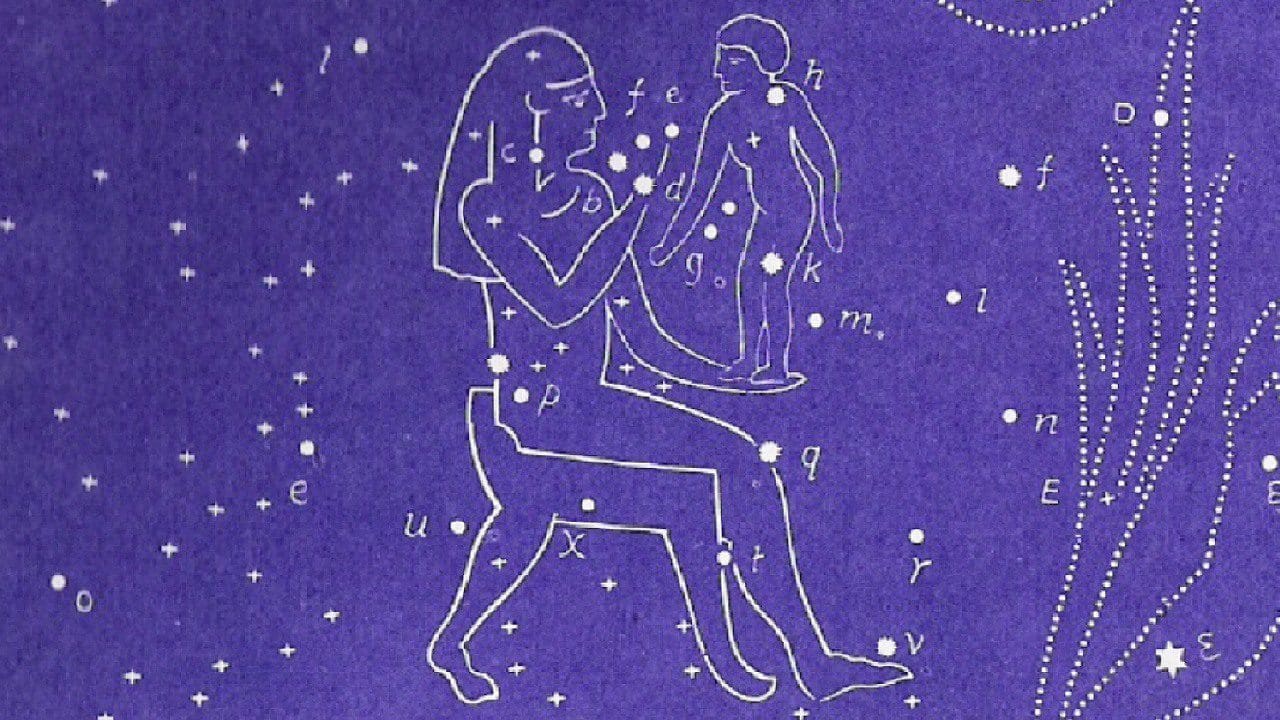
Image result for Decan Coma

In the late 90’s I began teaching the General Sign of the Celestial Prelude, as a supernova that exploded in the head of the infant of the decan Coma. This is the initial clue as to what the Magi were prompted to look for, not a comet, like Halley’s Comet that some have attempted to make a case for. The dates for Halley’s Comet are too early, to coincide with the birth of Christ, although it does fall within the timeframe of the General Sign of the Celestial Prelude, about 5 years before the triple union of Jupiter-Saturn in 7-6 BC. The foregoing and concurrent supernova in Coma was designed to draw the Magi’s attention to this general time frame of the birth of the promised seed, so they would recognize the true signs of the Star of Bethlehem when they took place in 3-2 BC.

In his critique of the Gospel in the Stars, Faulkner continues against the writings of Joseph Seiss;
“If one uncritically reads what Seiss wrote here about decans, it is convincing. However, once one realizes that there is no basis for the decanal arrangements as put forth by Gospel in the stars advocates, then the quotes do not amount to much. That is, one could easily understand these quotes in the context of the proper view of the decans being 10-degree increments within each zodiacal sign.”19 As I have provided this organized and historical view of the ancient Egyptian structure of their decans in 10 degree increments, going back to at least 3,000 BC, it appears Seiss’ case for the decans would remain a convincing one. In fact, Seiss concludes his discussion of the decans with this interesting sentence:

And after the closest scrutiny, those who have most thoroughly examined and mastered the subject in its various relations entirely agree with the same enumeration, which I therefore accept and adopt for the present inquiries into this starry lore, sure that the particular examination of each sign, with the Decans thus assigned to it, will furnish ample internal proof that this enumeration is correct according to the original intention. 20

Here Seiss appeals to self-consistency for ultimate proof of the arrangement. That is, the 3 other decans supposedly linked with the 12 zodiacal signs complement each other so well as to depict that the arrangement is true. Faulkner adds: “I cannot find a precedent for her decans in literature, and this arrangement appears to be unique to the gospel in the stars, suggesting that this arrangement originated with Rolleston. If anyone can produce a clear reference from Albamazar or from any other ancient or medieval source of the arrangement presented by Rolleston thus showing that her arrangement of the decans predated her, then I will gladly withdraw this.”21 [Faulkner 2013]

Obviously, with all the evidence we are presenting from Ancient Egyptian astronomy, we are taking up Faulkner’s challenge directly, of “producing a clear reference from any other ancient source that these decans” 22 notably predated her writings, and that he should withdraw his criticism of Rolleston, on these grounds.

Unlike Seiss, we are not relying exclusively on the internal self-consistency of the ancient meanings of the decans as they support the themes of the 12 main constellations, even though we do not deny the existence of this element of the Gospel in the Stars, and we have documented it in the agreement between the decans of Leo with Leo the lion. But we will point out Faulkner’s errors specifically with the decan of Coma that led him to false conclusions. As Faulkner points out regarding the Decan of Coma, he picks up its history starting with the nomenclature of the Coma Berenices decan seen as the hair of Queen Berenice II of Alexandria. Citing the Queen’s death in 221 BC, Faulkner concludes the constellation cannot date any earlier than that. 23 His summary obviates any link to the Coma Decan in the Dendera Zodiac, along with its potential 5000+ year history.

Figure 8. Virgo “clothed with the Sun with the Moon at her feet” on 9-11-3 BC, with the decan Coma “Berenices” pictured according to Greek Myth as a woman’s wig

References to this being the hair of Queen Berenice began appearing within a century after her death, and Ptolemy mentioned this faint grouping of stars as hair, but did not ascribe it to her. Faulkner does recognize how both Seiss and Bullinger identified Coma on the Dendera zodiac, but Faulkner says that “later cultures misunderstood this.”24 Faulkner stays on his critique by noting her reference to the Coma Decan on the Dendera zodiac;

In our previous blog from April 2020, we presented historical evidence of how the ancient Egyptians documented and calculated their stellar decans in their rich history of heliacal rising of stars.  
Rolleston (1865, part 2, p. 16) noted that on the Dendera planisphere there is a figure of a woman holding a small child below the figure of Virgo, and she surmised that this otherwise separate drawing was related to Virgo, though Virgo has no child displayed with her. Rolleston (1865, part 2, p. 17) posited that Coma represented the branch or sheaf of grain that Virgo normally is depicting as holding. 25

I agree with Rolleston’s assertation that “Coma represented the branch or sheaf of grain that Virgo normally is depicting as holding,” for a number of reasons primarily because it agrees chiefly with the Scriptural witness of the star Spica as the Branch, as seen below.  Since Faulkner has given no practical credence to the witness and powerful influence of the Dendera Zodiac or the Great Sphinx, he makes the mistake of ignoring this rich Egyptian astronomical history of the 12 signs supported by the decans, and acknowledges only the Greek history of the Coma Berenices decan, asserting that; this constellation cannot date earlier than Queen Berenice’s death in 221 BC! With one breath he acknowledges the ancient Egyptian history of the constellations, including the Coma Decan, but in the next breath, wipes it away as if it never existed, cutting it off beyond the Greek history of Coma Berenices.

As shown in Faulkner’s quote of Seiss; “The Greeks knew not how to translate it, [Coma] and hence took Coma in the sense of their own language, and called it hair—Berenice’s Hair (Seiss 1882,
p. 29).26 The Greek word for hair is Co’me, which in Latin was Coma, so the original meaning of the decan Coma on the Dendera Zodiac, linked to Virgo’s branch of grain, was corrupted in the Greek translation. 21 The original connotation in the Dendera Zodiac is found in how the Coma decan supports the gospel message being conveyed in Virgo, as seen in the brightest star in Virgo known as Spica.

Virgo is always portrayed holding a spike of wheat in one hand and a staff. The spike of wheat fits, the star Spica (alpha star of Virgo ), as one of the oldest star names in use (and the origin of “spike-” the English word for an ear of grain).  Virgo is the 2nd largest constellation and the Sun stays longer in Virgo than in any other constellation of the zodiac, entering on Sept. 21 and not leaving until November 1. The Sun is therefore within its boundaries at the time of the autumnal equinox, about Sept. 23.

Figure 9. Virgo at Sunset on Sept. 11th, 3 BC.

great sphinx

The sign Virgo emphasizes her fertility or motherhood, as she holds in her right hand a branch, or staff, also a title applied to the Messiah as the offspring of David, and in her left hand some sheaves of corn, or seeds of wheat (ear of grain, spike of wheat (Spica).

The star Spica, in Virgo, which appears to be only one of two specific stars shown on Dendera’s zodiac, the other being Sirius, embodies the Promised Seed-Jesus Christ in a four-fold ministry as King, Son of Man, Servant and Son of God, as seen in the Four Gospels; Matthew, Mark, Luke and John. This is also found in OT Messianic Prophecies listed below, showing how the Gospel in the Stars supports God’s Written Word concerning Jesus Christ. The Branch is the Biblical name for the Star-Spica in the Old Testament, as the name of the coming Messiah.

1. Matt.-King of Righteousness [“Kingdom” referred to in Matthew more than any-where else] [*Zech. 9:9, Jer. 23:4-6, 33:15] Thus the royal genealogy is in Matt. 1:1-17]. “Kingdom of Heaven” is only in Matthew, none of the other gospels.

Jeremiah 23:4-6 “…the days come, saith the LORD, that I will raise in David a righteous Branch, and a King shall reign and prosper, and shall execute judgment and justice in the earth…Judah shall be saved, and Israel shall dwell safely: ..he shall be called, THE LORD OUR RIGHTEOUSNESS.” This Branch is the same as that in Isaiah 4:2.
Jeremiah 33:14-16 “…I have promised unto the house of Israel and to the house of Judah…
will I cause the Branch of righteousness to grow up unto David; and he shall execute judgment and righteousness in the land…Jerusalem shall dwell safely…

2. Mark–Servant of Jehovah [“Lord” 3x here, 78x in the other 3 gospels] [Isa. 42:1, Zech. 3:8] Thus No genealogy is given in Mark. Zechariah 3:8 “…I will bring forth my servant the BRANCH.”

3. Luke
– Son of Man [Luke records his childhood, his dealings with women, publicans and other key aspects showing his humanity] [Zech. 6:12, thus the human genealogy is given going back to Adam, (Lk. 3:23-38)] Zechariah 6:12 “Behold the man whose name is the BRANCH.”
This Branch is the same as that in Isaiah 4:2, but here “my servant,” identifies the character is the title of Messiah (Isa. 4:2, 42:3, 50:10, 52:13, 53:11, Ezek. 34:23-24) and the Messiah, a tender branch from the almost extinct royal line of David (Zech. 6:12, Isa. 4:2, 11:1, Jer. 23:5, 33:15).

4. John
– Son of God [Zech. 4:2][“father”-121x, only 66 times in the other 3 gospels.
“
My Father”-35x only 18x in the other 3 gospels, “only begotten” 4x, none in other gospels]
The purpose of every chapter in
John’s Gospel reveals Christ’s true identity.

“Son of God” in the Gospel of John–
John 1:14-18: only begotten Son
John 1:34-36 Son of God & Lamb of God
v. 41-Messiah
v. 49-RABBI, King of Israel

Isaiah 4:2 “In that day shall the branch of the LORD be beautiful and glorious.”
In Isa. 4:2, Sanctification is promised by means of a branch, or Heb. tsemach, tseh’-makh, from Heb. tsamach, tsaw-makh’, a primary root, to sprout, thus meaning a sprout.  lit. or fig.: – branch, bud, that which grew, spring. This branch was the sprout of Jehovah. Messiah as in (Jer. 23:5, 33:15, Zech. 8:8, 6:12, and Luke 1:78).

Micah 5:1 “rod” (judge), and Psalm 2:9 “rod of iron,” denoting severity as in Rev. 2:27.

Isaiah 11:1 “And there shall come forth a rod out of the stem of Jesse, and a Branch shall grow out of his roots:
Isaiah 11:2 
And the spirit of the LORD shall rest upon him, the spirit of wisdom and understanding, the spirit of counsel and might, the spirit of knowledge and of the fear of the LORD;…”
The manifestations of the Spirit in the OT.

Rod – Heb. choter, kho’-ter, from an unused root, a twig, rod, or as other sources state it as Heb. maqqel, matteh, shevel, also Gr. rhabdos, rhab’-dos, a stick or wand, rod, sceptre, staff as seen in Rev. 2:27 represented the coming of Christ who was to be preceded by the rod as seen in Micah 5:1. Jesus embodies the rod or (scepter-Psalm 2:9). Others believe that Isa. 11:1 refers to a humble rod which shall come out of Jesse (as the Messiah).

This panoramic view of the Star Spica in Virgo shows how God’s Word elaborates on what this star really embodies, and why it was only one of two stars so emphasized on the Dendera zodiac, that so beautifully fortells of the birth of the Promised seed in the early Piscean Age.

I’m so thankful for our Heavenly Father who sent His Word to us whether spoken, in Creation, Written or in the Flesh, they all embody the Promised Seed- Jesus Christ, the Anchor of our souls, in whom we continually abide day by day unto the Coming of that Great Day!

God Bless!


Rene’

Footnotes

1. [http://yin.interaccess.com/~jas/5.shtml]
2. Posted on  by Asec
3. From The Alpha and the Omega – Chapter 1, Jim A. Cornwell, 1995.
4. Decoding the Great Pyramid, Lemesurier p. 12
5. [https://sacredsites.com/africa/egypt/dendera.html]
6. http://myblog.robertbauval.co.uk/
7. Heaven’s Mirror, Graham Hancock & Santha Faiia
8. Witness of the Stars, p. 43, E.W. Bullinger
9. The Dawn of Civilization, Gaston Maspero
10. The Temple of Esneh as found on the “Egyptian Post Card Page” at http://itdsrv1.ul.ie/~bolgerb/pc_egy.html.
11. Figure 3. Picture credit -Dendera Square Zodiac. http://www.voyager.co.nz/~masonpj/zodiac.htm
12. Faulkner 2013. https://answersingenesis.org/astronomy/stars/a-further-examination-of-the-gospel-in-the-stars/
13. Companion Bible, marginal note on Isa. 7:11, E.W. Bullinger
14. The Skies in Memory, John Lash in The Atlantis Blueprint, Wilson & Flem-Ath. p. 171.
15. Witness of the Stars p. 39, E.W. Bullinger
16. Gospel in the Stars, Joseph Seiss, ppg. 28-9
17. IBID, ppg.31-32.
18. IBID, p. 19 picture credit on the Decan Coma.
19. https://answersingenesis.org/astronomy/stars/a-further-examination-of-the-gospel-in-the-stars/
20. IBID,
21. IBID,
22. IBID,
23. IBID,
24. IBID,
25. IBID,
26. IBID,


Comments on Facebook

To those of you interested in commenting on this post please go to our Facebook Group Page 

https://www.facebook.com/groups/bibleastr


The Lunar Mansions Part 3, Dendera Lunar Decans

The Lunar Mansions Part 3, Dendera Lunar Decans

In Part 3 of our series on Lunar Mansions we will focus on the Lunar Decans of the Dendera Zodiac. In the first two parts of this series, we reviewed how the Lunar Mansions were preserved in ancient China, India, Isreal and Arabia. In Part 3 our focus is on ancient Egypt. The Dendera Zodiac is the best-known example of Egyptian zodiacal monuments, whose temple dates from the 1st century BC. The zodiac however, is believed to date far older than the temple housing it, going back at least to 2100 BC. Now housed in the Louvre, in Paris, the Dendera Zodiac displays a rounded ceiling vault with the 12 major signs, as well as the Egyptian northern and southern constellations, the planets, the sun and moon, and the 36 lunar decans, arranged around the periphery of the circular zodiac.

An early scientific study of Egyptian archaeological sites was conducted as part of Napoleon’s campaign into N. Africa. Bonaparte included French Archaeologists and language specialists to research key sites including the Giza Plateau. Many French scholars of the day believed the Dendera Zodiac to be thousands of years older than the Ussher’s date of creation. This was not the ideal or most politically expedient date for the “Holy Roman Empire,” but with the entrance of Champollion, as the foremost French Egyptologist in Napoleon’s reign, he provided a later incept date for the Dendera zodiac. As the first to decode the hieroglyphics on the famed Rosetta Stone, based on his study of Temple cartouches near the Temple’s ceiling location of the Dendera zodiac, he dated the royal names and by association, the Dendera Zodiac itself to a period between 50-200 BC. 1

Library of Alexandria Documentary Series: Temple of Dendera ...

As a result, this late dating of the Dendera Zodiac has persisted in orthodox Egyptian archaeology to this day. But English scholars like Herman Lockyer provided evidence that the Dendera Temple housing the zodiac was probably “rebuilt at least three times since 3733 BC; once in the reign of King Pepi I, [which Lockyer dates at 3233 BC] once again by Thothmes III in 1600 BC, and finally by the Ptolemies about 100 BC. According to Lockyer the temple may have been aligned previously at the star Dubhe, which ceased to be circumpolar about 4000 BC, and before that at gamma Draconis, which ceased to be circumpolar about 5000 BC.” [2]

Lockyer also held that these historical rebuilds of astronomical Temples, based on changing star alignments, shows an awareness of the Precession of the Equinoxes in ancient Egypt, that far predated Hipparchus‘ supposed c.140 BC “discovery” of the precession of the Equinoxes. Another of these French Archaeologists; “Dupuis calculated the incept date of the Dendera Planisphere around 4000 BC.” 3 There is an obvious host of modern scholarship in agreement with Lockyer, opposing the orthodoxy of modern evolutionary archaeology, including “Hamlet’s Mill” authors George Santillianna and Von Dechend, who documented a number of tribal cultures like the Inuit, Persians, Norsemen, Native Americans, Hawaiians, Japanese, Chinese, along with the ancient Egyptians, who all recognized the sacred signs
and iconography of the precession of the equinoxes.

Champollion’s later date above, agrees with Lockyer’s date of the latest rebuild of the Dendera Temple by the Ptolemies around 100 BC, while ignoring the earlier temple rebuilds, going back to the Old Kingdom. As the oldest circular zodiac, Dendera holds a key place, not only in Biblical Archaeology, and Archaeo-Astronomy, but also with its system of Decans, from ancient Egypt, providing rare evidence supported in the most ancient texts, like the Pyramid Texts, predates any existing record for a Gospel in the Stars. In a recent critique of the writings of Frances Rolleston and the idea of the “Gospel in the Stars,” that she popularized in the later 1800’s, [Faulkner-2013] states;

“Not only are there no texts preserving the original knowledge of the gospel in the stars, but we know of no sources before Rolleston that claimed that there ever were such texts, or that any ever lived who believed such things. The first source we know of to make this claim is Frances Rolleston’s book. Let me be clear—it is obvious from Rolleston’s book that she had no texts that clearly taught her thesis. Instead, she created the meanings to support her thesis without reliance upon any older texts. The evidence we have that is most consistent with the gospel in the stars thesis not being an ancient idea at all, but entirely the invention of Frances Rolleston less than 200 years ago.”4

Faulkner continues;
“Although many ancient cultures referred to decans, they are defined differently than how  Rolleston used the term. These cultures divided each astronomical sign into three decans. Since there are twelve signs circling the sky, each sign stretches over about 30° of the ecliptic. Thus, each decan spans roughly 10° along the ecliptic. Since it takes approximately 360 days for the sun to complete a circuit with respect to the stars, the sun occupies each decan for roughly ten days.“5

Faulkner’s description of how these “ancient cultures” calculated decans in their calendars, is an exact match for how the Egyptians calculated them related to the Dendera Zodiac. 
Although our admiration and respect for Rolleston is great, due to her reliance on Scripture, our approach to Biblical Astronomy holds Biblical Scripture as the ultimate source of truth and the veracity of the Celestial Gospel. The evidence for the Gospel in the Stars we cite, comes primarily from the Scriptures of the Bible first and foremost, then is supported by historical research and secular sources in Biblical Astronomy. Few are aware of the evidence linking the Dendera Zodiac with prophecies of the birth of Christ, that I have advocated and posted [@try-god.com] for over 15 years, and continue to expand, including this blog in the Spring of 2020. Below is a Scriptural example of the three decans linked to Leo the Lion, highlighted in yellow. 6

Mazzaroth Chart - Hebrew Astrology - Constellation 12. Leo ...

Obviously, Faulkner is not familiar with the abundant Scriptural references to the Gospel in the stars, and the internal integrity of God’s Word at the basis of this subject, that provides all the ancient textual evidence required, far out dating Rolleston on this subject. Added awareness of how the ancient Egyptian monument, the Great Sphinx embodies the Alpha-Omega signs of the Hebrew Mazzaroth, with prophecies of the Birth of Christ, that adds historical support to the Dendera Zodiac. When taken with the other monuments of the Giza Plateau, the witness from ancient Egypt for the Gospel in the Stars becomes a deafening crescendo of truth, impossible to ignore for any honest seeker of evidence for an astronomical gospel. A key element of the Dendera zodiac is the recognition of the ancient Egyptian star names associated with it, and their meaning, compared to the Hebrew meanings of the same stars. This gives us a view of the similar approaches to practical Astronomy between the two cultures and the potential common source of these star names, from Biblical Patriarchs like Seth and Enoch, and how they convey the gospel message, prior to their corruption in the idolatry of the Egyptian star religion.

The Pyramids of the Giza Plateau

Egypt: Temple of Dendera - Smit & Palarczyk | Egypt, Egypt art ...

This evidence from the Dendera Zodiac, with its system of Decans predates the usage of decans in any of the oldest Greek or Latin texts by thousands of years, providing an ancient source far in advance of Rolleston’s writings, or even Ptolemy, as a basis for the Gospel in the Stars. We will explore the details of this in later blogs in 2020, as this blog serves to introduce the reader to some of the research in this field underlying Biblical Astronomy. This method of decan calculation was standard practice in ancient Egypt. With this ancient Egyptian historical background, we don’t have to rely on Faulkner’s opinion of how this ancient system of decans came together, since we have scholarly accounts from the oldest texts in history like the Pyramid Texts and the Book of Job, that make specific references to the decan system in ancient Egypt, based on the “Helical rising” of stars and asterisms used for time-keeping, from at least the end of the Old Kingdom in Egypt, [circa 2200 BC], if not earlier. 7

The Pyramid Texts, writings and tomb wall decorations, dating back to the Old Kingdom (2780–2250 BC) provide a bulk of decan references and ancient Egyptian creation myths. The progression of decan stars in Heliacal rising also explains how the series of 3 decans aligns with each of the 12 major constellations of the zodiac, giving a basis of the order of decans in the zodiac of Dendera, as stated by Rolleston and other Gospel in the stars advocates, witnessed with Leo’s three decans above.

Figure 1. Dendera Zodiac with 36 Lunar Decans. 8

Figure 3. The figures represented in the Dendera Zodiac correspond to the traditional zodiacal signs

The color-coded image of the Dendera Zodiac below, shows specifically how the decans on the outer rim of this zodiac match up to the 12 main constellations in red, blue, orange,  and Yellow. Another element of dominion seen in the four faces of the Cherubim, [Ezek. 1:5-6], shows what the Babylonians called the 4 royal signs, we find Aquarius–Man who is created after God’s image, with Leo the Lion the king of non-domesticated animals. With the Taurus the Bull as the king of domesticated animals, seen at the bottom cardinal point with the sign of the Bull in Fig. 3. and the Eagle-Aquila, king of the fowl of the air, [Gen.1 26-28], we find a composite image of these four signs of the zodiac in the Cherubim. These four Cardinal Directions, of the Hebrew Mazzaroth provide a template for the 12 major signs both in Egypt and Israel. [Num. 24:7-9]

Figure 2. A color-coded image of the Dendera Zodiac. 9


Sun, Stand Thou Still Upon Gibeon; And Thou, Moon, In The Valley ...

Schwaller De Lubicz is another scholar who argued in favor of the ancient Egyptian knowledge of precession. He points out 2 hieroglyphs on the outer rim of Dendera’s zodiac that mark a line between Aries the Ram and Taurus the Bull, correlating to a date around 2200 BC, in Fig. 3 indicating how the Egyptians wanted to mark the transition in ages of precessional ages, in this case from the age of Taurus to that of Aries. As De Lubicz states;

“The mere fact that the cult of the Bull [Apis/Mentu] preceded the cult of the Ram [Amon]
in Egypt, and that the dates of these cults correspond to the equinoctial positions of their constellations at the appropriate time-approximately 4000 and 2000 BC-is conclusive.
“10

According to Schwaller DeLubicz, this was conclusive evidence that the ancient Egyptians were not only aware of, but applied their knowledge of the precession of the equinoxes. This evidence also speaks volumes concerning the age of the Dendera Zodiac, documenting this transition of the precessional ages of Taurus to Aries, following other elements of the calendar system inherent in the Dendera Zodiac before 3000 BC.

Figure 3. Overlaid Zodiacs of the Celestial Pole and Ecliptic Pole of the Dendera Zodiac. 11
zodiac poles

As we can see in Figure 3 above, the receding pole star is mapped on the smaller inner center circle, along with a series of four points related to the four axes on the larger outer circle of the zodiac. This shows us the pole star in the specific precessional ages going back to the Age of Gemini, marked on the larger zodiacal circle by the symbol “II“, prior to 4380 BC, portrays the transition from the Age of Gemini to the Age of Taurus. This depicts Gemini’s position at the early stages of Egyptian reckoning of precessional ages in Dendera’s zodiac, even though the latest version of the Temple of Dendera housing
this zodiac, was rebuilt in the late Hellenistic period.

Most of the prevailing sentiment in orthodox archaeology holds an evolutionary view where the sophistication of astronomical understanding of concepts like precession was beyond the ken of “primitive” cultures, despite abundant evidence to the contrary. The orthodoxy finds itself at a loss to explain how ancient history does not conform to their evolutionary view of increased astronomical sophistication with the passage of time, instead, they are faced with a reality where the older and superior application of this knowledge was corrupted by the mythology and idolatry of later cultures in the ancient world. As E.W. Bullinger stated:

“All the ancient systems of idolatry connected with Astrology and mythology were in the same way, not original inventions of what was new but the corruption of what was old,
and the perversion of original truth
.”12

Figure 4. Ancient Archaeological depictions of the Precessional Age of Taurus the Bull.

What are some of the commonalities among the various myths across ...

This reflects a history of Dendera’s temple and associated Zodiac extending back into Pre-dynastic ages coincident to the Precessional Age of Taurus. We take added note of their recognition of the Precession of the Equinoxes in ancient Egypt, and how early Pharaohs took their titles. Starting with the Menuhopteps, and Menes/ Narmer, who ruled before the Amenhoteps in Pharaonic historical progression. Notably, the Old Kingdom Pharaohs adopted Mentu the Bull in their titles during latter parts of the Precessional Age of Taurus, before the precessional shift to the Age of Aries, around 2200 BC. This transition of ages of the precession of the equinoxes, occurred when the retrograde motion of the Sun caused the sunrise in successive signs of the zodiac every 2.160 years, opening a new precessional age.

Figure 5. Pharaoh Rameses II linked with the Precessional Age of Aries in a Ram-headed Sphinx.

What are some of the commonalities among the various myths across ...

Once the Age of the Ram Aries began, the Pharaohs began honoring the Ram-Amon in their kingly titles. During this period and following was also when Ram-headed Crio-sphinxes began showing up in Egyptian iconography, as a representation of their creator-god Khnum, who they believed, fashioned the universe out of clay. This also accounts for Khnum’s association with the fertility of soil and the annual inundation of the Nile, marked by the star Sirius. As Khnum’s influence grew in power in Egyptian pantheons, the symbolism of the previous precessional Age of Taurus decreased in value. Egyptologist Richard Parker deciphered early symbols carved on an ivory tablet from the First Dynasty as: “Sirius, the opener of the year, the innundation.” As Krupp observes: “This implies that the basic elements of the calendar system were in place by 3100 BC. The same celestial calibrations endure all the way into the Ptolemaic period, 3,000 years later.“ [13]

This 1st Dynasty Ivory plaque depicts the star Sirius as a hieroglyph of a reclining Cow with the Sun above her head, easily visible in similar form in the Dendera zodiac, marking not only the decan to open the New Year, but also denotes the precession of the equinoxes. Since Isis embodied this reclining cow pictured with a star between bovine horns, seen just above the “Decans” label in the lower-left corner of Fig. 6, below, providing strong evidence of the use of the Sirius cycle, or Sothic Calendar in ancient Egypt, as a testimony to their advanced astronomical practices and recognition of precession
early on.

Figure 6. Dendera Zodiac cast at the Rosicrucian Museum-San Jose, CA. 14

The significance of the coordination of the lunar and solar cycles in the context of this New Year’s celebration is that the Heliacal Rising of Sirius also qued the Egyptians to add an  Intercalary month, keeping the calendar’s lunar cycles in line with the solar seasons. This luni-solar coordination also applies in view of the unity of lunar decans with the solar zodiac of 12 Constellations, on the Dendera Zodiac, not in disjointed separation. The calendars with long-standing and wide-spread use in Egypt included those of both administrative and religious uses. They date from Egypt’s unification around 3000 BC. The civil calendar consisted of 365 days, with 12 months of 30 days, and each month named for religious holidays during that month. On this lunar plan, each month consisted of 3 weeks, of 10 days, in-synch with their 36-decan system.

As the only circular astronomical model to be found in Egyptian antiquity, Dendera’s Zodiac depicts the 360 days of the Egyptian year, with decans arranged on the outer edge of the circular zodiac. Twelve signs with 3 decans each, in the 360-day year, even with a 37th decan allowing for the 5 extra days of the year, totaling 365 days of the Sothic Calendar. Figure 7 shows images of the specific star groups and asterisms in heliacal rising every 10 days on the Dendera Zodiac.

Figure 7. 36 Decans of the circular Dendera Zodiac with their star signs. 

Denderah Zodiac divided

As we have documented in parts 1 and 2 of this series on the Lunar Mansions, the Chinese, Arab and Indian zodiacs applied 28 Lunar Houses distinct from these 36 Decans. Some hold that the decans predate the use of the 12 signs in ancient Egypt to divide the ecliptic, but the Egyptian recognition of the ages of the precession of the equinoxes pointed out above, is contrary to that notion. It appears more likely that the decans were directly linked to each of the 12 tropical signs of the zodiac initially, in alignment with the theme of the Gospel in the stars. Thus the lesson of the decan supports that of the 12 constellations, even as we see with Leo’s destruction of the serpent- Hydra above. Bullinger tells us the Egyptian name for Leo was Pi Mentekeon, which means the pouring out, in reference to pouring out of divine wrath, as seen in the decan-Crater, the cup holding God’s wrath in the judgment of Christ’s victorious return, [Rev. 14:10, 16: 19]. The 3rd decan of the Raven Corvus also adds to this theme in one of the decan star names called Minchar al Gorab, meaning Corvus tearing to pieces the serpent’s remains;
[Prov. 30:17, 1 Sam. 17:46]. 15 

This attests to the integrity of the stellar witness, with all its elements reflecting the same truths of Scripture, as seen in the 19th Psalm. These ancient lunar calendar decans marked the Lunar Mansions, but due to inconsistent records of Decan stars, there was an occasional lack of consensus in Egypt, so with the exception of Sirius, the rest of these 36 decans endured several transformations during the Hellenistic period. 16

A good source for a specific list of these decan stars from the Middle Kingdoms was from an office-holder under Queen Hatshepsut (c. 1450 BC) of Egypt named Sesenmut, was buried near the queen’s tomb. On the ceiling of his burial monument was found an excellent example, from the Age of Aries of these 36 decans listed below.

Figure 8. The Decans of Senenmut’s Tomb 17

The Egyptians divided the decans of the night sky in different constellations in a way similar to modern astronomy. Senenmut’s Tomb is a great example of the decans in painted ceilings of different Egyptian tombs, that allow us to establish their number from tomb to tomb. In spite of periodic uncertainty, it seems there were at least 36 decans consistently depicted. Egyptians divided the year in 5 days plus 36, 10-day periods, corresponding to the 10 days of consecutive risings of decan stars recorded in Senenmut’s tomb, listed below:

  1. tpc-knmwt. A set of three stars represented by a man with a solar disk on his head. It is linked to Geb. [Canis Major]
  2. knmwt. A boat with a head of a snake in the ship’s bow with a standing boy with one finger in his mouth. It is associated to Isis or Ba. [Canis Major]
  3. hr-hpt-knmwt. A set of three stars seen in a tailed man with a bird’s head with a double crown.  It is linked to Isis or Horus’ sons. [Cancer]
  4. h3t-d3t. A set of four stars represented by a falcon-headed man with 2 big feathers.  It is associated to Isis or Hours’ sons. [Leo]
  5. phwy-d3t. A set of three stars seen in a man with a white crown on his head and a scepter in his hand.  It is linked to Horus’ sons. [Leo]
  6. tm3-hrt. A set of three stars represented by a man with two big feathers on his head and a scepter in his hand.  It is associated to Duamutef or Mesti. [Virgo]
  7. tm3-hrt. A set of three stars seen in a falcon-headed man with horns and a solar disk over them. He also holds a scepter in his hand.  It is linked to Duamutef or Qeehsenuef.  [Virgo]
  8. wsti. A man with the solar disk rounded by a royal snake.  It is associated to Duamutef.  [Virgo]
  9. bk3ti. A man with the double crown and a scepter in his hand.  It is linked to Duamutef.  [Virgo]
  10. tp-c–hntt. Two stars represented by a falcon-headed man with a solar disk on his head and a scepter in his hand.  It is associated to Duamutef or Hapy. [Scorpio]
  11. hntt-hrt. A set of two stars represented by a tailed man with a stick and a scourge in his hands.  It is linked to Horus.  [Scorpio]
  12. hntt-hrt. A set of four aligned stars seen in the four aligned stars, a head and an arm on a ship.  It is associated to Seth.  [Scorpio]
  13. tms-n-hntt. Three aligned stars represented by a baboon on a ship in front of a lunar disk.  It is linked to Horus.  [Scorpio]
  14. s3pt–hnnw. A set of 2 stars seen in Anu a falcon-headed man with a scepter in his hand.  It is associated to Isis or Nephtis.  [Scorpio]
  15. hr-ib-wi3. A set of four stars represented by a falcon-headed man with a solar disk on his head and a scepter in his hand.  It is linked to Seth or Ur.  [Scorpio]
  16. shsmw. Two stars seen in a man with a snake and a scepter in his hand.  It is associated to Seth or Ur. [Serpens]
  17. knmw. A headless man with a solar disk on his shoulders.  It is linked to Hapy or Duamutef.  [Serpens]
  18. smdt. Three stars represented by a tailed man with a double crown.  It is associated to Horus. [Capricorn]
  19. tpc–smdt. A tailed man with a double crown.  It is linked to Hapy.  [Capricorn]
  20. srt. A set of four stars seen in a falcon-headed man with the ateph crown and an animal tail in his skirt.  It is linked to Isis. [Aquila]
  21. s3wy-srt. Two stars seen in a woman with a scepter in her hand.  It is associated to Duamutef. [Aquila]
  22. hr-hpt-srt. A tailed man with scepter in hand, linked to Qebehsenuef. [Aquila]
  23. 3hwy. A tailed jackal headed man with a scepter in his hand.  It is associated to Duamutef. [Pisces]
  24. b3wy. A set of 3 stars represented by a tailed ibis headed man with the ateph-crown and a scepter in his hands.  It is associated to Duamutef. [Pisces-Cepeus]
  25. hnt-hrw. A tailed falcon-headed man with a tadpole.  It is linked to Hapy or Mesti.
  26. hr-ib-hntw. A tailed falcon-headed man.  It is associated to Horus.  [Aries]
  27. hnt-hwr. A boy with one of his fingers in his mouth sitting on a lotus flower.  It is linked to Horus. [Aries]
  28. kd. Three stars represented by a boy with one of his fingers in his mouth sitting on a lotus flower and a solar disk on his head.  It is associated to Horus. [Taurus]
  29. s3wy-kd. Two stars seen in a tailed man with the ateph crown and a scepter in his hand.  It is linked to Horus. [Taurus]
  30. crt. A tailed man with a papyrus plant.  It is associated to Qebehsenuef. [Taurus]
  31. h3w. Four stars seen in a tailed falcon-headed man with the double crown.  It is associated to Hapy. [Taurus]
  32. rmn-hrw-inw-s3h. 18 stars seen in a tailed man with the white crown and a scepter in his hand.  It is linked to Mesti. [Aries]
  33. msdr-s3h. A lioness headed woman with a royal snake and a crosier in her hand. It is associated to Duamutef. [Orion]
  34. rmn-hr-s3h. Three stars seen in a man with the white crown with a feather sitting on a throne.  It is associated to Horus. [Orion]
  35. c–s3h. An ibis-headed man with the ateph crown and a scepter in his hand.  It is associated to Horus. [Orion]
  36. s3h. Its corresponding is Orion and it’s represented by two ships. On the first one there are three people: a boy with one of his fingers in his mouth and a double crown on his head, a horned woman with a solar disk on her head and another woman with 2 feathers and the solar disk between them. On the other ship there is a snake in a lotus flower. It is associated to Maat-Horus.
  37. spdt. Its corresponding star is Sirius and seen in a tailed falcon-headed man with a solar disk on his head and a scepter in his hand.  It is associated to Isis. 18

This evidence reflects a long-standing history from Old Kingdoms and even Pre-dynastic ages of ancient Egypt of astronomical themes in support of the Gospel in the Stars. My encouragement to the reader is to review the links included here and the key background provided in presenting the case for the “Gospel in the Stars,” and Biblical Astronomy. Awareness of these related topics, present a more comprehensive view of Biblical Astronomy, depicting a grasp of sub-categories in this study, and how they support and inter-relate to the larger context.

God Bless!

Rene‘

Footnotes

1. [https://www.ancient-origins.net/artifacts-other-artifacts/circular-egyptian-mythology-does-dendera-zodiac-represent-most-ancient-021599]
2. Secrets of the Great Pyramid, Peter Thompkins, p.168
3. The Mazzaroth, Antiquity of the Chaldean and Egyptian Constellations, Frances Polleston
4.  https://answersingenesis.org/astronomy/stars/a-further-examination-of-the-gospel-in-the-stars/
5. IBID
6. https://www.pinterest.com/pin/338614465705844552/ [picture credit]7
7. The Senenmut Project-Introduction, Jose Lull
8. [https://www.ancient-origins.net/artifacts-other-artifacts/circular-egyptian-mythology-does-dendera-zodiac-represent-most-ancient-021599] [picture credit]
9. https://www.starmythworld.com/mathisencorollary [picture credit]
10. The Skies in Memory, John Lash as quoted in The Atlantis Blueprint, Wilson & Flem-Ath. p. 169
11. Secrets of the Great Pyramid, Peter Thompkins, p.172
12. Companion Bible, App. 42, EW Bullinger.
13. Echoes of the Ancient Skies, p.172, E.C. Krupp
14. Dendera Zodiac cast at the Rosicrucian Museum-San Jose, CA. [picture credit]
15. Witness of the Stars, p. 163, 168. EW Bullinger.
16. The Discovery of Time, ppg. 82-83, Stuart McCready
17. https://themathematicaltourist.wordpress.com/2012/10/13/the-decans-in-senenmuts-tomb/ [picture credit]
18. IBID

Comments on Facebook

To those of you interested in commenting on this post please go to our Facebook Group Page 

https://www.facebook.com/groups/bibleastr

Are Virtue Signaling Pastors Breaking the Law?

As we are all making sacrifices and enduring certain hardships due to the Covid-19 virus,
I wanted to pass on Jon Nessle’s excellent article in a special blog post this month.

Are Virtue Signaling Pastors Breaking the Law?
(2020 Covid-19 Pandemic)
By Rev. Jon O. Nessle

It was the winter of 1974 and my first Sermon. The room had been rented and
everything organized and I was ready. But then a snow storm hit. Normally an inch
or two of snow would not thwart my congregation who were from small Midwest
towns and farms, who would not think much of it. But this snow fall was over 8
inches! I called everyone up and said, don’t come. We will reschedule it. I knew
that there would be some stubborn or persistent folks who would brave the elements
and still try to come and I had elderly members that I did not want to put at risk. So
I postponed the meeting and told everyone to even call folks that they didn’t think
would come, just to make sure no one tried.

Weeks later when the meeting was to be held again, it began snowing again. I
declared, not again! I called up a few strong believers and we prayed for the snow
to stop. At the same time another congregant was flying in to the local airport. He
later told me of a strange thing he witnessed. He saw the snow stop falling! He said
it happened all across the sky simultaneously. The snow stopped all at once and as
the plane was descending to land he watched the clear patch of sky increase in size
moving downward. The layer of snow fell together like a falling blanket, leaving
clear air above! I asked him when was this? It was exactly at the same time we were
praying. We on the ground saw the snow stop and so we continued preparations for
the meeting.

Then one hour before the meeting was to start, I received a phone call from my
Mother. Her house had caught on fire! Thankfully, it was put out in time and the
damage was not terrible. I was 30 miles away. I asked her if she was OK and she
said yes and I explained that I could be there in a few hours and she said that was
fine. So I taught my first Sermon and made the Devil sorry he ever messed with me!
What was the difference between those two incidents? Wisdom.

With this current pandemic, these are unprecedented times in our lifetime,.
Ecclesiastes, a book of wisdom declares:
2
Ecclesiastes 3:1-8
1 To every thing there is a season, and a time to every purpose under
the heaven:
2 A time to be born, and a time to die; a time to plant, and a time
to pluck up that which is planted;
3 A time to kill, and a time to heal; a time to break down, and a
time to build up;
4 A time to weep, and a time to laugh; a time to mourn, and a time
to dance;
5 A time to cast away stones, and a time to gather stones together;
a time to embrace, and a time to refrain from embracing;
6 A time to get, and a time to lose; a time to keep, and a time to cast
away;
7 A time to rend, and a time to sew; a time to keep silence, and a
time to speak;
8 A time to love, and a time to hate; a time of war, and a time of
peace.

Perhaps this too is a time for wisdom : Because of the potential to spread the virus,
this is a time to refrain from embracing. Sometimes we face situations in which
there seem to be conflicts of priorities or Laws. This is one of them. On one hand,
the First Amendment of the U. S. Constitution states that “Congress shall make no
law respecting an establishment of religion, or prohibiting the free exercise thereof.”
On the other hand, Regional Health Authorities and State and County Governments
are imposing quarantines or limits on the size of meetings including Church, to limit
potential exposure to the virus. What should we do? Normally such constitutional
things are adjudicated in a Court of Law in which a Judge weighs the issues and then
based upon his or her wisdom, applies the law. We do not have time for that, for
this virus does not wait. But since this conflict of law will ultimately be resolved by
wisdom, can we not appeal to wisdom now?

This is the key question: Is complying with the Government’s temporary restriction
on large meetings, including Church meetings, an act of fear and therefore a violation
of faith? Is there a Biblical precedent for this situation? Yes there is! Quarantines
are Biblical and the rules are outlined in Leviticus 13ff. Therefore, obeying
quarantines are not a questioning of our faith.
3
Leviticus 13:1-5
1 And the Lord spake unto Moses and Aaron, saying,
2 When a man shall have in the skin of his flesh a rising, a scab,
or bright spot, and it be in the skin of his flesh like the plague of
leprosy; then he shall be brought unto Aaron the priest, or unto one
of his sons the priests:
3 And the priest shall look on the plague in the skin of the flesh:
and when the hair in the plague is turned white, and the plague in
sight be deeper than the skin of his flesh, it is a plague of leprosy:
and the priest shall look on him, and pronounce him unclean.
4 If the bright spot be white in the skin of his flesh, and in sight be
not deeper than the skin, and the hair thereof be not turned white;
then the priest shall shut up him that hath the plague seven days:
5 And the priest shall look on him the seventh day: and, behold, if
the plague in his sight be at a stay, and the plague spread not in the
skin; then the priest shall shut him up seven days more:

The priests were tasked with the job of diagnosis and quarantine because they were
authorities who could be trusted. While some could dogmatically claim that the
observation of such things must be done exactly the same today, I say that the
principles that are here can transfer to our modern situation. Today the trusted and
licensed ones who are tasked with diagnosis of disease and setting quarantines are
Doctors. Back then the Priests were trained and experienced in this. Today our
equivalent, Pastors, Priests and Rabbis, etc. are not. But the truth of quarantining
for a period of time still stands.

The Law of Moses also contained fascinating details about hygiene that protected
the Jews from germs 3000 years before they were discovered by Louis Pasteur.
There are directives about washing after touching dead things, and being unclean for
periods of time. This also includes washing clothes that were worn and even shaving
and social distancing!
4
Leviticus 14:8
8 And he that is to be cleansed shall wash his clothes, and shave off
all his hair, and wash himself in water, that he may be clean: and
after that he shall come into the camp, and shall tarry abroad out
of his tent seven days.
9 But it shall be on the seventh day, that he shall shave all his hair
off his head and his beard and his eyebrows, even all his hair he
shall shave off: and he shall wash his clothes, also he shall wash his
flesh in water, and he shall be clean.

Leviticus 14:34-48 even speaks of checking homes and condemning the buildings.
Again in modern times, religious leaders are not tasked or trained for such things.
Other trained and licensed experts are. It is fascinating to read this section of
Scripture knowing that mankind did not know about germs (but God did…)
5
Leviticus 15:2-13
2 Speak unto the children of Israel, and say unto them, When any
man hath a running issue out of his flesh, because of his issue he is
unclean.
3 And this shall be his uncleanness in his issue: whether his flesh
run with his issue, or his flesh be stopped from his issue, it is his
uncleanness.
4 Every bed, whereon he lieth that hath the issue, is unclean: and
every thing, whereon he sitteth, shall be unclean.
5 And whosoever toucheth his bed shall wash his clothes, and bathe
himself in water, and be unclean until the even.
6 And he that sitteth on any thing whereon he sat that hath the issue
shall wash his clothes, and bathe himself in water, and be unclean
until the even.
7 And he that toucheth the flesh of him that hath the issue shall
wash his clothes, and bathe himself in water, and be unclean until
the even.
8 And if he that hath the issue spit upon him that is clean; then he
shall wash his clothes, and bathe himself in water, and be unclean
until the even.
9 And what saddle soever he rideth upon that hath the issue shall
be unclean.
10 And whosoever toucheth any thing that was under him shall be
unclean until the even: and he that beareth any of those things shall
wash his clothes, and bathe himself in water, and be unclean until
the even.
11 And whomsoever he toucheth that hath the issue, and hath not
rinsed his hands in water, he shall wash his clothes, and bathe
himself in water, and be unclean until the even.
12 And the vessel of earth, that he toucheth which hath the issue,
shall be broken: and every vessel of wood shall be rinsed in water.
13 And when he that hath an issue is cleansed of his issue; then he
shall number to himself seven days for his cleansing, and wash his
clothes, and bathe his flesh in running water, and shall be clean.

Leviticus 17:15
And every soul that eateth that which died of itself, or that which
was torn with beasts, whether it be one of your own country, or a
stranger, he shall both wash his clothes, and bathe himself in water,
and be unclean until the even: then shall he be clean

Disease was prevented by the requirement to go outside the camp and defecate there
and then bury it. (Deuteronomy 23:12, 13.) Bloodborne diseases were prevented by
the prohibition of eating blood and viruses borne by unclean animals were avoided
by dietary laws. Leviticus 22: 4ff states that these rules even applied to the priests
themselves. Furthermore, Exodus 30:17-21 required the priests wash at the Laver.
While this would have ceremonial significance, it also has health implications for
the Tabernacle was a place of assembly for the congregation and as such, a common
source of the transmission of germs, much like schools are today. Social distancing
also was part of the Law:
6
Deuteronomy 23:10, 11
10 If there be among you any man, that is not clean by reason of
uncleanness that chanceth him by night, then shall he go abroad
out of the camp, he shall not come within the camp:
11 But it shall be, when evening cometh on, he shall wash himself
with water: and when the sun is down, he shall come into the camp
again.

So was the compliance with the Law a question of fear or faith? No, it
was of 
obedience. Therefore because of this precedent, I think that wisdom
should prevail 
and that we ministers who run Church meetings ought to think
of our most vulnerable congregants and not put them in harm’s way. Look. The Priests
and even Moses were super-believers and at times had interceded to miraculously stop
plagues, more than once. So why were these health related regulations even needed?
Wisdom…

Yes, these times are fearful and assembling with fellow believers is a comfort, but
the mitigating factor of the potential for virus transmission discourages that. But
thankfully, because of our affluence and technology in the USA and other countries,
there are other ways of assembly. We can assemble virtually over the Internet or in
cell phone conference calls. But we also must reach the most vulnerable group
which is our elderly folks who make up a significant proportion of some Churches.
They do not tend to utilize technology to the same degree as younger generations.
But there are still ways of dealing with this. I heard of congregations who have
assembled in their cars in parking lots and the Pastor preached from horseback.
Churches could even utilize closed Drive in Theatres for this purpose.

Furthermore, I know of no general reason for any minister to require anyone
to break 
quarantine, unless, of course, one has technicolor revelation to do so.
I say “technicolor” because such a thing would violate what I have just shared from the
Bible. There is precedent for doing so like when Paul circumcised Timothy despite
what he wrote about circumcision, but again, he had technicolor guidance to do so.
So if a minister thinks he has such guidance, may I remind him that the rules for
prophets given in the Old Testament apply:
7
Deuteronomy 18:22

When a prophet speaketh in the name of the Lord, if the thing follow
not, nor come to pass, that is the thing which the Lord hath not
spoken,
but the prophet hath spoken it presumptuously:
thou shalt not be afraid of [revere, (hence obey any more)] him.

There could be a miracle like what happened with the snow preceding my second
meeting. But if there is no divine intervention, people could get hurt. So if anyone
follows his so-called guidance and gets sick he cannot attribute that to their lack of
faith. There are healthy Churches and unhealthy ones, true ministers and false ones,
and there is a lot of gray area in between for both. When it comes to such
complicated analyses, the words of Jesus suffice: “By their fruits ye shall know
them.” He did not say “by their words…”

In my opinion, any organization who legalistically requires people to attend Church
is violating the spirit of assembly which is at the core of any ekklesia. People ought
to be coming because they want to, because they get results, fruit, not just words. If
people are criticized and judged there, something is wrong. It is not healthy. Or if
ministers feel they have to signify themselves or their Church by breaking the rules
of quarantine, both rules, I say, of our secular government and in the Bible, unless
they have “technicolor” revelation to do so, it is either that they are confused,
immature or virtue signaling. The English Oxford Dictionary describes “virtue
signaling” as: “a pejorative neologism for the conspicuous expression of moral
values.” That is, it is a newly coined term of communicating disapproval by
conspicuously expressing one’s moral values. They are disapproving of the
quarantine by signaling their supposed “holy bravery” by implying they have great
faith in spite of it. Well, that’s great for you, but what about grandma? You can be
responsible for your own risks, for the Bible says, “may your blood be on your
own 
head.” But what about the vulnerable folks in your congregation?

In a religious setting, virtue signaling is the “persistence or occurrence of various
costly religious practices such as circumcision, fasting, snake handling, and trial by
ordeal. This idea is that the participation in an act with a religious purpose serves as
a way to signal one’s dedication to the beliefs held by that religion, thereby signaling
personal morality to onlookers.” 1

These virtue signalers are trying to gain acclaim and followers like birds dancing and
displaying their plumage to attract mates. The Bible has another way of describing it.
8
Colossians 2:23a

Which things have indeed a shew of wisdom in will worship, and humility…

The word “will worship” is ethelothrēskeia which is defined as a self-devised external form of ceremonial service. 2
Self-devised, as in not of God, external, as in showing off, ceremonial, as in not practical or useable. So my advice is find yourself another Church if they are requiring you to break quarantine. After this is all over you can go back if there is anyone left…

1 Bulbulia, Joseph; Schjoedt, Uffe (2010-07-16), “Religious Culture and Cooperative Prediction under Risk: Perspectives from Social Neuroscience”, Religion, Economy, and Cooperation, DE GRUYTER, pp. 35–60

________________________________________________________________

Jon’s reference to Ecc. 3 and the “28 times” as they relate to the 28 Lunar Mansions, fits in with our current series on the Lunar Mansions, which we will be wrapping up in our Part 3, blog post later this month.

From the 28 times in Ecclesiastes 3:2-8 we see the obvious juxtaposition to “easy“ times
vs. “difficult” ones, 14 on either side, like 2 hands. These associated attributes with the twenty-eight “times” in Ecclesiastes 3: 1-8 come in pairs, and in each pair, one element is the opposite of the other. Birth/ Death; Planting/ Plucking; Killing/ Healing,
Breaking down /Building up, etc. This strongly suggests the goal is to portray a range
of human activity according to this pattern whether good or evil, depending on individual choice. Again, with the knowledge that all these results can occur in life, with God on our side in His path of righteousness, we can still prevail in the most difficult of “times” in this world. This brings to mind Deut. 30, where God’s Word lists some related pairs resulting from
freewill choice He has given to all men, to walk in their lives in the ways that they choose to go.

Deut. 30:19-20

19 I call heaven and earth to record this day against you, that I have set before you life and death, blessing and cursing: therefore choose life, that both thou and thy seed may live:

20 That thou mayest love the Lord thy God, and that thou mayest obey his voice, and that thou mayest cleave unto him: for He is thy life, and the length of thy days: that thou mayest dwell in the land which the Lord sware unto thy fathers, to Abraham, to Isaac, and to Jacob, to give them.

God not only gives us this freewill choice, He also tells us which choice benefits us the most! We are thankful for Jon Nessle, providing us a perspective of added wisdom in these difficult times that clarifies the vagaries of choice we are faced with every day.

Let’s Choose life Folks…


God Bless,

Rene’