The Lunar Mansions Part 3, Dendera Lunar Decans

The Lunar Mansions Part 3, Dendera Lunar Decans

In Part 3 of our series on Lunar Mansions we will focus on the Lunar Decans of the Dendera Zodiac. In the first two parts of this series, we reviewed how the Lunar Mansions were preserved in ancient China, India, Isreal and Arabia. In Part 3 our focus is on ancient Egypt. The Dendera Zodiac is the best-known example of Egyptian zodiacal monuments, whose temple dates from the 1st century BC. The zodiac however, is believed to date far older than the temple housing it, going back at least to 2100 BC. Now housed in the Louvre, in Paris, the Dendera Zodiac displays a rounded ceiling vault with the 12 major signs, as well as the Egyptian northern and southern constellations, the planets, the sun and moon, and the 36 lunar decans, arranged around the periphery of the circular zodiac.

An early scientific study of Egyptian archaeological sites was conducted as part of Napoleon’s campaign into N. Africa. Bonaparte included French Archaeologists and language specialists to research key sites including the Giza Plateau. Many French scholars of the day believed the Dendera Zodiac to be thousands of years older than the Ussher’s date of creation. This was not the ideal or most politically expedient date for the “Holy Roman Empire,” but with the entrance of Champollion, as the foremost French Egyptologist in Napoleon’s reign, he provided a later incept date for the Dendera zodiac. As the first to decode the hieroglyphics on the famed Rosetta Stone, based on his study of Temple cartouches near the Temple’s ceiling location of the Dendera zodiac, he dated the royal names and by association, the Dendera Zodiac itself to a period between 50-200 BC. 1

Library of Alexandria Documentary Series: Temple of Dendera ...

As a result, this late dating of the Dendera Zodiac has persisted in orthodox Egyptian archaeology to this day. But English scholars like Herman Lockyer provided evidence that the Dendera Temple housing the zodiac was probably “rebuilt at least three times since 3733 BC; once in the reign of King Pepi I, [which Lockyer dates at 3233 BC] once again by Thothmes III in 1600 BC, and finally by the Ptolemies about 100 BC. According to Lockyer the temple may have been aligned previously at the star Dubhe, which ceased to be circumpolar about 4000 BC, and before that at gamma Draconis, which ceased to be circumpolar about 5000 BC.” [2]

Lockyer also held that these historical rebuilds of astronomical Temples, based on changing star alignments, shows an awareness of the Precession of the Equinoxes in ancient Egypt, that far predated Hipparchus‘ supposed c.140 BC “discovery” of the precession of the Equinoxes. Another of these French Archaeologists; “Dupuis calculated the incept date of the Dendera Planisphere around 4000 BC.” 3 There is an obvious host of modern scholarship in agreement with Lockyer, opposing the orthodoxy of modern evolutionary archaeology, including “Hamlet’s Mill” authors George Santillianna and Von Dechend, who documented a number of tribal cultures like the Inuit, Persians, Norsemen, Native Americans, Hawaiians, Japanese, Chinese, along with the ancient Egyptians, who all recognized the sacred signs
and iconography of the precession of the equinoxes.

Champollion’s later date above, agrees with Lockyer’s date of the latest rebuild of the Dendera Temple by the Ptolemies around 100 BC, while ignoring the earlier temple rebuilds, going back to the Old Kingdom. As the oldest circular zodiac, Dendera holds a key place, not only in Biblical Archaeology, and Archaeo-Astronomy, but also with its system of Decans, from ancient Egypt, providing rare evidence supported in the most ancient texts, like the Pyramid Texts, predates any existing record for a Gospel in the Stars. In a recent critique of the writings of Frances Rolleston and the idea of the “Gospel in the Stars,” that she popularized in the later 1800’s, [Faulkner-2013] states;

“Not only are there no texts preserving the original knowledge of the gospel in the stars, but we know of no sources before Rolleston that claimed that there ever were such texts, or that any ever lived who believed such things. The first source we know of to make this claim is Frances Rolleston’s book. Let me be clear—it is obvious from Rolleston’s book that she had no texts that clearly taught her thesis. Instead, she created the meanings to support her thesis without reliance upon any older texts. The evidence we have that is most consistent with the gospel in the stars thesis not being an ancient idea at all, but entirely the invention of Frances Rolleston less than 200 years ago.”4

Faulkner continues;
“Although many ancient cultures referred to decans, they are defined differently than how  Rolleston used the term. These cultures divided each astronomical sign into three decans. Since there are twelve signs circling the sky, each sign stretches over about 30° of the ecliptic. Thus, each decan spans roughly 10° along the ecliptic. Since it takes approximately 360 days for the sun to complete a circuit with respect to the stars, the sun occupies each decan for roughly ten days.“5

Faulkner’s description of how these “ancient cultures” calculated decans in their calendars, is an exact match for how the Egyptians calculated them related to the Dendera Zodiac. 
Although our admiration and respect for Rolleston is great, due to her reliance on Scripture, our approach to Biblical Astronomy holds Biblical Scripture as the ultimate source of truth and the veracity of the Celestial Gospel. The evidence for the Gospel in the Stars we cite, comes primarily from the Scriptures of the Bible first and foremost, then is supported by historical research and secular sources in Biblical Astronomy. Few are aware of the evidence linking the Dendera Zodiac with prophecies of the birth of Christ, that I have advocated and posted [@try-god.com] for over 15 years, and continue to expand, including this blog in the Spring of 2020. Below is a Scriptural example of the three decans linked to Leo the Lion, highlighted in yellow. 6

Mazzaroth Chart - Hebrew Astrology - Constellation 12. Leo ...

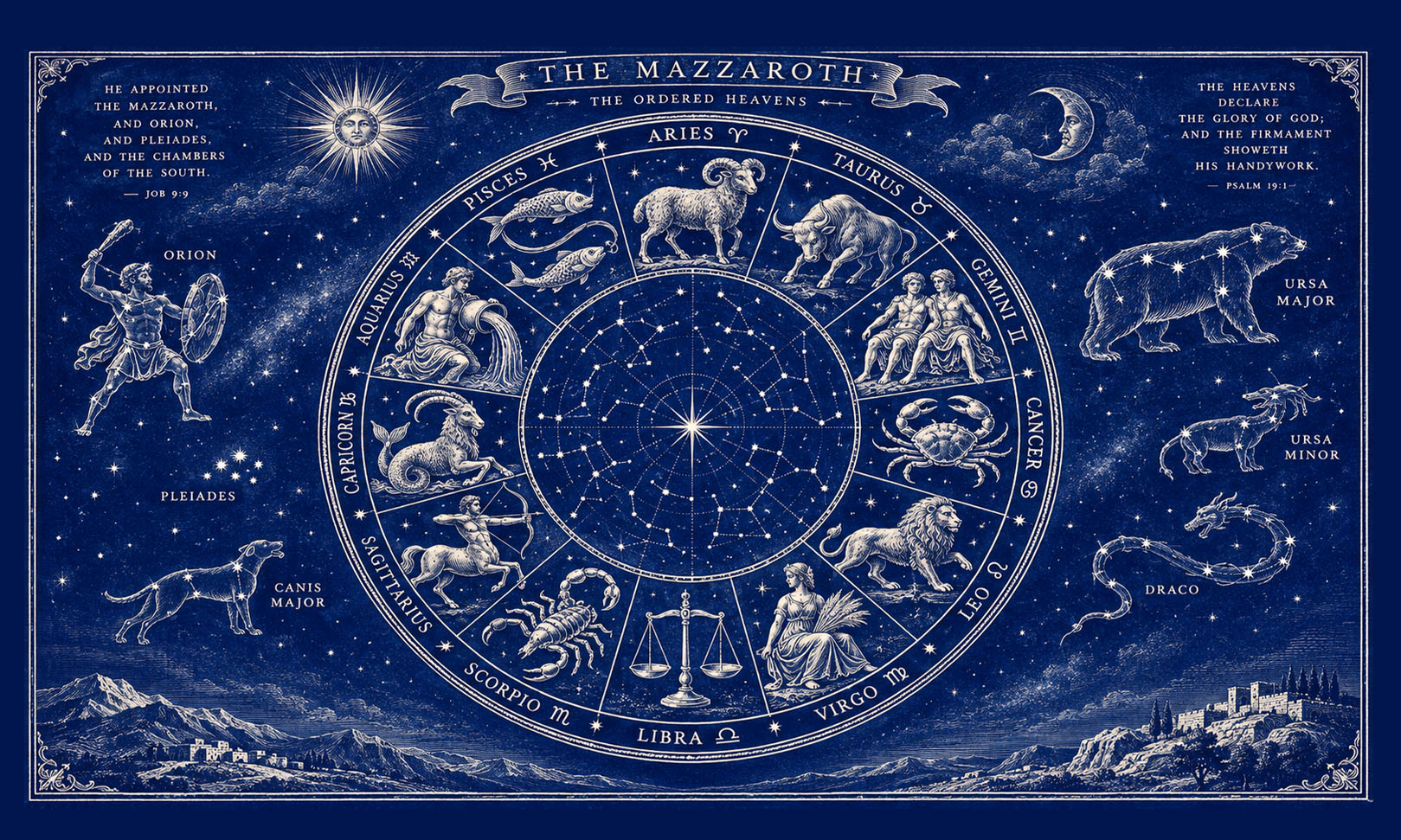
Obviously, Faulkner is not familiar with the abundant Scriptural references to the Gospel in the stars, and the internal integrity of God’s Word at the basis of this subject, that provides all the ancient textual evidence required, far out dating Rolleston on this subject. Added awareness of how the ancient Egyptian monument, the Great Sphinx embodies the Alpha-Omega signs of the Hebrew Mazzaroth, with prophecies of the Birth of Christ, that adds historical support to the Dendera Zodiac. When taken with the other monuments of the Giza Plateau, the witness from ancient Egypt for the Gospel in the Stars becomes a deafening crescendo of truth, impossible to ignore for any honest seeker of evidence for an astronomical gospel. A key element of the Dendera zodiac is the recognition of the ancient Egyptian star names associated with it, and their meaning, compared to the Hebrew meanings of the same stars. This gives us a view of the similar approaches to practical Astronomy between the two cultures and the potential common source of these star names, from Biblical Patriarchs like Seth and Enoch, and how they convey the gospel message, prior to their corruption in the idolatry of the Egyptian star religion.

The Pyramids of the Giza Plateau

Egypt: Temple of Dendera - Smit & Palarczyk | Egypt, Egypt art ...

This evidence from the Dendera Zodiac, with its system of Decans predates the usage of decans in any of the oldest Greek or Latin texts by thousands of years, providing an ancient source far in advance of Rolleston’s writings, or even Ptolemy, as a basis for the Gospel in the Stars. We will explore the details of this in later blogs in 2020, as this blog serves to introduce the reader to some of the research in this field underlying Biblical Astronomy. This method of decan calculation was standard practice in ancient Egypt. With this ancient Egyptian historical background, we don’t have to rely on Faulkner’s opinion of how this ancient system of decans came together, since we have scholarly accounts from the oldest texts in history like the Pyramid Texts and the Book of Job, that make specific references to the decan system in ancient Egypt, based on the “Helical rising” of stars and asterisms used for time-keeping, from at least the end of the Old Kingdom in Egypt, [circa 2200 BC], if not earlier. 7

The Pyramid Texts, writings and tomb wall decorations, dating back to the Old Kingdom (2780–2250 BC) provide a bulk of decan references and ancient Egyptian creation myths. The progression of decan stars in Heliacal rising also explains how the series of 3 decans aligns with each of the 12 major constellations of the zodiac, giving a basis of the order of decans in the zodiac of Dendera, as stated by Rolleston and other Gospel in the stars advocates, witnessed with Leo’s three decans above.

Figure 1. Dendera Zodiac with 36 Lunar Decans. 8

Figure 3. The figures represented in the Dendera Zodiac correspond to the traditional zodiacal signs

The color-coded image of the Dendera Zodiac below, shows specifically how the decans on the outer rim of this zodiac match up to the 12 main constellations in red, blue, orange,  and Yellow. Another element of dominion seen in the four faces of the Cherubim, [Ezek. 1:5-6], shows what the Babylonians called the 4 royal signs, we find Aquarius–Man who is created after God’s image, with Leo the Lion the king of non-domesticated animals. With the Taurus the Bull as the king of domesticated animals, seen at the bottom cardinal point with the sign of the Bull in Fig. 3. and the Eagle-Aquila, king of the fowl of the air, [Gen.1 26-28], we find a composite image of these four signs of the zodiac in the Cherubim. These four Cardinal Directions, of the Hebrew Mazzaroth provide a template for the 12 major signs both in Egypt and Israel. [Num. 24:7-9]

Figure 2. A color-coded image of the Dendera Zodiac. 9


Sun, Stand Thou Still Upon Gibeon; And Thou, Moon, In The Valley ...

Schwaller De Lubicz is another scholar who argued in favor of the ancient Egyptian knowledge of precession. He points out 2 hieroglyphs on the outer rim of Dendera’s zodiac that mark a line between Aries the Ram and Taurus the Bull, correlating to a date around 2200 BC, in Fig. 3 indicating how the Egyptians wanted to mark the transition in ages of precessional ages, in this case from the age of Taurus to that of Aries. As De Lubicz states;

“The mere fact that the cult of the Bull [Apis/Mentu] preceded the cult of the Ram [Amon]
in Egypt, and that the dates of these cults correspond to the equinoctial positions of their constellations at the appropriate time-approximately 4000 and 2000 BC-is conclusive.
“10

According to Schwaller DeLubicz, this was conclusive evidence that the ancient Egyptians were not only aware of, but applied their knowledge of the precession of the equinoxes. This evidence also speaks volumes concerning the age of the Dendera Zodiac, documenting this transition of the precessional ages of Taurus to Aries, following other elements of the calendar system inherent in the Dendera Zodiac before 3000 BC.

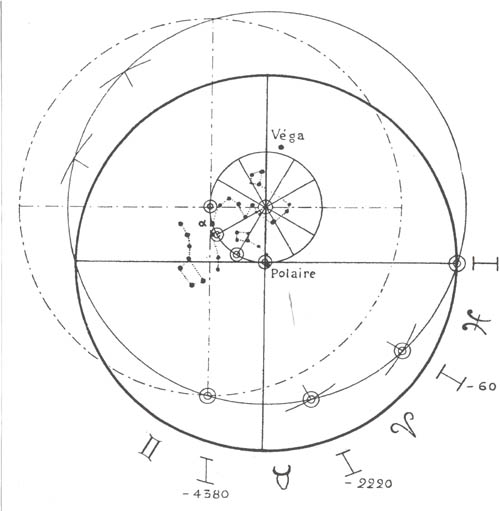
Figure 3. Overlaid Zodiacs of the Celestial Pole and Ecliptic Pole of the Dendera Zodiac. 11
zodiac poles

As we can see in Figure 3 above, the receding pole star is mapped on the smaller inner center circle, along with a series of four points related to the four axes on the larger outer circle of the zodiac. This shows us the pole star in the specific precessional ages going back to the Age of Gemini, marked on the larger zodiacal circle by the symbol “II“, prior to 4380 BC, portrays the transition from the Age of Gemini to the Age of Taurus. This depicts Gemini’s position at the early stages of Egyptian reckoning of precessional ages in Dendera’s zodiac, even though the latest version of the Temple of Dendera housing
this zodiac, was rebuilt in the late Hellenistic period.

Most of the prevailing sentiment in orthodox archaeology holds an evolutionary view where the sophistication of astronomical understanding of concepts like precession was beyond the ken of “primitive” cultures, despite abundant evidence to the contrary. The orthodoxy finds itself at a loss to explain how ancient history does not conform to their evolutionary view of increased astronomical sophistication with the passage of time, instead, they are faced with a reality where the older and superior application of this knowledge was corrupted by the mythology and idolatry of later cultures in the ancient world. As E.W. Bullinger stated:

“All the ancient systems of idolatry connected with Astrology and mythology were in the same way, not original inventions of what was new but the corruption of what was old,
and the perversion of original truth
.”12

Figure 4. Ancient Archaeological depictions of the Precessional Age of Taurus the Bull.

What are some of the commonalities among the various myths across ...

This reflects a history of Dendera’s temple and associated Zodiac extending back into Pre-dynastic ages coincident to the Precessional Age of Taurus. We take added note of their recognition of the Precession of the Equinoxes in ancient Egypt, and how early Pharaohs took their titles. Starting with the Menuhopteps, and Menes/ Narmer, who ruled before the Amenhoteps in Pharaonic historical progression. Notably, the Old Kingdom Pharaohs adopted Mentu the Bull in their titles during latter parts of the Precessional Age of Taurus, before the precessional shift to the Age of Aries, around 2200 BC. This transition of ages of the precession of the equinoxes, occurred when the retrograde motion of the Sun caused the sunrise in successive signs of the zodiac every 2.160 years, opening a new precessional age.

Figure 5. Pharaoh Rameses II linked with the Precessional Age of Aries in a Ram-headed Sphinx.

What are some of the commonalities among the various myths across ...

Once the Age of the Ram Aries began, the Pharaohs began honoring the Ram-Amon in their kingly titles. During this period and following was also when Ram-headed Crio-sphinxes began showing up in Egyptian iconography, as a representation of their creator-god Khnum, who they believed, fashioned the universe out of clay. This also accounts for Khnum’s association with the fertility of soil and the annual inundation of the Nile, marked by the star Sirius. As Khnum’s influence grew in power in Egyptian pantheons, the symbolism of the previous precessional Age of Taurus decreased in value. Egyptologist Richard Parker deciphered early symbols carved on an ivory tablet from the First Dynasty as: “Sirius, the opener of the year, the innundation.” As Krupp observes: “This implies that the basic elements of the calendar system were in place by 3100 BC. The same celestial calibrations endure all the way into the Ptolemaic period, 3,000 years later.“ [13]

This 1st Dynasty Ivory plaque depicts the star Sirius as a hieroglyph of a reclining Cow with the Sun above her head, easily visible in similar form in the Dendera zodiac, marking not only the decan to open the New Year, but also denotes the precession of the equinoxes. Since Isis embodied this reclining cow pictured with a star between bovine horns, seen just above the “Decans” label in the lower-left corner of Fig. 6, below, providing strong evidence of the use of the Sirius cycle, or Sothic Calendar in ancient Egypt, as a testimony to their advanced astronomical practices and recognition of precession
early on.

Figure 6. Dendera Zodiac cast at the Rosicrucian Museum-San Jose, CA. 14

The significance of the coordination of the lunar and solar cycles in the context of this New Year’s celebration is that the Heliacal Rising of Sirius also qued the Egyptians to add an  Intercalary month, keeping the calendar’s lunar cycles in line with the solar seasons. This luni-solar coordination also applies in view of the unity of lunar decans with the solar zodiac of 12 Constellations, on the Dendera Zodiac, not in disjointed separation. The calendars with long-standing and wide-spread use in Egypt included those of both administrative and religious uses. They date from Egypt’s unification around 3000 BC. The civil calendar consisted of 365 days, with 12 months of 30 days, and each month named for religious holidays during that month. On this lunar plan, each month consisted of 3 weeks, of 10 days, in-synch with their 36-decan system.

As the only circular astronomical model to be found in Egyptian antiquity, Dendera’s Zodiac depicts the 360 days of the Egyptian year, with decans arranged on the outer edge of the circular zodiac. Twelve signs with 3 decans each, in the 360-day year, even with a 37th decan allowing for the 5 extra days of the year, totaling 365 days of the Sothic Calendar. Figure 7 shows images of the specific star groups and asterisms in heliacal rising every 10 days on the Dendera Zodiac.

Figure 7. 36 Decans of the circular Dendera Zodiac with their star signs. 

Denderah Zodiac divided

As we have documented in parts 1 and 2 of this series on the Lunar Mansions, the Chinese, Arab and Indian zodiacs applied 28 Lunar Houses distinct from these 36 Decans. Some hold that the decans predate the use of the 12 signs in ancient Egypt to divide the ecliptic, but the Egyptian recognition of the ages of the precession of the equinoxes pointed out above, is contrary to that notion. It appears more likely that the decans were directly linked to each of the 12 tropical signs of the zodiac initially, in alignment with the theme of the Gospel in the stars. Thus the lesson of the decan supports that of the 12 constellations, even as we see with Leo’s destruction of the serpent- Hydra above. Bullinger tells us the Egyptian name for Leo was Pi Mentekeon, which means the pouring out, in reference to pouring out of divine wrath, as seen in the decan-Crater, the cup holding God’s wrath in the judgment of Christ’s victorious return, [Rev. 14:10, 16: 19]. The 3rd decan of the Raven Corvus also adds to this theme in one of the decan star names called Minchar al Gorab, meaning Corvus tearing to pieces the serpent’s remains;
[Prov. 30:17, 1 Sam. 17:46]. 15 

This attests to the integrity of the stellar witness, with all its elements reflecting the same truths of Scripture, as seen in the 19th Psalm. These ancient lunar calendar decans marked the Lunar Mansions, but due to inconsistent records of Decan stars, there was an occasional lack of consensus in Egypt, so with the exception of Sirius, the rest of these 36 decans endured several transformations during the Hellenistic period. 16

A good source for a specific list of these decan stars from the Middle Kingdoms was from an office-holder under Queen Hatshepsut (c. 1450 BC) of Egypt named Sesenmut, was buried near the queen’s tomb. On the ceiling of his burial monument was found an excellent example, from the Age of Aries of these 36 decans listed below.

Figure 8. The Decans of Senenmut’s Tomb 17

The Egyptians divided the decans of the night sky in different constellations in a way similar to modern astronomy. Senenmut’s Tomb is a great example of the decans in painted ceilings of different Egyptian tombs, that allow us to establish their number from tomb to tomb. In spite of periodic uncertainty, it seems there were at least 36 decans consistently depicted. Egyptians divided the year in 5 days plus 36, 10-day periods, corresponding to the 10 days of consecutive risings of decan stars recorded in Senenmut’s tomb, listed below:

  1. tpc-knmwt. A set of three stars represented by a man with a solar disk on his head. It is linked to Geb. [Canis Major]
  2. knmwt. A boat with a head of a snake in the ship’s bow with a standing boy with one finger in his mouth. It is associated to Isis or Ba. [Canis Major]
  3. hr-hpt-knmwt. A set of three stars seen in a tailed man with a bird’s head with a double crown.  It is linked to Isis or Horus’ sons. [Cancer]
  4. h3t-d3t. A set of four stars represented by a falcon-headed man with 2 big feathers.  It is associated to Isis or Hours’ sons. [Leo]
  5. phwy-d3t. A set of three stars seen in a man with a white crown on his head and a scepter in his hand.  It is linked to Horus’ sons. [Leo]
  6. tm3-hrt. A set of three stars represented by a man with two big feathers on his head and a scepter in his hand.  It is associated to Duamutef or Mesti. [Virgo]
  7. tm3-hrt. A set of three stars seen in a falcon-headed man with horns and a solar disk over them. He also holds a scepter in his hand.  It is linked to Duamutef or Qeehsenuef.  [Virgo]
  8. wsti. A man with the solar disk rounded by a royal snake.  It is associated to Duamutef.  [Virgo]
  9. bk3ti. A man with the double crown and a scepter in his hand.  It is linked to Duamutef.  [Virgo]
  10. tp-c–hntt. Two stars represented by a falcon-headed man with a solar disk on his head and a scepter in his hand.  It is associated to Duamutef or Hapy. [Scorpio]
  11. hntt-hrt. A set of two stars represented by a tailed man with a stick and a scourge in his hands.  It is linked to Horus.  [Scorpio]
  12. hntt-hrt. A set of four aligned stars seen in the four aligned stars, a head and an arm on a ship.  It is associated to Seth.  [Scorpio]
  13. tms-n-hntt. Three aligned stars represented by a baboon on a ship in front of a lunar disk.  It is linked to Horus.  [Scorpio]
  14. s3pt–hnnw. A set of 2 stars seen in Anu a falcon-headed man with a scepter in his hand.  It is associated to Isis or Nephtis.  [Scorpio]
  15. hr-ib-wi3. A set of four stars represented by a falcon-headed man with a solar disk on his head and a scepter in his hand.  It is linked to Seth or Ur.  [Scorpio]
  16. shsmw. Two stars seen in a man with a snake and a scepter in his hand.  It is associated to Seth or Ur. [Serpens]
  17. knmw. A headless man with a solar disk on his shoulders.  It is linked to Hapy or Duamutef.  [Serpens]
  18. smdt. Three stars represented by a tailed man with a double crown.  It is associated to Horus. [Capricorn]
  19. tpc–smdt. A tailed man with a double crown.  It is linked to Hapy.  [Capricorn]
  20. srt. A set of four stars seen in a falcon-headed man with the ateph crown and an animal tail in his skirt.  It is linked to Isis. [Aquila]
  21. s3wy-srt. Two stars seen in a woman with a scepter in her hand.  It is associated to Duamutef. [Aquila]
  22. hr-hpt-srt. A tailed man with scepter in hand, linked to Qebehsenuef. [Aquila]
  23. 3hwy. A tailed jackal headed man with a scepter in his hand.  It is associated to Duamutef. [Pisces]
  24. b3wy. A set of 3 stars represented by a tailed ibis headed man with the ateph-crown and a scepter in his hands.  It is associated to Duamutef. [Pisces-Cepeus]
  25. hnt-hrw. A tailed falcon-headed man with a tadpole.  It is linked to Hapy or Mesti.
  26. hr-ib-hntw. A tailed falcon-headed man.  It is associated to Horus.  [Aries]
  27. hnt-hwr. A boy with one of his fingers in his mouth sitting on a lotus flower.  It is linked to Horus. [Aries]
  28. kd. Three stars represented by a boy with one of his fingers in his mouth sitting on a lotus flower and a solar disk on his head.  It is associated to Horus. [Taurus]
  29. s3wy-kd. Two stars seen in a tailed man with the ateph crown and a scepter in his hand.  It is linked to Horus. [Taurus]
  30. crt. A tailed man with a papyrus plant.  It is associated to Qebehsenuef. [Taurus]
  31. h3w. Four stars seen in a tailed falcon-headed man with the double crown.  It is associated to Hapy. [Taurus]
  32. rmn-hrw-inw-s3h. 18 stars seen in a tailed man with the white crown and a scepter in his hand.  It is linked to Mesti. [Aries]
  33. msdr-s3h. A lioness headed woman with a royal snake and a crosier in her hand. It is associated to Duamutef. [Orion]
  34. rmn-hr-s3h. Three stars seen in a man with the white crown with a feather sitting on a throne.  It is associated to Horus. [Orion]
  35. c–s3h. An ibis-headed man with the ateph crown and a scepter in his hand.  It is associated to Horus. [Orion]
  36. s3h. Its corresponding is Orion and it’s represented by two ships. On the first one there are three people: a boy with one of his fingers in his mouth and a double crown on his head, a horned woman with a solar disk on her head and another woman with 2 feathers and the solar disk between them. On the other ship there is a snake in a lotus flower. It is associated to Maat-Horus.
  37. spdt. Its corresponding star is Sirius and seen in a tailed falcon-headed man with a solar disk on his head and a scepter in his hand.  It is associated to Isis. 18

This evidence reflects a long-standing history from Old Kingdoms and even Pre-dynastic ages of ancient Egypt of astronomical themes in support of the Gospel in the Stars. My encouragement to the reader is to review the links included here and the key background provided in presenting the case for the “Gospel in the Stars,” and Biblical Astronomy. Awareness of these related topics, present a more comprehensive view of Biblical Astronomy, depicting a grasp of sub-categories in this study, and how they support and inter-relate to the larger context.

God Bless!

Rene‘

Footnotes

1. [https://www.ancient-origins.net/artifacts-other-artifacts/circular-egyptian-mythology-does-dendera-zodiac-represent-most-ancient-021599]
2. Secrets of the Great Pyramid, Peter Thompkins, p.168
3. The Mazzaroth, Antiquity of the Chaldean and Egyptian Constellations, Frances Polleston
4.  https://answersingenesis.org/astronomy/stars/a-further-examination-of-the-gospel-in-the-stars/
5. IBID
6. https://www.pinterest.com/pin/338614465705844552/ [picture credit]7
7. The Senenmut Project-Introduction, Jose Lull
8. [https://www.ancient-origins.net/artifacts-other-artifacts/circular-egyptian-mythology-does-dendera-zodiac-represent-most-ancient-021599] [picture credit]
9. https://www.starmythworld.com/mathisencorollary [picture credit]
10. The Skies in Memory, John Lash as quoted in The Atlantis Blueprint, Wilson & Flem-Ath. p. 169
11. Secrets of the Great Pyramid, Peter Thompkins, p.172
12. Companion Bible, App. 42, EW Bullinger.
13. Echoes of the Ancient Skies, p.172, E.C. Krupp
14. Dendera Zodiac cast at the Rosicrucian Museum-San Jose, CA. [picture credit]
15. Witness of the Stars, p. 163, 168. EW Bullinger.
16. The Discovery of Time, ppg. 82-83, Stuart McCready
17. https://themathematicaltourist.wordpress.com/2012/10/13/the-decans-in-senenmuts-tomb/ [picture credit]
18. IBID

Comments on Facebook

To those of you interested in commenting on this post please go to our Facebook Group Page 

https://www.facebook.com/groups/bibleastr

Are Virtue Signaling Pastors Breaking the Law?

As we are all making sacrifices and enduring certain hardships due to the Covid-19 virus,
I wanted to pass on Jon Nessle’s excellent article in a special blog post this month.

Are Virtue Signaling Pastors Breaking the Law?
(2020 Covid-19 Pandemic)
By Rev. Jon O. Nessle

It was the winter of 1974 and my first Sermon. The room had been rented and
everything organized and I was ready. But then a snow storm hit. Normally an inch
or two of snow would not thwart my congregation who were from small Midwest
towns and farms, who would not think much of it. But this snow fall was over 8
inches! I called everyone up and said, don’t come. We will reschedule it. I knew
that there would be some stubborn or persistent folks who would brave the elements
and still try to come and I had elderly members that I did not want to put at risk. So
I postponed the meeting and told everyone to even call folks that they didn’t think
would come, just to make sure no one tried.

Weeks later when the meeting was to be held again, it began snowing again. I
declared, not again! I called up a few strong believers and we prayed for the snow
to stop. At the same time another congregant was flying in to the local airport. He
later told me of a strange thing he witnessed. He saw the snow stop falling! He said
it happened all across the sky simultaneously. The snow stopped all at once and as
the plane was descending to land he watched the clear patch of sky increase in size
moving downward. The layer of snow fell together like a falling blanket, leaving
clear air above! I asked him when was this? It was exactly at the same time we were
praying. We on the ground saw the snow stop and so we continued preparations for
the meeting.

Then one hour before the meeting was to start, I received a phone call from my
Mother. Her house had caught on fire! Thankfully, it was put out in time and the
damage was not terrible. I was 30 miles away. I asked her if she was OK and she
said yes and I explained that I could be there in a few hours and she said that was
fine. So I taught my first Sermon and made the Devil sorry he ever messed with me!
What was the difference between those two incidents? Wisdom.

With this current pandemic, these are unprecedented times in our lifetime,.
Ecclesiastes, a book of wisdom declares:
2
Ecclesiastes 3:1-8
1 To every thing there is a season, and a time to every purpose under
the heaven:
2 A time to be born, and a time to die; a time to plant, and a time
to pluck up that which is planted;
3 A time to kill, and a time to heal; a time to break down, and a
time to build up;
4 A time to weep, and a time to laugh; a time to mourn, and a time
to dance;
5 A time to cast away stones, and a time to gather stones together;
a time to embrace, and a time to refrain from embracing;
6 A time to get, and a time to lose; a time to keep, and a time to cast
away;
7 A time to rend, and a time to sew; a time to keep silence, and a
time to speak;
8 A time to love, and a time to hate; a time of war, and a time of
peace.

Perhaps this too is a time for wisdom : Because of the potential to spread the virus,
this is a time to refrain from embracing. Sometimes we face situations in which
there seem to be conflicts of priorities or Laws. This is one of them. On one hand,
the First Amendment of the U. S. Constitution states that “Congress shall make no
law respecting an establishment of religion, or prohibiting the free exercise thereof.”
On the other hand, Regional Health Authorities and State and County Governments
are imposing quarantines or limits on the size of meetings including Church, to limit
potential exposure to the virus. What should we do? Normally such constitutional
things are adjudicated in a Court of Law in which a Judge weighs the issues and then
based upon his or her wisdom, applies the law. We do not have time for that, for
this virus does not wait. But since this conflict of law will ultimately be resolved by
wisdom, can we not appeal to wisdom now?

This is the key question: Is complying with the Government’s temporary restriction
on large meetings, including Church meetings, an act of fear and therefore a violation
of faith? Is there a Biblical precedent for this situation? Yes there is! Quarantines
are Biblical and the rules are outlined in Leviticus 13ff. Therefore, obeying
quarantines are not a questioning of our faith.
3
Leviticus 13:1-5
1 And the Lord spake unto Moses and Aaron, saying,
2 When a man shall have in the skin of his flesh a rising, a scab,
or bright spot, and it be in the skin of his flesh like the plague of
leprosy; then he shall be brought unto Aaron the priest, or unto one
of his sons the priests:
3 And the priest shall look on the plague in the skin of the flesh:
and when the hair in the plague is turned white, and the plague in
sight be deeper than the skin of his flesh, it is a plague of leprosy:
and the priest shall look on him, and pronounce him unclean.
4 If the bright spot be white in the skin of his flesh, and in sight be
not deeper than the skin, and the hair thereof be not turned white;
then the priest shall shut up him that hath the plague seven days:
5 And the priest shall look on him the seventh day: and, behold, if
the plague in his sight be at a stay, and the plague spread not in the
skin; then the priest shall shut him up seven days more:

The priests were tasked with the job of diagnosis and quarantine because they were
authorities who could be trusted. While some could dogmatically claim that the
observation of such things must be done exactly the same today, I say that the
principles that are here can transfer to our modern situation. Today the trusted and
licensed ones who are tasked with diagnosis of disease and setting quarantines are
Doctors. Back then the Priests were trained and experienced in this. Today our
equivalent, Pastors, Priests and Rabbis, etc. are not. But the truth of quarantining
for a period of time still stands.

The Law of Moses also contained fascinating details about hygiene that protected
the Jews from germs 3000 years before they were discovered by Louis Pasteur.
There are directives about washing after touching dead things, and being unclean for
periods of time. This also includes washing clothes that were worn and even shaving
and social distancing!
4
Leviticus 14:8
8 And he that is to be cleansed shall wash his clothes, and shave off
all his hair, and wash himself in water, that he may be clean: and
after that he shall come into the camp, and shall tarry abroad out
of his tent seven days.
9 But it shall be on the seventh day, that he shall shave all his hair
off his head and his beard and his eyebrows, even all his hair he
shall shave off: and he shall wash his clothes, also he shall wash his
flesh in water, and he shall be clean.

Leviticus 14:34-48 even speaks of checking homes and condemning the buildings.
Again in modern times, religious leaders are not tasked or trained for such things.
Other trained and licensed experts are. It is fascinating to read this section of
Scripture knowing that mankind did not know about germs (but God did…)
5
Leviticus 15:2-13
2 Speak unto the children of Israel, and say unto them, When any
man hath a running issue out of his flesh, because of his issue he is
unclean.
3 And this shall be his uncleanness in his issue: whether his flesh
run with his issue, or his flesh be stopped from his issue, it is his
uncleanness.
4 Every bed, whereon he lieth that hath the issue, is unclean: and
every thing, whereon he sitteth, shall be unclean.
5 And whosoever toucheth his bed shall wash his clothes, and bathe
himself in water, and be unclean until the even.
6 And he that sitteth on any thing whereon he sat that hath the issue
shall wash his clothes, and bathe himself in water, and be unclean
until the even.
7 And he that toucheth the flesh of him that hath the issue shall
wash his clothes, and bathe himself in water, and be unclean until
the even.
8 And if he that hath the issue spit upon him that is clean; then he
shall wash his clothes, and bathe himself in water, and be unclean
until the even.
9 And what saddle soever he rideth upon that hath the issue shall
be unclean.
10 And whosoever toucheth any thing that was under him shall be
unclean until the even: and he that beareth any of those things shall
wash his clothes, and bathe himself in water, and be unclean until
the even.
11 And whomsoever he toucheth that hath the issue, and hath not
rinsed his hands in water, he shall wash his clothes, and bathe
himself in water, and be unclean until the even.
12 And the vessel of earth, that he toucheth which hath the issue,
shall be broken: and every vessel of wood shall be rinsed in water.
13 And when he that hath an issue is cleansed of his issue; then he
shall number to himself seven days for his cleansing, and wash his
clothes, and bathe his flesh in running water, and shall be clean.

Leviticus 17:15
And every soul that eateth that which died of itself, or that which
was torn with beasts, whether it be one of your own country, or a
stranger, he shall both wash his clothes, and bathe himself in water,
and be unclean until the even: then shall he be clean

Disease was prevented by the requirement to go outside the camp and defecate there
and then bury it. (Deuteronomy 23:12, 13.) Bloodborne diseases were prevented by
the prohibition of eating blood and viruses borne by unclean animals were avoided
by dietary laws. Leviticus 22: 4ff states that these rules even applied to the priests
themselves. Furthermore, Exodus 30:17-21 required the priests wash at the Laver.
While this would have ceremonial significance, it also has health implications for
the Tabernacle was a place of assembly for the congregation and as such, a common
source of the transmission of germs, much like schools are today. Social distancing
also was part of the Law:
6
Deuteronomy 23:10, 11
10 If there be among you any man, that is not clean by reason of
uncleanness that chanceth him by night, then shall he go abroad
out of the camp, he shall not come within the camp:
11 But it shall be, when evening cometh on, he shall wash himself
with water: and when the sun is down, he shall come into the camp
again.

So was the compliance with the Law a question of fear or faith? No, it
was of 
obedience. Therefore because of this precedent, I think that wisdom
should prevail 
and that we ministers who run Church meetings ought to think
of our most vulnerable congregants and not put them in harm’s way. Look. The Priests
and even Moses were super-believers and at times had interceded to miraculously stop
plagues, more than once. So why were these health related regulations even needed?
Wisdom…

Yes, these times are fearful and assembling with fellow believers is a comfort, but
the mitigating factor of the potential for virus transmission discourages that. But
thankfully, because of our affluence and technology in the USA and other countries,
there are other ways of assembly. We can assemble virtually over the Internet or in
cell phone conference calls. But we also must reach the most vulnerable group
which is our elderly folks who make up a significant proportion of some Churches.
They do not tend to utilize technology to the same degree as younger generations.
But there are still ways of dealing with this. I heard of congregations who have
assembled in their cars in parking lots and the Pastor preached from horseback.
Churches could even utilize closed Drive in Theatres for this purpose.

Furthermore, I know of no general reason for any minister to require anyone
to break 
quarantine, unless, of course, one has technicolor revelation to do so.
I say “technicolor” because such a thing would violate what I have just shared from the
Bible. There is precedent for doing so like when Paul circumcised Timothy despite
what he wrote about circumcision, but again, he had technicolor guidance to do so.
So if a minister thinks he has such guidance, may I remind him that the rules for
prophets given in the Old Testament apply:
7
Deuteronomy 18:22

When a prophet speaketh in the name of the Lord, if the thing follow
not, nor come to pass, that is the thing which the Lord hath not
spoken,
but the prophet hath spoken it presumptuously:
thou shalt not be afraid of [revere, (hence obey any more)] him.

There could be a miracle like what happened with the snow preceding my second
meeting. But if there is no divine intervention, people could get hurt. So if anyone
follows his so-called guidance and gets sick he cannot attribute that to their lack of
faith. There are healthy Churches and unhealthy ones, true ministers and false ones,
and there is a lot of gray area in between for both. When it comes to such
complicated analyses, the words of Jesus suffice: “By their fruits ye shall know
them.” He did not say “by their words…”

In my opinion, any organization who legalistically requires people to attend Church
is violating the spirit of assembly which is at the core of any ekklesia. People ought
to be coming because they want to, because they get results, fruit, not just words. If
people are criticized and judged there, something is wrong. It is not healthy. Or if
ministers feel they have to signify themselves or their Church by breaking the rules
of quarantine, both rules, I say, of our secular government and in the Bible, unless
they have “technicolor” revelation to do so, it is either that they are confused,
immature or virtue signaling. The English Oxford Dictionary describes “virtue
signaling” as: “a pejorative neologism for the conspicuous expression of moral
values.” That is, it is a newly coined term of communicating disapproval by
conspicuously expressing one’s moral values. They are disapproving of the
quarantine by signaling their supposed “holy bravery” by implying they have great
faith in spite of it. Well, that’s great for you, but what about grandma? You can be
responsible for your own risks, for the Bible says, “may your blood be on your
own 
head.” But what about the vulnerable folks in your congregation?

In a religious setting, virtue signaling is the “persistence or occurrence of various
costly religious practices such as circumcision, fasting, snake handling, and trial by
ordeal. This idea is that the participation in an act with a religious purpose serves as
a way to signal one’s dedication to the beliefs held by that religion, thereby signaling
personal morality to onlookers.” 1

These virtue signalers are trying to gain acclaim and followers like birds dancing and
displaying their plumage to attract mates. The Bible has another way of describing it.
8
Colossians 2:23a

Which things have indeed a shew of wisdom in will worship, and humility…

The word “will worship” is ethelothrēskeia which is defined as a self-devised external form of ceremonial service. 2
Self-devised, as in not of God, external, as in showing off, ceremonial, as in not practical or useable. So my advice is find yourself another Church if they are requiring you to break quarantine. After this is all over you can go back if there is anyone left…

1 Bulbulia, Joseph; Schjoedt, Uffe (2010-07-16), “Religious Culture and Cooperative Prediction under Risk: Perspectives from Social Neuroscience”, Religion, Economy, and Cooperation, DE GRUYTER, pp. 35–60

________________________________________________________________

Jon’s reference to Ecc. 3 and the “28 times” as they relate to the 28 Lunar Mansions, fits in with our current series on the Lunar Mansions, which we will be wrapping up in our Part 3, blog post later this month.

From the 28 times in Ecclesiastes 3:2-8 we see the obvious juxtaposition to “easy“ times
vs. “difficult” ones, 14 on either side, like 2 hands. These associated attributes with the twenty-eight “times” in Ecclesiastes 3: 1-8 come in pairs, and in each pair, one element is the opposite of the other. Birth/ Death; Planting/ Plucking; Killing/ Healing,
Breaking down /Building up, etc. This strongly suggests the goal is to portray a range
of human activity according to this pattern whether good or evil, depending on individual choice. Again, with the knowledge that all these results can occur in life, with God on our side in His path of righteousness, we can still prevail in the most difficult of “times” in this world. This brings to mind Deut. 30, where God’s Word lists some related pairs resulting from
freewill choice He has given to all men, to walk in their lives in the ways that they choose to go.

Deut. 30:19-20

19 I call heaven and earth to record this day against you, that I have set before you life and death, blessing and cursing: therefore choose life, that both thou and thy seed may live:

20 That thou mayest love the Lord thy God, and that thou mayest obey his voice, and that thou mayest cleave unto him: for He is thy life, and the length of thy days: that thou mayest dwell in the land which the Lord sware unto thy fathers, to Abraham, to Isaac, and to Jacob, to give them.

God not only gives us this freewill choice, He also tells us which choice benefits us the most! We are thankful for Jon Nessle, providing us a perspective of added wisdom in these difficult times that clarifies the vagaries of choice we are faced with every day.

Let’s Choose life Folks…


God Bless,

Rene’


Biblical Astronomy of Pi and the Lunar Mansions [Part 2]

Biblical Astronomy of Pi the Lunar Mansions-Part 2.

With the month of March 2020, the signs of Spring are in the air, which may be good or bad depending on your tolerance for allergies. But we always emphasize the positives here, and one thing I always look forward to in March is the 14th day of the month, [3.14] aka, Pi Day! Our tradition has been to recognize certain aspects of the Biblical incidence of Pi in God’s Word, which you can reference in some of the links in this study or our March archives on this blog. This month’s article holds some new and exciting pi references relating to the circle of Lunar Mansions, that I think you will enjoy.

In Part 2 of our study on the Lunar cycle, we begin with some further history on ancient Chinese Astronomy, and their emphasis on the Lunar Mansions. The Lunar Zodiac was first referenced in China under Emporer Yao in the 23rd Century BC. In China’s astronomical records, the Pleiades star cluster was among the earliest of Lunar houses on record, dating to 2357 BC, when the star Alcyone in the Pleiades was near the vernal equinox. 1 The 7 stars of this famed cluster are named by Job [9:9, 38:31] and referred to collectively as a “heap or accumulation, and the congregation of the judge or ruler,” said also to be referenced in Rev. 1 as a “mystery.”

Rev. 1:20
20 The mystery of the seven stars which thou sawest in my right hand, and the seven golden candlesticks. The seven stars are the angels of the seven churches: and the seven candle-sticks which thou sawest are the seven churches.

The Pleiades Star Cluster
[AAO Photograph]

This reminds us of the divine seven-fold pattern of the order of Cherubim according to their regular distribution around the four colored curtains of the Tabernacle walls of both the Holy Place, and the Holy of the Holies. As we find this pattern in the earthly Tabernacle, so we also find it in the Heavenly Tabernacle, as Rev. 15:5-8 reveals, seen in Part 1 . [cp. Rev. 8: 2]

This mystery of the seven stars can refer to the Angel’s first estate prior to their revolt, when Lucifer as the Bright and Morning Star led the angels as Morning stars and sons of God, in their collective shouts of joy, praising the Almighty, [Job 38:7, Isa. 14:12-20, Ezek. 28:12-19]. But once iniquity was found in Lucifer, he was cast out of heaven taking 1/3 of the angels down with him. [Rev. 12:7-9].

“Seek him that made the seven stars and Orion, and turned the shadow of death into the morning, and made the day dark with night: that called for the waters of the sea, and poured them out upon the face of the earth: The Lord is his name …”  [Amos 5:8] KJV

We find hints of this in Milton’s description of Creation at the dawn of the world, in Paradsie Lost; where he says of the Sun,

the Dawn and the Pleiades before him danc’d, shedding sweet influence…2

“He had in His right hand seven stars, out of His mouth went a sharp two-edged sword, and His countenance was like the sun shining in its strength.” [Rev. 1:16]

This reference in Rev. 1:16 is certainly reminiscent of the helical rising of the 7 stars of the Pleiades. There is a fable linked to one of these seven stars, that was lost in infamy. The Poet Aratos wrote;

As seven their fame is on the tongues of men, though six alone are beaming on the eye… 3

Pleiades Star Map

Image result for Pleiades images

Reportedly, this 7th Pleiad star disappeared around the time of the Trojan War [1194-1184 BC], where according to Rolleston, “the star shot like a comet towards the North pole,” leaving only six main Pleiad stars. One of these was named “Maia” in Greek, tracing to the Chinese “Mao,” preserving the historical roots of this Pleiad, from the 23rd Century BC in ancient Chinese culture. In addition to the lunar mansions, Chinese astrologers going back to Yi Xing also predicted solar eclipses by analyzing lunar position and motion. For every revolution westwards on the celestial globe, the Sun would move a degree to the east while the Moon also moved 13 and 7/19 degrees eastwards. After 29 rotations of the celestial globe, the Sun and Moon would meet for a solar eclipse. Chinese astronomical tools included star maps, like the Dunhuang Star chart, one of the oldest remaining star maps in existence, along with armillary spheres. Their celestial globe depicted 28 lunar mansions, with the celestial equator and ecliptic.

Chinese astrologers also used the Metonic Cycle, which they called the Zhang cycle due to the dynasty in which it was discovered, circa 600 BC. The Metonic Cycle converts 19 solar years to 235 lunar months. This also helped Royal Chinese astrologers predict solar eclipses, which they were highly motivated to accurately foretell, since their lives depended upon it, in some cases.

Western Astronomy has always been more focused on the Solar Zodiac, including the 12  signs or constellations that the Sun passes on the ecliptic during the year. However, in ancient China, attention was paid more on the 28 Mansions marking the movement of the Moon during a lunar month. This lunar focus of the Chinese Calendar, divided time in lunar months, having the practical benefit that the day of the month was evident by looking at the lunar phase, along with the current location of the Moon against the stars.

28 Chinese Lunar Mansions

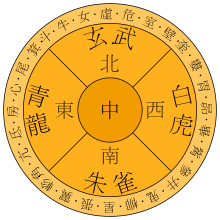
The 28 Mansions of the Chinese Lunar month (xiu or sù), one in each day of the sidereal lunation, served to name the days of the month before the Gregorian Calendar was adopted. Star locations were measured relative to the xiu divisions and their distance from the North pole. The month was divided into four symbols, representing four weeks of 7-days in a lunar month, and also the Four Seasons.

As we will see below, the common themes surrounding the 28 Lunar Mansions in various cultures of the ancient world, shows a unity of astronomical knowledge, rooted in the Biblical Patriarchs who founded the ancient cultures of Mesopotamia, Egypt, China & Israel after the flood. The ancient Biblical truths of the Almighty Creator God, Who rested on the 7th day, defined a division of time, based on the Creation Week. God’s Creation of the Sun, Moon and Stars to mark signs, seasons, days and years, divided and separated between the light and darkness of these heavenly bodies, providing a universal temporal order for the earth. The Seasons or appointed times [moed] depict the holy feasts when man was to recognize special calendar times ordained by the Almighty, according to a mandate from heaven, to honor God’s Covenant relation with man. The Creation Week set the pattern of the Sabbath, found in the 7 x 4=28; Lunar Mansions.

The transition from the end of one lunar phase to commencement of the next lunar phase is a most revered calendar unit across world cultures. In this way, God set aside the Sabbath Day as holy, consecrating the Sabbath in Isreal for all time, a big reason why Israel has always abided by a lunar calendar. Historical recognition of the influence of this seven-fold pattern is found in various septenary units of measurement. The Egyptian Royal cubit was composed of 7 hands or 28 fingers, as a standard cubit, with a 7th hand added. In truth, Gen. 1:1  has 7 Hebrew words with a total of 28 letters. By dividing 28 times the product of the letters by seven times, the product of the words, a calculation of the pi ratio results. 4 This is an example of a practical reckoning from the ancient world seen below, with astronomical and calendar applications.

“According to the septenary system of reckoning, the circumference of a circle was considered 22/7 of the circle’s diameter, as an approximation of the Pi ratio=3 1/7 or 3.142857, that is still applied as an adequate calculation for many engineering problems today.” 5

The following information comes from Leo Tavares and his website on Mathematical Monotheism, [https://sites.google.com/site/mathematicalmonotheism/the-genesis-1-1-mirror-code]. Since the Hebrew Alphabet is alpha-numeric, where every letter in their alphabet is also a specific number, below are the “numerical values of the 22 letters in the Biblical Hebrew alphabet, as they relate to Gen. 1:1:


 GENESIS 1:1  “In the beginning God created the heavens and the earth”

Thus the numeric values of these seven Hebrew words are as follows
913 + 203 + 86 + 401 + 395 + 407 + 296 =  37 × 73

A note from Tavares on his site on #37 is; “For the sum of the Fibonacci numbers indexed to the first 37 decimal digits of Phi (after the decimal point) = 401.” This shows a relation between the Pi and Phi ratios, that we have previously illustrated in various blog posts.

Not only does the center word value of Genesis 1:1 stand out as its only PRIME word value, it stands out as its SHORTEST word. In fact, it is made up of the first and the last letters of the Hebrew alphabet (the Aleph and the Tav). Since the Creator God, Almighty fittingly is set in the center of these 7 words like, the central candle of the Menorah between it’s other six candles, [Rev. 1:20] highlighting the Biblical teaching that God is the FIRST and LAST (Isaiah 44:6):

ALEPH + TAV = 401

This reveals an internal code of mirror symmetry in Genesis 1:1 that the sum of the Prime Factors of the three words to the LEFT of 401 yields the very same value as the Prime Factors to the RIGHT of 401. Here are the Prime Factors of the Genesis 1:1 word values:

913 = 11 × 83
203 = 7 × 29
86 = 2 × 43

 401 = 401

 395 = 5 × 79
407 = 11 × 37
296 = 2 × 2 × 2 × 37

 LEFT PRIME FACTOR SUM:

(11 + 83) + (7 + 29) + (2 + 43) =  175

 RIGHT PRIME FACTOR SUM:

(5 + 79) + (11 + 37) + (2 + 2 + 2 + 37) = 175

LEFT/RIGHT PRIME FACTOR SYMMETRY:

       175  (401)  175

As God is the FIRST and the LAST in (Isaiah 44:6): This verse of 7 Hebrew words reads as follows:

ISAIAH 44:6 “I am the FIRST, and I am the LAST; and beside me there is no God”

The numerical value of the seven Hebrew words in this passage is as follows:

  61 + 557 + 67 + 265 + 162 + 61 + 86 =    1259

This number is directly tied to 401 through the mathematics of a Circle. How? Aside from the fact that the numerical value of “ISAIAH” = 401, a Circle with a circumference of 1259 units yields a diameter of 401 units, according to the pi formula.

THE CIRCLE OF THE FIRST AND THE LAST

“I am the FIRST, and I am the LAST; and beside me there is no God” (Isaiah 44:6) = 1259

DIAMETER = 401 units

  “ISAIAH” = 401

FIRST + LAST Hebrew letters = 1 + 400 =

             401

CENTER word value of Genesis 1:1 = 1 + 400 =

             401

The Aleph and the Tav are the FIRST/LAST letters of the 22 letters in the Hebrew alphabet.  the PRIME FACTORIZATION SUM of the 22 Hebrew letter values points right back to “The Circle Of The First And The Last” that we just saw. Remarkably, it yields the PRIME ORDER of 1259.“ 6

The Pi ratio of the first and last letters of the Hebrew Alphabet also correspond to the Alpha/Omega of the first and last signs of the Hebrew Mazzaroth, as seen in the Great Sphinx.

This practical reckoning of the pi ratio also relates to the 22 letters of the Hebrew Alphabet, including 7 vowels, providing a linguistic and mathematical blueprint for Israel. As with all language systems, the Hebrew alphabet is a system of writing expressing a language’s sounds, both consonants and vowels, by means of single letters. Alphabets can function to move beyond outer appearances, and access deeper meanings in reality. Alphabets embody the presence of the infinite within the finite. Since the Creator spoke all Creation into reality, the Almighty chose the Hebrew language and Semitic culture as the primary carrier and access point for in-depth concepts leading the presence of God within His Holy Word, and fellowship in His Temple. This includes a key function of the alphabet; to enable the seeker to experience spiritual growth processes in fellowship with his Maker, via a series of accessible, substantive and systematic images, whereby the Almighty chose to reveal Himself. Did you also know that 3-14 is Einstein’s Birthday!?

Image result for Pi ratio in the Bible images


The Hebrew script, is a consonantal system with 22 characters, as part of a family of alphabets, based ultimately upon the Phoenician script. The Hebrew script was formalized around the same time as early Greek, with letters taking a varied form. For example, Resh, phonetically equal to the ‘R‘, is similar to a lower case Roman ‘r‘, each letter with its own definition. One meaning of Resh is “poverty,” [Prov. 10:15]. Lucifer prospered at God’s Right Hand, but when it was not good enough for him, he became desolate in opposition
to the Almighty, and was “plucked up” and cast away. Talk about a major “pluck up,” that has to be the biggest of all! This generally fits the mythology surrounding the lost Pleiad, as Lucifer was cast out of heaven, and rejected from his former angelic glory. [Isa. 14:12-20, Ezek. 28:12-19]

Next in the Hebrew alphabet we encounter the letter Bet. History tells us that Bet is one of seven “double letters,” each of which has two pronunciations, two meanings, as well as two applications: a positive, and negative. Since the 7 vowels of the 22 letters of the Hebrew Alphabet, function as both a vowel and a consonant, we find two immediate applications for these double letters. “They also have two possible sounds, but only three of the seven are retained in modern Hebrew. Three of the rest are apparently used only by a few, and the double of the remaining one, Resh, is said to have been lost, supporting the narrative above related to the  7 stars, but others say it’s a well-guarded secret. These 7 “double letters” have either a “hard” or “soft” pronunciation. The hard pronunciation is indicated by Dagesh; a (dot) in the center of the letter. The two-fold usage of these seven “double letters” in Ecc. 3:1-8 comprise 7 polarized sets, each portrayed by one of these “doubles,” forming a unique figure that could be classified as a specialized acrostic. Bet is itself a word meaning “within” and “house.” Metaphorically, it depicts a mouth, a house and the interior of man, symbolizing internalized action.” 7

 This meaning for Bet, of the interior of man, implies human freewill choice, that results from internal deliberation, spoken into action externally. This relates to the 7 polarized sets [Ecc. 3], as people chose daily actions within the ranges of human activity reflected within these 14 pairs. Also, Bet as a “house,” is intriguing in light of the truth that these 7 stars; [Pleiades] are the angels of the seven churches, since the church is considered the house of God, the dwelling place of His people, in the body of Christ, [Rev. 1:20, 1 Cor. 6:19-20].

The “Flower” of Lunar Phases.

Image result for Intercalation months reflected in dimensions of the Hebrew Tabernacle

The previous note from Tavares on the 7 words of Gen. 1:1 and #37 is; “For the sum of the Fibonacci numbers indexed to the first 37 decimal digits of Phi (after the decimal point) = 401.” This depicts the relationship between the Pi and Phi ratios from a math context, as in the Four kingdoms of Life. The sacred symbolism of the Tabernacle, reflecting the 7-day temporal order that man was to follow in fellowship with the Almighty, is formed on the lunar calendar embodied in the internal and external Tabernacle measures.
According to T. Paine, who first suggested an endwise union of either set of Tabernacle curtains from Josephus forward, depicts the internal Tabernacle measurements as 12 cubits wide, by 29.5 cubits long, versus the external measures of 12, 1/3 cubits wide by 30 cubits long. This represents an alternating lunar calendar of 29.5 and 30 lunar days in a month, a long-standing order in 360-day calendar years. The 12 cubit measure shows the 12 months of the solar year, while the 29.5 cubits embodies the lunar synodic month of 29.53059 days, or 29 days, 12 hours, 44 minutes, and 2.37 seconds. We see this also in the time between 2 full or New Moons as 29, 43/81 days, for internal dimensions of the Tabernacle curtains. The Tabernacle’s external measures of 12, 1/3 cubits wide, by 30 cubits long, show 12.368 synodic months per year, or 12, and 7/19‘s, by the 30 days of the solar month. 8

The external dimensions of the Tabernacle reflecting the 12.368 lunar synodic months or 12 7/19‘s are interesting, also when we consider the intercalation pattern utilized in Israel, to align the solar and lunar calendars. The present Hebrew calendar consists of two types of years, the sacred and the civil year. The sacred year is based on directives given to Moses, and is the official calendar year of religious feasts. The OT calendar received by Moses, began in the spring month of Abib, [Ex. 12:2]. With God’s revelation to Moses on Mt. Sinai, including the Tabernacle and the Ten Commandments, this information on the Hebrew Calendar was a built-in practice of the OT Law since at least the 14th Century BC,
nearly a thousand years before Greek scientist Meton developed the “19-year Metonic cycle” in Athens, circa 432 BC. The dimensions of 12 7/19, reflects the seven leap years in every 19-year cycle. Both Sacred and Civil Years contain 12 lunar months for 354.25 days until the leap year adds a 13th intercalary month. These 7 extra months are dispersed over 19-years. An approximated 209-days of lunisolar separation time are accumulated through close observation of the Sun, Moon, and Stars during this 19-year cycle. The extra 209-day cycle is divided into seven intercalary months to reinforce the sacred 7-day week,
alternating between 29-days and 30-days each in the Hebrew calendar.

The intercalary month is included seven different times, every 2 or 3 years within the 19-year, lunisolar “Metonic” cycle of the Hebrew calendar. The intercalary month also called Second Adar, was added between the months of Adar, and Nisan. Second Adar is inserted by adding it to the end of the 12-month lunar year.

The Hebrew lunisolar calendar thus emerges with a number of assumptive connotations. Seven Days and nights, with the Sabbath between the weeks, the lunar phases started with New Moon crescents and intercalary days, all enshrined divine providence upon Earth. The Creator’s temporal order of the lunisolar calendar also sums into longer periods of Jubilee cycles.

The Jubilee year is the Sabbatic Year that follows seven successive Sabbatic years (Levi. 25: 8-54). The numerical matching of 7 days to 7 years was basic to mounting the 50-days to Pentecost and the 50-year Jubilee cycle. After six years, the 7th year was a Sabbatic year. Seven multiples of seven years are 49 years resulting in a 50-year Jubilee. The Jubilee year gave rest to the soil, reverted landed property back to original owners, and freed Israelites that were formerly slaves. These calendar statutes reinforced the
appointed feasts of God.

As we investigate the Tabernacle structure further, we find that the distribution of the Tabernacle’s internal colored curtains, hung in relation to the wooden planks forming Tabernacle walls, are worthy of a closer look. Each of the violet curtain stripes bore an image of Cherubim angels embroidered on three-colored curtains of violet, crimson and purple. “The entire 140 cubit length [14 x 10] of the combined sheets of curtains, were each 28 cubits long, giving 9 full series of colors [9 x 3=27] with a surplus cubit for another entire colored stripe, [totaling 28].” 9 This reflects in practical terms the Lunar Sidereal cycle which is between 27 and 28 days; [27.3 days].

Image result for Intercalation months reflected in dimensions of the Hebrew Tabernacle

The 28 Lunar Mansions divide into 7 x 4 along the lines of the four Cherubim angels each with seven mansions. Since these Cherubim angels were depicted on the violet stripes preceded by the crimson stripe and followed by purple stripes of curtains, they were designed to align with the middle of the wooden planks of the Tabernacle walls. As the curtains conform to the numbers of the sidereal lunar cycle, they represent the Lunar phases in coordination with the solar cycle represented by the gold plated wooden planks. Thus we find it noteworthy that the “regular sequence of colors, Cherubim panels, loops and knobs, cycle around the full circuit of Tabernacle walls in perfect order until the 2nd curtain terminates in the last 1/3 of the 19th wooden plank.” 10

With the 19th wooden plank reflecting the 19th solar year, from the start of this sequence, we can see how the curtains symbolize the sidereal lunar cycle, aligned with the “Metonic cycle,” seven times in 19 solar years, on the 1st Tabernacle wall. If there is any lingering doubt regarding this alignment, it is quickly erased, as this symmetrical pattern mirrors the opposite wall on the other side of the room. This is realized as the “third curtain piece terminates with a crimson half stripe at the rear 1/3 of the 19th wooden plank. This symmetry is maintained by the “reversal of order of stripes on the opposite side of the room, completing the corresponding position of the 20 violet Cherubim panels, with seven at the end.” 11

As we find mirror symmetry in the verse structure of Genesis 1:1 and Isa. 44:6 above, so we can see the same type of symmetry in the Menorah, and the structure of the Tabernacle curtains, mirrored on opposite sides of the enclosure. Again, this would have been at least 700 years in advance of the Babylonian or Chinese employment of the “Zhang” or Metonic cycle, assuming the practice of the intercalary cycles reflected in the alignment of curtains with the walls reflecting the Creator’s temporal order in the Hebrew Tabernacle.

Figure 1. The Four Lunar Phases

Image result for quarter moon images

Divisions of seven-day weeks divide the four basic lunar phases seen in Figure 1. Starting with a New Moon and the first sighting of its crescent, the Moon is observed according to regular monthly patterns from New Moon, waxing to 1st Quarter Moon, to Full Moon, then waning to 4th Quarter Moon, and back to New Moon. Original Hebrew illuminations of lunar time, put God between the weeks on Sabbath Days.

The first half Moon is visible in about seven-days, so the first week of the Lunar month is placed between the New Moon crescent and the 1st Quarter Moon. The Moon waxes from the Quarter to the Full Moon at the end of two weeks. The Moon’s light then reverses phase in the third week, as it wanes to half visibility. A fourth week completes the month and visibility again recedes toward a New Moon. As the four-week cycle of seven days each in the four lunar phases completes the month, we can envision how the 28 times in 2 sets of 14 pairs, from Ecc. 3:1-8. will correlate to this cycle of the lunar month.

The Hebrew word for “time” [H6256-eth] in Ecc. 3:1, means “the right or proper time. In the plural it refers to circumstances, events or courses of time. Strong’s says there are three principle situations described by eth–a. Regular events. b. An appropriate time for unrecurring incidents. c. A set time. The Greek equal is Kairos [G2540]. 12 The monthly lunar phases would fall under the 1st or 3rd of the three options above; the regular events or lunar phases of the repeating sidereal lunar cycle.

Figure 2. Monthly Lunar Phases

Image result for quarter moon images

As seen in the Tabernacle measures above, the synodic lunar month measures 29.53o59-days. Alternating lunar months of 29-days or 30-days were common practice in lunisolar calendar systems. The average lunar month of 29.5-days repeats upon sighting the New Moon. This Lunar cycle dictates the pattern of Lunar light and darkness, and these 14 pairs of “times” depict 14 sets of opposites, between the light and dark of the Moon, wherein this range of human activity, the Almighty fellowships with His people.

One of the overarching purposes of Ecclesiastes is to explain the Meaning of life, by first realizing that meaning in life is not to be found in life itself, which from a humanistic view is meaningless, being hostile and inscrutable, and thus a vanity as Solomon summarizes. But from a godly perspective, when we view life from the purposes of the Life-Giver, then the true meaning of life can be ascertained. Its main purpose was to show the futility of human existence apart from God.

I trust you have found this Tabernacle Tour valuable in expanding your understanding of the Hebrew Lunar Calendar, and the Lunar Mansions from multiple Biblical perspectives.

God Bless!

Rene’


Footnotes

1 Star Lore Myths Legends and Facts, p. 409 William Tyler Olcott
2 IBID, ppg. 408-409
3 IBID, p. 420
4 https://www.biblegematria.com/pi-and-the-bible.html
5 Secrets of the Great Pyramid, Peter Thompkins p. 306
6 https://sites.google.com/site/mathematicalmonotheism/the-genesis-1-1-mirror-code
7 Otiot: Sacred Signs, from “The Book of Sacred Names.” Jacobus G. Swart
8 The Tabernacle of Isreal, James Strong, p. 41
9 IBID, James Strong, p. 83
10. IBID
11. IBID, p.84
12. Strong’s Concordance,  [H6256-eth]. James Strong

Comments on Facebook

To those of you interested in commenting on this post please go to our Facebook Group Page 

https://www.facebook.com/groups/bibleastr