The Celestial Gospel.

Welcome to our April 2024 Blog! This month we are featuring the class Syllabus notes for the first two segments of the Celestial Gospel Seminar that was run by Rev. Jon Nessle and myself in Mahwah New Jersey. What a great Day in the Word we enjoyed with all the Northeast believers, this month graciously hosted by PK Krywos of the Christian Family Fellowship of New Jersey Believers. The class Syllabus notes for Segment 3-the concluding session are found in the June 21′ blog. The entire class will be available online shortly for your edification and enjoyment!

 Old Covenant Foundations of the Celestial Gospel

There is an existing debate over the validity of a Celestial Gospel over the years, the term referring to what E.W. Bullinger called the “Witness of the Stars” in his popular book on the subject, published in 1893. A Bullinger contemporary  was Dr. Joseph Seiss, who published “The Gospel in the Stars,” a decade earlier in 1882. These two resources provided a foundation for study in this important area of research, as they built on earlier work of Frances Rolleston who published her work in the book; The Mazzaroth, or the Constellations in 1865. E.W. Bullinger credits Rolleston for her research as the first to generate interest in this key but, misunderstood topic.

Although F. Rolleston was the first among more modern writers to advocate the Celestial Gospel, that does not mean that there are no ancient texts that support or attest to the Gospel in the Stars. For the most part, we need only consult the Biblical Text for all the needed proof, since God always protects
the integrity of His Word, whether Spoken, Written in the Stars, or written in
Scripture. A goal of this research is to provide a solid Biblical and spiritual foundation for The Gospel in the Stars, which as a specific topic of study has remained a bit cloudy and ill–defined in certain categories up to now. Since the cornerstone of the Celestial Gospel foundations are found in holy Scripture, they provide the spiritual principles upon which the Star Gospel is based, but they are
by no means the only historical evidence supporting these foundations. There is a rich astro-archaeological history of ancient cultures like Egypt, India, Persia, not to mention ancient Israel naming a few, whose testimonies added their voices to support of the meanings and concepts of the star names of the Celestial Gospel.

Although the monumental works of Rolleston, Bullinger, Seiss and others did provide a basis to understand the idea of the Celestial Gospel, their works did not fully disclose the OT Covenant foundations of the Celestial Gospel in God’s Word. Thus, lacking the full Biblical basis for the Celestial Gospel, it is critics like Faulkner, who have attempted to exploit this blindspot to discredit the idea of The Celestial Gospel, that demands a response to shine a positive spotlight on this key topic. This is a focus of our current study. In context of Jon Nessle’s OT History Class, an overarching framework of God’s OT Covenants initiated by God to Man were established, starting with Adam and Seth, and  included Noah, Abraham, Moses, David and the prophets, completed in the Promised Seed-Jesus Christ. This was generally accomplished in previous teachings in our seminar on the Celestial Gospel of the OT History Class. Today we will expand on the basis of these teachings, providing added key details to the truths we first presented two years ago.  

In a recent critique of the writings of Frances Rolleston and the idea of the “Gospel in the Stars,” that she popularized c. mid-1800’s, [Dr. Faulkner-2013] states;

“Not only are there no texts preserving the original knowledge of the gospel in the stars, but we know of no sources before Rolleston that claimed that there ever were such texts, or that any ever lived who believed such things. The first source we know of to make this claim is Frances Rolleston’s book. Let me be clear—it is obvious from Rolleston’s book that she had no texts that clearly taught her thesis. Instead, she created the meanings to support her thesis without reliance upon any older texts. The evidence we have that is most consistent with the Gospel in the stars thesis not being an ancient idea at all, but entirely the invention of Frances Rolleston less than 200 years ago.”#1

To begin our response to Dr. Faulkner’s assertion that the idea of “the Gospel in the Stars thesis not being an ancient idea at all,” we will open with evidence to first counter Faulkner related to the Great Sphinx. 

Figure 1. The Great Sphinx

ancient egypt

In the ancient Egyptian language, one later derivation of the word “Sphinx” is found in the Egyptian “shesep ankh,” meaning a living image. However, instead of the living idol images of idol gods or pharaohs, a proposal of this study is that the Great Sphinx was originally intended as an oracle of the Promised Seed and the Messiah. Both Lockyer and Rolleston state, that a function of the Great Sphinx symbolized the summer Solstice 4000 years before Christ, sealed by the union of the constellations Virgo and Leo. The name “Sphinx” in the ancient dialects means “the pouring out” as in [Deut. 33:19] relating to the creation of the world, the inundation and the summer solstice, where the Nile begins to rise. Deut. 33:19 translates the inundation of the Nile as ‘abundance’ in the blessing of Zebulon who bore Virgo upon his standard.”#2  There exists a tradition that the Creation took place at the summer solstice. This view of the figure of the Great Sphinx was seen as the junction of the signs Virgo and Leo, marked by the star Denebola–a star name meaning “the Lord comes quickly.” 3#

The Riddle of the Sphinx attests to the Sun’s solar circuit on the ecliptic [Ps. 19:1] that marks the starting point of where to begin reading the first chapter of the wondrous heavenly scroll of the Celestial Gospel. Another meaning of the word “Sphinx” is to “bind closely together” and this design of the junction of the signs of the Virgo and Leo constellations, shows the two ends of the Mazzaroth to be joined in a renown mythical union of the greatest and oldest Sculpture on our Planet. The union of the head of the woman-Virgo with the body of Leo the Lion, the Great Sphinx is a constant reminder from ancient Egypt, to begin our deciphering of the circular witness of The Celestial Gospel in Virgo that concludes in Leo. This ancient and great monument thus not only preserves the canon of God’s Word engraved in the heavens but also this fusion of alpha/omega signs in Scripture are inseparably linked for all time, written in the stars. As Enoch Prophesied of the Promised Seed [Jude 1:14] before this witness was ever committed to holy Writ of Scripture, [Ps. 19:1-4], so his witness is a doctrinal pillar to support the Celestial Gospel. This heavenly witness has been continuously rehearsing the truths of the Creator’s handiwork to all ancient cultures of the created earth, as God established a tabernacle for the Sun in the 12 constellations and signs of the Mazzaroth, on the Zodiacal Band and the ecliptic, [Rev. 12:1-2].

Rolleston
notes that this junction of Virgo and Leo, marked by the star Denebola, a name meaning “the Lord or Judge who comes quickly,” thus embodies the living image, of the Lord Jesus Christ coming in judgment. As the star marking the link between Virgo and Leo, the prophetic message of the alpha and omega signs of the Biblical zodiac, the celestial image of the coming Messiah has endured in the largest, oldest and most renown sculpture on the planet-The Great Sphinx.

The Mystery of the Sphinx and the Celestial Gospel

Scriptural references and ancient sources demonstrate that God called the constellations by their names, opening with Virgo and ending with Leo, and their order is divinely orchestrated, forming the ancient basis of the Gospel in the Stars. The Almighty has ensured the preservation of His Gospel in the Stars not only in the 100+ individual ancient Hebrew star names, many preserved in Hebrew Scriptures, but also with 425+ star names from all ancient languages, including ancient Egypt that documents the themes taught by each of the 12 constellations, supported by their decans.

Ps. 147:4-5 4 He telleth [H] the number of the stars; He calleth [H] them all by their names. 5 Great is our Lord, and of great power: His understanding is infinite. [See also Isa. 40:22-26]

The Scriptures are God’s Revealed Word and absolute standard for truth, and the oldest book in Scriptural canon is the Book of Job, that contains more ancient direct astronomical references to star names than any other. Some of the same words that God uses as star names also occur in other Scriptural contexts, from which we can glean added depth to the truth evident in both Gospels written in the stars and Scripture. The truth that God Himself numbered and named the Stars, shows the weight and emphasis He puts on His Celestial Gospel, [Isa. 55: 8-13]. God did not leave the integrity of the truth of His Word in the hands of men, for any aspect of His Word, endorsing the integrity of both Scripture and the Gospel in the Stars under the exclusive authority of God Almighty alone. We find this depicted as the Almighty questions Job, regarding Who has control over the Heavens.

Job 38:31-33 31 Canst thou bind the sweet influences of Pleiades, or loose the bands of Orion? 32 Canst thou bring forth Mazzaroth in his season? or canst thou guide Arcturus with his sons?33 Knowest thou the ordinances of heaven? Canst thou set the dominion thereof in the earth?

It is the witness of Scripture alone that supports the validity of the Celestial Gospel, to stand or fall on the merit of these Godly Covenants, as the word of the Almighty requires no assistance from secular sources, the ordinances of heaven. But this does not mean there is a lack of secular evidence in support of the Celestial Gospel, including archaeological history from ancient Egypt that appears on this link, to my blog in April, 2020. This study is part of a series of rebuttals against Dr. Faulkner’s critique of Frances Rolleston’s writings on The Mazzaroth, along with the works of Dr. Bullinger and Dr. Seiss.

To understand the roots of the Celestial Gospel, we must first comprehend God’s Creation of the Heavens and Earth, and His Covenant’s with Man, beginning in Genesis. The Stars, Sun and Moon were not created till the 4th day of Creation Week. These lights in the firmament were organized, to divide the day from the night, and for signs, seasons, days and years, as the Sun, Moon and Stars move in their pre–ordained courses on the ecliptic, set in synchronized motion by the Hand of The Almighty, in the beginning. [Gen. 1:14-19, Ps. 19, Isa. 40:22-26]

Faulkner admits that; “Gen. 1:14 records that one of the purposes of the heavenly bodies is for man to mark the passage of time (seasons, days, and years), which has always been a function of astronomy. As the first man, Adam was in place to establish astronomy, in its calendrical function, thus Faulkner has no quarrel with this aspect of the stellar witness of the heavens, that has been a given in the scientific community going back to many ancient cultures like Egypt and Greece, also agreed by Josephus.” #4

As we proceed in this study, we will see how Adam’s position as the first man in establishing astronomy and timekeeping based on astronomical calendars, is a key aspect of the narrative providing a foundation for the Celestial Gospel, established with Noah’s Covenant, that cannot be ignored. We will also see that the Celestial Gospel includes key topics in astronomy both vital and central to the History of Astronomy, forming a basis at the origins of Astronomy as an aspect of Scientific inquiry. An example of this is the conception of the 12 constellations on the ecliptic as a unit. Another related concept is that of The Zodiacal Band, found documented below. Both of these concepts are included in the Celestial monument of the Great Sphinx, as seen in the oldest book of Biblical Canon, the book of Job;

Job 19:23-25

23 Oh that my words were now written! oh that they were printed in a book!
24 That they were graven with an iron pen and lead in the rock forever! 25 For I know that my redeemer liveth, and that he shall stand at the latter day upon the earth:

These verses were not only indicative of Job’s knowledge of his coming redeemer, but also of his faith that this redeemer would stand at a future latter day upon the earth. This knowledge directly corresponds both, with a witness that was engraved in the rock forever, remaining unto our day, and in agreement with the witnesses of the celestial and written gospels. The word “For,” beginning verse 25, grammatically depicts the purpose of his words along with a monumental witness in stone, whose longevity still stands in our day, as a witness to the redeemer that Job foresaw so long ago. Thus, Job’s reference in this majestic declaration of his redeemer, graven in rock forever, is readily linked with this enduring memorial on the Giza plateau, analogous with the prophecy written in the stars, as a unit between Leo and Virgo, in the Celestial Gospel, memorialized in the Great Sphinx.

In the only book of the Bible, exclusively addressed to the Patriarchal Age, Job’s stone-cut words ring out from the earth’s most massive and ancient hand carved sculpture, as a witness of the stars, testifying to observe, what God provided not only to Biblical Patriarchs in the Bible’s first book written by Job, but in
unique concert with the Celestial Gospel that predated the written Scriptures, engraved in the heavens as a precursor of the first book of God’s sacred text, in Genesis 15. Here God records His Covenant with Abraham, telling him to look to the stars, to see if he could number them, adding “so shall thy seed be.” The very idea that God recorded His Covenant with Abraham in the stars of the Celestial Tapestries, linked the perpetual nature of His Covenant with the 12 tribes of Israel to the fixed stars, in steadfast permanence, that furnished evidence in the 12 constellations of the Heavens; as a multi-media affirmation of His truth, the enduring witness and everlasting Word of the Almighty Creator.

As we have seen in previous blogs the origin and purpose of the Great Sphinx is rooted in astronomy. The stellar function of the Great Sphinx is augmented by the role of the Sphinx as a sighting device, tying directly to its astronomical functions, in this case to observe and record the horizon points of the sunrise, as documented by Moses Cotsworth.#5 This aspect of the Sphinx shines new light on its astronomical origins related to the Dendera Zodiac, from it’s Temple in Esneh, Egypt. From the hieroglyphs on this ancient Egyptian Zodiac we find a representation of the basic celestial elements of the Great Sphinx broken down in Figure 2 below.

Figure 2. Inset graphic of Virgo and Leo originating the basis for the Great Sphinx in its original Celestial Context.#6

relief from the Temple of Esneh

The inset graphic on the Dendera Zodiac above is from Egypt’s Esneh Temple, where an image of a Sphinx was put between the signs for Leo (on the lower left) and Virgo (on the right, holding a branch). The word sphinx means “to bind closely together” (from Greek-Sphiggo), depicting the point where the Mazzaroth/ 12 constellations begin and end. And, like the female head of the Sphinx, the constellations begin with Virgo, and end in the Sphinx’s lion tail, with Leo. This reveals an astronomical purpose of the alpha-omega signs on the ecliptic, denoting the inception point of where to begin reading the witness of the stars as they relate the circular message of the coming King and redeemer-Jesus Christ, on the ecliptic. This divine order of the Mazzaroth, is preserved in the Sphinx, as an exhibit in a Megalithic Museum of archaeo-astronomy structures on the Giza Plateau-with the Pyramids, and the Great Sphinx unlocking age-old mysteries of the zodiac, consistent with the themes of the Gospel in the Stars, taught by men of God like Enoch, and Seth; as great examples of Patriarchs of the Bible, before the tenets of Scripture were fully committed to writing. This notion is supported by ancient traditions in Egyptian and Bible History, where Enoch held a key place as the embodiment of Thoth-the god of wisdom, and as the divine scribe–recorded the King’s deeds in his reign. The semblance between Enoch and Thoth/Hermes, is evident as both were revered pertaining to the invention of writing and sacred books. With shared celestial roots, Hermes ostensibly recorded 36,525 books and lived 365.25 years, so Enoch also lived 365 years, [Gen. 5:23] to match the number of days in a solar, and Egyptian Sothic year. This stands out in the genealogy of Bible Patriarchs as an anomaly, as all of Enoch’s relatives- in a line of Bible Patriarchs had life spans exceeding 895 years-except Lamech who lived 777 years; in excess of twice Enoch’s lifespan. In later Judeo-Christian lore, from Josephus, offspring of Seth including Enoch, was credited with planning and building two pillars, one of stone linking to the Great Pyramid of Giza, and the other, likely the Great Sphinx, were both encoded with prophetic wisdom “in the Siriadic land,” referring to Egypt, the land of Sirius, before the flood. [see the “pillar” of Isa. 19:19]#7

In reference to a key astronomical function of the Great Sphinx, in its Pre-dynastic stellar role as a sighting device, one astronomical aim was to watch and record the horizon points of the sunrise, seen not only in the Great Sphinx’ orientation facing due east, but also to mark the tropics of Capricorn & Cancer. 

The Great Sphinx

Image result for Great Pyramids with satellite pyramids images

The Sphinx’s solar alignments related to earth’s tropical borders, depicted ancient knowledge of the Zodiacal band, within which the heavenly bodies and stars named by God the Creator [Ps. 147:4, Gen. 37:9-11, Isa. 40:26, Job 9:7], shed their 3-fold light upon the Earth. God set the tropics of Cancer and Capricorn, as celestial boundaries wherein the Sun, Moon and Planets all move, above and below the celestial Equator. God created all the stars and numbered these celestial bodies, but He did not name them all without exception. Thus, the stars within the Zodiacal Band-God marked to carry His message in The Celestial Gospel, and His eternal plan to redeem mankind. There have been few to realize the key role of the Great Sphinx as the Alpha/Omega signs in the the circle of the Celestial Gospel, but I have not seen it referenced as an early symbol of the Zodiacal Band anywhere else. We find added biblical evidence of this in Joseph’s 2nd dream, [Gen. 37:9-11], in its astronomical context.

Gen. 37:9-11 9 And he dreamed yet another dream, and told it his brethren, and said, Behold, I have dreamed a dream more; and, behold, the sun and the moon and the eleven stars made obeisance to me. 10 And he told it to his father, and to his brethren: and his father rebuked him, and said unto him, What is this dream that thou hast dreamed? Shall I and thy mother and thy brethren indeed come to bow down ourselves to thee to the earth? 11 And his brethren envied him; but his father observed the saying.

The Zodiacal Band of 12 primary Constellations and their stars.
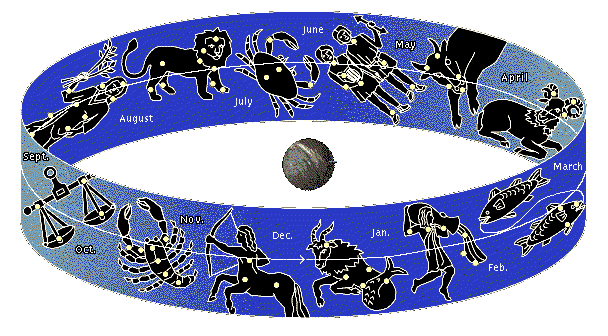
In Joseph’s second dream, we find evidence not only of the knowledge of the Zodiacal band with the Biblical Patriarchs, since Joseph’s 11 brothers appear as 11 stars, with Joseph as the 12th constellation, summarizing the primary signs found along the paths of the Sun and Moon, embodied in Joseph’s parents. We also see evidence of the ancient knowledge of the Precession of the Equinoxes, wrapped up in the idea that “the eleven stars made obeisance to me.” This idea that the other 11 Constellations of the ecliptic, bowed down, prostrated them-selves to Joseph’s sign/star, exhibits a figurative idea of precession, expanded upon in the link above. This ancient knowledge of the zodiacal band with the Bible Patriarchs, is added astronomical proof, and key aspect of the Celestial Gospel in concert with Scripture, astronomy and the Great Sphinx; the head of the woman-Virgo unified with the body of the Lion-Leo, as a stellar prophecy of the promised seed in the birth of Christ.

We also find the perfection of divine order in the number 10 related to the genealogy of Biblical Patriarchs, and the legacy of God’s Covenants with man, where not only Noah was counted as the 10th generation from Adam, [Gen. 5:1-32], but also in Abraham as the 10th generation from Shem, son of Noah [Gen. 11:10-26]. Thus all Earth’s inhabitants, were saved in Noah’s seed, as the focus of God’s singular purpose to redeem and save sinful man from every tribe, tongue, nation, and race, through the blood of our Lord Jesus Christ, [Gen. 3: 15]. This reveals God’s purpose, as developed in a further series of Covenants building from Noah to Abraham and his seed, providing both a temporal and spiritual context of how God Almighty not only repaired these Ages or spiritual dispensations, but also progressively revealed His eternal purposes in Christ.

Contrary to Faulkner, Dispensationalism presents a framework to interpret Scripture as it lays out successive periods of redemptive history where God progressively revealed more and more about His plan of redemption. This corresponds to [Heb. 11:3] “the worlds [aion-ages and time periods] or each of the ages [dispensations] were framed by the word of God… This also exposes Faulkner’s falsehood that God would reveal His entire redemption plan to the first Adam.

As we build the case for The Celestial Gospel in Scripture, an added key aspect of this narrative involves the astronomical subject matter of the ancient prophets in harmony with the application of their star prophecies. In the oracle of Balaam in [Num. 24:8] below as he beholds the glory of Israel’s wilderness encampment, and he identifies three of the four tribes at the cardinal points of the compass; Aquarius in verse 7, emptying his water buckets into the Southern fish–Pisces Australis, with Taurus the wild Ox in verse 8, and Leo the Lion in Num. 24:9. Num. 24:8 documents how God brings the 12 tribes coming from Joseph and his 11 brothers out of Egypt, in summary by referencing three of the “corner-stone tribes” of Israel that embodied the constellations of Aquarius, Leo and Taurus. These royal constellations of Israel provide us the anchor points of the 4 key tribes at the foundational sides of Israel’s wilderness camp, later carried over to the structure of the city plan of Jerusalem itself.

iii. Balaam’s Prophecy. This imagery from the prophecy of Balaam spoke of the destiny of Israel. He mentions that Israel “shall pour water out of his buckets” (Reuben/Water Bearer), “he lay down as a lion” (Judah/ Lion),  and he has “the strength of a unicorn” (Joseph/Bull), and shall “break their bones” as does either an eagle or constrictor serpent (Dan; Num. 24:7-9). This attests to the fact that the Northern tribe of Dan was omitted from this list of the 12 tribes because they introduced the forbidden practice of idolatry to Israel, and were replaced by the Eagle/Aquila. The idea that again all four figures correspond to the cornerstone symbolism indicates that this prophecy refers to constellations linked to these 12 tribes. For instance, ancient stellar history shows the signs of Taurus (the bull) and Orion, in cave art of Lascaux, in France, dating back to 3000-2900 B.C.

cave art

For those who do not think there is any reference to the stars in the picture of the bull above, please note the series of dots above his back. These are the Pleiades. The dots under the eye of the bull are the Hyades, and the four dots to the left of the bull’s nose are the stars in Orion’s belt. There is really no avoiding this identification. #8

The book of Job is the earliest completed book of the Old Testament, written circa 2900 B.C. In Job 38:31-32, the Pleiades and Orion are both mentioned by name, and linked closely with Taurus.

Num. 24:2-9 [ESV]

 2 And Balaam lifted up his eyes and saw Israel camping tribe by tribe. And the Spirit of God came upon him, 3 and he took up his discourse and said, “The oracle of Balaam the son of Beor, the oracle of the man whose eye is opened,[a] 4 the oracle of him who hears the words of God, who sees the vision of the Almighty, falling down with his eyes uncovered: 5 How lovely are your tents, O Jacob, your encampments, O Israel! 6 Like palm groves[b] that stretch afar, like gardens beside a river, like aloes that the Lord has planted, like cedar trees beside the waters. 7 Water shall flow from his buckets, and his seed shall be in many waters; his king shall be higher than Agag, and his kingdom shall be exalted.

 8 God brings him out of Egypt and is for him like the horns of the wild ox; he shall eat up the nations, his adversaries, and shall break their bone  in pieces and pierce them through with his arrows. 9 He crouched, he lay down like a lion and like a lioness; who will rouse him up? Blessed are those who bless you, and cursed are those who curse you.”

The cycles of the Sun and Moon bowing down to Taurus from Joseph’s dream [Gen. 37:9-11], tells us that the precessional Age of Taurus is indicated, which is consistent with the cardinal constellations pointed out in Numbers 23-24, that detail the precessional markers or cardinal points for this age. This precessional knowledge filtered through ancient Egypt and was applied along with the Sothic Calendar, during the Age of Taurus, documented by many archaeo-astronomers. #9 Even as Abraham is recorded in history among the first teachers of the ancient Egyptians, there were others like Enoch and Shem before him. As Jacob’s grand-father, Abraham also schooled Jacob in the tenets of the Patriarchal Academy of Astronomy.

This exerted a powerful influence on the Astronomy of the ancient Near East. We find this knowledge applied in the stellar alignments of numerous ancient Egyptian temples oriented to zodiacal signs signifying their related precessional age, as pointed out by Dr. Herbert Lockyer, providing added evidence that the Biblical Patriarchs not only knew of the precessional cycle, but also applied it in a spiritual context, as we find here in Numbers 24, with their wilderness encampment around Israel’s Tabernacle. In Exodus 25, God’s Word reveals a standard of the Pattern [H8403] of the Tabernacle [H4908; Ex. 26, 38:21, Ex. 39, 40:1-33, Ps. 46:5, 84:1-2, 132:5-7]#10 that God showed Moses, as a blueprint to build God’s tent, or Sanctuary [H4720-Exo. 25:8 below], according to how God dwelt among His people, as a point of contact for Israel, as He led them into and through the wilderness.

Ex. 25:8-10
8 And let them make me a sanctuary; that I may dwell among them. 9 According to all that I shew thee, after the pattern of the tabernacle, and the pattern of all the instruments thereof, even so shall ye make it. 10 And they shall make an ark of shittim wood: two cubits and a half shall be the length thereof, and a cubit and a half the breadth thereof, and a cubit and a half the height thereof.

Dr. Ernest Martin’s conclusion, from scrutinizing this Biblical data, that “there was a common Divine pattern regarding the structure of the universe seen in the Garden of Eden, the Hebrew Camp in the wilderness, and the Temple built by King Solomon. One way to see this common pattern between the earthly and  heavenly structures is in a comparison between the three general compartments within the Temple, and the three heavens noted in Scripture, as the three main sections of the Temple were designed to show these three heavens. The first section was open to the sky and to all weather phenomena, where birds could also fly within it. This area of the Temple answered to the “first heaven” which was like our atmosphere surrounding the earth. The “second heaven” in the Temple symbolically began at the eastern curtain in front of the Holy Place. Josephus tells us this curtain had the principal stars of the heavens displayed in  tapestry form. It represented the entrance into the starry heavens beyond our  atmosphere. Josephus says that west of this curtain, the center of the Zodiacal Circle with its seven visible planets were displayed on the south side in the form of the Menorah, and its the seven lamps. The twelve signs of the Zodiac denoting the twelve months of the year were displayed on the north side in the twelve loaves of the Table of Shewbread. This second court of the priests represented all the starry heavens above the earth’s atmosphere. But beyond this “second heaven” there was yet a “third heaven.” This “third heaven” was the Heaven of Heavens, or in Temple terminology the Holy of Holies was equal to God’s celestial abode where His Palace and Divine precincts were located, that the Apostle Paul called “Paradise.” Each one of the twelve tribes of Israel had a zodiacal sign associated with it.“ Dr. Martin goes on to link an astronomical pattern in the design of the camp in the wilderness and where each of the 12 tribes of Israel were placed in relation to the Tabernacle. This pattern was later established around the environs of Jerusalem itself. Moses positioned each of the twelve tribes of Israel to represent a particular zodiacal sign in its regular stellar, or astronomical order.” #11

It is curious to me how Dr. Faulkner, liberally quotes Josephus in his writings to degrade the idea of the Gospel in the stars, yet he somehow omits this quote from Josephus that favors a recognition of the Gospel in the Stars, as found in not only certain curtains in the Tabernacle of Israel, but also in the 3 main areas of the pattern of the Tabernacle and Temple, as they resemble 3 Heavens and Earths, in their pattern. It seems that Dr. Faulkner’s choice of support research lacks an equity in presenting the views of Josephus related to the Gospel in the Stars.

ii. Four Principal Tribes of Israel. Jacob (Israel) had 12 sons, and each of them is linked in God’s Word with one of the 12 constellations of the zodiac. [q] Hebrew scholars have at times been uncertain of the correspondence of all twelve tribes but the four references to the royal signs are clear from Scripture. The relate to the four principal tribes: Reuben, Judah, Dan, and Joseph.

Figure 3. Aquarius and the Southern Fish. [Reuben] 

The Message in the Stars - Aquarius - Berean Insights

The Water Bearer pours out a river into the Southern Fish.

The Star Fomalhaut is located in the eye/head of the Southern Fish. This aligns with mental ability. The color that is associated with this Direction may vary: it can be blue, representing water. As we view the colors of the Hebrew Tabernacle, their scriptural basis provides a solid foundation of God’s Word to draw our conclusions from, avoiding speculation and private interpretation.

Each of those four tribes is linked with one of the royal constellations in the blessing given them by Jacob or Moses. Reuben was told he is “unstable as water,” alluding to the Water Bearer. The name Reuben, means “Behold a son,” also ties him to the Water Bearer, among the zodiac signs, having the figure of a man. He is also mentioned as being over the “excellency of power” (Gen. 49:3-4), as Reuben aligned to the winter season in the original prophetic calendar, [Deut. 33:6]. 

The tribe of Judah was given the prime position in this Zodiacal design by being located directly east of the entrances to the Tabernacle and the later Temples.  The positions of these four prime tribes were arranged 90 degrees from each other within the 360 degree circle– to accord with the four seasons of the year, and the cardinal points of the compass. As a key aspect of the Gospel in the Stars a prophetic account centering on the Messiah and Promised Seed of Israel destined to come from the tribe of Judah, each of the 12 signs told a critical aspect of the Messiah’s deliverance of Israel, as the chief tribe Judah/Leo– was set to preside over the summer season in prophetic and the calendar matters, [Deut. 33: 7].

Figure 4. Leo The Lion of Judah. #12 

Leo Constellation" Postcard for Sale by GriffDesigns | Redbubble

“Judah is a lion’s whelp” (Gen. 49:9) ties him to the Lion. Moreover, John refers to Christ as “the lion of the tribe of Judah” (Rev. 5:5), establishing the linkage of Judah to the lion. The Lion represents the King, and Judah began the royal lineage through which the Davidic line of kings came. The name Judah means “praised,” suggesting that this line of kings in the Christ-Line through him (especially Christ) would be praised.

The next pivotal tribe proceeding counterclockwise around this zodiacal design of the “Camp of Israel“… was Dan. It was positioned on the north side of the Temple and Jerusalem as a venomous animal, sometimes displayed as an eagle with a snake in its talons, called Scorpio, a venomous scorpion today. Its station was at the autumn season in the prophetic calendar of Israel.

“Dan shall be a serpent…that bites the horse heels” (Gen. 49:17), which parallels the symbolism of the Scorpius/Serpent, depicted stinging the Serpent Bearer-Ophiuchus in the heel, [Gen. 3:15] The name Dan means “judge” and the serpent symbolizes the wisdom of a judge. The serpent in Eden was acknowledged as one of the wisest of his creatures. For example, the Lord has admonished his servants to be “wise as serpents and harmless as doves.” The kind of wisdom referred to especially invokes that of being a good judge. Antares, the bright star in the Scorpion’s heart, is realized as the seat of wisdom. For example, the Lord put wisdom into the heart of King Solomon so that he could judge his people wisely, (2 Chron. 1:11-12, 1 Kings 10:24; cp, Ex. 26:2, Ecc. 8:5, Job 38:36).

Figure 5. Taurus the Bull From Jamieson #13

The Constellation Taurus, the bull.

Finally, Joseph is compared to a wild ox, with Joseph’s son’s Ephraim and Manasseh compared to its two horns (Deut. 33:17). The Hebrew word refers to an extinct species of wild ox the size of an elephant having two long forward pointing horns, seen in the sign of Taurus the Bull. The bright star Aldebaran in Taurus represents its eye, the symbol of a seer (one who “sees”). Joseph was a great seer, so the Bull was appropriate for his sign. The name Joseph means “Jehovah has added,” probably referring to his multitude of descendants, in Ephraim and Manasseh, the horns of this sign. Ephraim was on the south side of the Temple and Jerusalem as the bullock of Taurus, positioned to align to  the spring season in the context of its prophetic and calendar implications. 
Thus, each of the four principal tribes of Israel are explicitly correlated in the blessings of Jacob, to one of the four cornerstone constellations at the cardinal points.

iv. Banners and Directions. Each of 12 tribes of Israel had a flag or banner with its sign. The Hebrew word for “sign” is translated “ensign” in the KJV Bible (Num. 2:2), but Hebrew scholars make it clear that the signs also refer to zodiac constellations. According to tradition, the figure of a man was found on Reuben’s banner, a lion on Judah’s, a serpent on Dan’s, and a bull on Joseph’s (Son’ Ephraim, who took his place). These were the same images seen on the tribal flags in their wilderness camp, reflecting the four banners facing the four cardinal directions: Judah facing East, Reuben facing South, Ephraim facing West, and Dan facing North, with the Scorpion replaced by the Eagle.
(Num, 2:3,10,18,25). Below the High Priest [Christ] is seen in the center vesica, with these four cardinal constellations at the corners of this engraving.
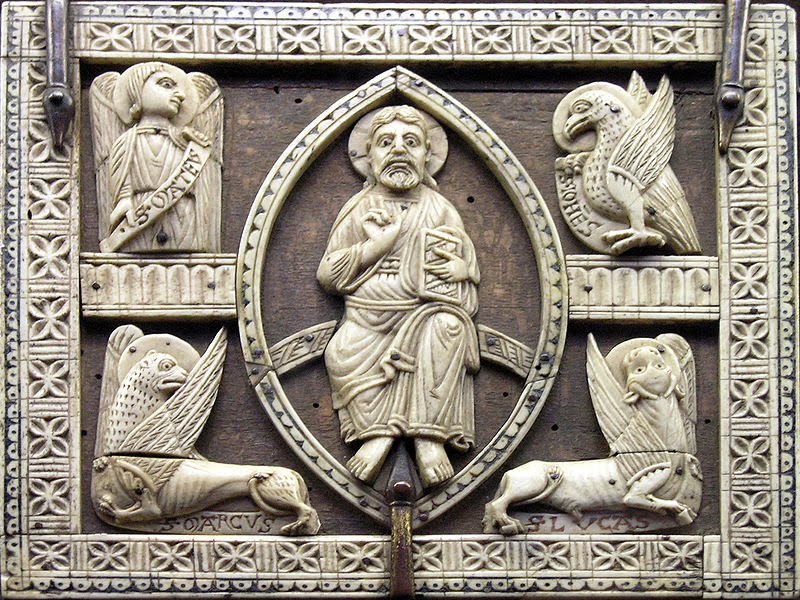
The Four Cardinal Points

The ancient Greeks described Taurus as a snow-white bull. Aldebaran, a first magnitude star is located at the eye of the Bull, the eye-symbolic of a seer, as was Joseph of Egypt, associated with the Bull. Thus, the Bull is symbolic of spiritual strength, and especially the gift ministry of being a Prophet/Seer.

Blue is symbolic of peaceful tranquility, that goes with the wisdom of a good judge. When applied with a gift ministry it is the wisdom that is from above, which is first pure, peaceable and gentle, easy to be entreated, full of mercy and good fruits [Gal. 5:22] as part of the fruits of righteousness, sown in Peace of them that make peace. This is how we can emulate the Prince of Peace, to promote true and genuine peace and Justice.

Antares is located at the heart of the Scorpion. The heart is a figurative seat of wisdom, and the scorpion/serpent symbolizes wisdom. The heart/chest-the regulator/pump of the body’s life-blood can also symbolize emotional/ and physical/ strength.

Thus, the placement of all four of the royal stars in the cornerstone signs is consistent with the symbolism of emotional, spiritual, mental and physical aspects of all living souls. Note also that spiritual and physical aspects are opposite each other in the circle (white opposite purple), as are the mental and emotional (blue opposite red), also found in the Yin/Yang symbol.

This may contain: the twelve zodiac signs in different colors and sizes, with symbols for each zodiac sign

In Num. 10:14-28, God’s Word removes the mystery of the order of the 12 tribes as they camped in the wilderness. Num. 11:14 verifies that the Standard [H1714–degel; flag, banner] of Judah/Leo in first place, followed by Issachar in v. 15, and Zebulon in v. 16, with the sons of Gershom and Merari, Levites bearing the Tabernacle. Next was the Standard of Reuben’s tribe in v. 18; followed by Simeon in v. 19, and Gad in v. 20, with the Kohathites bearing the Sanctuary in v. 21, to sum up the first 6 tribes. The Standard of the Camp of Ephraim is listed in v. 22, with Manasseh next in v. 23, as Taurus’ two horns, then Benjamin, in v. 24. Verse 25 shows the Standard of Dan as the rearward of all the camps and their hosts, followed by Asher in v. 26, and Naphtali in v. 27. Verse 28 concludes with;

28 Thus were the journeyings of the children of Israel according to their armies, when they set forward.

Figure 6. the 12 tribes in their wilderness Camp around the Tabernacle. #14

This contains an image of: marching order of the twelve tribes of israel - LinuxMint Image Search Results

From a Bible perspective outside the books of Genesis and Job, God revealed His Word and Will to the Patriarchs in the stellar witness and Celestial Gospel of the Promised redeemer of mankind. When we consider the Hebrew word “mazzaroth,” we find an early reference to the 12 Mazzaroth signs, occurring as a unit in Job. Later references to the 12 signs of the ecliptic in Scripture, are built upon what we find here in Job and the Genesis Creation record and the  Patriarchs. This provides added evidence of the antiquity of this knowledge of the entire zodiac, in the context of the Bible Patriarchs. In the graphic above we find the 12 Tribes of Israel linked to the order of the 12 Mazzaroth signs, with 3 tribes camped on each side, 4-square and the Tabernacle in the center, with Moses, Aaron and the Priests in the middle inside the square of 12 tribes.

This order of the 12 tribes as they camped around the Tabernacle is established in Numbers 2 in a graphic in the marginal notes of The Companion Bible by E.W. Bullinger, related to Num. 2:32.#15 Bullinger also has marginal notes on Num. 2:2 related to the word ‘standard‘ [H1714–degel; translated ‘ensign‘ as follows; “each standard is said to have its “sign” [H226–owth; sign, token, symbol, standard, prodigy, miracle, indicating a signal of something, as God’s Abrahamic Covenant had circumcision, [Gen. 17:11].#16 A foundational aspect of God’s Word is seen in Gen. 1:14;

14 And God said, Let there be lights in the firmament of the heaven to divide the day from the night; and let them be for signs, and for seasons, and for days, and years:

These ‘signs‘ are specifically related to the stellar nature of the 12 signs of the ecliptic, as seen in Gen. 37:9 linked with the 12 tribes of Israel fulfilled in the  11 brothers of the Patriarch Joseph. As we search the details of The Celestial Gospel, we will find it specifically and clearly stated in God’s Word, as part of God’s Old Covenants with His chosen people, especially in Abraham’s Covenant.

As Gen. 2:19-20 states:

19 And out of the ground the Lord God formed every beast of the field, and every fowl of the air, and brought them unto Adam to see what he would call them; and whatsoever Adam called every living creature, that was the name thereof.

 20 And Adam gave names to all cattle, and to the fowl of the air, and to every beast of the field; but for Adam there was not found a helper meet for him. [KJ21]

In v.19 what Adam would “call” the beasts of the field, and whatever he “called them“ is the same Hebrew word [H7121-Qara] as in v.20 where Adam names  every beast of the field. Strong’s says Qara means “to cry out, to call aloud, to roar, proclaim, pronounce or preach, to summon, invite, call together, to appoint, praise, celebrate, or call by name.” Its basic meaning is to enunciate a specific message addressed to a specific recipient, to elicit a specific response. The verb form of this word is used in the act of naming, that sometimes is an assertion of sovereignty over the thing being named; [Gen. 1:5, Ps. 147:4, Isa. 40:26]#17
Even as God-the Father of lights asserts His authority and sovereignty over the division of Day and Night in Gen. 1:5, and over the naming of the stars in Ps. 147:4, so Adam asserted his sovereignty over the Animal Kingdoms of life, delegated to him by God.

We should note that Adam’s delegated sovereignty pertained to Earthly things, while God’s sovereignty ruled over all, with special emphasis on the things of the Heavenly Creation, as they shed their 3-fold light upon the Earth. When God calls the roll up yonder for the stars, they are present and accounted for in His summons, to fulfill the reason and purpose He called and created them. The named Stars fulfill their part to proclaim the Celestial Gospel in witnessing to the Coming Christ! This word [Qara] is also found in reference to the Seed of Abraham, namely Isaac, [Gen. 21:12b] “for in Isaac shall thy seed be called.”

Genesis 1:14-16
And God said, 
Let there be lights in the firmament of the heaven to divide the day from the night; and let them be for signs, and for seasons, and for days, and years: [15] And let them be for lights in the firmament of the heaven to give light upon the earth: and it was so. [16] And God made two great lights; the greater light to rule the day, and the lesser light to rule the night: He made the stars also.

Gen. 1:14: “signs“- indicate first, the significance of the work wrought, and secondly, someone significant to come.[5] In context, the “work wrought” is God’s re-ordering of creation in the 2nd Heaven and Earth, repairing the damage inflicted on the 1st Heaven and Earth as a result of Lucifer’s revolt in heaven, causing it to be “without form & void.” [Gen. 1:1, Rev. 12:1ff] God’s repair job is divided into 7 spiritual administrations, or dispensations, each one bringing man’s relationship with his Creator back into increasing harmony, [Heb. 11:3]. This repair narrative is found in God’s progressive Covenants with Man, with each step bringing man closer to that perfect fellowship in Original Paradise with the Creator restored.

It also refers to the celestial narrative that “someone is coming,” the redeemer, the promised seed who is Jesus Christ. He is the central figure and subject of God’s Word. He is the one that the 12 Mazzaroth signs prophesy, the one embodying the light of the world, who fulfilled all Old Testament Law, and personifies the spiritual illumination of the world. The earth was thrown into Chaos between Gen. 1:1 & 1:2, but the effulgence of this light, the Sonrise of the ages, was framed between the two great lights of the Sun and the Moon on his birthday, precisely in the star Spica also called Al Zimach in Arabic (tsemach in Hebrew) in Virgo, on Tishri 1, 3 BC. Jesus’ birthday on New Year’s Day of the Hebrew calendar, celebrates the anniversary of Creation, revitalizing the social and spiritual structure of Israel according to the ruling Standard and scepter of the King of Kings. God had this date preserved in His omniscient foreknowledge before the Creation, instituted in the Hebrew Calendar, uniquely marked by the stars included in the story of Bethlehem on this date in 3 BC. We also find the pattern of the four points of the compass in star and planet signs marking the birth of Christ.

The pattern of eastern access to the Temple and Tabernacle is established in the order of the celestial signs surrounding the birth of Christ. We find this in the pattern of the 3 Jupiter-Venus Conjunctions, marking Christ’s birth that occurred from 3 to 1 BC. The first Conjunction was in the final degree of Cancer, near its zero line border with Leo. The second was fully in Leo, while the third was in Virgo. These three signs represent the eastern quarter of the zodiac of Israel, the heavenly image of the eastern side of the wilderness camp of the Israelites, the entrance or Way to the Door of the holy place (the truth) in the Hebrew Tabernacle. In Genesis 3:24, after God rejected Adam and Eve from Paradise, He protected the Way of the Tree of Life on the east of Eden, with the Cherubim’s fiery sword, until the redeemer could come to reactivate the way of salvation and eternal life with God, for humanity. This door ultimately led to the altar of the holy of holies, (the Life)-the inner heart of God’s temple-Sanctum, holding the Ark of the Covenant. The temporal progression of 3 Venus planetary unions perfectly matched the divine pattern of Israel’s tribal order on the east side of the Tabernacle. Judah/Leo was due east of the entrance to the holy of the holies, via the holy place, centrally located between the other two eastern tribes of Issachar/Cancer and Zebulon/Virgo. This eastern door to the Tabernacle represents the way, the truth, and the life, of John 14:6, embodied in Jesus Christ as light of the world, and the door of the sheep, as OT Shepherds slept across the door to their penned flocks, guarding the sheep with their lives, blocking the opening in the fold-walls. A Good Shepherd– is seen in the decan Auriga [Jn.10:9-17]. A Great Shepherd [Heb. 13:20, 1Pet. 2:25] & Chief Shepherd in [1Pet. 5:4] true way that leads unto life. [See also Jer. 23, 25:32-38, Ezek. 34]

Numbers 27:16-17

The Shepherd is the most popular metaphor for Bible leadership, but also we see that God chose actual shepherds for many of the primary roles of leadership over Israel. For example, Moses and King David, are two most prominent paradigms of leadership in all of Scripture, both started out as shepherds. And of course, Ps.  23:1-a most popular Bible verse, God Himself is compared to a shepherd.

The word for “lights” in the firmament [Gen. 1:14, 16 “maor“]18 is the same word used in reference to the lamps of the Menorah, (Exodus 20:27, 35:14). This word shares the same root of the word used for “light” in [Gen. 1:3-4], that God divided from the darkness, setting the universal standards of Day and Night. It should be noted that the Day was divided from the Night, and the light from darkness prior to the creation of the Sun and Moon. This points to spiritual light vs. dark
[Jn. 1:5], as the reason that the Earth became without form and void, between Gen. 1:1-2. The pure Light perfection of the Almighty in perfect righteousness removes any possibility that God created the universe in Chaos, thus the context of Lucifer’s failed insurrection against the Almighty, is the reason the earth was thrown into chaos. Also, the foundational order of Creation seen in God’s order or command to divide the light from the chaotic darkness, was a response to the enemy in his overthrow of God’s original order in the First Heavens and Earth, precedes God’s re–organization of this light in the Second Heavens and Earth, during the “Genesis Creation week.” The verses above also exhibit how the Sun, Moon and Stars regulate seasons, days and years, in God’s created temporal order.

The Celestial Gospel was always to be based on the long-view of Biblical history of God’s Covenants with man, as they progressively bring man closer to the state of Adam’s original fellowship with God, which God never explained to Adam or any other Bible Patriarch. God’s monumental job of restoring Creation is being set and accomplished by bringing humanity back into a state of spiritual redemption so man can fellowship with God as Adam and Eve did in Original Paradise. God started His dialogue of dividing Day from Night and light from Darkness before He created the Sun and Moon and stars, as the lights in the sky, referenced in His Covenant of Day and Night that began in Gen. 1:3-5, was upheld in Gen. 8:22, and ends in Rev. 21:23-25. This excludes Faulkner’s assertion that God revealed to Adam the details of His foreknowledge regarding the entire Plan of Redemption,#19 that was not included in the Celestial Gospel to begin with! Here Faulkner not only discounts God’s eternal plan and the purposes in His Covenants, but also contradicts Scripture in too many ways to count! The basis for Faulkner’s “strawman” argument against the Celestial Gospel, also ignores the truth that God kept the Great Mystery a secret which excluded it from the Celestial Gospel, as part of His master-plan of Redemption, [I Cor. 2: 7-10, Rom. 16:25-26].

A precept of this study documents how in truth, the Celestial Gospel is clearly and specifically stated in God’s Word, as part of God’s Old Covenants with His chosen people. The Hebrew word for “Covenant” [H1285-Beriyth]#20 is defined as “an agreement between nations; [Josh. 9:6], individuals and friends; [I Sam. 18:3, 23:18] or man and wife, [Mal.2:14]. A most important Covenant between God and Abraham [Gen. 15], was confirmed by Moses, [Ex. 24:7-8, 34:27, Deut. 5:2], was renewed and amended, after the exile, through the intervention of the prophets; [Isa. 42:6, 49:8] and the Messiah [Mal. 3:1, cp. Jer. 31:33-37]. It was a treaty, an alliance of friendship, a pledge, an obligation between a Monarch and his subjects, a Constitution. It was a contract accompanied by signs, a solemn oath and sacrifices, that sealed the relationship with promises of blessing for obedience and curses for disobedience.”

The Celestial Gospel also documents the effectual means of Oral transmission of the Covenant tenets, not replacing their foundations in God’s perpetual Scriptural Covenants with man, but as an inseparable part of them, prior to their being recorded into the scrolls of the OT Scriptures by Moses. Man has always needed an external standard for Godly truth outside of himself, working in union with man’s inner compass and God–given conscience, that began with Adam & Eve in the Garden, before the giving of the OT Law. We will see more details of this in the record of the Abrahamic Covenant below.

Covenant Theology holds that God created humanity as one people, starting with Adam and Eve, who broke God’s only condition, not to eat of the tree of the knowledge of Good and Evil. After their fall from perfection, and rejection from Original Paradise, and with their seed in Seth, were led back to God via certain key Biblical Patriarchs with whom God made perpetual Covenants. This redemptive history, starts after the fall of Adam and Eve, as God makes firm His Covenant with Noah [Gen. 6:18] to bring him and his family into the Ark, with every living thing of all flesh, two of every sort, male and female. In Gen. 9, God established His Covenant with Noah and his seed after him [Gen. 9:9-17], with His token of the Covenant on 2 levels: with every living creature on the Ark with Noah, for perpetual generations, and with Earth itself, seen in the rainbow, not to destroy it by flood again.

Figure 1. Genesis Patriarch’s Table. 21

By adding up the age of years in the genealogies of Genesis 5 and 11 we find the number of years from the Creation of Adam to the birth of Abraham as about 2000 years. Since there is almost universal agreement that Abraham lived around 2000 B.C., we can see the Bible teaching that the human race was created near 4000 B.C. and is thus, is about 6000 years old.

Noah is a key Biblical Patriarch because he embodies the transition between the pre-flood and the post-flood world. Thus all the systems of Biblical timekeeping going back to Noah, Abraham, Isaac, Jacob & Joseph, after the flood, includes the coordination of the luni-solar year, the year divided into 12 months of 30 days, giving a 360-day year, relating to the 360 degrees of the circle, all trace back to Noah’s pre-flood days. Thus, the calendrical practices of the Patriarchs of the Bible are summarized in Noah, combining the Lunar, Solar and Sidereal years in his standards of astronomical timekeeping. Since Noah was already 600 years old when the deluge fell upon Earth [Gen. 7:6], Noah’s use of this calendar continued, up to and including the 120-year period (120 x 3= 360), wherein he built and furnished the Ark. The Ark’s construction was according to the revealed plan of God, following a consistent divine pattern, the same tripartite pattern found in the Tabernacle of Moses and the Temple of David and Solomon, based on 3 Heavens and Earth’s and 3-fold creation of man in body, soul & spirit. Noah’s Covenant basis for his 360-day calendar, is also found in God’s Covenant of Day and Night, as we will see presently.

The Genesis record of Noah establishes the advanced astronomical practices of the Biblical Patriarchs, providing a basis from which, the roots of ancient Astronomy and studies in Archaeo-Astronomy are traced to their true context. Noah’s Covenant with God took place after his family came out of the Ark, and included the first burnt offerings on the altar that Noah built, [Gen. 8:20-22]. This established an unconditional Covenant relating to the Earth, even as God’s Covenant with Abraham did, referring to Israel’s claim on the Promised Land. This is in opposition to those who would remove or ignore God’s perpetual claim on the Promised Land that He chose for His People, as the Creator of Heaven and Earth.

The accuracy of these ordinances of heaven set the standard for truth, in the key area of calendars and timekeeping also, still applied today, according to the perpetual Covenant of Day and Night [Jer. 33:20-22]. This is one trait of “heavenly mandates” that their truths can remain intact beyond the scope of their original Biblical Administration. In the record of Gen. 8 and Noah’s Flood, verse 22 certainly stands out as an ordinance of heaven that has remained a constant, governing the seasons [Gen. 1:14] after the flood. This is a key aspect of God’s Covenant with Noah, where God’s Promises are made with Noah and his seed, that day and night shall not cease.

Genesis 8:22
While the earth remains, seedtime and harvest, and cold and heat, and summer and winter, and day and night shall not cease.

This verse opens with the words; “While the earth remains,” speaking to this Covenant being Everlasting and perpetual in nature because the Earth will be around forever. The connective “and” is found 7 times in v. 22, and according to Bullinger “pairs four sets of opposites, to express the completion and perfection of this perpetual Covenant,” that shall not cease.#22  In Gen. 9, as God further established His Covenant with Noah, and his seed and every living beast on earth, with His token or sign of an everlasting Covenant, listed 7x in Gen. 9; [Gen. 9:9, 11, 12, 13, 15, 16, 17], that The Almighty established with all flesh upon the Earth. Gen. 8:22 is a key aspect of the “Rainbow Covenant” with Noah, as the productivity of the earth’s life cycles in four seasons, in the 4 Kingdoms of life, perpetuate in the 2nd Heavens and Earth, in the Covenant of day and night, [Jer. 31:31-37]. Gen. 8:22 also reflects the biblical symbolism of the number four, as the first square number mathematically, witnessed pervasively in nature, as 4 elements of earth, wind, fire, and water, four points of the compass, north, south, east and west. Also, the 4 lunar phases, mirror the 4 Cherubim angels that quarter the 12 Mazzaroth signs. There are also four heads of the animal kingdom, witnessed in the four constellations at the celestial cardinal points; Leo the Lion-King of wild beasts, Taurus the Bull and king of domesticated animals, Aquila the Eagle, king of the bird kingdom, and the Man–Aquarius of the human kingdom. There are numerous other examples of biblical symbolism in the number four, like the four-fold ministry of Christ reflected in the Four Gospels, supporting this wisdom in God’s order of Creation. #23

Footnotes for Segments 1 & 2.

1. A Further Examination of the Gospel in the Stars, Faulkner [www.Answers in Genesis.com]
2. http://philologos.org/__eb-mazzaroth/207.htm
3. IBID
4. A Further Examination of the Gospel in the Stars, Faulkner [www.Answers in Genesis.com]
5. “The Rational Almanac“, Moses Cotsworth.
6. Figure 2 picture credit. “Witness of the Stars” p.21,  E.W. Bullinger
7. The Works of Josephus, 5.4 & 5.5, p. 707. translated by W. Whitson.
8. https://www.ancient-origins.net/ancient-places-europe/dating-lascaux-art-0017021
9. “Secrets of the Great Pyramid,” Peter Thompkins, refers to Archaeo-astronomy of; Sir Norman Herbert Lockyer, Schwaller de Lubicz, Livio Stechini ppg. 159-175. See Also Giorgio de Santillana & Hertha von Dechend, in “Hamlet’s Mill.”
10. Strong’s Concordance [H8403] and [H4908] & [H4720] James Strong.
11. “The Stars proclaim the Bible Message.” [Damien Mackey refers to Dr. Earnest Martin]. Also on; [http://www.rogerswebsite.com/articles/TheLostHistoryofJerusalem.pdf]
12. Figure 4. Picture credit, [http://www.redbubble.com/people/griffdesign]
13. Figure 5. picture credit from Jamieson.
14. Figure 6. picture credit, 12 tribes encamped
15. Companion Bible Image in marginal notes of Num. 2
16. Strong’s Concordance, [H1714–degel] and [[H226–owth] James Strong.
17. IBID, [H7121-Qara].
18. IBID, [H3974-maor].
19. “Universe by Design,” p. 134, Chapt. 1 FN. Dr. Danny Faulkner
20. Strong’s Concordance, [H1285-Beriyth] James Strong.
21. [www.pinterest.com]
22. E.W. Bullinger’s Companion Bible. Marginal note on Gen. 8:22.
23. “Number in Scripture.” ppg. 123-125, E.W. Bullinger
 

Synopsis of the Celestial Prelude

Birth of Jesus Christ
Biblical Astronomy of the Birth of Christ

Synopsis of the Celestial Prelude Pt. 1.

I’m very humbled and Thankful for the opportunity to teach in Rev. Jon Nessle’s current class on “The Witness of the  Four Gospels“, to provide a Synopsis of the Celestial Prelude, and some of its more recent developments. These are the teaching notes of the presentation earlier this month for 12-5-23.

I want to introduce a subsequent aspect of Biblical Astronomy teachings, built upon the foundation of the Celestial Prelude of the last 22+ years. As we have referenced in the recent Timeline, where we began documenting the history of Celestial signs that led to the General Sign of the Coma Supernova starting in history after 200 BC. Part of my thesis states that this pattern of Celestial signs marking Christ’s first appearance, forms a blueprint for his return, his long-awaited Second Coming. A central aspect of living in the end-times is to be prepared for the Return of Christ–mankind’s Great and only Hope! Since the inception of this ongoing research project, the pattern of these celestial signs has come into sharper focus, as multiple historical accounts say, the General Sign of the Coma Supernova was visible to the naked eye for about 275 years. The Supernova explosion in the head of the woman’s child, in the Coma Decan amounted to a celestial prophecy of Christ’s first coming that would remake all history forever, for mankind! The appearance of this Coma Supernova sign that started God’s sacred celestial timepiece, unto the Specific signs ticking down to the birth of Christ! It is only fitting and logical that the Heavenly Father’s sacred timepiece set in the sky should also include the keys to the general timing of the appearance of Christ’s Return. Just as there was a general expectation in various cultural populations for the appearance at the Messiah’s birth, so there is in modern times, for his Return.

Frances Rolleston was perhaps the first in more modern times to recognize the signs surrounding the birth of Christ in her work “The Mazzaroth.” She included a section “Rolleston (1865, pt. 2, pp.104–106)#1 on The Bethlehem Star, stating  that in about 125 BC a bright star appeared, so bright it was visible to the naked eye during the day. Rolleston also said that this event induced Hipparchus to make his star catalog about the same time. In his work-The Almagest, Ptolemy said it was Hipparchus’ discovery of the precession of the equinoxes that gave him the impetus to produce his Star Catalogue.” #2 We need to take a moment here to recognize the seismic influence Hipparchus and Ptolemy had on ancient Astronomy, and the involvement of both of these historical stalwarts speaks volumes to the legitimacy of the Coma Supernova.

Both of these giants where eyewitnesses to the Coma Supernova, and if there were two ancient astronomers one could choose to have as eyewitnesses of this Key event, these two all-stars would surely be on the guest list. Probably one of the greatest (and underrated) astronomers that ever lived, was Hipparchus of Rhodes. He is known to have been active at least from 147 –127BC, making him contemporary to the explosion of the Coma Supernova, as a recorded eye-witness to its appearance, c. 134 BC.

Hipparchus of Nicea

Hipparchus of Nicea by Raphael (by Dryoldscholar, Public Domain)

“Hipparchus is considered the greatest astronomical observer, and by some the greatest astronomer of classical antiquity. The majority of textbooks laud the accomplishments of Aristotle and Ptolemy, yet Hipparchus probably did more for the subject than any other Greek. Most of Ptolemy’s works are based on his ideas, yet Ptolemy is generally given credit because he perfected many of Hipparchus‘ concepts.

Over 200 years pass in Greek astronomy
between Hipparchus and Claudius Ptolemy of Alexandria. Ptolemy basically took all of Greek astronomy and summarized it in his great book – The Almagest (meaning The Greatest), a total of 13 volumes, that became the “astronomical Bible” for centuries. In it, he expanded on all the great works of earlier astronomers and added some “finishing touches” to the geocentric model.”3

Needless to say, these two stalwarts of ancient astronomy had incalculable influence on the science of astronomy, and the fact that both these pillars of science were the leading influencers in opening the recognition of the Coma Supernova, in light of Christ’s birth speaks volumes in history.

A Church father named Ignatius, the apostolic father closest in time to the New Testament writers (died 107 A.D.) wrote of the star as follows: “(It was) a star which shone in heaven beyond all the stars, its newness caused  excitement.”#4

Rolleston’s reference to Ignatius, one of the Church Fathers and the Bishop of Antioch, in about 69 AD, records that, “At the appearance of the Lord a star shone forth brighter than all other stars.”5 If we are careful not to confuse this Coma supernova reference with the planet Jupiter, we find evidence of visibility of a supernova still visible over 200 years after it was first seen as a marker of the general timeframe of Jesus’ birth. Seiss has more viable history on this point:

“Hipparchus about a hundred twenty-five years before Christ, [c. 128 BC] saw it [Coma supernova] as a new star, and was led by it to draw up his catalogue of stars. Ptolemy, about one hundred and fifty years after Christ, refers to it as having been observed by Hipparchus, but as having become so faint [c. 147 AD] as hardly to be any more discernible.”#6 

Pliny the Elder wrote in 79 AD that Hipparchus suspected the fixed stars were not as fixed as other people thought. After all, Hipparchus had seen a new star in Coma appear from nowhere. He first recorded the equinox precession of the about 1 degree a century. #7

“She [Rolleston] was first modern not only to recognize the role these giants played in the history of astronomy with the Coma Supernova, but she also realized the role of the Zoroastrian Magi in the annals of the star, credited to Zoroaster.

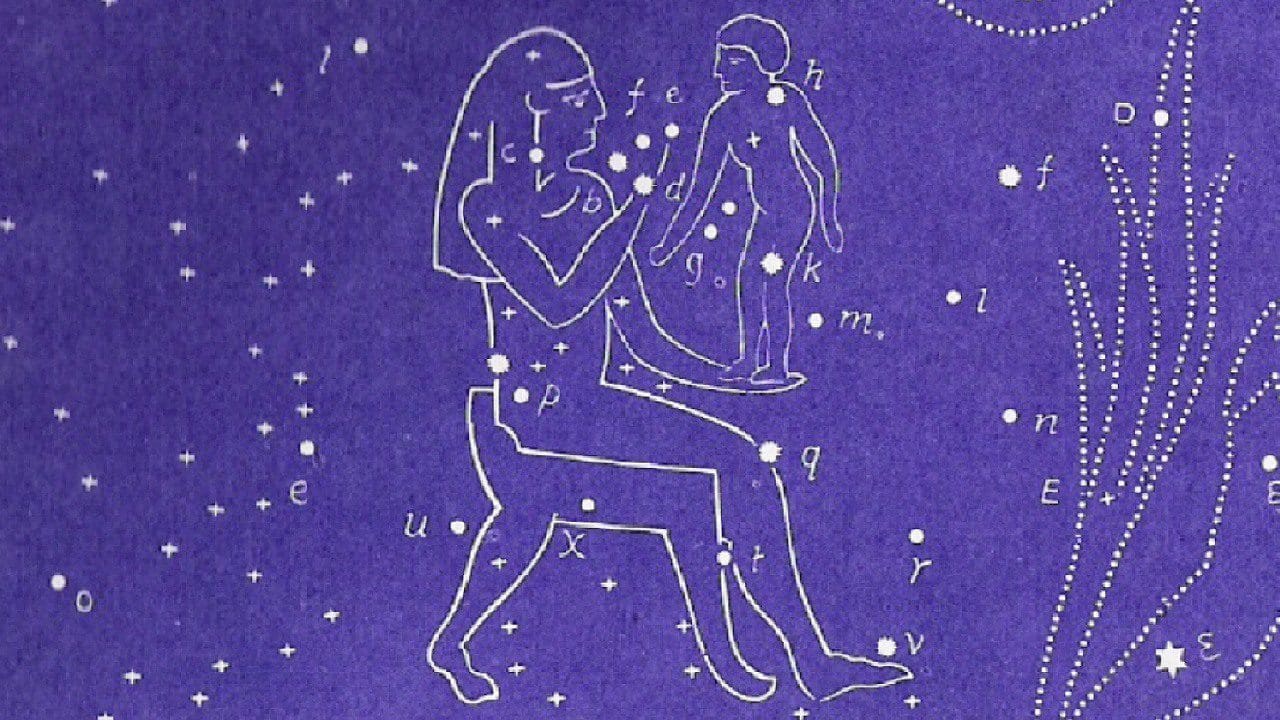
Rolleston cited Arabian astronomer Albumazar describing the signs and “decans of Virgo with Virgo having two parts and 3 forms, saying in the 1st decan as the Persians and Egyptians teach-a young maiden arose, a pure and immaculate virgin in Arabic named Adrenedefa, holding in her hand two ears of corn, seated on a throne, nourishing an infant, whose Hebrew name was Ihesus, meaning to save, that the Greeks called Christos, or Christ, rising with the virgin. These figures, found in the Egyptian Planisphere [Dendera Zodiac-Plate 3] with the Virgin holding the ear of corn as Virgo, while Koma may be the original name seen in Coma, marking the Head of the infant, the Desired seed of the Woman. It was said Zoroaster predicted this star would appear in the figures of the Virgin.” #8

Since the Coma Supernova was preceded and followed by other notable star signs leading to Christ’s birth, it may behoove us to check for other celestial signs in the Celestial Encore that fit the blueprints we have uncovered in the Celestial Prelude. A key we might look for in this end-time pattern of celestial signs that fit the Celestial Prelude, logically would be signs according to an inverse order in which they took place the first time around. One example of this would involve the Coma Supernova being the first sign marking the start of a series of increasing celestial signs leading to Christ’s birth-as a Prelude. The complement of a Celestial Encore may include a supernova type sign taking  place, not as a prelude, but as more of a sign leading to a Celestial finale, to mirror a series of concluding celestial signs reflecting in juxtaposition the birth of Christ.

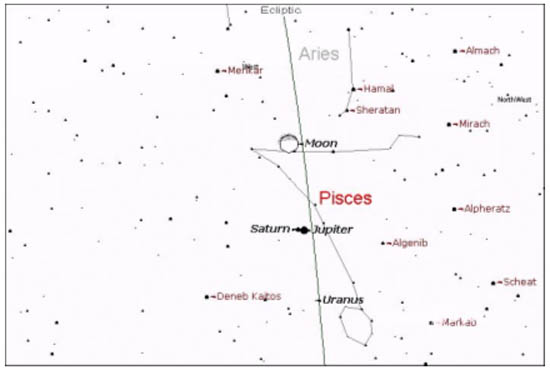
As the Creator and God of the Heavens and Earth, our Heavenly Father saw fit to mark mankind’s long awaited deliverance, written in the circle of the stars, by the celestial transition at Spring equinox/vernal point, to open the Age of Pisces in the precession of the equinoxes. He also marked the celestial signs surrounding the birth of the Christ, with a unique series of triple planetary unions, involving Jupiter-Saturn triple conjunctions of 7 BC. This would be the last Jupiter triple conjunction to mark the actual signs of Christ’s birth four years later in 3-2 BC.

As a genuine “mandate from heaven,” these celestial signs ordained from the Hand of the Creator, mark the long awaited fulcrum of all history, and decisive epoch of the coming of the promised seed, near the inception point of the Age of Pisces, in 7 BC. As the heavenly signs of the birth of Christ unfold in a true extent of their scope and structure, we can only stand in humble awe and reverence as they testify to God’s omniscient Power and Love. The Power and Glory of His creation reveals His three-fold light as He shed it forth for all the faithful, in the heavens, in the Scriptures, and in Christ– God’s word made flesh, to enlighten the Earth. Some persistent questions in this field include: How did the Magi’s trip to Jerusalem come about? The impetus for this question seems to first arise with the Prophet Daniel, and the actions he took to convey these keys to the Zoroastrian Magi, especially with the arrival of the Coma Supernova, followed by the afore-mentioned Jupiter-Saturn triple union in 7 BC. This led to the recognition of the actual signs of Christ’s birth, with the Triple union of Jupiter-Regulus in 3-2BC. The science of our method is not based on corrupt divinations of astrology, but agrees with our study precepts that guide us in our Biblical Astronomy Research Principles.

Let’s take a brief overview of both General and Specific signs of the Celestial  Prelude. Its General sign, was visible to the naked eye for over 200 years, while the celestial signs from 7-5 BC, focus on the triple Conjunction of Jupiter–Saturn during this time.

The General Sign

The premise of a Celestial Prelude is based on the simple fact that God would not ordain the long-awaited birth of His only begotten son, the eternal purpose of the ages, without a little advanced notice. This prelude has two parts, the first general the 2nd specific. The confusion of these two separate aspects of the Celestial Prelude has perplexed many in their search for truth surrounding the “Star of Bethlehem.” A good question to approach this topic of the first part of the Celestial prelude is;

Where did the popular idea of a single bright star, obvious to everyone, marking the birth of Christ originate? The answer to this question is found in what I call the General Sign of the Celestial Prelude, which alerted the Magi to the broad period of time when the promised seed would appear. The first decan, or subordinate sign of Virgo was first called “Coma,” meaning; he desired or longed for, as seen in the Book of Haggai.

Haggai 2:7

7 And I will shake all nations, and the desire of all nations shall come: and I will fill this house with glory, saith the LORD of hosts. 9

In his book Witness of the Stars, E.W. Bullinger documents the perversion of the meaning of the sign Coma, by the Greeks, into the hair or wig of Berenice. Coma was originally pictured as a woman holding her child, in the Dendera zodiac, who embodied the desired one of the nations. It was in this decan of Virgo that around 132-125 BC, a new star, so bright that it was visible in daytime, suddenly appeared in the head of the holy child seated in the lap of the woman, in the sign Coma. 10

This idea of a supernova being part of the celestial pageantry marking the birth of Christ, is not without precedent. We should be aware of Johannes Kepler’s exploits regarding a link he made between conjunctions of Jupiter and Saturn, and a supernova. In October of 1604 the great German astronomer Johannes Kepler observed the movements of Jupiter and Saturn as they neared union with Mars, near the head of Ophiuchus. He noted simultaneously a supernova
was visible over the next two years in the heel of Ophiuchus. This brilliant new star later became known as “Kepler’s Nova,” and he wondered if the Magi had seen a similar event, when he recalled elements of an old rabbinical commentary by Abrabanel on the Book of Daniel, that referenced a significance for Israel, of Jupiter-Saturn Conjunctions in Pisces. We find evidence of this from Richard H. Allen concerning these planetary Conjunctions of 7 BC in this reference:

“Within their boundaries (of Pisces) took place three distinct unions of Jupiter and Saturn in the year 747 of Rome, – the year to which for a long time was assigned Christ’s birth; these phenomena strikingly agreeing in some of their details with Saint Matthew’s account of the Star of Bethlehem. The view that these planetary appearances guided the Magi in their visit to Judea was first advanced by the celebrated Kepler… It was the  Rabbis that held the tradition, recorded by Abrabanel in the 15th Century, that a similar Conjunction occurred in Pisces three years previous to the birth of Moses, and they anticipated another at their Messiah’s advent.”11  

Following the triple Conjunction of Jupiter and Saturn in the specific signs of the Celestial Prelude was a unique triangular massing of planets. Kepler refers to the Feb. 25th, 6BC triangular massing of planets; Jupiter, Saturn and Mars, as the “decisive Conjunction of 6 BC that opened our precessional age of Pisces.” As we noted, Kepler also boosted the idea of the impetus for the Magi trip to Judea was initiated at the arrival of this series of Conjunctions. This could make him a larger presence in the history of Astronomy, even more than what he is already accredited with, because of the spiritual nature of this insight. As we will see regarding the birth of Moses, Jupiter-Saturn unions in general and especially a triple Conjunction, held a special signification for Israel, but they were not limited to Pisces. This misconception has led to confusion in marking the signs of Moses’ birth, but once this is realized we find great unity in the signs prior to the births of Abraham, Moses and Christ. Kepler was also intrigued by the idea that there might be an affinity between this series of planetary unions, marked by the appearance of the 1603 supernova. At the same time, Kepler doubted these signs would have marked the actual birth of the Messiah, since another Jupiter-Saturn Conjunction akin to this occurred a few months later, as part of a triple union. Although Kepler recognized some of the potential critical nature of these signs in relation to the coming of the Messiah, he did not discern between what I am terming as the general and Specific signs leading up to the birth of Christ. This contributed to his confusion regarding how these general signs could mark the birth of Christ, as it will for anyone who fails to make this key distinction. It is important to notice that Kepler was not only the first I am aware of, to suggest a planetary Conjunction scenario to explain the “Star of Bethlehem,” but he was also the first to connect a supernova with these unions and relate it to what the Magi had seen.

E.W. Bullinger uncovers below, the popular belief regarding this general sign that was prevalent in and before the first century BC: “a traditional prophecy well known in the East, carefully preserved and handed down, that a new star would appear in this sign [Coma] when he whom it foretold, would be born.” 12
This tradition was at least partially based on Balaam’s declaration in Numbers 24, meaning that Balaam’s prophecy holds, for our purposes, minimally a twofold import.

Numbers 24:17

17 I shall see him, but not now: I shall behold him, but not nigh: there shall come a Star out of Jacob, and a Sceptre shall rise out of Israel, and shall smite the corners of Moab, and destroy all the children of Sheth.13

   First, Balaam’s revelation refers to the advent of Christ the King, the ascendant bright and Morning Star, who came forth out of Jacob’s genealogical line. This genealogical or “Christ-line was marked astronomically by common cases of Jupiter-Saturn triple conjunctions seen at both the births of Abraham and Christ, both marked by the king planet. Secondly, there is a celestial double meaning in the phrase: Star out of Jacob, with links for both the general and specific aspects of our Celestial Prelude. The new star–supernova in the head of the toddler in Coma’s lap; visible for over 200 years, was the general sign, the  Star out of Jacob, that prepared the Magi to watch for the specific aspects of the second part of the Celestial Prelude, which included the Jupiter-Saturn triple union of 7 BC in Pisces. We find this second aspect of Balaam’s prophecy relating to the scepter, symbolic of the reign of the king planet-Jupiter. As we progress in our study, it’s evident that Jupiter was the planet the Magi called “his Star” in Matthew 2:2. The Magi had noted the triple union of signs in 7 BC, involving Jupiter and Saturn, that gave them a blueprint for the actual signs marking Christ’s birth, that also involved a triple conjunction of Jupiter starting in 3 BC. An early sign in August of 3 BC motivated them to begin their caravan to Jerusalem. The study on “The Stars Over Bethlehem,” shows more detail on the Magi’s observations at the Messiah’s birth, both in Virgo and Coma. As the verse in Haggai 2:7, teaches specifically in the 2nd part of the verse that states: “And I will fill this house with glory, saith the LORD of hosts.” Haggai’s prophecy here refers directly to not only the future glorified Temple, as we find later in the context of Haggai 2, but also with NT hindsight to the spiritual body of Christ as the temple of the Lord. [I Cor. 3:9-17, Eph. 2:18-22]

Haggai 2:9
The glory of this latter house shall be greater than the former, saith the Lord of Hosts: and in this place will I give peace, saith the Lord of Hosts. 14

Eusebius, a scholarly church historian of the early fourth century, evidently made a considerable study of literature available from the centuries before him, and came to this conclusion about the star.”15 He references a quote on what eyewitnesses saw during the time of Christ’s birth as follows: “We saw how an indescribably great star shone among these stars and dimmed them so that they no longer shone, and so we knew that a King was born for Israel.

This is revealing in a historical light, when we consider that in the years after the Magi’s visit to Jerusalem, shekels from Judea struck during the period of the second revolt, [132 AD.] bore the design of a bright star over Jerusalem’s Temple, called Bar Kaukab, or Son of the Star. Historically, this was a reference to the Jewish leader of an uprising against Rome at the time, but the truth cut into these coins remains the bright star in the sky over the temple!#16 This supports and commemorates the arrival of the Coma supernova appearing in the head of the infant son in Coma’s lap, the desired of the nations, circa 134 BC aligning with Hipparchus’ sighting of the Coma Supernova. It is Christ as the chief corner-stone who glorifies the New Jerusalem as the light of the world, and these coins engraved images honors the traditional prophecy of a general sign pertaining to this new star, shining in the head of the glorified Christ-child. These proofs show a fresh start in the study the “Star of Bethlehem,” revealing great hidden truths. Once we distinguish between the general and specific signs marking the birth of Christ, most of the confusion that plagues this topic will be removed.

Modern Science has also progressed significantly of late, to fill in gaps in our ken of Supernova’s. Traditional supernova’s experience a very bright and powerful explosion, which has been thought of a a singular event, but this overlooks the likelihood of a Recurrent Novae. Recurrent novae – are “defined as systems with more than one recorded nova outburst. There are few members of the new the Recurrent novae subclass: at this point in research, just ten,” one of which [RS Oph] has a documented history of at least eight multiple outbursts, from 1898 to 2021, a 123-year period.#17  Recurrent novae repeat the nova process over a much shorter period-about every 10 to 150 years, while nova outbursts are thought to repeat on much longer timescales of potentially over 1000+ years.

Figure 1. The Recurrent Nova RS Oph. 18

Recurrent Nova RS Ophiuchi Just Blew its Top! - Sky & Telescope - Sky & Telescope

RS Oph about 5,000 light-years away in the constellation Ophiuchus. In its quiet phase it has an apparent magnitude of about 12.5. It has been observed to erupt in 1898, 1933, 58′, 67′, 1985, 2006 and 2021, reaching a magnitude of about 5 on average. 14/38 Thus, in the six eruptions of RS Oph over the last 125 years, this Recurrent Supernova in Ophiuchus has exploded on average nearly every 21 years.

If the Coma Supernova was recurrent for a period of about 250+ years, from c. 134 BC to about 147 AD, it would explain the sequence of events described in history according to modern scientific evidence, with the reputable references we have cited. Ancient records only tally naked eye-visibility of the Coma Supernova, not potential fluctuation due to multiple eruptions of a Recurrent Supernova, as this was not part of the “new stars” concept at the time. As we find in Figure 1 above, the effect of the supernova eruption described by Eusebius above from  extra-biblical sources refer to “a great star that shone among these stars and dimmed them so that they no longer shone…” is indeed evident resulting from recurrent eruptions of the Oph Recurrent Supernova, seen above-adding weight to this hypothesis.

In Isa. 9:6, one of the great prophecies of the birth of the promised seed-Jesus Christ, used of the Messiah was Sar-Shalom; the Prince of Peace, the one who brings true and genuine Peace to all Creation [Eph. 2:11-22]. It is also used of Prince Moses in Ex. 2:16. According to Hislop, The Chaldean version of this word; “Zer,” meaning “to encompass” gives us not only the English basis for: “Zero signified by a circle among the Chaldeans,” but also Zero; “the seed.” Thus, it relates to the Hebrew word zera [*H2233] #19 used in prophetic and Messianic references to Jesus Christ’s birth-promised seed in Gen. 3:15, to the end the Chaldean word for the “woman’s promised seed” was “Zero-ashta,” also forming the basis of the name Zoroaster.

We should note that in the prophecies of Zoroastrianism in the Zend-Avesta, the predicted return of Zoroaster was a savior who would renew all existence in preparation for the Last Judgment. These references to the woman’s promised seed point directly to the general sign of the Celestial Prelude. Hislop also notes:
“In almost all nations, not only was a great god known under the name of Zero or Zer; the seed, and a great goddess under the name of Ashta or Ishta; the woman, but the great god Zero is frequently characterized by some epithet which implies that he is The only One.” #20 This evidence provides a strong basis for a direct correlation to the decan Coma, the seed who was the desired of the nations, especially in view of the Supernova in this child’s [Christos] head of Coma as seen in the Dendera Zodiac, marked as the promised seed, in the general sign of the Celestial Prelude. The implication that the promised seed of the woman would be the only one, speaks to the truth that Christ is the Alpha and Omega, or the first and last way God made available for the redemption of Mankind.

Coma, “the desired of all nations,” occupies the first one-third portion of Virgo’s ecliptic arc. Even though the modern name associated with this decan is Coma Berenices, depicted as a woman with a hank of hair, the true picture (according to star names and history) is a woman holding a child on her lap. Even Shakespeare referred to it that way. She is also depicted so on the Denderah zodiac of Egypt, dated approximately 2300 BC. Coma validates Virgo’s message about the promised child. From the very first position on the ecliptic, God displays His Son in a portrayal of His birth—and virgin conception. #21

Coma Berenices: NGC 4414

Coma Berenices: NGC 4414

NGC 4414, a spiral galaxy in the constellation Coma Berenices, photographed by the Hubble Space Telescope. #22a

The ancient star names in Coma identify the seated woman as “a pure and immaculate virgin,” “the virgin who carries,” and “who bears.” Another star name identifies the child as “the Branch.” Clearly, Coma represents the virgin; and her child, “the desired of all nations,” is the highly favored and exceedingly blessed coming One (the offspring of Virgo’s womb). There is evidence that Coma possibly housed the star of Bethlehem. Several astronomers from different countries recorded that a new star, or supernova, ignited about the time of Jesus of Nazareth’s birth—and this star was visible into His earthly life.[i] This is more compelling testimony that He is Messiah. Some believe that a supernova reportedly appeared in the constellation of Coma in the child’s head. #22b

Figure 1. The Decan of Virgo-Coma. #23

The decan of Coma appears as the three bright stars forming the inverted “L” shape, that significantly contains the North Galactic Pole, located 5 degrees west of Beta Coma. This is interesting in light of the original star picture linked with this decan, as seen in the Dendera Zodiac, of a mother holding her Son in her lap, “the Desired of the Nations,” [Figure 1, above]. The close proximity of the North Galatic Pole, recalls the image of Cepheus “the crowned  king” who regally sits above the Celestial Pole star–polaris, embodies Christ the king seated heaven at God’s right hand of the Heavenly Father, [Eph. 1:20-23].

Coma Speaks - part 2 | Atam.Org
The Stars of the “L” shaped Decan Coma. #24

The roots of their knowledge of the Promised Seed trace to the monotheistic teachings of Zoroaster. A second man of the same name was said to have coexisted with Daniel in the reign of “Darius the Mede” in the 5th – 6th Centuries. We find a reason for their joy, in Rolleston’s quoting of Abulfaragius below:
“Zeradusht {Zoroaster} taught the Persians that in the latter times a virgin should bring forth a son, and that when he should be born a star should appear, and should shine and be conspicuous in the midst of the figure of the virgin. It is then said that he commanded his disciples, the Magi, when they should see the star, that they should go forth where it directed them, and offer gifts to him that should be born.”#25 (emphasis mine)

This confirms what we have already seen in Zoroastrian writings concerning the coming of the promised seed. The Magi would certainly have been joyfully awestruck when they realized the dual witness of the supernova in Virgo’s 1st decan of Coma, along with “his star,” the king planet Jupiter at rest in the mid-section of Virgo, on their way to Bethlehem, fulfilling the prophecy written in the stars, and established by their teachers, Zoroaster and the prophet Daniel.

A graphic rendition of this is found in our banner at the top of this blog post. It shows both the general sign of the Celestial Prelude next to the specific sign of Jupiter in Virgo, standing still @ zenith over Bethlehem, on winter Solstice as the Sun was standing still, as the Magi testified to the Creator’s precision, with the Rhythm of His star cycles in perfect harmony, bringing the Magi to their appointed rendezvous and destiny as witnesses of His purpose of the ages, the foretold Messianic arrival of the redeemer of Mankind.

The Coma supernova set the stage for the triple union of Jupiter-Saturn in 7BC leading to the birth of Christ. This union in Pisces also marked a transition in the ages of the precession of the equinoxes, from the Age of Aries to the Age of Pisces. This was not only the case in ancient Israel but the world-views of many ancient cultures including, Sumeria, Babylon, Egypt, Persia & Meso-Americas, all held similar views. According to this pattern, Jupiter-Saturn triple unions occur in Pisces only once every 800 years, showing how this series subdivides the precession, totaling a period of about 25,000+ years. Since every 30 cycles of Jupiter-Saturn triple unions in Pisces totals a period of 24,000 years, this period is near enough to the full cycle of precession, to warrant our focused attention. The new Precessional Age was highlighted because for the prior 2160 years, Aries was the sign wherein the Sunrise took place on the Spring equinox.

The Triple union of Jupiter-Saturn in 7BC marked the first time that the Sun arose in the Sign of Pisces, on the Spring equinox, signifying a new Precessional Age, the Age of Pisces. Over 2000 years has already passed since this opening of the Piscean Age, and the Birth of Christ that occurred 4 years later. The Sign of Pisces contains 2 fish, one swims to the North Pole, vertically and the other on the horizon along the ecliptic. The fish representing the houses of Judah and Israel, showing the Promised Seed will come out of the Royal House of Judah. Jesus Christ would be a Son of Adam, Abraham and David to fulfill all righteousness.

The fullness of the gap between the sufferings of the Lord, seen during his first coming, and his glorious return as King of Kings and Lord of Lords continues 8 to take place now in the Piscean Age. Finally, this triple Conjunction of Jupiter-Saturn in Pisces gave the Magi all they needed to identify the signs marking the birth of Christ when the triple union of Jupiter-Regulus took place in Leo, starting on Sept. 14th, in the Lion of the tribe of Judah. This overview of Bible and Celestial History, beautifully encapsulates how God utilized the Natural Law witness in the heavens, coordinated with Divine Scripture, conclusively, to reveal in increasing detail, the identity of His only begotten Son Jesus Christ.

As Hebrews 11:3 tells us;
Heb 11:3 Through faith [G4102] we understand [G3539] that the [G3588] worlds [G165] were framed [G2675] by the word [G4487] of God, [G2316] so that things which are seen [G991] were not [G3361] made [G1096] of [G1537] things which do appear. [G5316]

”worlds” [G165 aion] ages of time were repaired, or set back in order by the individual spoken Words [G4487 rhema] of God. #26

According to Jon Nessle’s teaching, we can trace the Audible Spoken Words of God in Scripture at the inception of each Spiritual Administration, “framed” [G2675–katartizo] means; to establish, set up, arrange, complete, perfect, finish, refit, repair, mend. #27 [I Cor. 1:10, Gal. 6:1, I Thess. 3:10]

Each of the seven Biblical administrations represents a step closer in the progression towards the total reparation of temporal ages, thrown into chaos by Lucifer’s revolt in the 1st Heaven and Earth. As Entropy Law was instituted, resulting from the disobedience of Adam and Eve, the enemy became a “Time Lord” in the kingdoms of this world. Entropy Law, also known as the 2nd Law of Thermodynamics, or “Time’s Arrow,” dictates a degradation of all matter in Creation, inexorably moving from higher degrees of order to lower states of order. Thus, the palpable effect of the release of sin nature on Creation, was realized [Rom. 8:19-23]. The Creator is the only One Who could reclaim the rule of the Temporal World, from Eternity past, He set His plan in motion to be carried out in Jesus Christ. Each Spiritual Administration/ Age, brings Man closer to the Return of Paradise in Christ, where God’s order is restored forever. In this way Christ is seen as consummation of the ages, the center and embodiment of God’s plan to repair the damage done by the enemy’s revolt, with the fall of man. As all history turns upon the Messiah– the axis of temporal order [BC/AD], so the faithful look to the Messianic prophecies of his appearing in believing for the restoration of the Ages.  

Stay tuned for Part 2 of this teaching on Tune-in-Tuesday which took place 12-12-23, with the teaching notes to be posted soon!

God Bless and Merry Christmas,

Rene’

Footnotes

1. The Mazzaroth, Frances Rolleston (1865, pt. 2, pp. 104–106)
2. IBID.
3. IBID.
4. IBID.
5. The Mazzaroth, Frances Rolleston
6. Gospel in the Stars, Joseph Seiss
7. IDID
8. The Mazzaroth, Frances Rolleston
9. KJV. Haggai 2:7
10. Witness of the Stars, E.W. Bullinger
11. Star Names, their Lore and Meaning, Richard H. Allen
12. Witness of the Stars, E.W. Bullinger
13. KJV. Numbers 24:17
14. KJV. Haggai 2:9
15. Men of Science, Men of God, Dr. Henry Morris.
16. http://www.jewishvirtuallibrary.org/coins-from-the-second-revolt
17. https://skyandtelescope.org/astronomy-news/recurrent-nova-rs-ophiuchi-just-blew-its-top/
18. IBID
19. Strong’s Concordance–zera [*H2233], James Strong.
20. The Two Babylons, Alexander Hislop
21. [https://lmci.org/constellations.cfm?subdir=LMCI_Sky_Culture]
22a. IBID
22b. Picture credit; Coma Berenices: NGC 4414
23. IBID, Figure 1. Picture credit
24. https://atam.org/virgo-coma-speaks-part-2/
25. The Mazzaroth, Frances Rolleston
26. Strong’s Concordance-[G165 aion], [G4487 rhema], James Strong.
27. IBID-[G2675–katartizo]


Cuneiform Tablets, the Magi and the Star of Bethlehem

Cuneiform Tablets, the Magi, and the Star of Bethlehem

The August Blog of 2023 builds upon the last couple of articles we have posted, as it expands on Daniel’s use of the Babylonian Star Dairies as a tool to teach the Magi about the celestial signs in line with the Biblical Messianic Prophecies that would predict the birth of Christ. God did not leave Himself without witness of His only begotten Son-Jesus Christ, not only in Scripture but also in the Gospel of the Stars even as His promises to Abraham linked to the Celestial Gospels. God’s master-plan of redemption was known to mankind long before it was written in human script, even as the Messiah-the Lion of the tribe of Judah–Abraham’s grandson, was prophesied in Leo, [Gen. 15:5, 49:8-10]. This month’s study reveals an ancient Babylonian Cuneiform tablet that appeared in the period of Daniel’s leadership in the royal courts over the Magi in Babylon and Persia. We will review some of the traits of what I have termed the Celestial Prelude, as the celestial signs that led up to the birth of Christ, which allowed the Magi to recognize and correctly identify the stars of the Messiah’s birth.

God’s plan to rescue humanity is embodied in Jesus Christ, the only begotten Son of God, and his birth was connected with and prophesied in the stars. The Star Gospel as found in the Old Testament, or for Judaism in the Tanakh, long foretold his birth, ministry, death, resurrection and ascension. Following the rise of ancient Babylon, the forces of king Nebuchadnezzar conquered Judah, the southern kingdom of Israel in 604 BC, and led most of its key people in captivity to Babylon. Among the exiles was a group of gifted and intelligent young men with their leader named Daniel. After distinguishing himself by first accurately revealing king Nebuchadnezzar’s dream, and then interpreting it for him, he was rewarded with a high seat in Babylon’s royal court, that included key governmental authority, where he was made chief over all the magicians, soothsayers, and wise men of Babylon. This put Daniel and his friends in key positions to influence many royal decrees that descended, not only from Nebuchadnezzar, but many of the subsequent Kings including Cyrus, during their lifetimes. As we have seen, the Babylonians were already renown in history for their study of the stars both from a perspective of science and symbolism. With the rise of Daniel and his team, their view of Scripture and Messianic prophecy influenced the royal court, regarding the coming Christ. Having the Babylonian Star Diaries, the cuneiform clay tablets at his disposal, provided valuable resources for his work in identifying and accurately teaching the Magi the celestial signs to look for, that led to the birth of Christ.

Figure 1. Old Persian cuneiform syllabary From the Tomb of Darius. 
(circa 500 BC)

Daniel’s knowledge of the Gospel in the Stars not only enlightened his view of the OT Prophecies of Christ, but also provided the special insight needed to teach these key truths to the Zoroastrian Magi, whose monotheistic religion also influenced King Cyrus, as one of the most enlightened leaders in history. Daniel’s knowledge of the Gospel in the Stars was closer to the Bible Patriarchs like Noah, since it was a throwback to the initial revelation of what was first given, later corrupted in the practices of astrology and divination, rooted and further developed in Babylon. As in modern times, astrologers cast their horoscopes, while many believe that the stars fatalistically control one’s destiny. But Daniel, preserved the Tanakh, and developed his own order of scholar-disciples committed to his teaching, based on the truth of Scripture, not to include astrology or other kinds of divination, as they were strictly forbidden in the Hebrew Scriptures. Daniel spent all his adult life in Babylon and later in Persia as a high official of the kings he served, while never wavering from his true service for the One true God. When the Prophet Daniel was carried off in captivity to Babylon, it was the result of one of 27 sieges of Jerusalem in Israel, the first destroyed by Nebuchadnezzar, who burnt the Temple in 587-586 BC, [2 Chron. 36:17-20], the 2nd in 69-70 AD, by Titus’ of Rome who also burnt the Temple.

In a recent study by John Wee, he provides examples of the “five major scholarly disciplines in the Assyrian Court” that provide insight into the scene that confronted Daniel in the Courts of Babylon and Persia, in his oversight of the professional court astronomers and Magi.

I Scribal Learning, Commentaries, and the Lamentation Priest

“The profession and its texts become more illuminated from the late Neo-Assyrian period, especially during the reigns of Esarhaddon (680–669 BC) and his son Assurbanipal (668–c. 627 BC), two monarchs who displayed particular interest in cuneiform scholarship and in celestial and other kinds of divinatory lore. Assurbanipal boasted that he “wrote on tablets the wisdom of the god Ea, the Lamentation arts,” and compiled a catalog (4R 53) listing individual liturgies ascribed to Lamentation priests. As one of the five major scholarly disciplines in the Assyrian court, the kalû (“lamentation priest”) stood along-side the āšipu (“magician / exorcist”), bārû (“haruspex /diviner”), ṭupšarru or ṭupšar Enūma Anu Enlil (“scribe /astronomer”), and asû (“physician”). Compound terms such as kalûtu or āšipūtu designated the “arts” or expertise of each profession, denoting not merely skills or proficiencies in the abstract, but also cuneiform text corpora associated with the profession. Different professions operated in ways that complemented each other. Chief kalûs like Urad-Ea and his son and successor Nabû-zēru-iddina belonged to the Assyrian king’s inner circle, and regularly wrote letters to the king concerning festival observances and kettle-drum performances before planets & gods. Other occasions, however, called for their participation in joint rites with the cooperation of court magicians. One Lamentation priest of some stature was Marduk-šāpik-zēriwho, even when (temporarily?) out of favor with the king, was influential enough to gather various professionals and apprentices under his auspices, including magicians, haruspices, physicians, astronomers, and other Lamentation priests (SAA 10, 160 obv. 47 – rev. 37). The details of his educational credentials are worth citing at length:” #1

In the reference from John Wee below we find these priests were groomed in families as they learned the “arts” of their profession from their fathers in service to the King, that included being well “read” (šitassû) in “the arts of the magician and of the astronomer” or the astronomical omen series Enūma Anu Enlil. Enlil, … I have observed the stars of the sky. I have read Šummaizbu, [Kataduqqû], Alamdimmû, Nigdimdimmû, […], Šummaālu. I learned … Under the protection of the king my lord, I have fulfilled … and … I am competent in my father’s duty”. The list of achievements is impressive, including ritual performance and recitation, observances of “healthy (and) sick flesh” that may be medical in nature, and various text series on astronomical omens (Enūma Anu Enlil), omens from birth anomalies (Šumma izbu, or abbr. Izbu), omens from human physiognomy (Alamdimmû, etc.) and speech (Kataduqqû), and omens from various terrestrial experiences and encounters (Šumma ālu, or abbr. Ālu). The juxtaposition of professional arts and text series, which we see in Marduk-šāpik-zēri’s résumé, occurs also in a catalog (K 2248) from Assurbanipal’s famous library at Nineveh: “[The arts of the magician], the arts of the lamentation priest, Enūma Anu Enlil, Alamdimmû, Šumma izbu (written Sa-gig, Katadugga, Lugal-e (the myth of Ninurta’s Exploits) and An-gim dím-ma (the myth of Ninurta’s Return to Nippur). These are from the mouth of the god Ea.” #2

These Astronomer-Priests needed also to be experts in the arts of celestial calculation related to planetary movements mapped and recorded in celestial time and space resulting from their direct observation. It is reasonable that Daniel and his friends were trained in some of these skills prior to the Babylonian Captivity, and brought some of this training to the courts of Babylon from Israel. For Lamentation priests, in particular, their responsibility for rituals before planets imply existing concerns for maps of celestial time and space, and suggested motivations for developing or at least keeping up to date with astronomical ideas and methods.

Illustrating the value put on celestial prediction, Lamentation priests of the Ebabbar temple in the Neo-Babylonian city of Larsa performed a kettledrum ritual in anticipation of a lunar eclipse, which was likely based on knowledge of the Saros cycle, but which ended up actually not happening due to cumulative errors in calculation. Beaulieu (2000,12f.) has noted that, among cuneiform tablets owned or copied by descendants of Sîn-lēqi-unninni, “the largest group consists of astronomical texts,” “the second group consists of copies of rituals which were performed by the kalû priests,” …” Indeed, Lamentation priests (kalûs) of the Sîn-lēqi-unninni family and magicians (āšipus) of the Ekur-zākir family appear to account for all astronomical tablets from Seleucid Uruk, and individuals from both groups were sometimes designated ṭupšar Enūma Anu Enlil (“astronomer”). In contrast to the distinct office of “astronomer” in the late Neo-Assyrian court, the title “astronomer” became employed in much more restricted contexts in the Achaemenid and Seleucid periods, with magicians and especially Lamentation priests engaged in astronomical scholarship and occasionally adopting the title itself. The expanded roles of lamentation priest and magician could be attributed to professional ties to Babylonian temples and temple institutions, which grew in importance as patrons of traditional cuneiform scholarship under Persian and Hellenistic rule.” #3 Daniel’s influence however, would have included an emphasis in the astronomical arts and studies in reading and interpreting the actual stars and their movements for the genuine Magi, as opposed to the astrological rituals linked to observances of “cultic magic.” 

The importance of the acquisition of Cuneiform texts by these scribes was one of their duties to expand the holdings of the king’s libraries, which kept the scribes busy amongst all their other scribal obligations. “In yet another letter sent to the city of Borsippa, the king listed in detail specific titles of cuneiform works to be acquired, demanding that his scholars seek out “rare tablets that are known to you, but are not in Assyria.” As these letters suggest, the king’s agents were expected to be broadly versed in cuneiform scholarship, so as to be competent enough to recognize new or innovative compositions, to accurately copy tablets of different genres, and to categorize them according to the needs of the library. Assyrian library records, for example, show that “two (exemplars) of kalûtu” were in fact donated not by a Lamentation priest, but by one “Arrabu the magician.” This and other frequent dissonances between texts and professions led Parpola (1983, 8f.) to conclude that “the texts listed for them [i.e., the different tablet contributors] do not represent their entire private libraries but rather only that part of it which they did not need in their professional work.” In fact, the ownership (and donation) of kalûtu tablets by Arrabu the magician seems merely reflective of the way professional boundaries mapped uneasily onto the boundaries of text ownership and expertise.”#4

In this light it is logical that Daniel would have had his priest-team looking out for any cuneiform texts that would fit the traits of the Messianic prophecies of the coming Hebrew Savior-King, and that these scribes were expert enough to read these texts and identify the Messianic traits that fit the case. Daniel’s responsibilities would have included the oversight and pairing of Kings with Scholar-scribes, where he could not only steer his research in a direction that would advance the cause of the genuine Magi, but also maximize relations between his team and the ruling monarch.

A sense of the kinds of tablets owned and copied by Lamentation priests may be obtained from the excavated library in the south-east gate-building (area Le XVI3) of the Bīt rēš, the temple of the god Anu in Seleucid Uruk. The 170 or so cuneiform tablets of this library date to 192–162 BC and belonged to Anu-bēlšunu and his family of kalûs who claimed descent from Sîn-lēqi-unninni. “Also from this library is the famous “List of Kings and Sages/Scholars” (BagM Beih. 2, 89) that pairs kings with sages (apkallu) or scholars (ummânu) in (mostly) one-to-one fashion, implying that scholars in later times were the intellectual successors of the antediluvian sages. Astronomical texts here include omens and commentaries on the series Enūma Anu Enlil (BagM Beih. 2, 76. 80), other celestial omens (BagM Beih. 2, 75), horoscopes (BagMBeih. 2, 81–82 and 106; NCBT 1231), an astronomical almanac (BagM Beih. 2, 83), a Calendar Text (BagMBeih. 2, 79; Wee 2016b, esp. 182), a GDBT-type text (BagMBeih. 2, 78), as well as various planetary texts, ephemerides, diaries, and other records on the positions of celestial bodies.”#5 The records we are sourcing of Babylonian star diaries and cuneiform texts, fall in the 400-year period, part of when Daniel’s oversight of the Royal Court Magi in the Babylonian and Persian empires, occurred from mid-6th century BC to the mid-2nd century BC. This would have encompassed not only Daniel’s entire adult life, but also the key Magi mentored and influenced by him for centuries.

In the reference from Rochberg below, we find the ancient idea of a Gospel in the Stars, or constellations were “Heavenly Writing” millennia in advance of Rolleston, was not only basic content in Cuneiform Tablets, but also functioned as a kind of “Rosetta Stone” lexicon in translating the dead language of Sumerian into Akkadian used in Babylon.

The first of these Mesopotamian astronomical precepts is found in texts stating that the starry sky depicted [sitirti samami, sitir same, or sitir burume], “heavenly writing“—literally a hallowed cuneiform text inscribed by the star-gods themselves, (CAD 17/pt.3, p. 144; Rochberg, 2004, pp. 64, 163, 294, 299; Rochberg-Halton, 1988, p. 15 n. 54; von Soden, 1981, III, 1253, sitru, lexical section). This accords with the title of the Babylonian astrologer: tupsarru, “writer, scribe,”—an expert who read the sacred “writing” of the celestial sky for signs of future earthly events to be avoided or exploited (Brown D., 2000, pp. 33-36; Rochberg, 2004, pp. 41, 45, 71, 219; CAD 19, pp. 152-153, tupsarru). The concept is summarized by Francesca Rochberg, “The metaphor may be interpreted to express the idea that a written message was encoded in the sky, and that the message was a form of communication from the gods. #6

Hence, Babylonian Astronomers/astrologers were adroit grammarians proficient at reading and writing in the highly complex cuneiform writing system; a task that included mastery of their spoken tongue, Akkadian, as well as proficiency in the reading and writing of Sumerian, which was the “dead” language of the southern Mesopotamian people from whom the Akkadian-speaking Babylonians adopted the cuneiform script. Babylonian astrologers‘ knowledge of Sumerian is visible in their study of the Sumerian-Akkadian “dictionaries,” a point evinced by the list of texts edited by astrologers serving the Assyrian king, Esarhaddon (Lambert, 1976, pp. 313-318; Rochberg, 2004, p. 211). The circa 1800-1600 BC Sumerian-Akkadian “dictionaries” listed a Sumerian logogram beside its Akkadian meaning; a Sumerian logogram consisting of a cuneiform sign or sign grouping for a Sumerian word, which was then used to represent an Akkadian word with the equivalent meaning (Huehnergard, 1997, pp. 107-111). Pertinent to the current article is that these Sumerian-Akkadian dictionaries were an essential resource to the astrologer (Lambert, 1976, pp. 313-318; Rochberg, 2004, pp. 209-236). And Mesopotamian and Hellenic scholars were translating these Sumerian-Akkadian dictionaries into Greek in the late first century AD, a time contemporaneous with the writing of the Gospels (Geller, 1997, pp. 6495; Sollberger, 1962, pp. 63-72). The Sumerian-Akkadian dictionaries illustrate that the cuneiform writing system was predisposed to an astounding level of polysemy, i.e., multiple meanings on a word or phrase. The latter point exemplified in the Sumerian logogram MUL, which meant “star” in Sumerian and represented the Akkadian word kakkabu, “star” (CAD 8, p. 45, kakkabu). Yet MUL also functioned as the logogram for the Akkadian nouns sitirtu, “inscription” and sitru, “writing” (CAD 17, pt.3, p. 144, sitirtu, b; CAD 17, pt.3, 144, sitru), as well as the verb nabatu, “to shine brightly” (CAD 11, pt.1, p. 22, nabatu). MUL could also be read MULU, which represented the Akkadian word mulmullu, “arrow” (CAD 10, pt.2, 190-191, mulmullu). #7

This reveals root of the Sumerian concept of “Heavenly writing” with the example of the Sumerian logogram MUL [from the Cuneiform astronomical compendium–MUL.APIN text] translated not only to the Akkadian word for “star,” but also to the logogram for the Akkadian nouns sitirtu, “inscription” and “writing.” This idea that one of the oldest writing systems on the planet was an embodiment of a star-book or Gospel in the stars, is a powerful concept first utilized by the God of Noah and Abraham, prior to the Scriptures being recorded in Hebrew. As these ideas were applied to a cultural Calendar, where the people lived by them, it served as a means to honor either the true God or idols. An example of this is found in heliacal rising stars.

The calendrical significance of heliacally rising stars also fits better with descriptions such as “a constellation exceeding (the limits) of its month” (EBC obv. 5–6) immediately following in §B1. This emphasis on the heliacal rising of stars is also evident in the Gospel of Matt. 2:1-2 where the words “in the rising” in the Greek are “en te anatole” referring to the rising of a star just prior to sunrise, that the Magi had observed as they prepared to depart on their journey to Jerusalem. The star was visible until it was lost in the brightness of the sun. The “star” they observed was the king planet– Jupiter which we will see in reference to the Cuneiform tablet [LBAT-1601] below, became critical in meaning when it went into retrograde motion. We find an example of this in the Izbu Cunieform tablet below;

B1 Title of Izbu Tablet I (EBC obv. 5–7)

“At its heliacal rising or first visibility, a star is just emerging from the sun’s glare and is still relatively close to the sun, so dates for the first visibilities of stars served as estimates of the sun’s position on the star map during the course of a year. In this way, constellations could be assigned to certain ideal months. Due to delays or errors in intercalation, for example, months reckoned in practice could deviate noticeably from these ideal months, so that constellations appeared to exceed the limits of their expected months. Something similar happens later in LBAT 1601 (obv. 15 H–16H), where an appendix to Sa-gig tablet II (§C2α) does not actually address the incipit-title of Sa-gig tablet II (§C2) but one of its later entries. These instances alert us to the fact that, though the commentator was primarily concerned with incipit-titles, he was also cognizant of other contents of these works, exemplars of which (not only the titles) were available for his consultation. Described in this section is a planet at a point where it appears to be momentarily stationary, either when it first pops up after a period of invisibility, or when it switches from direct motion to retrograde motion or vice versa (innemid) in its movements east and west, or when it arrives at a maximum latitude in its movements north and south. The second of these phenomena, when a planet is reaching a stationary point and about to change its direction along an east-west axis, was expressed by the N stem of the verb emēdu (logogram), which very literally indicates the “meeting” or “joining together” of a planet and a fixed point in celestial space. Although this terminology is normally reserved for stationary points, the commentator extended the idea to planetary positions of first visibility and maximum latitude as well, when the planet appears stationary for a moment.”8 The context of these comments related to planetary retrograde motion gains importance in light of the subject matter of Izbu Tablet II below. 

§B3 Incipit-Title of Izbu Tablet II
(LBAT 1601 obv. 3 H–5H // EBC  obv. 12–13)

What “begins with the lion” here is not temporal but textual, referring to the incipit-title and teratological entry at the very beginning of Šumma izbu tablet II: “If a woman gives birth, and (the child) has a lion’s head, there will be a harsh king in the land.”

Aligned with the notion that the stars were a “heavenly writing” (šiṭir šamê /šiṭirtišamāmī ), this Izbu omen likely became activated when a planet lit up the relevant scene in the night sky. The lion was of course represented by the Lion (Leo) constellation, which lies a little west of Erua (identified as γ Comae Berenices). According to an Achaemenid or Seleucid List of Stars and Deities from Borsippa, “Erua (is called) Creatress of semen” (5R 46 no. 1: 46), reflecting a medical tradition that women too contributed seed in reproduction, perhaps modeled after how the primeval waters Apsû and Tiamat mingled their fluids as the first act of the Babylonian Creation Myth (Enūma elišh I, 3–5). In any case, the epithet “Creatress of semen” arose out of similarities between the name “Erua” and a.ri.a (the logographic mul mul ku6 (K 42, line 22) in ACh Ištar no. 6. –ma In-nu ina -ši Izbu II 1 (Leichty 1970, 45; De Zorzi 2011, 274; 2014, 393). Mul=ba-na-at ri-ḫu-tum 5R 46 no. 1: 46; Wee (2016a, 162f.).  Stol (2000, 7–8). #9

250  John Z. Wee, Pan-astronomical Hermeneutics and the Arts of the Lamentation Priest writing for “semen”). As portrayed in the sky, Mother Erua right beside the Lion constellation evoked the image of a child born with a lion’s head.

This amounts to historical evidence not only of the Babylonian knowledge of The Star Gospel –“heavenly writing” 2500 years+ before Rolleston, but also this “Izbu tablet omen” refers to many points in line with Biblical Messianic Prophecies starting in Gen. 3:15 the first prophecy of the Promised seed in the Bible. As the tablet notes indicate, the Child with a lion’s head is an astronomical reference to Leo, and the celestial signs that would mark his birth. This also agrees with another prophecy of Leo in Gen. 49:8-10 that details the astronomical elements of the Jupiter-Regulus triple conjunction in 3-2 BC, as the king planet Jupiter [sceptre in Num. 24:17] united with Regulus, the king star in the Lion’s heart. This embodies the King planet “lighting up the relevant scene in the night sky.” Even if this prophecy was couched in an astrological context, the true Magi would have known how to interpret it correctly in line with Messianic prophecy. It was also a contingent statement, where the Magi were instructed to look for Jupiter in Leo as the relevant scene in the sky to be watchful for. [see traits of the Celestial Prelude] that the Magi would have gathered in their observation of the 7 BC triple union of Jupiter-Saturn. The statement that “there would be a harsh king in the land” refers to a Messianic prophecy of a king who will rule with a rod of iron, [Ps. 2:6-9, Num. 24:17]. The reference to Erua (identified as γ Comae Berenices) not only refers to the Coma Supernova as the General sign of the Celestial Prelude, marking the general timeframe of Christ’s birth, but also recalls the original star picture Virgo’s decan, of the woman with her child in her lap; [Fig. 2] prior to the corruption of this decan star picture in the Seleucid List of Stars, into the picture of a woman’s wig in Coma Berenice’s. Another aspect of this is Erua’s/Coma’s title of the “Creatress of semen” as an indirect reference to the woman’s seed in Gen. 3:15, describing by the truth that God Created the seed that produced Jesus in Mary’s fallopian tubes so that Jesus would carry the innocent blood as a perfect sacrifice for all mankind, separate and distinct from the first Adam’s corrupted and sinful bloodline carried by Eve, as an astrological view of this unique event that had never occurred in previous secular history, before or since.

Figure 2. Coma Decan in the Dendera Zodiac  #10
Image result for Decan Coma

As this Coma decan of Figure 2 above comes from the ancient Dendera Zodiac, we should also recall that Axis E of this renowned zodiac represents a prophecy of the appearance of Coma’s Child, whose Axis E intersects the fish of Pisces as it extends across the circular zodiac. This tells us that the 7 BC triple union of Jupiter-Saturn marked the opening of the new precessional age of Pisces, as it closed out the previous Age of Aries the Ram. [See our Dendera Zodiac Poster in the right margin of this blog page]

Figure 3. Axis E on the Dendera Zodiac. #11

Following the triple Conjunction of Jupiter and Saturn in 7 BC was a unique triangular massing of planets. The great German astronomer Johannes Kepler referred to the Feb. 25th, 6BC triangular massing of planets; Jupiter, Saturn and Mars, as the “decisive Conjunction of 6 BC that opened our precessional age of Pisces.” As we have noted, Kepler also advanced the idea that the Magi were guided to Judea by the appearance of this series of Conjunctions.

E.W. Bullinger uncovers below, the popular belief regarding this general sign of the [Celestial Prelude] that was prevalent in and before the first century BC: “a traditional prophecy well known in the East, carefully preserved and handed down, that a new star would appear in this sign [Coma] when he whom it foretold, would be born.” 2 This tradition was at least partially based on Balaam’s declaration in Numbers 24, meaning that Balaam’s prophecy holds, for our purposes, minimally a twofold import.

Numbers 24:17 I shall see him, but not now: I shall behold him, but not nigh: there shall come a Star out of Jacob, and a Sceptre shall rise out of Israel, and shall smite the corners of Moab, and destroy all the children of Sheth.

 First, Balaam’s revelation refers to the advent of Christ the King, the ascendant bright and Morning Star, who came forth out of Jacob’s genealogical line. This genealogy was marked astronomically by the similarity in the Jupiter-Saturn triple conjunctions surrounding both the births of Abram, Moses and Christ. Secondly, there is a celestial double meaning in the phrase: Star out of Jacob, with bearings on both the general and Specific aspects of our Celestial Prelude. The new star, or supernova in the head of the infant in Coma, visible to the naked eye for over 275 years, was the general sign, the Star out of Jacob, that prepared the Magi to watch for the aspects of the specific signs of the Celestial Prelude, which included the Jupiter-Saturn triple unions of 7 BC in Pisces. We find this second aspect of Balaam’s prophecy relating to the scepter as symbolic of the reign of the king planet; Jupiter. As we progress in our study it will become plain that Jupiter the king planet was the star that the Magi referred to as “his Star” in Matt. 2:2. The Magi had noted the triple Conjunction of signs in 7 BC, involving Jupiter and Saturn, that gave them a blueprint for the Jupiter-Regulus triple union marking the birth of Christ, starting in 3 BC. An early sign in August of 3 BC motivated them to begin their caravan to Jerusalem.

C2 Incipit-Title of Sa-gig Tablet II (LBAT 1601 obv. 12 H)

The line begins with a citation of the incipit-title of Sa-gig tablet II. What appear to be dates (Month 10 Day 7 ~Month 1 Day 1) actually indicate the incipit-title of the Calendar Text series 10. 7. 11, which identifies the initial position of a virtual moon at Capricorn (sign 10) 7° on Month 1 Day 1 of an ideal calendar. The use of Babylonian month names like (iti) (lit. “Ṭebētu,” 10th month) for zodiacal signs of the same number (i.e., Capricorn, the 10th sign) was not unusual in Calendar Texts, where an ideal year of 360 days was mapped exactly onto the sun’s ecliptic of 360°, so that each month begins with the sun’s movement into a new zodiacal sign, and the 30 days of a month correspond to the 30° of a zodiacal sign.” #12 Here we find an example of how the 12 signs of the zodiac matched their alignment in the astrology of the 12 months of their Babylonian calendar, with the 360-day year matched the 360° zodiac, depicting the Babylonian “base 60” hallmark of their number system, still in use in modern times. I submit that a combination of these celestial signs pointed out in the Cuneiform Tablet [LBAT 1601] with the chart on the Characteristics of Celestial Prelude below, gave the Magi all they needed in astronomical information to lead them to Christ’s birth.

The Celestial Prelude and the Biblical Astronomy of the Birth of Christ

In the early 2000’s when I first posted my studies on the Celestial Prelude of the Birth of Christ on [www.try-god.com], my proposal that the General Sign of the Celestial Prelude was the Coma Supernova that marked the general timeframe when the Magi should be aware and cognizant of the period leading up to the birth of Christ. The period was highlighted by the explosion and continued naked-eye visibility of the Coma Supernova, that was first reported in historical records around 134-128 BC. This was the inception of the time when the Magi would be looking for a triple planetary union with Jupiter in Leo. The precursor to this was the specific signs of the Celestial Prelude in the 7 BC triple union of Jupiter-Saturn in Pisces, the primary key that set the precedent for the actual Triple conjunction of Jupiter–Regulus in Leo, [see the Traits of the Celestial Prelude below.]

In previous blogs on the Coma Supernova marking the Birth of Christ as the General Sign of The Celestial Prelude, it was visible to the naked eye for a period perhaps of 275 years, as we documented in the blogs of the Celestial Prelude. The Second part of these heavenly signs that allowed the Magi to recognize the celestial markers of the birth of Jesus Christ as the Specific Signs of the Celestial Prelude, revolve around the triple conjunction of Jupiter-Saturn in 7 BC, that gave the Magi the stellar keys to breaking the code that sent them on their 800-mile journey to Jerusalem and Bethlehem to pay homage to the young king of kings. The separation of the General and Specific signs of the Celestial Prelude helped to untangle much of the confusion that has plagued this topic of study for millennia. Our realization that the Jupiter-Saturn triple conjunction of 7 BC, was the primary precursor that set the pattern and stage for the actual signs of Christ’s birth, removed added confusion from this topical study. With this fresh perspective of this triple union of Jupiter-Saturn, we can point out the precise details and aspects of the celestial signs marking the birth of Christ. This is a major departure from previous astronomical proposals for the “Star of Bethlehem,” including birth timing that align with the Hebrew Holy days of their calendar. With our updated view of the triple planetary unions of Jupiter and Saturn in Pisces, in 7 BC, in the proper historical context of this series of planetary unions that has been taken for Jesus’ actual time of birth by some, and also accepted as just too early to mark his birth by others, adjusts the vague and fuzzy details into clear focus. The debate between these two major camps that continues today, can finally be solved. This study will show, that the details of this celestial pageantry can even mark the very moments of the birth of the infant Jesus, with our recognition of the impact of these signs on the Magi in their search of Scripture for the revelation of the promised seed, in Rev. 12. How did the Magi know what to look for in this search? The entrance of the Babylonian Cuneiform Tablets referenced above, adds another element that fits the historical narrative of how the Prophet Daniel would have provided the best advice and clues for the Magi in their intrepid search for the only Begotten Son of God, that was so richly rewarded. The star trail that the heavenly Father left for Daniel and the Magi, leaving no stone unturned, allowed these notable priests to separate the stardust from the golden gifts that they delivered to Joseph, Mary & Jesus. The signs God left for them- a series of celestial clues for those with eyes to see and ears to hear, made provision so they wouldn’t miss this momentous occasion. This is precisely the proposal of this study that herein lies the true significance of these rare unions of Jupiter and Saturn in Pisces in 7BC. Based on the details of this specific set of preliminary signs, the Magi were alerted to a series of planetary unions and heavenly signs announcing the actual birth of Christ.

The Specific Signs of the Celestial Prelude of 7 BC to 5 BC  

Dates BC Conjunction of Planets Constellation
May 27th, 7 Jupiter-Saturn Pisces
Sept. 15th, 7 Jupiter, Saturn; [ring cycle], Sun & Earth aligned. Pisces
Oct. 5th, 7 Jupiter-Saturn Pisces
Dec. 1st , 7 Jupiter-Saturn Pisces
Feb. 25th 6 Triangular massing of Jupiter, Saturn & Mars Pisces
Mar. 5th , 6 Jupiter-Mars Pisces
April 15-20, 6 Lunar occultations   Series
Mar. 23rd, 5 Total Lunar Eclipse Virgo
Sept. 15th, 5 Total Lunar Eclipse Pisces

This series of planetary Conjunctions involving Jupiter certainly drew the focus of the Magi to the king planet, which they recognized as “his star.” They would have noted Jupiter’s triple planetary union with Saturn, and they knew that this union was caused by Jupiter’s retrograde motion. The Magi would have noted these triple unions involving Jupiter in both 7-5 and 3-2 BC. Therefore, the Magi would have been watchful not only of Jupiter’s motion, but vigilant also for a triple union associated with its motion. Perhaps we can begin to see the wisdom of the Heavenly Father’s choice of stellar signs, which make up this celestial epistle of introduction, for the Magi to mark the signs surrounding Jesus’ birth. These clues alone would have provided the Magi much on their way to finding the Messiah, but God had a lot more in store, as the Jupiter-Saturn triple unions chased, the 6 BC massing of planets with Mars, after which followed a key Conjunction including Mars. Finally, on the heels of this Conjunction involving Mars, in the next month came a remarkable series of lunar occultations, followed by two total lunar eclipses in 5 BC. These preliminary signs not only provided the Magi with the blueprints they would need to recognize the celestial signs identifying the time frame of the birth of Christ in 3-2 BC, but they even set the pattern of Total Blood Moon Lunar eclipses, marking the victorious return of Christ. The fact that the signs of this dress rehearsal unfolded over a period in excess of two years was also a clue of what to expect, when the curtain actually arose on the celestial pageantry of the birth of Christ. The period of exactly 2 years from Sept, 15th of 7 BC to Sept. 15th of 5 BC as seen in the chart above, set the stage for two Jupiter-Venus Conjunctions bracketing the heavenly signs marking the actual birth of Christ between Aug. 31st, 3BC and Aug. 21st of 1 BC, we can see how the Magi would recognize these specific markers leading them to the promised seed-Jesus Christ. Also, the fact that these signs almost all occur in Pisces, is interesting due in part to an ancient eastern tradition, that the influence of the sign of Pisces, the fishes presided over the land surrounding and including Israel. Others believed that Pisces symbolized the House of Jacob, and with the obvious presence of the King planet Jupiter, would spell out why the Magi came to Jerusalem looking for the King of Israel. This relationship of Jupiter-Saturn heavenly signs linked to Israel stretched back in history even to include the births of Abraham and Moses. In the following reference to Jupiter-Saturn unions related to the birth of Moses, R.H. Allen has probably isolated the quote from Abrabanel referenced by Kepler;

“The Rabbis held a tradition, recorded by Abrabanel in the 15th Century, that a similar Conjunction took place three years previous to the birth of Moses, and they anticipated another at their Messiah’s advent.”13 

Figure 4. May 27th, 7 BC Jupiter and Saturn in Conjunction in Pisces, with the Sun and Mercury in Gemini, Venus in Cancer, Mars in Virgo and Moon in Pisces. 14

In this first preliminary sign we find Jupiter the scepter and King planet in Conjunction with Saturn, symbolic of Satan, in Pisces near dawn in the eastern sky, as a result of Jupiter’s proper motion.

birth of jesus

The first thing to notice about the Specific Signs of the Celestial Prelude from 7-5 BC, is that this first Conjunction of Jupiter and Saturn shows the authority of the scepter of God’s kingdom resident with Saturn-Lucifer in his first estate as the Angel of light. He was set apart and alone in his authority from the celestial signs that follow, outside of the clearly marked two-year period from Sept. 15th 7BC to September 15th 5BC, containing the rest of these specific preliminary signs.

Its purpose is to mark the first estate of Lucifer as the original bright and Morning Star, second only to God the Creator, in the 1st heaven and earth–head over all the angels as the angel of light, prior to the Creation of Man in the Garden of Eden. Let’s take some time to digress here and set the background of Lucifer’s history according to the accuracy of God’s Word written in the stars, and in Scripture. This first sign refers to Lucifer in his original estate as the “star of the morning” as Isaiah 14 tells us:

Isaiah 14:12

How art thou fallen from heaven, O Lucifer, son of the morning! How art thou cut down to the ground, which didst weaken the nations!

draco

The demise of Lucifer is indicated in the astronomical mechanism known as the precession of the poles, with the star Thuban: alpha draconis, the brightest star in Draco the dragon, as the original pole star. The precession of the poles indicates Lucifer’s demise, because the pole star has moved from Draco and now resides near Polaris, or Al Ruccaba of the “little flock” in Ursa Minor. The pole star between the feet of the crowned king Cepheus, depicts Jesus Christ in at least two ways. First, as the prominent king, and new Chief Cornerstone, since Cepheus is the crowned king, even as Regulus the king star, is between the feet of Leo, the Lion king of Judah; [Gen.49:8-10]. Cepheus also means “the branch” and is depicted as a king holding a branch/sceptre at the north pole, [Jer. 23:5, 33:15]. Secondly, and with spiritual foreshadowing, he is the head of his spiritual body, the Church. God put all things under Christ’s feet, indicating his seven-fold lordship over all Creation; [Eph. 1:20-23]. The exception to this, of course is God Himself, Who Christ ultimately subjects himself to [I Cor. 15:27-28], avoiding the pitfall of Lucifer’s egomaniacal demise. The Decan of Cepheus depicts the Royal king and redeemer coming quickly to rule, enthroned in the highest, at the northern polar reaches of the heavens. With his scepter in hand and the Northern Pole Star symbolizing all things in Creation under his feet, as seen in the capstone of the Great Pyramid, we have powerful imagery of the Authority and Dominion of the King of Kings. As the principles of Biblical Astronomy tell us, the star names relating the Biblical narrative of each constellation they appear in, relate the info. Their description of the promised seed in each constellation and decan of the Mazzaroth, as it aligns with how those star names are used in Scripture–sets the standard.  There are 19 main stars in Cepheus, 3 of which we focus on here.

Zech. 6:12-13 “Thus speaks the Lord of Hosts, saying behold the man whose name is the Branch; and he shall grow up out of his place, and he shall build the Temple of the Lord.” v. 13 “Even he shall build the Temple of the Lord; and he shall bear the glory, and shall sit and rule upon his throne; and he shall be a priest upon his throne; and the counsel of peace shall be between them both.”

Here we see the promised seed of the woman clothed in the celestial royalty of absolute dominion over all Creation, corresponds to the “Branch;” the holy scion of God in light of the branch prophecies in God’s Word. As the only Crowned star picture in the heavens, the name “Cepheus” in the Dendera Zodiac, is known in ancient Egypt as Pe-Ku-hor; meaning “one coming to rule-” a consistent theme of the star names below. The 3 primary stars of Cepheus are as follows;

1. Al Deramin-he who comes quickly from the right Arm or Hand of the Father-The Hand of Blessing.
2. Al Phirk-signifying the Redeemer of the stars of his flocks [Ursa Minor and Major].
3. Al Rai-The Shepherd who bruises or breaks
. [Ps. 23; and the 7 Redemptive Names of God embodied in the Shepherd.]

Figure 5a. Cepheus Decan. 15

A8894510-F71A-41C7-B134-7371581E9B26

Thus, we have the Redeeming Shepherd coming quickly from the right hand of God who bruises or breaks, to redeem his flocks. An interesting note regarding these 3 primary stars at the North Celestial Pole, as the Pole star recedes according to the Precession of the Poles, each of these 3 brightest stars in Cepheus will inherit the title and function of Pole star, currently occupied by Polaris-[Al Ruccaba] of Usra Minor. Starting around 4000 AD in 1500-year intervals, these primary stars of Cepheus will occupy the coveted Northern “Pole Position;”

1st  Al Deramin
2nd Al Phirk
3rd Al Rai

Cepheus as the third and final decan of the sign, “Pisces,” He is the crowned and bearded King arrayed in his royal robes, seated as if on a throne where he holds a scepter raised in his left hand stretched out to Cassiopeia. Cassiopeia is a decan constellation belonging to the next primary constellation group of “Aries, the Ram.” Jon Nessle taught us the record in his recent 8/15/23 session 1b of Chapter 5 in the OT History class, on how the King of Persia-Darius I extended his golden scepter to his Queen Esther, [Esth. 5:1-3] when she entered the royal court uninvited, resulting in saving the Jews in his kingdom, from Haman’s evil plan of genocide against Israel. With a futuristic view, Cassiopeia also can represent the bride of Christ, delivered by him. Even as king Darius I saved all Israel with his extended scepter, so Christ has saved all his church. Cepheus has his foot literally planted atop the Northern Pole Star; “Al Ruccaba” as pictured in a time-lapse photo below, depicting how all the stars revolve around the King of Kings. [I Cor. 15:24-28].


Stars orbit polaris

These signs and constellations at the North Pole or circumpolar stars are reflective of the “Royal Family” since they never set. The ancients called them the imperishables. With the right foot of the King standing over the penned and guarded sheep of Ursa Minor, we can see Jesus the Shepherd protecting his flock of the “little dipper” from his enemies, that will be trodden underfoot.

Figure 5b. Cepheus Decan. 16

43B0547C-C993-458A-9C2E-5BC90774E8AE

Even in this veiled mythology we can see the light of the narrative of the returning Shepherd-redeemer shining through to deliver his flocks. Bullinger refers to this precession of the North pole and Al Ruccaba specifically as follows:

“Although the star does not revolve like the others, the central point in the heavens is very slowly but steadily moving. When these constellations were formed the Dragon possessed this important point, and the star alpha, in Draco, marked this central point. But by its gradual recession, that point is sufficiently near this star Ruccaba, in the Lesser Sheepfold, (Ursa Minor) for it to be what is called “the Polar Star.” But how could it have been known five or six thousand years ago? How could it have been known when it received its name, which means the turned or ridden on? That it was known is clear: so likewise was it made known in the written Word that the original blessing included not merely the multiplication of the seed of the faithful Abraham, but it was then added, “And thy seed shall possess the gate of thy enemies,” [Gen. 22:17]. 17

This is an obvious indicator of the accuracy of these God-inspired star names [Ps. 147:4], dating back to antiquity, showing divine insight inherent in the heavens from earliest times. This establishes a previous point that the purpose of God’s Revelatory Astronomy stands in juxtaposition to the evolutionary theories governing modern scientific Astronomy or the idolatry of astrology. Bullinger’s reference also shows the witness of the stars in concert with that of the Scriptures, and how the individual words in Scripture link to star names as a consistent testimony throughout this study, and a primary theme of our blog and web-site.

This stellar transition of the pole star reflects an aspect of the transference of power from the fallen Morning star, who presided over ten categories of precious stones, representing angels [Ezek. 28:14], to the Risen Morning Star [Rev. 22:16], presiding over 12 categories of precious stones, representing the 12 tribes of Israel, the 12 signs of the zodiac, and later the 12 apostles at the foundations of the Age of Grace and the 12 foundations of New Jerusalem, [Rev. 21:10-21]. The following is a Summary of the Traits of the Celestial Prelude:

The summary below shows the specifics of the signs that led the Magi to the birth of Christ.

Characteristics of the Specific Signs of the Celestial Prelude

  • Jupiter was clearly marked as “his star.”
  • Jupiter was involved in a triple planetary Conjunction.
  • Jupiter was involved in a series of planetary conjunctions.
  • Jupiter’s retrograde motion would play a key role.
  • Jupiter’s triple union was followed by a massing of planets.
  • This massing of planets was followed by a Mars Conjunction.
  • The Jupiter-Mars Conjunction was followed by a series of lunar occultations, and 5BC total lunar eclipses.
  • This series of conjunctions would last about two years.
  • The annual twenty days when the Sun is in Virgo would be a key.
  • The September 15th alignment of Jupiter, Saturn the Earth and Sun in 7 BC that occurred in the evening at sunset, directed the Magi’s attention to the end of the 20-day period when Virgo was “clothed with the Sun.”
  • The second lunar eclipse on September 15th of 5 BC established that the Magi should be watchful of lunar activity during this time. This framed the 42 minute period between Sunset and Moonset on the only day of the year when Virgo “was clothed with the Sun and the moon under her feet.” [Rev. 12:1-5]
  • The September 15th Heliacal Rising of Jupiter and Saturn foreshadowed the Heliacal Setting of Spica, located between the setting Sun and Moon in Virgo, identifying a 30-minute period when the birth of Christ happened.

This important interlude and temporary detour into the symbolism of the first Jupiter-Saturn conjunction is required to fully grasp the significance of the spiritual war we are currently engaged in, whether we realize it or not. God has fully equipped us for victory with our panoply of spiritual weapons and armor, in Christ but we must dress and train ourselves in our renewed mind implements, if we are to be victorious, [Eph. 6:10-17]. Now we are ready to resume to our dialogue on the Babylonian Cuneiform Tablets as part of the “Esoteric Babylonian Commentary” (abbr. EBC) that represents an excerpt from a larger commentary tablet LBAT 1601, that is unusually wide in scope encompassing … medical diagnosis, cuneiform sign exercises, and magical incantations and rituals, which reinterpreted these diverse fields of knowledge in terms of astronomical phenomena. The topics selectively excerpted into EBC by a lamentation priest suggest a compartmentalization of textual expertise, consistent with professional purviews in the late 1st millennium BC. #18

Next we will look at an Appendix of the EBC below;

  • Qα Appendix to §Q (EBC rev. 4–5)

As was the case with §B2α, the appendix here belongs only to EBC, but not to LBAT 1601. The term ṣâtu probably has the same sense that it had in §Q, referring primarily to the lexical tradition. The commentator’s aim was to ratify the conclusions reached in §Q and to relate the tripartite world of “mound, sea, and wind” to the great gods Anu, Ea, and Enlil. Anu’s identity as the “primeval” world mountain rising out of watery origins certainly befitted his status as head of the Mesopotamian pantheon in late period Uruk. Some corroboration, is provided by tablet IX of the incantation series Sag-gig-ga-meš (“Headaches”): “The goddess Ištar, prior to whom (nam-an-na =ullânušša) none exists in tranquility (and) delight, allowed it (i.e., the headache) to come down from the mountain” (CT 17,22: 155–158). The expression nam-an stems from the idea that an (i.e., the god Anu) designated the “primeval” (ullânu). We are on much firmer ground with the other two major gods of the pantheon. “Ea refers to water” simply alludes to the subterranean waters of the Apsû as Ea’s domain. The epithet im-ḫur-saĝ for the god Enlil appears in the composition Enlil in the Ekur (Enlil A: 97), as well as in a bilingual passage where the epithet is left untranslated in Akkadian: “The great mountain, Enlil- im-ḫur-saĝ, whose peaks rival the heavens, whose foundations are laid in the pure Apsû” (4R 2  27 no. 2: 15–18).  To be sure, interruptive glosses such as im tu-ḫur-saĝ (“im-ḫur-saĝ – with the sign read as the logogram 15 ‘wind’”) are less common in commentaries, though there is a striking parallel in another commentary on the Babylonian Creation Myth: tu šá-a-ri, “the sign – read as the logogram 15 – (means) wind.” In view of the avowed plan for these commentaries, i.e., to bring diverse fields of knowledge under the umbrella of pan-astronomical hermeneutics, the singling out of Anu, Ea, and Enlil here most likely served astronomical purposes as well. Just as the entire cosmos was encapsulated in the basic sound patterns of cuneiform (§Q), components of this cosmos typified by the three great Mesopotamian gods were likewise inherent in the sky, since all celestial bodies traveled along three heavenly paths: the Path of Anu centered on the ecliptic, the Path of Ea to the south, and the Path of Enlil encompassing the circumpolar stars to the north. #19

We may prefer, instead, the following syntax: *im-ḫur-saĝ :im:šá-a-ru: šá-du-ú, “im-ḫur-saĝ, (with) the sign im meaning wind (and) the logogram meaning mountain.” Lambert (2013, 140: 20). The erroneous understanding d:d: ul-la-nu: d 40: mu-ú /-ṭú : d: šá-a-ri,“Girra = Anu = fire; from of old. Ea = water. Earth = the Nether-World mountain. Enlil = air” by Scurlock/Al-Rawi (2006, 371f.) has led to the astounding conclusion that these were “Mesopotamian equivalents for the four elements as conceived by Hellenistic philosophers.” #20

In the light, of “the entire cosmos was encapsulated in the basic sound patterns of cuneiform“ spoken words of the Creator in Gen. 1:1-2…some revealing parallels have been drawn between the Creation Epic of the Babylonian Cosmos and the Biblical Cosmos in Gen. 1, by Iurii Mosenkis, included below. This insight may help to see how these Biblical concepts were corrupted in Babylonian astrology.

Gen. 1:1-2
‘In the beginning God created the heavens and the earth. Now the earth was without shape (tōhū) and empty (bōhū), and darkness was over the surface of the watery deep (tehōm), but the Spirit (rūah.) a [1] of God was moving (the root rh.f ‘to soar’ related to rh.m ‘to hatch’) over the surface of the water’ (Gen. 1:1–2). Let us interpret the key concepts of the passage.

Tōhū is akin to names of sea and sea monster b [2]. Not only Tōhū but also the cognate Akkadian Tiamat ‘primeval water monster’ and Leviathan ‘water monster’ (mentioned in, Job 41) might be compared to the Egyptian constellation of the Crocodile (modern Draco). c [3]

Bōhū as a cognate of Hebrew behēmōt ‘earth monster,’ might be compared to the Egyptian constellation of Hippopotamus (Ursa Minor). d [4] The Spirit of God (rūah, a cognate of the Arabic legendary bird Ruhh name) can be related to the image of the Cygnus constellation (‘swan’ or simply ‘bird’ in ancient Greek astronomy). e [5]

Thus, three primordial beings in the Creation story (Tōhū, Bōhū, and Ruah) might be linked to the circumpolar (unsetting, ‘immortal’) constellations of Draco, Ursa Minor, and Cygnus. Aforementioned Behemoth, Leviathan, and the monstrous bird Ziz of medieval legends might be other images of the same constellations.

On the other hand, three primordial beings of Chaos may symbolize three Babylonian zones of the heaven: tōhū may be referred to the zone of Enki-Ea the water god (the southern constellations), Bōhū may be linked to the zone of Anu the sky god (the constellations near the ecliptic), ruah refers to the zone of Enlil the air god (the imperishable northern constellations).

Behemoth’s sword (Job 40:19) and ‘the flame of a whirling sword’ which guarded the Paradise (Gen. 3:24) may be regarded as sword-shaped Cygnus or more likely as Boötes which also resembles the sword. The fall of the primordial serpent in the book of Revelation 12, may be related to such astronomical events as the exit of the North Celestial Pole from the constellation of Draco (after 2000 BC) and the moving of the constellation toward the horizon. [fall]

The throne of God (merkābāh) is a cognate of the star name of chariot (markab), in Pegasus’ decan, whereas the unsetting circumpolar constellation of Ursa Major is regarded as a chariot in ancient astronomy, f [6].

Ursa Major might also appear in the image of menorah (the first description: Exodus 25:31-40) as ‘a lamp to burn continually’ (Ex. 27:20; Lev. 24:2-4). Hanuka (as the rite of altar renovation) and the burning of Hanukal Menorah may symbolize the winter location of Ursa Major in direct opposition to the rising constellation Ara (literally ‘altar’). [Rev. 1:20] g [7] 

[1] Hebrew rūah. ‘breath, soul, wind’, Ugaritic rh, rh. ‘id’ (О Балу, с. 413), cf. Sumerian EN.LIL ‘lord of wind’.

[2] Hebrew tehōm. ‘abyss’ or ‘ocean’ (Abb. 3:10; Ps. 42:8; night see: О Балу: Угаритские поэтические сказания, с. 358), Akkadian tâmtu ‘sea’ and Tiamat ‘sea monster as an embodiment of primordial chaos’ (slain by Marduk who was symbolized by Jupiter).

[3] The name of Leviathan is a cognate of Ugaritic Lotan or Lawtan (who fights Baal Hadad) and Greek (borrowed from Semitic) Ladon (Draco, according to Hyginus’ Astronomy); cf. also Biblical monsters Tannin (Gen. 1:21; Ps. 74:13, comments: О Балу, с. 157; the same word in Ex. 7:9 means ‘snake’, in Ez. 29:3 ‘crocodile’, in Is. 27:1 ‘sea creature’; Hebrew tannin means ‘snake’, ‘sea snake’, ‘sea beast’: О Балу, с. 363) and Rahab (Is. 51:9; Ps. 89:10), Ugaritic snake Tunnunu fighting Balu (О Балу, с. 19-20, 181–182). The division of the dragon in Babylonian cosmogonical myth means the creation of zodiac (this creation by Marduk after his victory over Tiamat is clearly described in the Babylonian epic). Draco is the primeval snake named Ophion in Orphism. However, some of these images might be influenced by the concept of Hydra constellation.

[4] Bōhū is traditionally compared to βάαυ as a primordial creature of Phoenician cosmogony (Philo of Alexandria). Crocodile (Draco) is depicted on the back of the Egyptian hippopotamus-goddess Taurt (Ursa Minor). Cf. bhmtw as the designation of еру beast-shaped constellation in Qumranб Text I. 4Q 186.1: Тексты Кумрана, СПб., 1996, вып. 2, с. 264.

[5] Arabic Roc like Indian Garuda (which captures elephants and rhinoceroses) may also be Cygnus near Ursa Minor (behemoth in Egyptian mythology). The word rūah means ‘air’ and ‘wind’ in the Bible (Dobin, J., p. 215), and this word might be compared with Sumerian; En-lil, ‘god of wind’, as the lord of the northern sky; cf. also Eg. Shu, the god of air, and the first bird on the first hill (perhaps, the North Pole) in Egyptian cosmogony. [Bennu bird]

[6] Cf. also Cassiopeia constellation, associated with a throne in ancient Greek astronomy.

[7] Ursa Major is known also as the Minoan Double Axe in ancient Crete. #21

The last element we want to add for your consideration of the idea that the Cuneiform Tablets, were referred to as “heavenly writing.” and their possible link to the Gospel in the Stars. Evidence has surfaced that indicates that there are two celestial forms of history authentication related to Scripture. From Greece came the belief in katasterismos, i.e., that the constellations depicted tableaux of miraculous earthly events that had been transferred onto the stars. And from Mesopotamia came the belief that the constellations depicted divine, cuneiform “writing” that imparted inviolable truth through wordplay encrypted in each star-god’s name or epithet. Originating from Mesopotamia was the astrological belief that the constellations depicted “heavenly writing” that divulged unassailable truth through the medium of wordplay encrypted in the star-gods’ titles. Cuneiform literature confirms that Mesopotamian’s construed pun-based wisdom as a form of divine revelation, and recorded such findings in their religious mythologies as if they were historical facts. #22

The Hellenic tenet called katasterismos, or “placing among the stars,” proclaimed the forty-eight ancient constellations as a sacred record of historic events that had occurred on earth—each star-figure engaging in one or more of the preternatural feats that made it, like Jesus, immortal (Cancik, Schneider, 2005: 7, 33-34; Condos, 1997: passim). Moreover, Greek celestial mythology written seven centuries before Jesus’s birth attests that Orion had the ability to walk upon the sea. It will be shown that this supernatural power, which was reported as historical fact, appears to have been derived from astronomical observation. When Orion is plotted on a star-map his outstretched legs depict him striding away from celestial land and onto the astral “Sea” delineated by the eight, contiguous aquatic constellations consisting of the Dolphin, Goatfish, Southern Fish, Water-pourer, Sea Serpent, River, Twin-Fishes, and Ship; an act accentuated by the fact that his front foot, demarcated by the star Rigel (P Orionis), is also the first star (X Eridani) in the River constellation, Eridanus. #23

Figure 6a. The Star Rigel in Orion’s foot as the first star of the celestial river Eridanus. Fig. 6ab Eridanus Super-void. #24

EarthSky - A winding river of stars called Eridanus 🌌 Tonight, you'll need a very dark sky in order to see Eridanus the River. You won't see this one from the city,The Eridanus Supervoid up close shows galaxy superclusters flat-lined across its massive walls ...

When Matthew, Mark, and John inspected the place where Jesus had ascended, ouranos, “heaven, firmament,” they saw Orion in the act of walking upon the celestial “Sea” depicted by the eight, adjacent watery constellations; with wordplay in one of the cuneiform titles for Orion imparting the phrase “Walking upon the Sea.” Other puns in Orion’s cuneiform title yielded “Son of God” and “Anointed-One” – terms that accorded precisely with the evangelists’ conception of Jesus. We argue that these correlations compelled the Gospel authors to equate Orion with Jesus and ascribe the constellation’s astronomically based “sea walking” ability to him as well. Moreover, it will be shown that the setting of Jesus’s Sea-Walk miracle corresponds with the celestial landscape surrounding Orion; and that wordplays in Orion’s stellar Sea-Walking tableau correlate with the common themes found in the Gospels’ Sea-Walk narratives. #25

Seven-hundred years before the birth of Jesus the Greek astronomer-poet Hesiod wrote:

“Orion … the son of Euryale, the daughter of Minos, and of Poseidon, and that there was given him as a gift the power of walking upon the waves as though upon land” (Hesiod, 1977, pp. 70-71). Interestingly, this claim appears in the Astronomia, “Astronomy,” a text whose subject matter was astronomical in nature. The Greek mythographer Apollodorus reiterated this claim around 50 BC, “Poseidon bestowed on him [Orion] the power of striding across the sea.” #26

And decades before Jesus‘ Sea-Walk miracle took place, the Roman astronomer-poet Gaius Julius Hyginus (64 BC-17 AD) wrote, “Orion … He had the ability of running over the waves as if on land. . .” (Grant, 1960, p. 221). How did Hesiod and later Greco-Roman astronomical writers conclude that Orion could walk upon the sea? The answer is intimated by Hesiod in the Astronomia. Shortly after proclaiming Orion’s miraculous sea-walking ability, the Earth-goddess sent up a giant Scorpion to pursue Orion and sting him dead. Zeus placed both Orion and Scorpius in the sky as a testimony to this monumental chase scene: as Scorpius rises in the east, Orion sets in the west; a celestial picture simulating the primordial chase undertaken by these two constellations. The simultaneous rising of Scorpius and setting Orion seen in Fig. 8 below, inspired the supernatural story of his death, reported as historical fact in Hesiod’s ‘Astronomia.’ Pertinent here is Hesiod accepted the supernatural, stellar “chase“ scene portrayed in Scorpius-Orion as an event that had once taken place on earth because it was depicted in the heavenly realm of the constellations; the still-frame of Scorpius “chasing“ Orion, serving as the proof upon which this miracle was based. #27

Figure 6b. Ophiuchus viewed between and above Scorpio and Sagittarius. [public domain]

This section of the sky between Sagittarius and Scorpius, is also where Kepler’s Nova exploded onto the scene at Ophiuchus’ heel, at this truly critical juncture or crossroads in the heavens. This is where the ecliptic, that houses the 12 signs of the Mazzaroth, [Ps. 19:4-6] crosses the Galactic equator! It is highly fascinating that Kepler’s Nova exploded so close to the star Saiph; meaning the wounded one, as if to specifically mark it. The Planisphere axis intersects the star Saiph, in the LXX Greek meaning “bruised,” located in Ophiuchus‘ heel, the same Greek word found in Gen. 3:15 for “bruised,” while Ophiuchus‘ other other leg is poised over the head of the Scorpion, striking his fatal blow, crushing the enemy-scorpion. Kepler’s Supernova marked the celestial inception point of this Planisphere Axis of the Heavens, in kindred harmony with the Jupiter-Saturn cycle of conjunctions, which over 1600 years previous, had qued the Magi to begin their trek to Jerusalem for the birth of Christ.

With what we have already documented in previous blogs concerning the Gen. 3:15 Planisphere Axis, this Planisphere Axis inter- sects a series of Stars, constellations and decans, telling a very specific story-of the prophecy of Gen. 3:15 which is still in the process of becoming history as Jesus has already fulfilled much of these star prophecies, sealing the dragon’s doom! The root and basis of all world mythology, not only spanning the Ecliptic and the Galactic Equator with the Celestial Gospel, also links the words of Scripture, to specific star names in reference to these prophecies of the Promised Seed Jesus Christ.

Figure 6c. The Ecliptic in relation to the Galactic Equator.

When we consider the location of Kepler’s Supernova in close proximity in the Star Saiph in Ophiuchus’ Heel, being stung by the Scorpion, we are witnessing the first of multiple heel alignments on the Planisphere Axis relating different aspects of the victory of the Promised Seed over the Serpent, as promised in Genesis 3:15. Figure 6c above, shows the Galactic Axis in harmony with the Axis of the Planisphere extending through Ophiuchus’ Heel between Sagittarius and Scorpius, rising in the east with Orion setting in the western Galactic Plane. Here Orion’s foot star-Rigel is the first star of the heavenly river Eridanus also intersecting the celestial equator, depicting the relationship at the center of the Milky Way Galaxy, unifying the message of The Star Gospel on the ecliptic and equator via the Galactic plane.

Figure 7. Ophiuchus, battling Serpens as the Scorpius stings his heel. #28

the serpent scorpion

In the record of Scripture, with the celestial depiction of the first Messianic Prophecy of Gen. 3:15, we find this stellar chase scene portrayed between Scorpius-Orion at opposite ends of the heavens; 

Gen. 3:15 And I will put enmity between thee and the woman, and between thy seed and her seed; it shall bruise thy head, and thou shalt bruise his heel.

Here we have a reference to the spiritual battle between light and darkness, embodied between the serpent and its seed, versus the Woman with her seed. God is telling the serpent that the seed of the woman, who is Jesus Christ would bruise the serpent’s head, indicative of the fatal blow that Christ inflicts on the enemy, as opposed to the scorpion stinging Christ’s heel, showing Christ’s sacrifice, as short-term sufferings that freed all mankind from the serpent’s curse. While the man Ophiuchus’ heel is stung by the Scorpion, he is wrestling the serpent–Serpens for Corona–the Crown of Dominion above, revealing how our spiritual adversary, shown as a serpent works through his seed–the scorpion, in conflict with the man, fitting the three Scriptural elements of the star picture; in Fig. 7, the Man vs. the Serpent and its Scorpion-seed. In Hebrew the Scorpion is Akrab, meaning war or conflict; against the Man, for dominion over Creation. The Church of the body of Christ is already walking in this victorious power, as the entire kingdom of the serpent and his seed is crushed under our feet, in Christ. We must recognize this unalterable victory as a past tense reality, we only need to stand on the truth of God’s Word to reap the full benefits of this eternal victory, both in this world, and the coming one.

This story from Gen. 3 is depicted in astonishingly powerful ways in the Gospel in the Stars, as the truths the stellar axis brings to light as it intersects stars across the heavens in Fig. 8 below.

Figure 8. Genesis 3:15 Planisphere Axis. #29

This “Genesis 3:15 Planisphere Axis” extends through the North pole intersecting a number of constellations and notable decans that relate aspects of the Genesis 3:15, theme from various teaching perspectives. Starting at the bottom of the planisphere, we find the Scorpion constellation–Scorpius, whose prominent tail stinger is located under the heel of Ophiuchus the Serpent-bearer sign, who is engaged in a struggle with the serpent-Serpens. The axis intersects the star in Ophiuchus‘ heel, called Saiph, in the LXX Greek meaning “bruised.” [30] This is the same Greek word found in Gen. 3:15 for “bruised,” while Ophiuchus’ other leg is poised over the head of the Scorpion, striking his fatal blow in crushing the head of the enemy. Kepler’s Nova marked the star Saiph to open the Galactic Axis where it crosses the ecliptic path of the 12 signs of the Mazzaroth, calling our focus to this axis, and its alignment of Heels across the heavens between two Stars named “Saiph,” at each end of the Genesis 3:15 Axis. We find further evidence in the lunar signs of the evening on Wed., April 28th, after Christ was crucified. During this evening the 1st Full Moon following the Spring Equinox, in 28 AD, the Moon passed over Ophiuchus’ foot-the Man who just laid down his life, by shedding his sinless blood to redeem all mankind, fulfilled this key part of the Messianic Prophecy of Gen. 3:15. This Paschal Moon seen from Jerusalem rose about 7:16 pm, and set about 6:15 am Jerusalem standard time, the eve of April 28th and morning of the 29th of April, 28 AD. [31]

I submit that the Mythology of Greece, Mesopotamia and many other ancient earthly nations, are all rooted as corrupted forms of what Joseph Campbell called the World Monomyth. In his works he embodies a framework for Comparative Mythology, wherein the Hero’s Journey is a template where he embarks on his journey, has transformative adventures, and returns home. #32  In the Genesis 3:15 Planisphere Axis as this axis extends through the next sign, we find it intersecting the decan of Scorpius called Hercules, whose foot is placed over the Head of Draco the serpent–dragon whose location over the North pole, has been removed from it and now resides under King Cepheus’ foot over the tail of Ursa Minor. The axis runs between the two heads of Hercules and Ophiuchus, who are aligned, but inverted to each other. The star in Hercules’ head is Ras Al Gethi, meaning the head of him who bruises, keeps with the Gen. 3:15 theme. 33 As this axis extends down to Hercules’ left foot, it shows the result of Ophiuchus‘ battle with the Serpent, since Hercules left foot crushed the Dragon’s head, destroying the devil’s works. As Hercules is kneeling, his right heel is lifted up as if wounded, in some star maps as Fig. 9 with a spear through his heel, [Rev. 12:9-10, Ps. 74:12-14]. Thus, we can see the source of the Greek Myth of the Labors of Hercules, not to mention Jason and his Argo-nauts pursuing the Golden Fleece; the ever-shining constellations as they tell of the greatest Hero of All-Jesus Christ!! Even as “Joshua” is the Hebrew equivalent of “Jesus,” so “Jason” is the Greek namesake of our Lord of Lord’s.

Figure 9. The Decan of Hercules

greek mythology of hercules

A.R. George writes: In ancient cuneiform scholarship the writing of a name can be adapted to impart information about the nature and function of its bearer. John 20:30-31 leaves an intriguing clue regarding the nature of Jesus’ miracles, referring to them as semeia, “signs,” the plural form of semeion. And although the Greek semeion indeed meant “sign, mark, omen”—it also had a more nuanced meaning: “a Godly sign, an omen, especially of the constellations regarded as signs” (Liddell & Scott, 1997, p. 727). #34 Once again most mythographers have it backwards since the constellations existed prior to mankind, and were untouched by the infected hand of man, being the handiwork of the Almighty.

Moreover, one of the astronomical epithets for Orion, SUKAL, “Vizier, Messenger,” also represented a revered type of priest whose title meant “Anointed-One,”—the cuneiform equivalent to the Greek-Christos. Their highest order of such priests assumed the designation, “Anointed-One-of-the-ApsU,” implying they held sway over the Apsu, i.e., the stellar Sea that Orion was walking upon in Greek celestial mythology. In an era when celestial punning was construed as religious revelation, it seems likely that Matthew, Mark, and John would have conceptualized this as an epiphany imparting that Orion was the avatar of Jesus, whose Sea-walk also included the disciples’ boat- correlating with Argo, the Ship constellation stationed just southeast of Orion–Jesus. How the Argo may have come to be seen as a Boat full of “disciples” is found encrypted as wordplay in its Mesopotamian title. The Argo appears to be the derivative of a Mesopotamian “Cargo Ship” or “Barge” written Makurru in Akkadian. Cuneiform astronomical texts confirm that this stellar Ship was found in the “path of Ea,”-which is the southern region of the night sky (Hunger & Pingree, 1989, pp. 35-39). Mythical texts also confirm its presence in the Apsu, or celestial “Sea” that Jesus–Orion is walking upon; (Kramer & Maier, 1989, pp. 42-43). #35

In summary, some key elements in this study include; the LBAT 1601 Cuneiform Tablet, and how it could have aided the Magi in their search for the Star of Bethlehem, and how this tablet meshes with the Traits of the Celestial Prelude, as a likely basis for Daniel to teach the Magi what to look for in their search. These Cuneiform Tablets could have also provided a historical medium to transmit the prophetic content of the Celestial Gospel from ancient times. As we continue efforts to uncover more documentation along these lines, we could see added evidence for the Gospel in the Stars. In recognition of this, I’m signing off in Cuneiform this month!!

God Bless! 

Rene’


Footnotes

1. John Z. Wee, Pan-astronomical Hermeneutics and the Arts of the Lamentation Priest.
2. IBID, 10, 212 obv. 9 – rev. 1. 9–15, (SAA 10,160 obv. 36–45)
3. John Z. Wee, Pan-astronomical Hermeneutics and the Arts of the Lamentation Priest.
4. IBID, Parpola (1983, 8f.)
5. IBID, (BagM Beih. 2, 89, 75, 76, 78, 79, 80, 81–82, 83 and 106; NCBT 1231, Wee 2016b, esp. 182)
6. (Rochberg-Halton, 1988, p. 15, n. 54)
7. John Z. Wee, Pan-astronomical Hermeneutics and the Arts of the Lamentation Priest.
8. IBID, B1 Title of Izbu Tablet I (EBC obv. 5–7)
9. IBID, §B3 Incipit-Title of Izbu Tablet II (LBAT 1601 obv. 3 H–5H // EBC  obv. 12–13)
10. Figure 2. picture credit for Coma Decan, p. 39 Witness of the Stars, E.W. Bullinger.
11. Figure 3. picture credit, Axis E on the Dendera Zodiac. The Skies in Memory, John Lash in The Atlantis Blueprint, Wilson & Flem-Ath. p. 171.
12. John Z. Wee, Pan-astronomical Hermeneutics and the Arts of the Lamentation Priest. [C2 Incipit-Title of Sa-gig Tablet II (LBAT 1601 obv. 12 H)]
13. Star Names their Lore and Meaning, p. 341, R.H. Allen
14. Figure 4 picture credit, May 27th, 7 BC Jupiter and Saturn in Conjunction in Pisces, from Starry Night Pro, astronomy software.
15. Figure 5a. picture credit for Cepheus Decan. [https://emmausroadministries.international/2020/06/05/the-real-story-in-the-stars-part-22-cepheus-the-king/]
16. Figure 5b. picture credit for Cepheus Decan. [https://emmausroadministries.international/2020/06/05/the-real-story-in-the-stars-part-22-cepheus-the-king/]
17. Witness of the Stars, p. 152, E.W. Bullinger.
18. John Z. Wee, Pan-astronomical Hermeneutics and the Arts of the Lamentation Priest. Esoteric Babylonian Commentary
19. IBID, Qα Appendix to §Q (EBC rev. 4–5)
20. IBID, Scurlock/Al-Rawi (2006, 371f.)
21. THE HISTORICITY OF THE BIBLE, CHRONOLOGY, ARCHAEOLOGY, ARCHAEOASTRONOMY by Iurii Mosenkis. [ref. a-h]
22. How Orion’s Ability to “Walk upon the Sea” Was Attributed to Jesus: The Astronomical Basis for Christ’s Sea-Walk Miracle, John McHugh, M. A. BYU; Provo, Utah, USA E-mail: jjmchugh72164@comcast.net
23. Ibid, (Toomer, 1998, p. 384; Aratus, 1997, pp. 98-99, 316; Condos, 1997, p. 105)
24. Figure 6a picture credit [Earthsky.org] Fig. 6ab picture credit Eridanus Supervoid. [pinterest.com]
25. How Orion’s Ability to “Walk upon the Sea” Was Attributed to Jesus: The Astronomical Basis for Christ’s Sea-Walk Miracle, John McHugh, M. A. BYU; Provo, Utah, USA E-mail: jjmchugh72164@comcast.net
26. IBID, (Apollodorus, 1967, pp. 30-31, brackets inserted)
27. IBID, (Hesiod, 1977, pp. 70-73; c.f., Aratus, 1997: 118121).
28. Figure 7 picture credit, Witness of the Stars, Book cover, E.W. Bullinger.
29. IBID, Figure 8 picture credit
30. Strong’s Concordance [H7779], James Strong.
31. Biblical Astronomy Newsletter, Bob Wadsworth
32. An Introduction [revised edition] Joseph Campbell.
33. Witness of the Stars, p. 59, E.W. Bullinger.
34. How Orion’s Ability to “Walk upon the Sea” Was Attributed to Jesus: The Astronomical Basis for Christ’s Sea-Walk Miracle, John McHugh, M. A. BYU; Provo, Utah, USA E-mail: Freedman, 1992, I, pp. 472-474)
35. IBID, (McHugh, 2016, pp. 90-94; Hunger & Pingree, 1989, p. 39; CAD 10/pt.1, p. 141; Gossmann, 1950, no. 254; Salonen, 1939, pp. 12-19; ePSD: magur).